ProtectCrystal handling note
Meaning label and material limit
Why Black Obsidian Is Often Described as a Protective Crystal
Black obsidian is often described as a protective crystal because its look and material story fit several ideas people associate with protection: darkness, reflection, boundaries, seriousness, and grounding. In crystal-shop language, those ideas often get shortened into phrases like “protective stone” or “boundary stone.”
The important limit is this: the protective label is mainly symbolic, personal, and marketplace language. It does not show that black obsidian can physically, emotionally, spiritually, financially, or practically protect a person. A bracelet, pendant, mirror, or tumbled stone may be meaningful to someone who uses it as a reminder, but the meaning should not be treated as a verified effect.
upward
Start with the broader guide
Use the broader guide first if you need the full scope before this page.
The short version: protective is a meaning label, not a material test
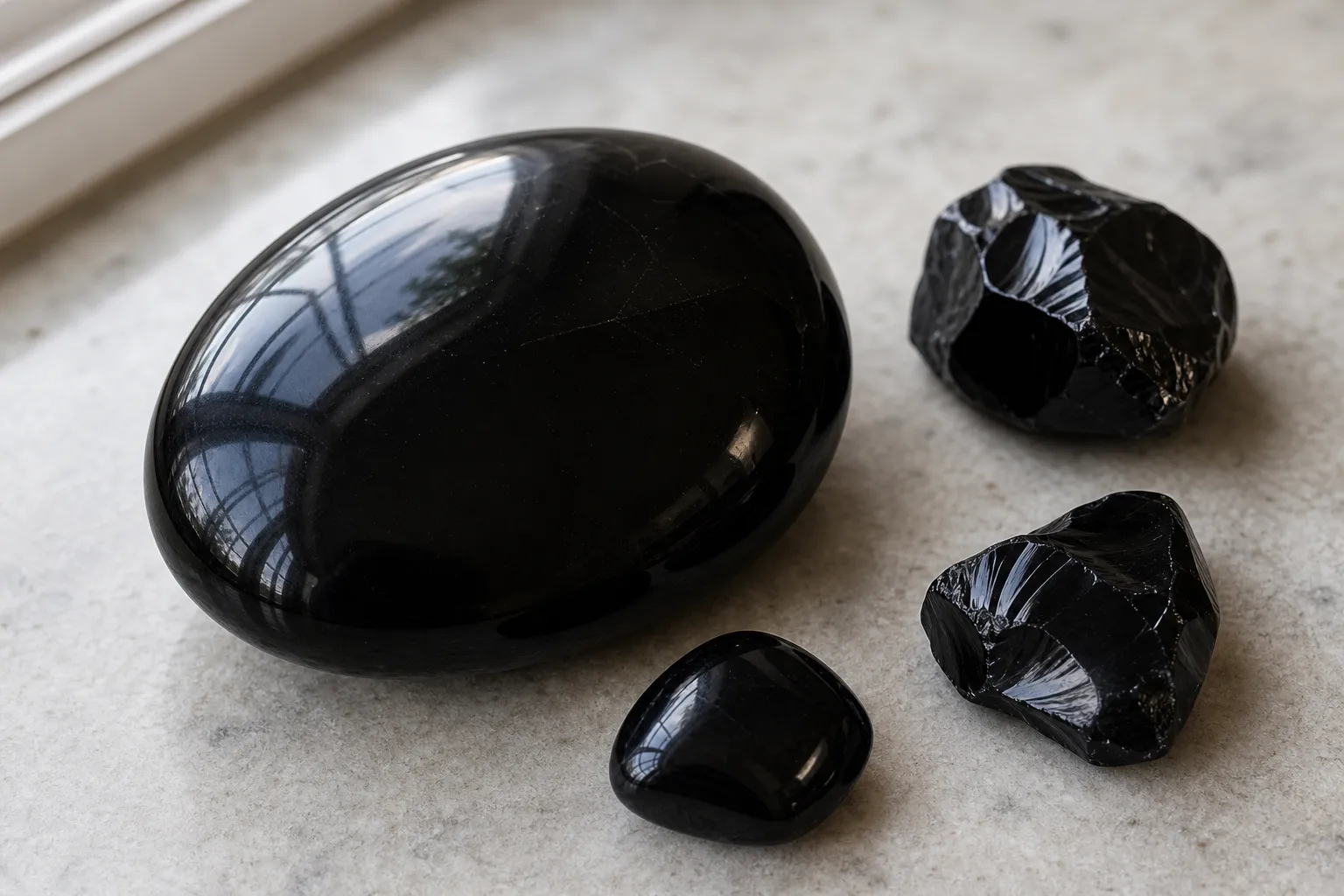
Black obsidian is a real geological material: natural volcanic glass formed when silica-rich lava cools quickly. In polished pieces, it often looks dark, glossy, smooth, and sometimes mirror-like. Those visible traits help explain why people connect it with protective crystal meanings.
But the word “protective” does not identify the stone in a scientific way. It does not prove authenticity, origin, composition, or any personal outcome. A seller may call a bracelet “protective,” but that usually tells you how the product is being framed for crystal users, not what the material can be shown to do.
A grounded way to read the phrase is:
- Material fact: black obsidian is glass-like volcanic material.
- Visible impression: it can appear dark, glossy, reflective, and sharp-edged if broken.
- Symbolic meaning: many crystal users connect those traits with boundaries, reflection, and grounding.
- Marketplace shorthand: sellers often compress those ideas into protection language.
- Practical limit: the wording does not confirm a protective effect.
That distinction matters because black obsidian is often sold with emotionally strong descriptions. The meaning may be important to a buyer, but it should not replace practical safety steps, emotional support, professional guidance, or ordinary decision-making.
Why black obsidian fits protection symbolism
Black obsidian’s protective reputation does not come from one single source. It comes from several overlapping associations that make sense visually and culturally, while still remaining symbolic.
Its black color suggests boundary and seriousness
Black stones are commonly linked with privacy, containment, quiet, depth, and boundary-setting. Black obsidian fits that pattern strongly because it usually has a deep, dark appearance rather than a pale or colorful one.
For many crystal users, that darkness becomes a visual cue: a stone that feels closed, firm, and inward-facing. This is why black obsidian protection meaning is often described with words around guarding, shielding, or keeping distance from unwanted influence.
Those are metaphorical associations. The color can explain why people interpret the stone that way, but color alone does not show that the stone changes a person’s surroundings or circumstances.
Its glassy surface invites mirror symbolism
Polished black obsidian can have a reflective surface. That mirror-like quality is one reason it is linked with self-reflection, truth, and seeing what is usually overlooked.
In crystal-use language, “protection” is sometimes less about an outside shield and more about pausing, noticing patterns, or keeping clearer personal boundaries. This is where black obsidian mirror symbolism becomes relevant.
- looking back at yourself;
- noticing what you are avoiding;
- creating distance before responding;
- separating your choices from outside pressure.
The surface is observable. The meaning attached to it is personal, symbolic, or cultural.
Its volcanic origin gives it a strong material story
Obsidian forms through volcanic processes, and that origin gives it a dramatic identity. It is dark volcanic glass, historically valued in many places for tools, sharp edges, ornaments, and polished objects.
That material story can make black obsidian feel intense or decisive in contemporary crystal language. A buyer may see it described as grounding, protective, clarifying, or boundary-focused partly because its physical identity already feels strong: dark glass from volcanic activity, capable of taking a smooth polish and forming sharp edges when fractured.
The geology supports the material description. It does not establish that the stone creates protection around a person.
How seller language turns symbolism into stronger claims
Many readers ask why black obsidian is described as protective after seeing product listings, bracelet descriptions, pendant pages, or crystal meaning blogs. The wording often blends material facts, spiritual language, emotional benefit language, and sales copy so closely that it becomes hard to tell what is being claimed.
Common seller-style wording may present black obsidian as:
- a protective stone;
- a grounding stone;
- a stone to wear close to the body;
- a boundary or shield symbol;
- a stone for meditation or personal ritual;
- a reflective or truth-focused stone;
- an item to place near doors, desks, windows, or bedrooms.
Those phrases are useful for understanding the marketplace, but they are not independent proof. Commercial pages often present symbolic meanings as if they were practical results. A careful reader should slow down and ask: is this describing the stone’s appearance, a belief system, a personal practice, or a promised outcome?
Black obsidian is called protective because many modern crystal sellers and users associate its dark, reflective, volcanic-glass character with boundaries and grounding. That association may be meaningful, but it remains a meaning label rather than a verified protective property.
This is especially important when listings move from symbolism into claims about dependable results, unseen forces, or serious personal problems. You can appreciate the language as symbolism if it fits your practice. If you are trying to evaluate a factual claim, the support is limited.
Wearing black obsidian: what the meaning can and cannot do
Black obsidian jewelry is one of the most common places people see the protective label. Bracelets, pendants, rings, necklaces, and beaded pieces are often sold with wording that suggests keeping the stone close.
A more grounded reading is that wearing black obsidian can act as a personal reminder. Someone may choose a bracelet as a cue to pause before saying yes, step away from an argument, keep firmer boundaries, or remember a private intention. In that sense, the object functions like a visual and tactile prompt.
That is different from saying the jewelry itself guarantees protection. The bracelet may carry meaning for the wearer; it should not be treated as a safety device, a way to control other people, or proof that unwanted situations will be prevented.
There is also a physical handling point. Obsidian is glass-like. Polished beads and pendants are usually smooth, but chips, cracks, broken points, and damaged carvings can create sharp edges.
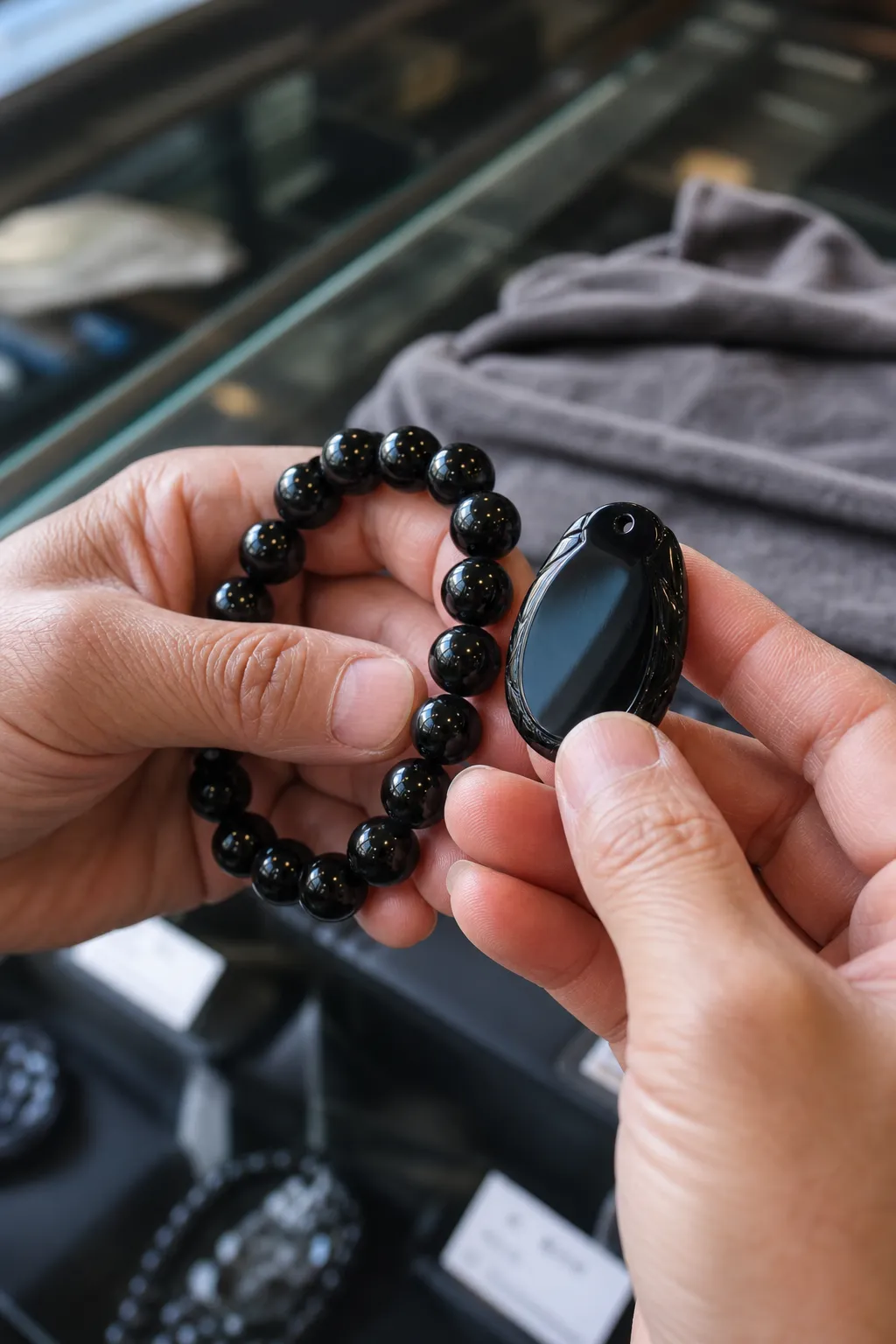
If you wear black obsidian against skin:
- inspect beads, pendants, and drilled holes for chips;
- avoid wearing cracked or broken pieces;
- be careful with sharp points or thin edges;
- do not sleep in pieces that could press, snag, or break;
- avoid striking or dropping the stone.
This is the kind of “protection” that can actually be checked: not a crystal effect, but practical handling. A smooth, intact piece is more comfortable and sensible to wear than a chipped one.
What changes how you should read the label?
The basic answer does not change: black obsidian’s protective reputation is symbolic and market-based rather than established as an effect. What changes is how much weight you personally give that symbolism.
If you are buying for meaning
If you want black obsidian because the symbolism helps you focus on boundaries, reflection, or grounding, the protective label may be useful. Choose a piece that fits your actual use: a pocket stone, a simple bracelet, a pendant, or a polished palm stone.
The meaning comes from how you relate to it, not from the strongest wording in a listing.
If you are buying for material identity
If your concern is whether the piece is actually obsidian, “protective” wording does not help. Look instead at observable cues such as dark glassy luster, polish quality, translucency at thin edges in some pieces, chips, bubbles or inclusions, and seller transparency.
Even then, visual checks can suggest but not prove identity. For certainty about composition or origin, specialized testing may be needed. Technical studies of obsidian artifacts often use geochemical methods to determine source and composition; a shopper does not need that for every bead, but it shows the limit of appearance-only certainty.
If you are reading strong benefit claims
If a listing says black obsidian can reliably protect you from harm, change other people’s behavior, resolve emotional distress, or guarantee an effect, treat that as wording beyond what the material facts can support. The stone may still be attractive or meaningful, but the claim should not be read as evidence.
If you are choosing between ritual and care
Some people use moonlight, smoke, sound, or intention-based practices with black obsidian. Those belong to personal ritual. Physical care is different: wiping dust away, avoiding harsh chemicals on jewelry, keeping elastic cords and metal findings dry when appropriate, and preventing chips.
It helps to keep those two categories separate. Ritual meaning is personal; material care is about keeping the object intact and comfortable to use.
Common confusion around black obsidian protection claims
A reflective black surface does not prove special power.
It explains why mirror symbolism is appealing, but reflection is a visual trait.
“Protective” does not mean authentic.
A seller can call many materials protective. The word does not verify that a piece is natural obsidian, untreated, or from a particular source.
“Grounding” is usually crystal-use language.
Some people use it to describe feeling steady, focused, or reminded of boundaries. It should not be treated as a measured property of the stone.
Jewelry meaning is not constant protection.
Wearing a black obsidian bracelet may be meaningful, but it should not be expected to control events, people, health, finances, or safety.
Commercial wording often compresses too much.
A product page may move quickly from volcanic glass to protection, meditation, placement, and emotional language. Those categories are not the same.
FAQ
Is black obsidian protective?
It is often described as protective in crystal-use language, especially because of its dark color, glassy surface, and association with boundaries. That is a symbolic meaning, not a confirmed effect.
Does “protective” prove a piece is real black obsidian?
No. “Protective” is a seller or meaning label. It does not prove material identity. Look at observable features and seller details, and remember that certainty may require specialized testing.
Is black obsidian jewelry safe to wear?
Smooth, intact polished pieces are commonly worn as jewelry, but obsidian is glass-like. Avoid cracked, chipped, or sharp-edged pieces against skin, and be careful with thin points or damaged carvings.
What is the most practical way to use the meaning?
Treat black obsidian as a personal reminder if the symbolism works for you. It can represent boundaries, reflection, or steadiness, but it should not replace practical decisions, support, or safety steps.
A practical way to read “black obsidian protective crystal”
When you see black obsidian described as a protective crystal, read the phrase in layers.
- First, identify the material layer: it is being presented as black obsidian, a dark volcanic glass. Check whether the photos, polish, shape, edges, and seller details match what you would expect from a glassy stone product.
- Second, identify the meaning layer: the seller or user is associating black obsidian with boundaries, reflection, grounding, or protection. This may be part of contemporary crystal-use culture.
- Third, identify the claim layer: if the wording promises reliable results or suggests the stone can solve serious life, safety, emotional, or wellness problems, step back. That is no longer just symbolism.
A balanced buyer can appreciate black obsidian meaning without over-reading it. The stone’s dark shine, volcanic origin, and mirror-like polish explain why it has become a popular protective symbol. They do not prove that protection occurs. The most grounded use is to treat black obsidian as a meaningful object, inspect it like a glass-like material, and keep seller claims in proportion.
Sources
Sources and further reading
Reference links are limited to sources considered suitable for public citation in this page.