
ProtectCrystal handling note
Care framework
Cleaning, Storage, and Everyday Care for Obsidian, Cinnabar, and Hematite
A good crystal cleaning and storage care routine for obsidian, cinnabar, and hematite starts with a simple rule: do not treat all three as interchangeable “protective stones.” They may sit together in a shop display or a home collection, but they do not ask for the same handling.
Obsidian is glass-like and can chip or leave sharp edges when damaged. Hematite care depends heavily on moisture, surface finish, and repeated wear. Cinnabar needs the most conservative routine because the mineral is associated with mercury sulfide; everyday care should reduce abrasion, loose dust, unnecessary contact, and casual handling.
The practical starting point
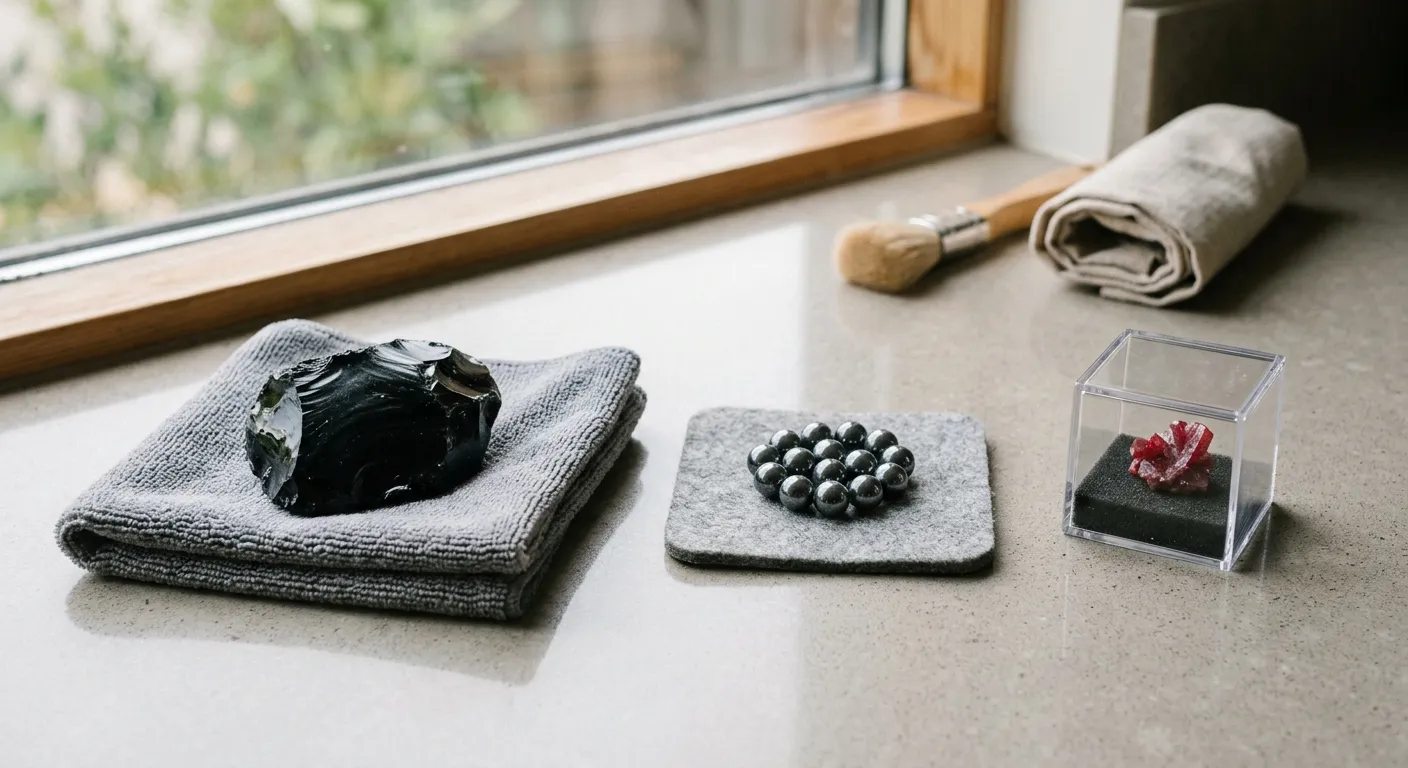
- Use a soft dry cloth before reaching for water.
- Avoid abrasive powders, stiff brushes, salt rubbing, and rough scrubbing.
- Store pieces separately when their surfaces, edges, or handling needs differ.
- Keep cinnabar away from children, pets, food-prep areas, and frequent skin contact unless the item has been professionally assessed.
- Treat visual identity cues as helpful clues, not final proof.
This root guide gives the framework. It is not meant to replace a focused cleaning tutorial, a conservation assessment, a lab identification, or professional advice for damaged or questionable pieces.
Start With the Piece in Front of You
The care routine should match the object, not just the name on the seller label. A polished palm stone, raw specimen, bead strand, pendant, carving, and mixed display bowl all have different weak points.
Use this table before cleaning, storing, or displaying a piece.
Polished obsidian stone
Main care concern: Scratches, chips, sharp damaged edges.
Better first move: Soft cloth; inspect edges.
Avoid first: Abrasive powders, rough pads, impact.
Raw or chipped obsidian
Main care concern: Cuts from sharp edges; further breakage.
Better first move: Handle by stable areas; wrap separately.
Avoid first: Loose storage with heavier stones.
Hematite bead, ring, or tumbled piece
Main care concern: Surface finish, moisture, repeated wear.
Better first move: Dry wipe after handling.
Avoid first: Soaking, wet storage, rough contact.
Shiny hematite-like item
Main care concern: Coating or uncertain identity.
Better first move: Treat gently; keep dry.
Avoid first: Assuming shine, weight, or magnetism proves identity.
Cinnabar specimen
Main care concern: Abrasion, dust, unnecessary contact.
Better first move: Minimal handling; separate storage.
Avoid first: Scrubbing, frequent touching, food areas.
Cinnabar jewelry or carving
Main care concern: Contact, finish, identity uncertainty.
Better first move: Treat as low-contact unless assessed.
Avoid first: Wearing like ordinary decorative beads.
Mixed protective crystal bowl
Main care concern: Different material limits in one place.
Better first move: Separate by fragility and handling needs.
Avoid first: One universal rinse, salt bath, or loose pile.
A useful care system follows three decisions: clean by surface, store by vulnerability, and display by contact level.
Why One Generic Crystal Routine Does Not Work
Many crystal owners learn broad care habits: rinsing, salt, sunlight, smoke, moonlight display, burial in soil, or keeping everything together in one pouch. Some of those practices may be meaningful in personal or cultural use, but physical care is a separate question.
The material question is: will this method expose the piece to water, grit, heat, residue, abrasion, dust, or repeated handling?
Obsidian: glass-like, smooth, but chip-prone
Obsidian is commonly described in mineral references as volcanic glass. For home care, that means the surface may look smooth and durable while still being vulnerable to chips, impact, and sharp broken edges.
- Keep obsidian away from rough pads and gritty cleaning materials.
- Do not toss polished obsidian into a bowl with harder or heavier pieces.
- Inspect points, blades, chips, and raw edges before handling.
- Treat a broken edge like a sharp glass-like edge, not like a harmless decorative stone.
If you are asking how to clean obsidian, the answer is usually modest: dust gently, wipe with a soft cloth, use only controlled moisture when appropriate, dry it fully, and prevent knocks during storage.
Hematite: finish and moisture matter
Hematite is often recognized by a metallic-looking luster and a heavier feel than many decorative stones, but appearance alone cannot confirm identity. Marketplace pieces may also be coated, treated, magnetic, imitation, or sold with loose naming.
- Wipe after handling or wearing.
- Avoid soaking, especially with beads, rings, elastic strands, or coated-looking pieces.
- Keep pieces out of damp storage areas.
- Protect polished or shiny surfaces from rubbing against rough objects.
- If the finish changes, stop rubbing or wet cleaning.
For hematite, the question is often less “Can it touch water once?” and more “What repeated habit will wear the surface over time?”
Cinnabar: separate it from ordinary cleaning habits
Cinnabar needs a clearer line. Mineral references identify cinnabar as a distinct mineral, and chemical references connect mercury sulfide with that identity. For everyday owners, that supports conservative handling without turning this article into a medical, regulatory, or disposal guide.
- Do not scrub cinnabar.
- Avoid abrasive cleaning that may create dust.
- Do not treat it as a washable tumbled stone.
- Keep it away from children, pets, and food-prep areas.
- Avoid frequent skin contact unless the item has been professionally assessed.
- Store and display it where casual handling is unlikely.
If a seller calls something “cinnabar jewelry,” “red cinnabar,” or “cinnabar carving,” that wording does not settle what the object is, how it was treated, or whether it is suitable for regular wear.
The Material-Specific Care Map
This is the root-level map for cleaning, storage, and display. It gives the direction; narrower guides can handle step-by-step detail.
Obsidian
What to remember: Glass-like; chips can be sharp.
Cleaning: Soft cloth, gentle dust removal, careful spot cleaning.
Storage: Wrap or separate from harder/heavier objects.
Display: Stable surface; avoid fall-prone edges.
Hematite
What to remember: Finish, friction, and moisture exposure matter.
Cleaning: Dry wiping; minimal moisture; no aggressive rubbing.
Storage: Separate pouch, lined tray, dry place.
Display: Avoid damp areas and rough contact.
Cinnabar
What to remember: Reduce abrasion, dust, and contact.
Cleaning: Minimal disturbance; avoid abrasive methods.
Storage: Separate, labeled, low-contact storage.
Display: Protected display away from children, pets, and food areas.
The best routine is usually not complicated. It is restrained. Most damage starts when a piece is over-cleaned, stored loose, or handled as if every crystal responds the same way.
Cleaning: What to Use and When to Stop
For ordinary display pieces, start with the least forceful method that solves the problem.
Useful basic tools
- Clean microfiber or other soft lint-free cloth.
- Soft brush used lightly on stable surfaces.
- A small amount of clean water only when suitable for the material and finish.
- Dry cloth for immediate drying after any damp contact.
- Separate cloths if cinnabar is part of the collection.
Avoid making the first attempt too aggressive. Dust rarely needs soaking, salt, vinegar, abrasive paste, stiff brushes, or repeated polishing.
Cleaning obsidian without scratching or chipping
For obsidian, protect the surface and the edges.
- Inspect the piece for chips, cracks, thin points, or sharp edges.
- Remove loose dust with a soft cloth.
- For a small mark on a stable polished surface, use a barely damp cloth rather than soaking the piece.
- Dry it fully.
- Store it where it will not knock against heavier or rougher objects.
Do not use gritty powders, abrasive pads, or a rough shared bowl. With pointed carvings, blade-shaped forms, and broken pieces, edge safety is part of care.
Hematite moisture caution and finish protection
For hematite, repeated exposure matters. Jewelry and beads may meet water, skin oils, lotion, soap, sweat, and storage friction.
- Wipe the piece dry after handling or wearing.
- Avoid soaking bead strands, rings, and coated-looking pieces.
- Keep it away from bathrooms, wet cloths, and damp storage.
- Store it separately from rough minerals and metal objects.
- Stop cleaning if the finish dulls, flakes, rubs off, or changes.
Visible signs such as luster, streak, weight impression, or magnetic behavior may suggest questions to ask, but they do not prove identity on their own.
Cinnabar handling during cleaning
Cinnabar should not be folded into the same cleaning routine as obsidian or hematite. The goal is minimal disturbance.
- Move it only when needed.
- Handle it over a clean, controlled surface, not a kitchen counter or shared eating area.
- Use minimal dry dusting only if necessary, with a soft method that does not abrade the surface.
- Avoid water-heavy cleaning unless the object has been assessed by someone qualified to evaluate it.
- Return it to separate, low-contact storage.
If a cinnabar piece is broken, powdery, shedding material, or intended for frequent wear, treat that as beyond routine crystal cleaning.
Storage: Separate by Care Need, Not Just by Color
Protective crystal storage often becomes decorative: bowls, trays, shelves, altar spaces, bedside dishes, travel pouches. The problem is that attractive storage can mix materials with very different limits.
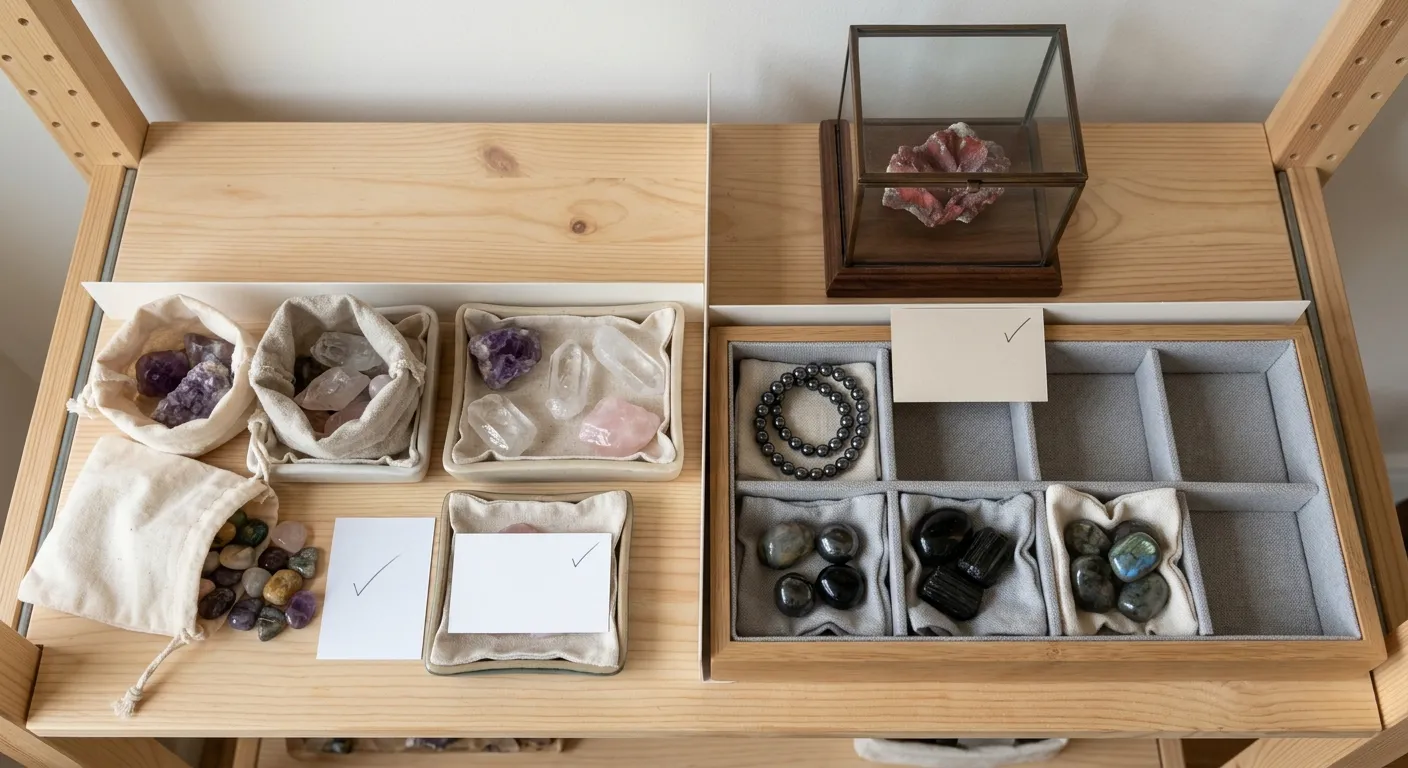
A simple three-zone system works better.
Everyday handling pieces
What belongs there: Sturdy polished stones that are frequently picked up.
Why it helps: Keeps casual-use items away from fragile or low-contact pieces.
Finish-sensitive pieces
What belongs there: Polished hematite, glossy obsidian, carved pieces, beads, coated-looking items.
Why it helps: Reduces rubbing, scratches, moisture exposure, and surface wear.
Low-contact pieces
What belongs there: Cinnabar, powdery specimens, unknown red minerals, fragile raw pieces.
Why it helps: Limits unnecessary handling and keeps caution visible.
This system is more useful than arranging everything by color, symbolism, or shop category. Personal meaning can still matter, but physical storage should follow material needs first.
Label uncertain pieces
Appearance alone does not confirm obsidian, hematite, or cinnabar. Seller language can be useful, but it is not the same as identification.
For home storage, uncertainty is still actionable. Use labels such as:
- “Sold as cinnabar — low contact”
- “Hematite-like beads — keep dry”
- “Obsidian chip — sharp edge”
- “Unknown red carving — separate”
- “Polished black stone — gentle cleaning only”
Good labels prevent the common mistake of relying on memory after tags, packaging, or receipts are gone.
Avoid the mixed bowl problem
A mixed crystal bowl looks simple, but it often creates the most care conflicts. Pieces rub together, dust gathers, visitors handle items casually, and sharp edges can be missed.
- Use a divided tray instead of one loose bowl.
- Put soft cloth under polished surfaces.
- Keep chipped obsidian away from casual reach.
- Keep hematite dry and away from rough contact.
- Keep cinnabar separate, labeled, or enclosed.
Storage separation for crystals does not need to be elaborate. A small box, lined tray, individual wrap, or labeled pouch can prevent most everyday issues.
Display: Think About Falling, Dust, Moisture, and Reach
Display is part of care. A stone that sits in the wrong place may be touched too often, knocked over, exposed to dampness, or cleaned aggressively because dust builds up.
Obsidian display
For obsidian, prioritize stability. Avoid narrow ledges, crowded shelves, and fall-prone windowsills. Give pointed, thin, or chipped pieces more space.
Hematite display
For hematite, avoid damp settings: bathrooms, kitchen windows, plant shelves with misting, or trays that collect condensation. Jewelry should not be stored where it will be splashed, tangled, or rubbed.
Cinnabar display
For cinnabar, choose a low-contact location. A covered display box, closed shelf, or clearly separated specimen area is usually more sensible than an open tray near daily activity.
Dusting also deserves attention. A dirty cloth, stiff brush, or repeated rubbing can become abrasive. Use clean tools, work lightly, and stop if a surface is powdery, fragile, shedding, or uncertain.
Crystal Cleansing Methods and Material Limits
Many readers use the word “cleansing” for personal or cultural crystal practices. This page treats that as a use context, not as a promise of physical outcomes. The care question is simpler: what does the method physically do to the object?
Water rinse
Physical care question: Does moisture or handling affect the piece?
Obsidian: Brief damp wiping may suit stable polished pieces. Hematite: Avoid soaking; keep dry. Cinnabar: Avoid routine washing.
Salt or salt water
Physical care question: Is it abrasive or harsh on finish?
Obsidian: Avoid gritty rubbing. Hematite: Avoid, especially for finish-sensitive pieces. Cinnabar: Avoid.
Sunlight
Physical care question: Could heat, placement, or falling matter?
Obsidian: Avoid unstable hot ledges. Hematite: Avoid damp or hot display habits. Cinnabar: Prefer protected low-contact display.
Smoke
Physical care question: Will residue settle and require rubbing?
Obsidian: Wipe gently if residue forms. Hematite: Avoid buildup and repeated rubbing. Cinnabar: Avoid residue plus rubbing.
Sound or nearby objects
Physical care question: Does anything strike or disturb the piece?
Obsidian: Low concern if not struck. Hematite: Low concern if not struck. Cinnabar: Keep disturbance low.
Burial in soil
Physical care question: Does dirt, moisture, abrasion, or loss matter?
Obsidian: Poor fit for polished pieces. Hematite: Poor fit for moisture caution. Cinnabar: Avoid.
Grouping with other stones
Physical care question: Will surfaces rub or collide?
Obsidian: Separate from hard/heavy stones. Hematite: Protect finish. Cinnabar: Keep separate.
The root rule is straightforward: if a method requires soaking, salt, rubbing, burial, heat, residue, repeated handling, or surface disturbance, check the material first.
Wearing and Handling in Daily Life
Wearing a stone adds friction, moisture, oils, impact, and repeated contact. A display piece may sit untouched for months; a bracelet, pendant, ring, or pocket stone has a much harder life.
Obsidian pendant, bead, or pocket stone
Watch for: Chips, sharp points, scratches from keys or coins.
Better habit: Use a pouch; inspect edges; avoid loose pocket storage.
Hematite jewelry
Watch for: Moisture, lotions, sweat, finish wear, rubbing.
Better habit: Put on after lotions dry; remove before water-heavy activities; wipe dry.
Cinnabar jewelry or beads
Watch for: Frequent contact, abrasion, damaged or powdery surfaces.
Better habit: Treat as low-contact unless assessed; do not use as children’s jewelry or play objects.
If a cinnabar item is damaged, shedding, powdery, or sold with unclear claims, do not try to solve the issue by polishing, washing, or wearing it “carefully.” Move it out of routine use and treat it as a higher-caution object.
Buyer Checks Before You Clean a New Piece
Newly purchased stones often arrive with dust, fingerprints, packaging residue, seller labels, or unclear care instructions. Before cleaning, inspect the object.
Ask before cleaning
- Is it polished, raw, carved, drilled, mounted, glued, or strung?
- Are there chips, cracks, powdery areas, loose grains, or sharp edges?
- Does the surface look coated, painted, sealed, worn, or flaking?
- Was it sold as obsidian, hematite, cinnabar, or only in “style” language?
- Is it meant for display, carrying, or wearing?
- Would water, rubbing, or salt contact make uncertainty worse?
Do not test durability by scratching, scraping, soaking, or hard rubbing. Those actions can damage the piece and still fail to confirm what it is.
Visible signs may include color, luster, fracture style, streak, weight impression, polish, and texture. They can suggest a direction, but they cannot prove authenticity by themselves. If certainty matters, specialized testing or qualified assessment may be needed.
Conservative care when identity is uncertain
- Keep uncertain cinnabar-like pieces separate and low-contact.
- Keep hematite-like pieces dry and gently stored.
- Keep obsidian-like pieces with sharp edges away from casual handling.
A Practical Routine for Mixed Collections
If you own all three materials, the goal is not to over-clean. It is to prevent avoidable damage and keep handling decisions clear.
A simple monthly routine
- Check the display area. Look for dampness, unstable pieces, dust buildup, open food areas, or items that visitors have moved.
- Remove friction points. Separate obsidian from heavy stones, move hematite away from rough contact, and keep cinnabar out of casual handling zones.
- Dry wipe only where needed. Use a clean soft cloth for stable polished obsidian and hematite. Do not force dust out of fragile crevices.
- Handle cinnabar separately. Move it only when needed, avoid shared polishing cloths, and return it to a low-contact place.
- Update labels. If a tag fell off or a piece moved into the wrong tray, relabel it before you forget.
- Stop when simple cleaning is not enough. Stains, residue, shedding, cracks, unknown coatings, and powdery surfaces are not invitations to scrub harder.
Avoid these common mixed-care habits
- One salt bowl for all protective crystals.
- One water soak for every new stone.
- One polishing cloth used aggressively across the whole shelf.
- One loose travel pouch containing obsidian, hematite, and cinnabar.
- One open display bowl that guests handle freely.
- One sunny windowsill used for every piece.
These shortcuts are popular because they are simple. They are also where material-specific care gets lost.
Where to Go Next
This page is the overview. Use a narrower guide when your question has become specific.
If your question is mainly about cleaning black, rainbow, polished, raw, or chipped obsidian: look for a focused guide on how to clean obsidian without scratching, edge checks, and obsidian chipping prevention.
If your question is mainly about hematite beads, rings, tumbled pieces, or shiny marketplace items: look for a focused guide on hematite moisture caution, surface finish, storage, and everyday wear.
If your question is mainly about cinnabar specimens, carvings, beads, pendants, or red stones sold as cinnabar: look for a focused guide on cinnabar storage, display, dust avoidance, and low-contact handling.
If your question is mainly about water, salt, smoke, sunlight, soil, sound, or personal crystal routines: look for a focused guide on crystal cleansing methods and material limits.
If your question is mainly about a growing home collection: look for a focused guide on protective crystal storage, labeling, separation, and display organization.
Care Boundaries Worth Remembering
Material care is not the same as crystal meaning. Obsidian, cinnabar, and hematite are often discussed as protective crystals in personal and marketplace language, but that does not decide whether water, salt, abrasion, or daily wear is appropriate.
Visible cues are useful but limited. Color, shine, fracture, weight impression, streak, and surface finish can suggest questions; they do not confirm identity alone.
Cinnabar deserves its own routine. Keep it separate, avoid abrasion, reduce dust disturbance, limit contact, and place it away from children, pets, and food-prep areas.
The gentlest useful action is often enough. Most home care problems come from doing too much: soaking when wiping would do, scrubbing when dusting would do, mixing when separating would do, or treating a display specimen like a washable pocket stone.
Quick Care Checklist
Use this before cleaning, storing, moving, or displaying a piece:
- Identify whether the item is obsidian, hematite, cinnabar, or only “sold as” one of them.
- Check for chips, sharp edges, cracks, powdery areas, coatings, and worn finish.
- Start with a soft dry cloth.
- Avoid abrasive powders, stiff brushes, rough pads, and gritty salt contact.
- Keep obsidian away from impact and loose contact with heavier stones.
- Keep hematite dry, separated, and protected from finish wear.
- Keep cinnabar separate, low-contact, and away from children, pets, and food-prep areas.
- Do not rely on one visual cue as proof of identity.
- Do not use one crystal cleansing routine for all three materials.
- Stop cleaning if the piece sheds, changes surface, scratches, chips, or raises new uncertainty.
A strong everyday routine is calm and material-specific: clean less aggressively, store more thoughtfully, and let each stone’s physical limits guide how it is handled.
Sources
Sources and further reading
Reference links are limited to sources considered suitable for public citation in this page.