ProtectCrystal handling note
Obsidian vs Hematite Weight: Why Hematite Feels Heavier
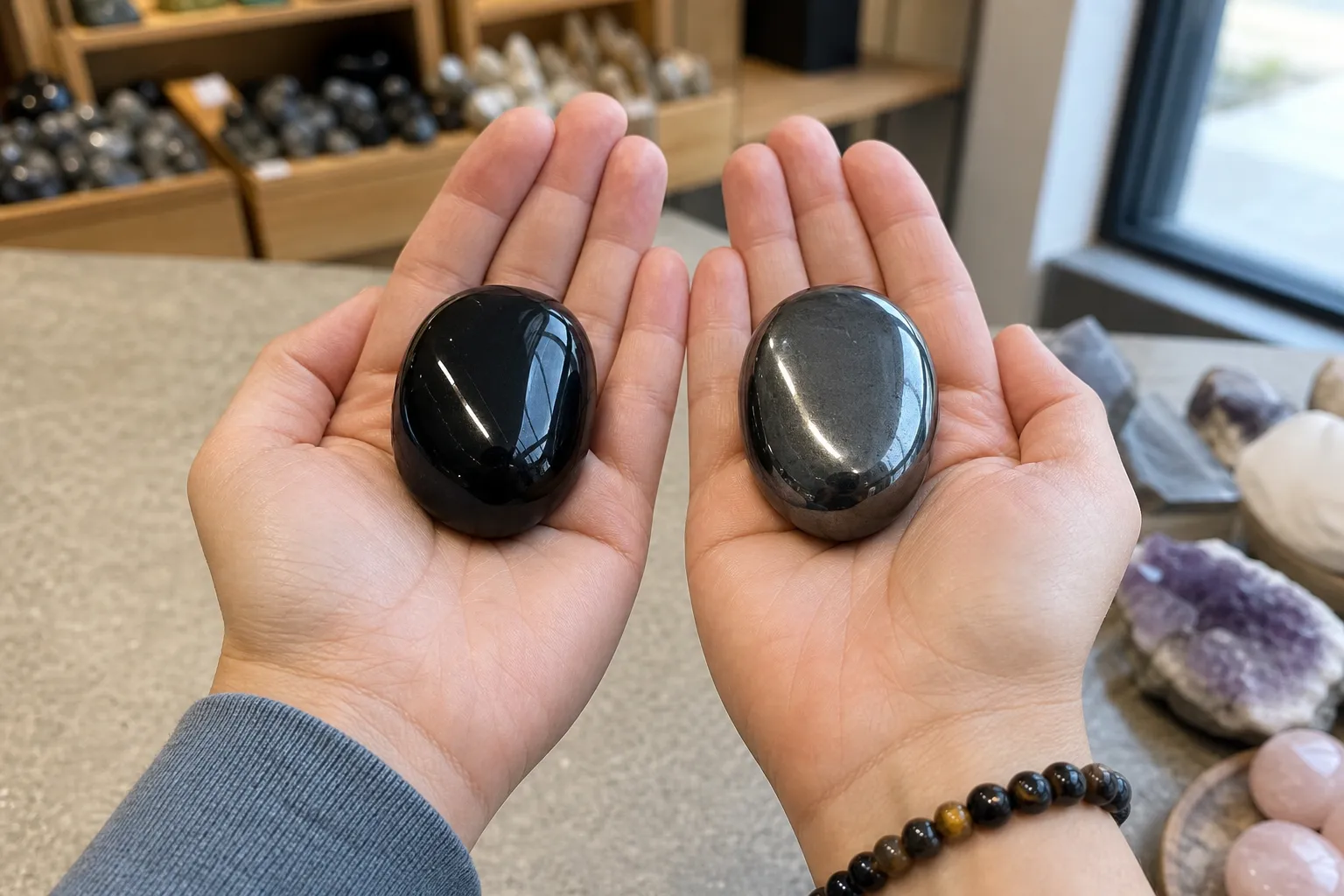
If you are holding two dark polished stones that are close in size, hematite will often feel heavier than obsidian. The main reason is density: hematite is a dense iron oxide mineral, while obsidian is volcanic glass. For the same amount of space in your hand, hematite usually contains more mass.
That is the short answer to the obsidian vs hematite weight question.
Weight is still a clue, not proof. A large obsidian palm stone can weigh more than a small hematite bead. Drill holes, metal spacers, coatings, composite materials, and substitutes can also change the feel. But when the pieces are genuinely similar in size and shape, hematite’s heavier hand-feel is one of the clearest first differences a buyer may notice.
upward
Read the full overview first
Use the broader guide first if you need the full scope before this page.
Why hematite feels heavier
Density describes how much material is packed into a given volume. Specific gravity is the mineral-identification term often used to compare that density with water. You do not need to calculate it at a shop counter; the practical point is simple: if two beads take up about the same space, the denser one will feel heavier.
Hematite is iron oxide and is commonly described in mineral references as a dense mineral with metallic to submetallic luster. That is why a hematite bead, cabochon, or small polished stone can feel unexpectedly weighty for its size.
Obsidian is different. It forms as volcanic glass when lava cools rapidly with little crystal growth. In crystal-shop language, black obsidian may be grouped with dark “crystals,” but geologically it is glassy material rather than a crystalline mineral like hematite. Its lower density is why a similar-size obsidian piece usually feels lighter.
Same-size polished piece comparison
Hematite bead or tumbled stone
You may notice a heavy, compact feel, sometimes cool and metallic-feeling, because hematite is a dense iron oxide mineral.
Black obsidian bead or tumbled stone
You may notice a lighter feel for the same apparent size, with a glossy or glassy surface, because obsidian is volcanic glass.
Larger obsidian piece
It may outweigh a smaller hematite piece because total size can override density.
Drilled or mixed-material jewelry
Weight becomes less predictable because holes, cores, spacers, coatings, or substitutes affect mass.
So if a hematite bead feels heavier than an obsidian bead of the same apparent size, that is expected. If the pieces are not truly comparable, the weight comparison becomes much less useful.
“Same size” has to mean same volume, not just the same label
A listing may describe two beads as 8 mm, but that does not always mean they contain the same amount of material. One bead may have a larger drill hole. One may be flatter, chipped, faceted, or slightly smaller than described. In bracelets, metal spacers and charms can also change the total weight.
For a fair obsidian weight comparison, check these details first:
- Outer size is only a start. A round 10 mm bead and a flat 10 mm disc do not hold the same volume of material.
- Drill holes remove mass. Large-hole beads may feel lighter than solid-looking beads of the same outer diameter.
- Shape affects hand-feel. A compact round hematite bead can feel much heavier than a thin obsidian chip.
- Polish can disguise differences in photos. Glossy black obsidian, dark coated beads, and hematite-like materials may look closer online than they feel in person.
- Total object size still matters. A large obsidian palm stone can easily weigh more than a small hematite bead.
The careful wording is: hematite often feels heavier than obsidian of similar size. “Always heavier” is too broad, because real jewelry is not made of perfect lab shapes.
Clues that support the weight impression
Weight becomes more helpful when you combine it with surface and construction clues. A heavy black stone should not be identified by weight alone, especially if it is polished jewelry.
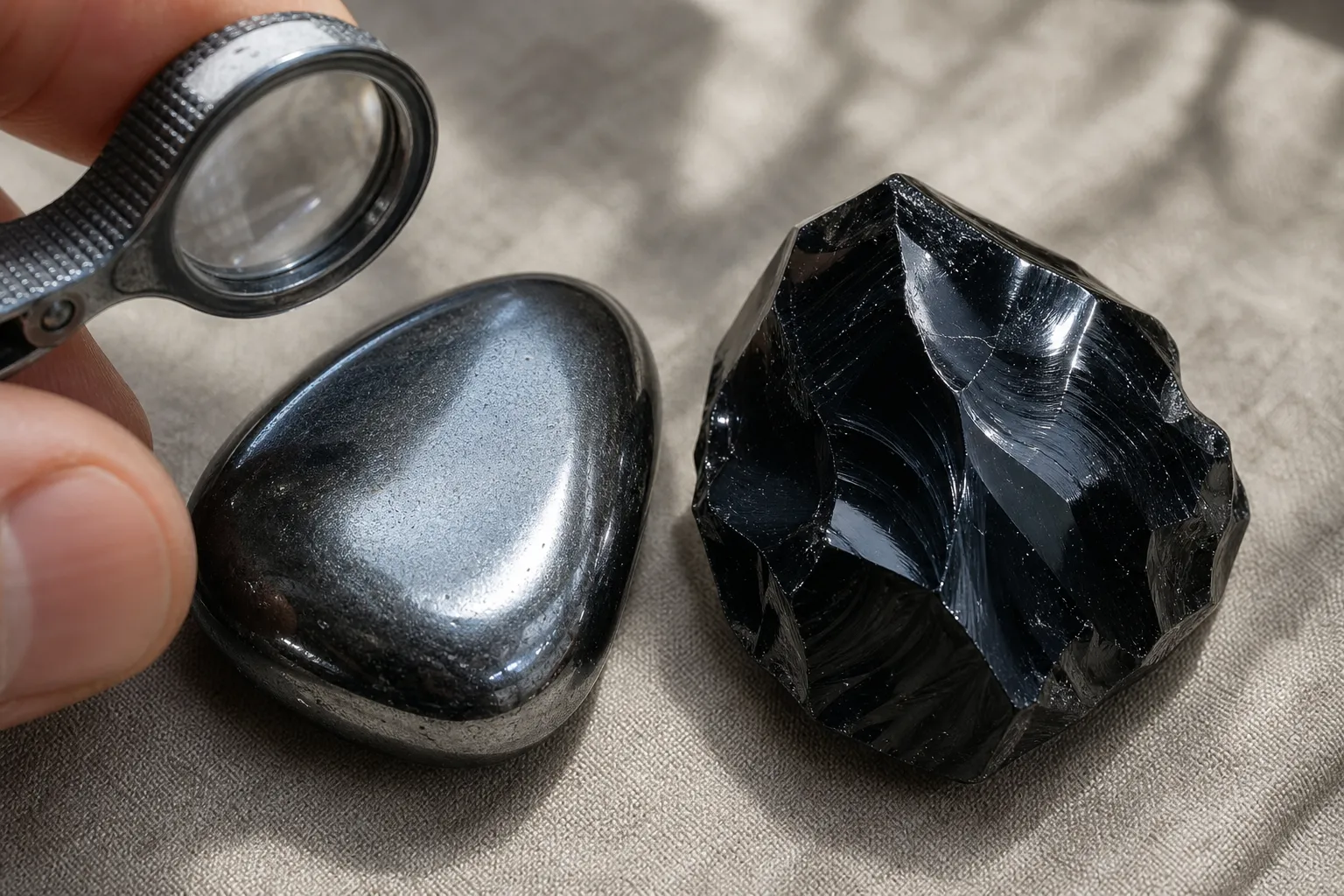
For hematite, visible signs may include a metallic or gunmetal sheen, dark silver-gray color, and sometimes reddish-brown tones in scratches, chips, or rougher areas. Mineral-identification references often describe hematite’s streak as red to reddish-brown. However, streak testing can mark or damage polished beads, so it is not a casual test for a bracelet or valued specimen.
For obsidian, the look is usually more glassy than metallic. Black obsidian often has a deep glossy surface, and thin edges or small chips may show a glass-like quality. Broken obsidian can be sharp because of its glassy fracture, though that matters more for rough pieces than for polished beads.
How the supporting clues differ
Weight at similar size
More suggestive of hematite: noticeably dense or heavy. More suggestive of obsidian: lighter than hematite.
Surface look
More suggestive of hematite: metallic, gunmetal, dark silver-gray. More suggestive of obsidian: glossy black and glassy.
Material type
Hematite is an iron oxide mineral. Obsidian is volcanic glass.
Edge or chip appearance
Hematite may look metallic or earthy. Obsidian may show a glass-like quality.
Streak clue
Reddish-brown may be associated with hematite, but testing can damage polish. It is not a main jewelry clue for obsidian.
These signs can point you in a direction, but they do not confirm the material on their own. Polished surfaces, dyed materials, coatings, and manufactured lookalikes can blur the difference. If a piece is costly, important to you, or sold with strong identity claims, professional mineral or gemological testing may be needed for certainty.
Why online labels make the weight question harder
Obsidian and hematite are often compared because both appear in dark polished jewelry: bracelets, malas, pocket stones, small carvings, and beads. Some listings also use symbolic crystal language around grounding, focus, or personal intention. That kind of wording may explain why shoppers compare them, but it does not identify the material or prove any physical effect.
Marketplace names can also be confusing. You may see terms such as:
- hematite
- magnetic hematite
- hematine
- hemalyke or hematite-like
- black obsidian
- black crystal bracelet
- real hematite
- heavy black crystal
These labels are not interchangeable. In jewelry contexts, “magnetic hematite” may refer to manufactured or altered material rather than a simple natural hematite specimen. Hematine and hemalyke are commonly encountered as hematite-like product names, but the label alone does not tell you the full composition.
A bead that is heavy and metallic-looking may suggest hematite or hematite-like material. It does not prove natural hematite. The same applies in reverse: a glossy black bead labeled obsidian may be volcanic glass, but similar-looking dark materials can also appear in jewelry.
Photos are especially limited because they hide weight, drill-hole size, edge translucency, and surface texture. When buying online, read the material wording closely. A clearer listing should say whether the item is natural, treated, magnetic, reconstituted, glass, or a substitute. Even then, seller wording is not the same as independent testing.
When hematite may not feel as heavy as expected
Hematite’s weight is often noticeable, but a few situations can make the comparison less obvious.
A small hematite bead may not feel impressive beside a much larger obsidian stone. An obsidian bracelet with many beads, metal spacers, or charms may feel heavier than a plain hematite sample because the whole object contains more material. A hollow, heavily drilled, coated, or composite bead may also feel lighter than expected.
Expectations can mislead, too. If someone says hematite should feel a fixed amount heavier, that is too neat for real objects. The difference depends on dimensions, bead shape, drill holes, and the actual material present. It is better to look for a noticeably denser feel in a fair comparison, not an exact ratio.
For bracelets, compare like with like:
- same bead diameter
- similar bead count
- similar drill-hole size, if visible
- similar spacers, charms, and metal parts
- similar overall bracelet length
Only then does hematite vs obsidian bracelet weight become a useful clue. If one bracelet has larger beads or more metal, the comparison is no longer just about hematite density vs obsidian density.
Practical buyer takeaway
Weight is one of the easiest first checks because you can notice it immediately. If a dark polished bead is much heavier than a similar-size piece of black obsidian, hematite or hematite-like material becomes a reasonable possibility. If it feels lighter and glassier, obsidian or another glassy material may be more likely.
Use weight alongside a few other observations:
- Weight: Does it feel unusually dense for its size?
- Luster: Is the surface metallic/gunmetal or glassy?
- Seller wording: Does the listing say hematite, magnetic hematite, hematine, hemalyke, obsidian, or glass?
- Construction: Is it solid, drilled, coated, mixed with metal, or part of a larger bracelet?
- Testing limits: Would a home test scratch, mark, or otherwise damage the piece?
Avoid heating jewelry or relying on internet tricks as identity proof. If streak testing comes up, remember that it can damage polished stones. For a valued piece, a non-destructive professional check is the better next step.
The bottom line: hematite often feels heavier because it is dense iron oxide, while obsidian is volcanic glass. In a fair same-size comparison, that difference can be obvious in the hand. Just do not ask weight to do more than it can. It can guide your judgment; it cannot confirm authenticity by itself.
Sources
Sources and further reading
Reference links are limited to sources considered suitable for public citation in this page.