
ProtectCrystal handling note
Handling guide
Handling Safety for Cinnabar, Obsidian, and Hematite
If you are comparing cinnabar, obsidian, and hematite as protective crystals, start with the object in your hand rather than the meaning attached to it. Handling safety for cinnabar obsidian and hematite comes down to a few practical questions: what the piece may shed, whether it can cut or chip, how often it touches skin, whether it is dusty or broken, and who can reach it at home.
The three materials do not call for the same kind of caution. Cinnabar deserves the most conservative treatment, especially when its identity or surface condition is uncertain. Obsidian needs attention because broken or thin glassy edges can be sharp. Hematite jewelry raises a different issue: seller labels, coatings, magnetic descriptions, and wear conditions may not tell you exactly what the item is made from.
Crystal meanings can explain why someone is drawn to a stone. They should not be used as proof that a physical object is harmless, suitable for daily wear, or correctly identified.
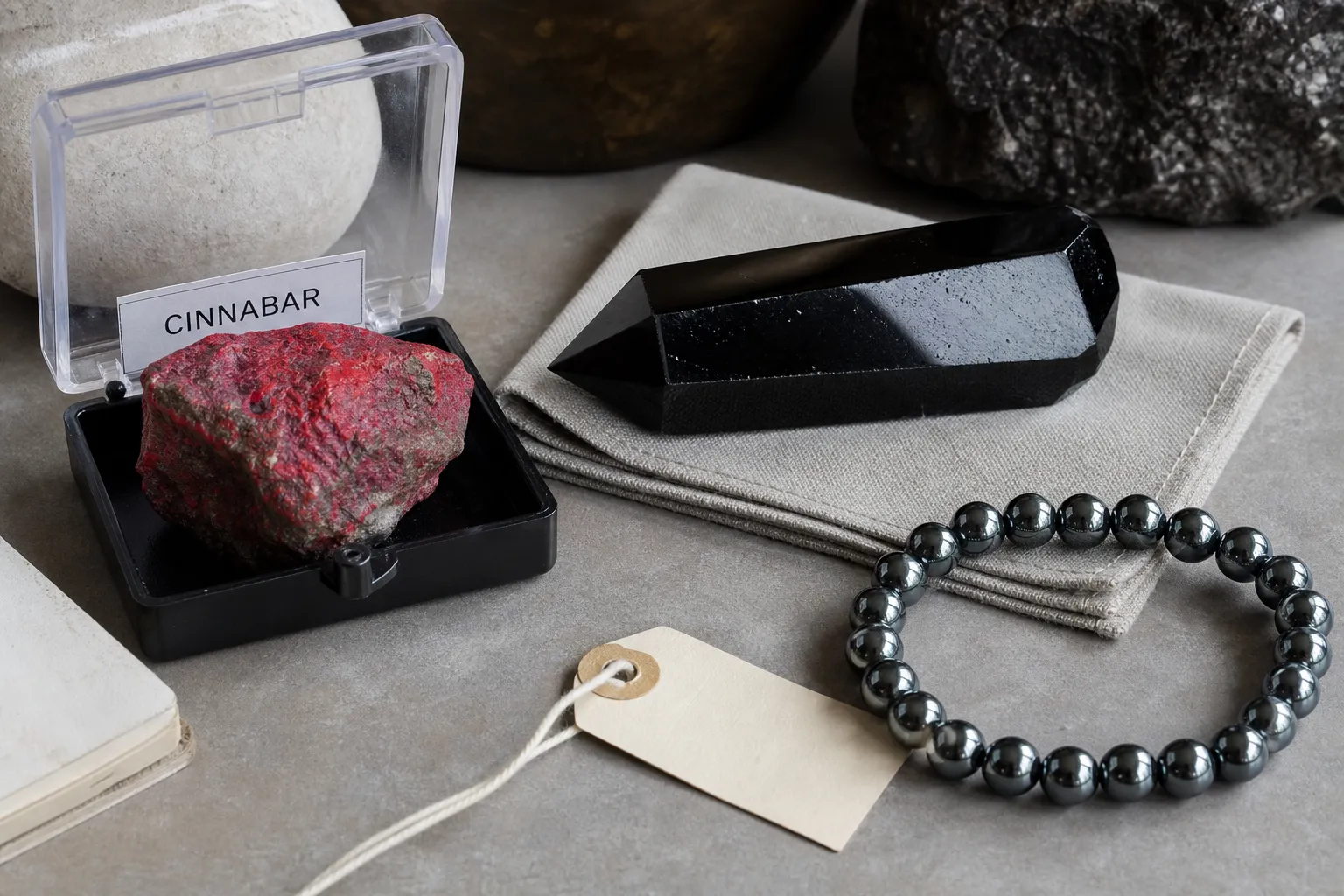
The practical safety map
A red cinnabar-labeled carving, a glossy black obsidian point, and a metallic hematite bracelet are not one handling category. A polished display piece, a raw specimen, a bead bracelet, and a broken fragment all ask for different decisions.
This is a root guide, so it gives the map: what to check first, which concerns belong to which stone, and when a narrower topic is worth reading. It does not replace specialized mineral testing, toxicology guidance, jewelry-material review, or professional advice for higher-stakes situations.
Five checks before you wear, wash, display, or store a piece
Before a crystal goes in a pocket, on a bracelet, into a display bowl, or onto a shelf within reach of children or pets, slow down and check the basics.
1. Is the identity known, or only claimed?
A label such as “cinnabar,” “obsidian,” or “hematite” is useful, but it is not the same as verified composition. Color, luster, weight impression, texture, chips, finish, and seller wording can suggest possibilities, not prove them.
This matters most when the handling decision depends on the material itself. Cinnabar handling safety should not be decided from red color alone. Hematite jewelry safety is also not settled by a metallic gray look, because items sold in that category may be described as magnetic, coated, treated, composite, or imitation.
2. Is it raw, polished, carved, coated, drilled, or broken?
Finish changes the task. A polished stone may feel smooth, but polish does not prove identity. A raw specimen may have grit, crumbly matrix, sharp points, or associated minerals. A carved piece can collect residue in grooves. A coated bead may behave differently from a solid mineral bead. A broken crystal can expose sharp edges or powdery surfaces that were not present when it was sold.
3. Will it touch skin, water, food areas, children, or pets?
Display-only handling is different from daily wear. Occasional inspection is different from keeping a stone in a pocket. A locked cabinet is different from a low table, bedside bowl, classroom shelf, or pet-accessible windowsill.
A cautious household approach is to keep questionable, dusty, sharp, fragile, or cinnabar-labeled pieces away from mouths, food-preparation spaces, bedding, toy areas, pet zones, and unsupervised handling.
4. Is there dust, grit, flaking, loose pigment, or breakage?
Dust and loose particles deserve attention across all three categories. Avoid grinding crystals, filing, drilling, sanding, scraping, or creating powder unless the material has been properly assessed and the work is done with appropriate controls. For ordinary buyers and collectors, the simpler rule is: do not create dust, and avoid inhaling dust from unknown or safety-sensitive pieces.
If a stone arrives with loose powder in the packaging, flaking areas, or crumbly matrix, isolate it before deciding how to clean or store it.
5. Are you using a spiritual or marketplace label to answer a physical question?
“Protective crystal” is a common cultural and marketplace phrase. It may describe why someone chooses obsidian, cinnabar, or hematite, but it does not establish physical protection, material identity, or suitability for every kind of contact.
A crystal can be meaningful to someone and still require practical caution as an object.
Cinnabar: use the most conservative handling
Cinnabar is the stone in this group where caution should appear early, not as a final footnote. In crystal shops and collector settings, cinnabar may appear as a red mineral specimen, a carved object, a lacquer-like decorative item, a bead, or a piece whose exact composition is not obvious from a photograph.
Because this page does not currently have a usable public reference set for detailed toxicology statements, it should not make exact exposure claims. The practical boundary is still clear: when an item is sold as cinnabar or may contain cinnabar, handle it conservatively, especially if it is raw, powdery, scraped, drilled, broken, or intended for frequent contact.
For a buyer, that means
- handle cinnabar-labeled pieces briefly rather than rubbing, carrying, or fidgeting with them;
- wash hands after handling, especially before eating or touching the face;
- avoid wearing uncertain cinnabar pieces against skin for long periods;
- avoid mouth contact entirely;
- do not soak, scrape, sand, drill, polish, grind, or powder the piece;
- keep it away from children and pets;
- store it in a closed container, display case, or isolated area where dust and fragments are less likely to spread;
- consider specialized testing or knowledgeable review if the piece is valuable, old, powdery, or intended for jewelry use.
So, is cinnabar safe to handle? The better question is: what kind of cinnabar item, in what condition, and for what use?
A sealed decorative object, a raw mineral specimen, a powdery fragment, and a bead necklace raise different concerns. Without reliable identification and material information, a universal yes-or-no answer would be misleading. For ordinary buyers, the safer editorial position is limited: treat cinnabar as display-first, avoid dust and prolonged contact, and do not let children or pets handle it.
Be especially careful with seller reassurance. If a listing says a cinnabar item is suitable for jewelry or daily carry, that statement should not be treated as a material assessment unless it is backed by appropriate information. Appearance and shop language are not enough.
Avoid using cinnabar-labeled pieces in water bottles, elixir-style preparations, incense mixtures, powders, cosmetics, food-adjacent displays, or mouth-contact objects. If a cinnabar-labeled piece is already shedding, isolate it and seek appropriate mineral or safety guidance before deciding what to do next.
Obsidian: watch the glassy edges
Obsidian is often loved for its deep black, smoky, rainbow-sheened, mahogany-colored, snowflake-patterned, or mirror-like appearance. In protective-crystal language, it is often described as strong or shielding. For handling, the more practical point is that obsidian can behave like glass when chipped, broken, or shaped into thin edges.
The concern is not that every obsidian palm stone is a problem. A rounded, intact piece may be simple to hold. The concern is that sharp edges can be easy to miss when a stone is dark, glossy, or wrapped in jewelry.
Be more careful with
- arrowheads, blades, knives, spear-point shapes, and thin carvings;
- chipped towers, points, pyramids, and spheres;
- broken beads or pendants;
- rough nodules with glassy protrusions;
- small fragments mixed into storage boxes;
- jewelry settings where a corner has cracked or come loose.
If obsidian breaks, do not test the edge with a fingertip. Use good light and pick up fragments with a barrier such as a cloth, paper towel, or gloves. Keep pieces away from bare feet, children, pets, bedding, and soft bags where sharp fragments can hide.
For storage, wrap the broken piece separately or place it in a rigid container. Do not toss it back into a mixed crystal bowl where it may scratch other stones or cut someone later.
Obsidian jewelry deserves the same kind of inspection. Check for chips around drilled holes, exposed wire ends, cracked beads, loose cabochons, pointed carvings, and edges that press into skin or snag fabric. Rounded and intact forms are easier to manage for daily carry than thin, pointed, or damaged pieces.
Hematite: jewelry safety depends on composition, coating, and wear
Hematite is commonly sold as beads, bracelets, rings, worry stones, magnetic-style jewelry, and metallic-looking decorative pieces. Buyers often expect it to feel heavy, cool, dark gray, silver-gray, or mirror-polished. Those cues can be useful, but they do not prove what a jewelry item is made from.
That is why hematite jewelry safety is not a single question. It depends on whether the item is natural hematite, treated material, coated material, a magnetic product, a composite bead, or an imitation. Without testing or reliable documentation, avoid assuming too much from shine and color alone.
For everyday wear, check the stress points
- chipped beads around drill holes;
- fraying elastic cord;
- coating wear, staining, or residue;
- rings that crack easily when dropped;
- surface changes after moisture exposure;
- seller descriptions that use “magnetic” without explaining the material;
- skin discomfort, staining, or irritation during wear.
If skin contact causes discomfort, stop wearing the item. That is a practical wear decision, not a diagnosis.
Magnetic seller claims need a separate pause. “Magnetic” can refer to different product constructions or seller descriptions. It should not be treated as proof of natural hematite, and it should not be treated as evidence of a beneficial effect. For handling, magnetic items may also pinch, snap together, attach to metal objects, or raise questions near items that should not be exposed to magnets. If a specific device or medical-technology concern is involved, use the relevant professional or manufacturer guidance rather than a crystal article.
Moisture is another common issue. As a general jewelry habit, avoid soaking unknown hematite jewelry, especially if it is strung, coated, glued, plated, or unclearly labeled. Water may affect stringing materials, adhesives, finishes, and metal components even when the main bead looks unchanged. Wipe gently with a dry or slightly damp soft cloth when appropriate, then dry promptly. If the surface flakes, stains cloth, smells unusual, or leaves residue, isolate the piece and avoid wearing it until you better understand what it is.
Raw, polished, carved, coated, or broken: finish changes the task
Buyers often assume polished means worry-free and raw means difficult. That is too simple. A polished surface may reduce roughness and make a stone easier to hold, but it does not prove composition. A raw surface may show natural texture and matrix, but it may also include fragile edges, grit, dust, or unknown associated minerals.
Cleaning should follow the same logic. Do not turn cleaning into a home test. Scrubbing, soaking, heating, chemical treatment, and polishing can damage a piece or create new handling concerns.
A cautious cleaning sequence
- Inspect the object under good light before touching damaged areas.
- Remove loose surface dirt only if it can be done without scraping or making dust.
- Use a soft dry cloth for many display pieces.
- Keep cinnabar-labeled, powdery, coated, or unknown pieces out of water unless proper material guidance is available.
- Dry handled jewelry and display stones before storage.
- Stop if the surface flakes, stains, crumbles, or gives off loose particles.
Display and storage: match the container to the concern
Safe crystal display storage is not about hiding every stone away. It is about matching the setup to the piece’s condition and the people or animals around it.
A shelf used by one careful adult is different from a coffee table, bedside bowl, classroom shelf, therapy-room tray, pet-accessible windowsill, or children’s collection box. The more contact a piece is likely to get, the more practical the setup should be.
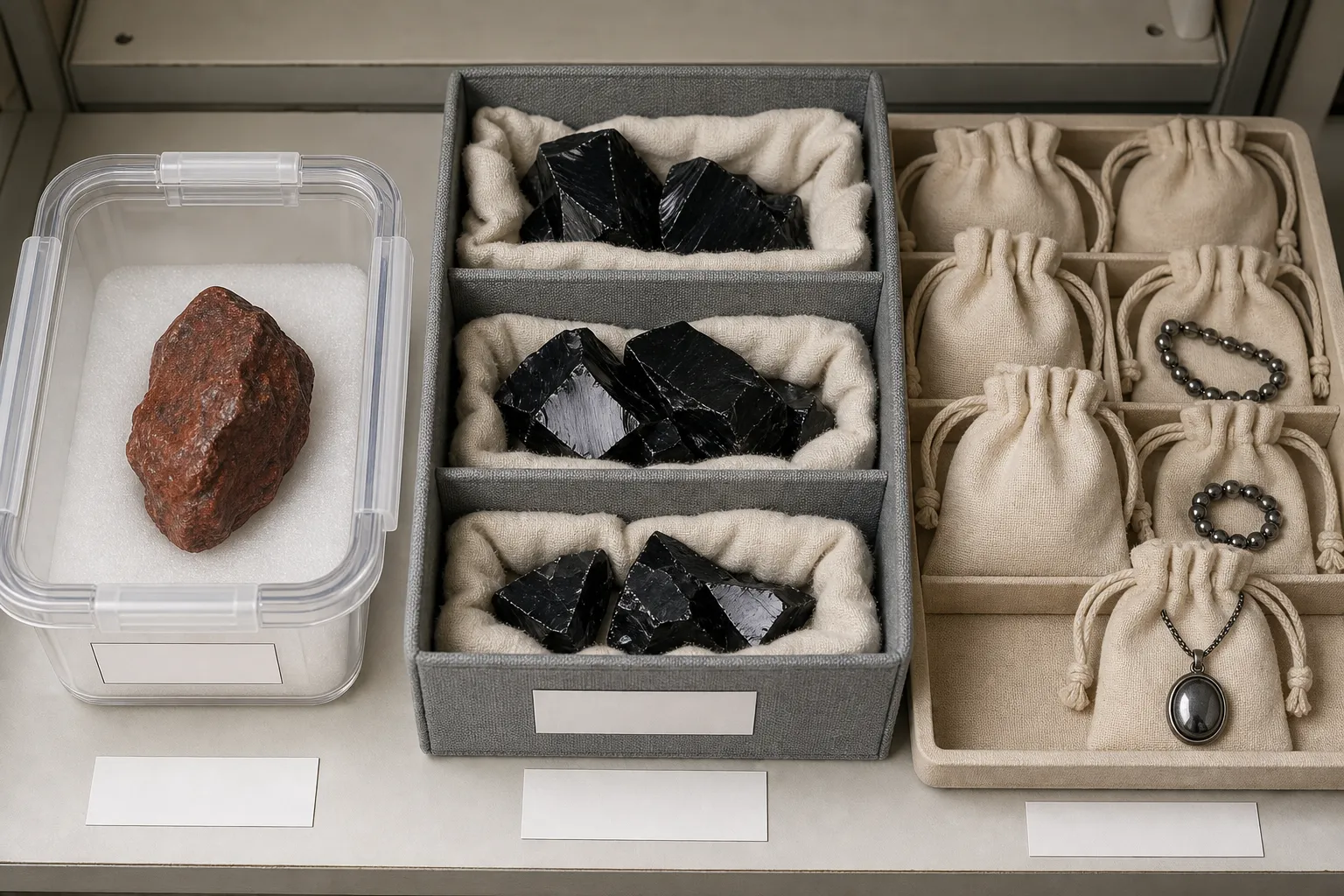
Labels help more than people expect. A small note such as “sharp edge,” “unknown red specimen,” “do not wash,” or “display only” can prevent accidental handling later.
Children and pets change the decision. Small stones can be swallowed, sharp pieces can cut, fragile items can break, and unknown specimens can be mouthed, chewed, or scattered. Cinnabar-labeled pieces, dusty minerals, broken obsidian, and small hematite beads should not be placed where children or pets can reach them.
After a crystal breaks, keep children, pets, and bare feet away from the area. Use a barrier to collect fragments, place them in a rigid or sealed container, and wipe visible residue gently without stirring dust into the air. If the broken piece is cinnabar-labeled, powdery, or unknown, avoid further handling until you decide whether editorial review is needed.
What visual cues can and cannot tell you
Buyers naturally start with what they can see: red color, metallic shine, glassy luster, weight impression, polish, magnetic response, or seller photography. Those cues matter, but they have limits.
A visual check can help you decide which questions to ask. It cannot verify composition, identify every treatment, or answer every handling concern.
Useful observations include
- seller wording such as “natural,” “treated,” “coated,” “composite,” “magnetic,” “dyed,” “carved,” or “vintage”;
- chips, cracks, dust, powder, residue, or flaking;
- sharp tips, thin edges, or broken corners;
- drill-hole damage in beads;
- surface staining on packaging or cloth;
- unusually bright pigment-like red surfaces on cinnabar-labeled items;
- black glassy fragments around obsidian pieces;
- coating wear on metallic hematite-style jewelry.
These signs can suggest caution. They do not prove that a piece is correctly identified or suitable for every use.
Professional mineral testing or knowledgeable review becomes more relevant when the decision has consequences beyond casual display. Examples include a cinnabar-labeled item intended for jewelry or classroom use, a red mineral specimen with powdery areas, a hematite-labeled product where magnetic or coated claims matter, an inherited piece with no reliable label, or any stone that will be drilled, cut, polished, repaired, or altered.
Avoid home tests that involve scratching, heating, acids, grinding, or dust. Those tests can create the very handling concerns you were trying to understand.
How protective-crystal meanings fit in
Many readers compare cinnabar, obsidian, and hematite because these stones are often described in protective-crystal language. That context is real in the marketplace and in personal practice. It can explain why someone wants a black obsidian pendant, a hematite bracelet, or a red cinnabar display piece.
Meaning and material handling answer different questions.
A person may choose obsidian because it feels symbolically strong to them. That does not change whether a chipped edge needs wrapping. A person may like hematite as a grounding-style bracelet. That does not identify the coating or explain a skin reaction. A person may be drawn to cinnabar for its color or tradition. That does not make dust, mouth contact, or daily wear a good assumption.
The cleanest framing is
- this stone is often chosen for protective symbolism;
- some buyers use it as a reminder object;
- the handling decision still depends on material, finish, condition, and contact route.
That keeps personal meaning separate from physical handling.
Common handling mistakes to avoid
Most problems are not rare expert-level mistakes. They are ordinary buyer habits that skip one of the checks above.
- Treating “protective” as a safety label. A protective-crystal description does not tell you whether a piece is sharp, dusty, coated, fragile, treated, or suitable for close contact.
- Washing every new crystal the same way. Water, soap, salt, vinegar, alcohol, heat, sunlight, and scrubbing can affect stones, adhesives, strings, coatings, and labels differently.
- Carrying raw or sharp stones loose in a pocket. Loose carry can create chips, scratches, broken tips, and hidden fragments. Obsidian is the clearest example, but any pointed or broken piece can become a handling issue.
- Trusting appearance as proof. Red does not prove cinnabar. Metallic gray does not prove natural hematite. Black glassy shine does not answer every obsidian question.
- Letting children or pets handle unknown stones. Unknown crystal safety precautions matter most when objects are small, chewable, dusty, sharp, fragile, or mislabeled.
- Altering stones at home. Cutting, drilling, sanding, grinding, and polishing can create dust, chips, heat, and fresh surfaces. This is especially important for cinnabar-labeled, unknown, coated, or fragile pieces.
A simple buyer decision guide
When you are standing in front of a display, unpacking an online order, or sorting an inherited box, use a sequence instead of guessing.
- 1. Sort by material claim. Group pieces by what they are claimed to be: cinnabar, obsidian, hematite, unknown, or mixed. Keep cinnabar-labeled and unknown red specimens separate until you know more.
- 2. Sort by condition. Separate intact polished stones from raw, dusty, chipped, cracked, sharp, flaking, or broken pieces.
- 3. Sort by intended use. Display, occasional handling, pocket carry, jewelry, gifting, classroom use, and child-accessible storage are different decisions.
- 4. Choose the least intrusive care method. If you do not know what it is, do not soak, scrub, scrape, or destructively test it. Use dry inspection and isolated storage first.
- 5. Escalate only when needed. If a piece is valuable, powdery, old, cinnabar-labeled, intended for jewelry, or used around children, pets, students, clients, or frequent visitors, consider editorial review rather than guessing.
Use the branch that matches the action you are about to take. Wearing, washing, drilling, gifting, displaying, and storing are not the same decision.
Bottom line
Cinnabar, obsidian, and hematite may sit together in protective-crystal collections, but their practical handling questions differ.
Cinnabar calls for conservative handling, especially around dust, wear, mouth contact, alteration, children, and pets. Obsidian calls for attention to glassy edges, chips, and broken fragments. Hematite jewelry calls for caution around composition, coatings, magnetic seller language, moisture, breakage, and skin contact.
The most reliable habit is to handle the actual object in front of you: its label, finish, condition, contact route, and storage setting. Use crystal meanings as personal context if they matter to you, but let physical cues and cautious handling decide how the piece is worn, cleaned, displayed, or stored.
Evidence boundary: no public references were provided for this edited version. The guidance above is therefore kept general and conservative rather than making precise toxicology, regulatory, or testing claims.