ProtectCrystal handling note
Black Obsidian, Hematite, and Cinnabar Meanings Side by Side
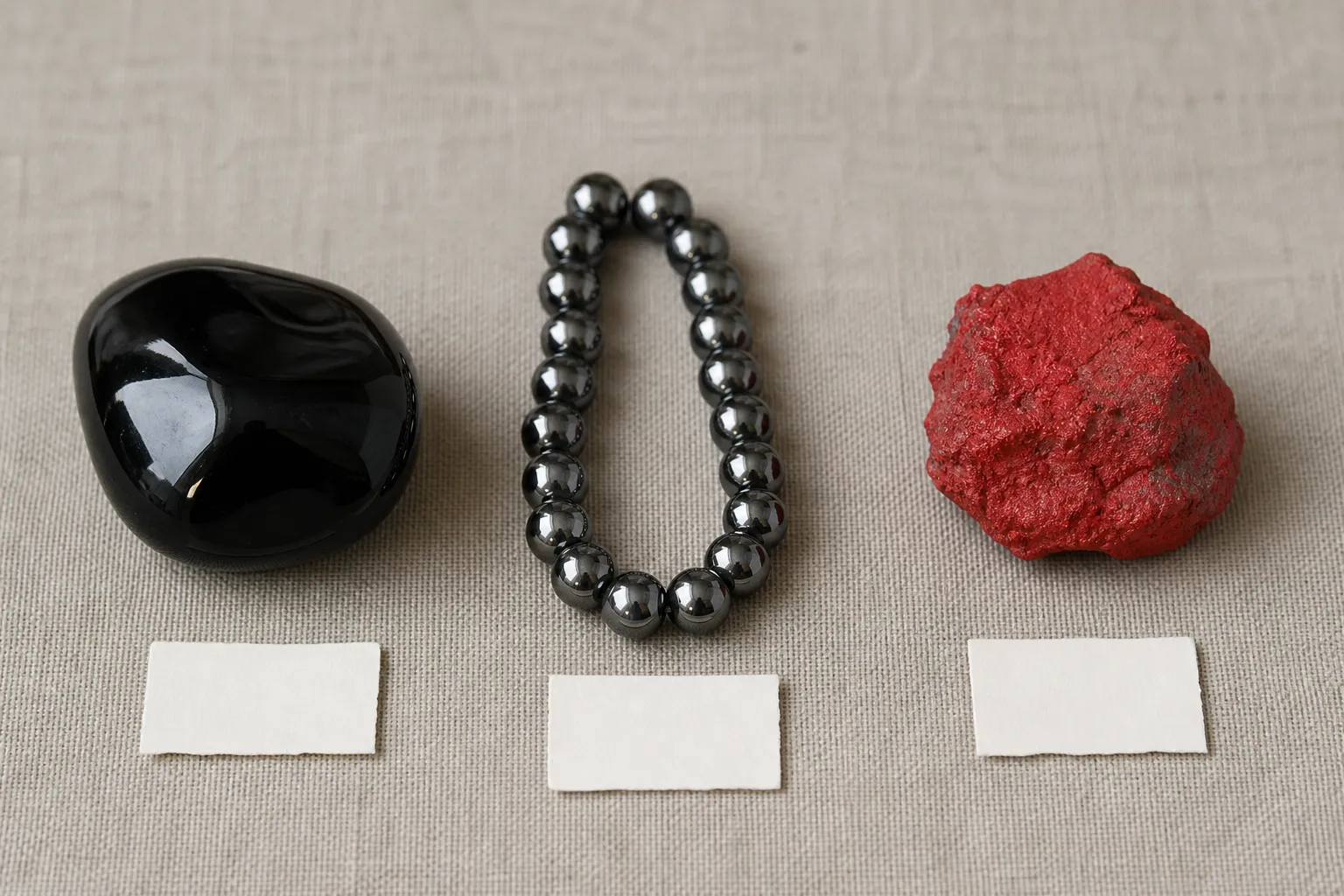
If you are comparing black obsidian hematite cinnabar meanings, the simplest split is this: black obsidian is usually used for boundary and protection symbolism, hematite for grounding and steadiness, and cinnabar for red, intense transformation or ambition language.
Those are crystal-use meanings, not guaranteed effects. The physical materials also deserve different levels of attention. Black obsidian and hematite are usually handled like common polished stones or beads. Real cinnabar is different because cinnabar is a mercury-containing mineral, so dust, abrasion, mouth contact, and casual jewelry use need more care.
upward
Start with the broader guide
Use the broader guide first if you need the full scope before this page.
Side-by-side meaning comparison
Black obsidian
Common crystal-shop meaning: Protection, boundaries, clearing, “shadow work” language.
Practical buyer reading: A bold black stone often chosen when someone wants strong boundary symbolism.
Handling note: Check for sharp chips or edges, especially on rough pieces.
Hematite
Common crystal-shop meaning: Grounding, steadiness, focus, calm weight.
Practical buyer reading: A dark metallic-looking stone often chosen for a steady, anchored feel.
Handling note: Check finish and coating; appearance alone does not prove composition.
Cinnabar
Common crystal-shop meaning: Transformation, ambition, vitality, red symbolic intensity.
Practical buyer reading: A dramatic red material often given more forceful symbolic language.
Handling note: Treat real cinnabar carefully; avoid dust, ingestion, mouth contact, and abrasion.
Quick memory cue
- Black obsidian: the strongest “boundary” symbol.
- Hematite: the steadiest “grounding” symbol.
- Cinnabar: the most intense red “change” symbol.
The meaning side and the material side should stay separate. A glossy black stone may fit the expected look of obsidian, but that does not verify identity. A shiny hematite bead may be natural hematite, coated, magnetic, or another material sold under a familiar name. A red object labeled cinnabar may be natural mineral, lacquer, resin, dyed material, composite, or imitation. Seller wording and photos can suggest possibilities, but they cannot settle every material question.
Black obsidian: boundary and protection language
In a black obsidian meaning comparison, obsidian is usually the most direct “protective” symbol. Crystal sellers and users often describe it as a stone for boundaries, energetic clearing, facing difficult inner material, or keeping unwanted influence at a distance.
For a buyer, that usually translates into a visual and emotional choice: black obsidian is the boldest option if you want a dark, reflective stone with a serious, boundary-focused feel. It is commonly sold as bracelets, pendants, palm stones, spheres, towers, carvings, and polished pieces.
The observable cues are simple: black color, glassy shine, smooth polish on finished pieces, and sometimes sharp edges on rough or chipped pieces. These signs may fit black obsidian, but they do not prove what the item is. If you see a black obsidian and hematite bracelet described with protection language, read that as seller meaning language first, not as evidence of a promised result.
Hematite: grounding, steadiness, and focus language
The hematite grounding meaning is usually calmer than obsidian’s boundary language. Hematite is often associated with steadiness, focus, practical attention, and feeling anchored. In crystal-shop wording, it is less about shielding and more about stability.
Many buyers meet hematite through beads, rings, small polished stones, and dark metallic-looking pieces. Listings may also use phrases such as black hematite crystal meaning, especially when the item has a dark gray, gunmetal, or mirror-like finish.
A practical reading is: choose hematite symbolism when you want “steady and focused” rather than “intense and forceful.” If black obsidian feels like a boundary stone, hematite is often described more like a stabilizing stone.
There is one buyer caution: many hematite-looking beads are polished, coated, magnetic, or labeled in simplified ways. Shine, weight impression, and color can help you read a listing, but they cannot prove exact composition from a photo. That matters less for personal symbolism and more for expectations about what you are actually buying.
Cinnabar: red transformation symbolism, with a material caution
The cinnabar meaning in crystals is usually the most intense of the three. Sellers often frame cinnabar around transformation, ambition, creative drive, prosperity language, red power, or vitality. Some listings pair black obsidian and cinnabar as a dramatic combination: black for boundaries, red for change.
That pairing can be meaningful as personal symbolism, but it should not override the material question.
Cinnabar is widely identified in mineral references as red mercury sulfide, often written as HgS. It also has a long history as a red pigment and symbolic material in several cultural and archaeological contexts. That helps explain why cinnabar carries such strong red associations in modern crystal language.
For buyers, the main point is practical: if an item is sold as real cinnabar, do not treat it like an ordinary pocket stone. Avoid water infusions, mouth contact, grinding, sanding, abrasive cleaning, and anything that may create dust. Keep it away from children and pets. If a cinnabar-labeled bead or carving is actually lacquer, resin, dyed material, or a composite, the handling question may be different—but you usually cannot confirm that from a product photo alone.
Keep these three layers separate
When looking at protective crystal meanings compared across black obsidian, hematite, and cinnabar, separate the listing into three layers.
1. Symbolic meaning
This is the language people use for intention, ritual, decor, jewelry, or personal association.
- Black obsidian: protection, boundaries, clearing.
- Hematite: grounding, steadiness, focus.
- Cinnabar: transformation, ambition, red intensity.
This layer can be personally meaningful, but it should not be treated as a guaranteed effect.
2. Observable buyer cues
This is what you can actually look at or ask about before buying.
For black obsidian, visible signs may include black color, glossy polish, a glassy look, and possible sharp chips on rough pieces.
For hematite, visible signs may include dark gray to black metallic luster, smooth bead finish, mirror-like polish, or a dense-feeling description. Coatings and substitutes are possible.
For cinnabar, visible signs may include red color, carved or bead form, lacquer-like surfaces, pigment references, or seller claims such as “real cinnabar.” Red color alone is not enough. A cinnabar-labeled object may be natural mineral, processed material, imitation, or another red substance.
3. Material caution
This is where the comparison is uneven.
Black obsidian and hematite usually call for ordinary stone-handling judgment: avoid dropping, chipping, scratching delicate surfaces, or assuming every finish is water-friendly.
Cinnabar deserves more careful handling if it is real or if the material is uncertain. The label “real cinnabar” should make you pause before wearing, cleaning, storing, or gifting it casually.
Common confusion in seller language
Many product pages blend meaning, material identity, and sales language into one paragraph. A listing might say a bracelet contains black obsidian, hematite, cinnabar, lava stone, or other dark beads, then describe the whole piece as protective or grounding.
Read those descriptions in layers:
- “Protection,” “grounding,” and “transformation” are meaning words.
- “Black,” “red,” “metallic,” “polished,” “bead,” and “carved” are appearance or form words.
- “Real cinnabar,” “natural hematite,” and “black obsidian” are material claims that may need stronger verification.
The phrase black obsidian and cinnabar can sound especially powerful in shop language because it combines dark boundary symbolism with red transformation symbolism. That may be exactly why some buyers like the pairing. Still, if the red component is sold as real cinnabar, the handling question matters more than the symbolism.
The same applies to a hematite and cinnabar comparison. Hematite is usually discussed as steady and grounding; cinnabar is usually discussed as vivid and forceful. Materially, cinnabar is the one that deserves the clearest buyer questions: What is the object actually made of? Is it natural mineral, lacquer, composite, dyed stone, or imitation? Is it sealed or coated? Is the seller making a material claim or only using a style name?
If you are choosing one for jewelry or display
For jewelry, black obsidian is often chosen when the wearer wants a strong black stone with boundary symbolism. Hematite is often chosen for a dark metallic look and a steadiness or focus meaning.
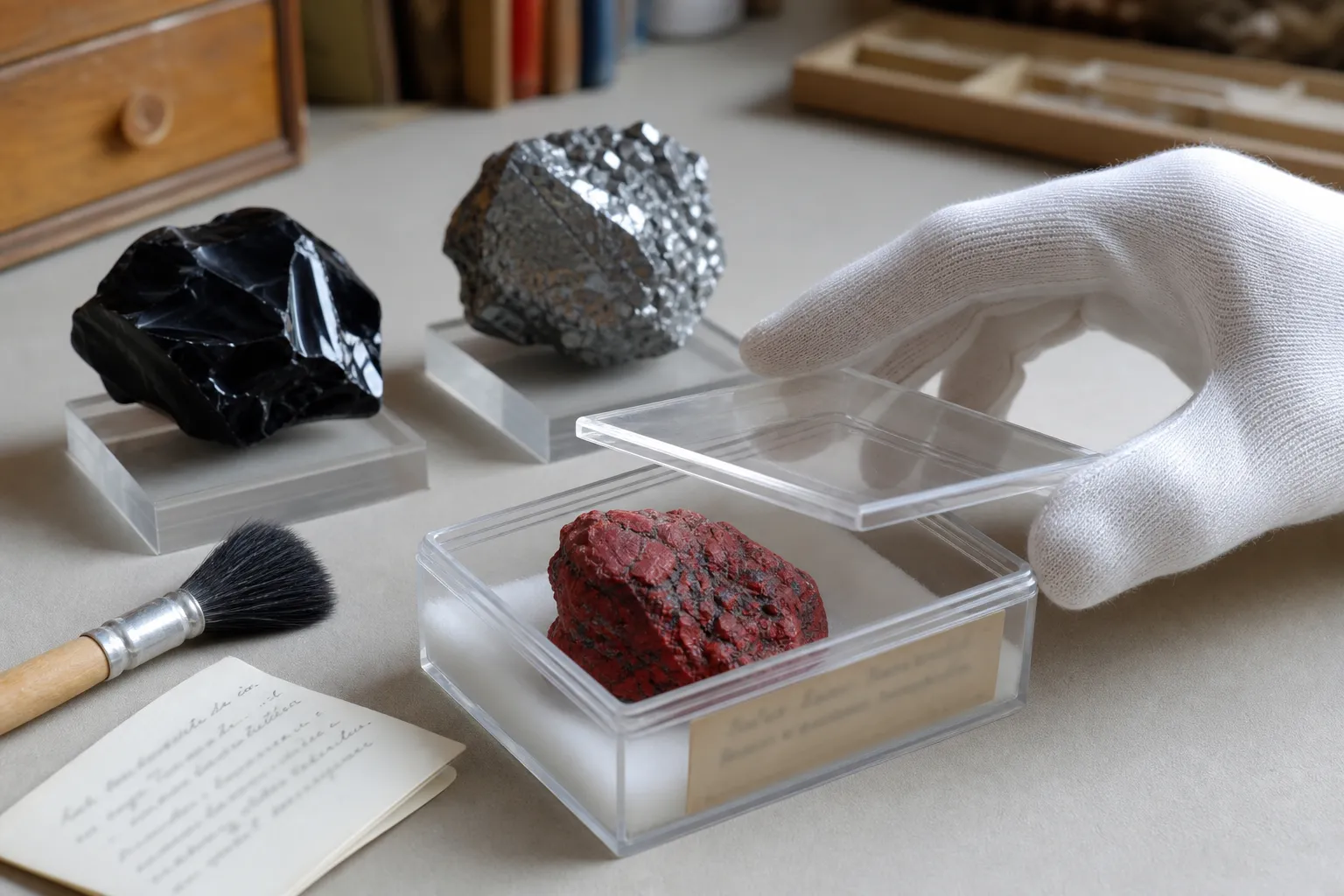
Cinnabar is more complicated. Its red symbolism may be appealing, but cinnabar safety for jewelry depends on what the object actually is, whether it sheds material, and how it is worn.
If a piece is sold as real cinnabar:
- Do not wear it where it may be chewed, licked, heavily rubbed, or abraded.
- Avoid damaged pieces that shed powder or dust.
- Avoid soaking, sanding, ultrasonic cleaning, or harsh scrubbing.
- Store it separately so it is not scraped by harder items.
- Keep it out of reach of children and pets.
For display, use the same logic. A labeled cinnabar specimen or carving should be handled gently, kept intact, and not treated like a casual pocket stone. Wash hands after handling if the surface is dusty or uncertain. If you are worried about an exposure situation, use appropriate local medical or poison-control resources rather than relying on a crystal article.
For black obsidian and hematite, the practical concerns are usually chips, finishes, coatings, and realistic identification. A polished black bead or shiny metallic bead can be meaningful to wear, but meaning language does not confirm the material.
Quick answers
Which one is most associated with protection?
Black obsidian is usually the strongest protection and boundary symbol among the three. That is a common crystal-use meaning, not a confirmed outcome.
Which one is most associated with grounding?
Hematite is usually the clearest grounding stone in this comparison. It is often described around steadiness, focus, and a calm, anchored feeling.
Which one needs the most careful handling?
Cinnabar. If it is real cinnabar or the material is uncertain, avoid dust, abrasion, ingestion, mouth contact, and access by children or pets.
Can appearance prove which stone I have?
No. Color, shine, weight impression, and seller photos can suggest possibilities, but they cannot confirm every material identity. For certainty, specialized testing may be needed.
The simplest way to remember the difference
- Black obsidian: “I want a strong boundary symbol.”
- Hematite: “I want a steady grounding symbol.”
- Cinnabar: “I want intense red transformation symbolism, and I understand it needs more careful handling if real.”
That is the cleanest way to compare black obsidian, hematite, and cinnabar without mixing up symbolism with material facts. Use the meanings as personal or cultural language, then make the buying decision from the object itself: seller wording, surface condition, finish, form, and especially whether anything is being sold as real cinnabar.
Sources
Sources and further reading
Reference links are limited to sources considered suitable for public citation in this page.