ProtectCrystal handling note
Buyer comparison guide
Obsidian, Cinnabar, and Hematite Compared
If you are looking at obsidian cinnabar and hematite compared, the useful split is not “which one is strongest?” It is this:
- Obsidian is volcanic glass, usually bought for its dark, glassy look and often described in crystal shops with protection or grounding language.
- Hematite is an iron-oxide mineral, commonly dark metallic in polished jewelry, even though its powder or streak is associated with red-brown color.
- Cinnabar is a vivid red mercury-sulfide mineral and historic pigment material. It needs more careful handling than the other two, especially when the surface is powdery, damaged, abraded, or uncertain.
For a buyer, the better first questions are: What material am I actually looking at? How will I use it? What can I check from photos or in person? What should I not assume? Color, shine, weight, and seller wording can help you ask better questions, but they cannot confirm identity, composition, treatment, or personal effects by themselves.
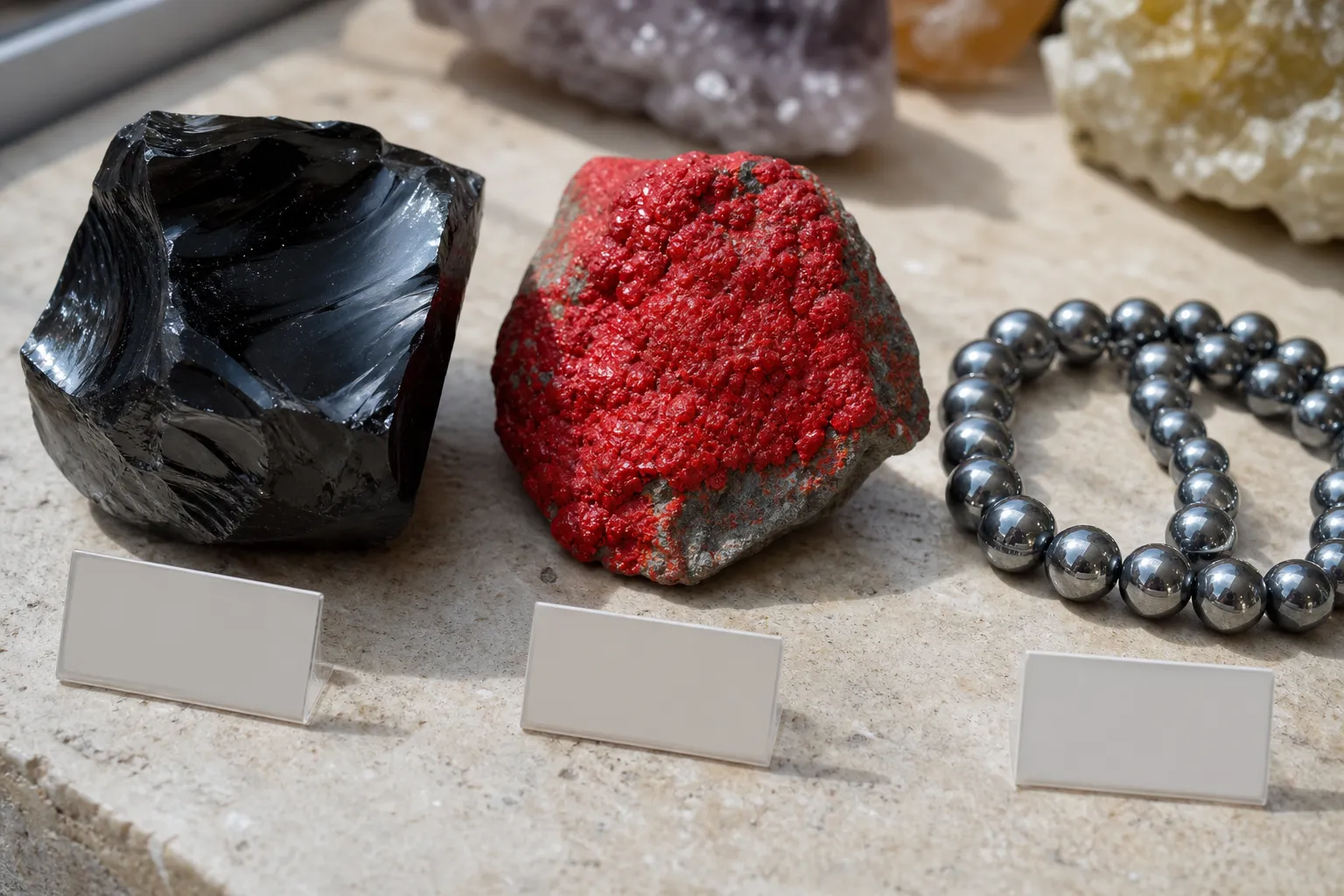
Quick comparison: what separates obsidian, cinnabar, and hematite
These three materials show up together in protective-crystal shopping because buyers often meet them in the same places: bracelets, beads, carvings, palm stones, display pieces, and meaning-based listings. Materially, they are very different.
Obsidian
Plain description: Volcanic glass.
Common buyer appearance: Black, smoky, brownish, mahogany, or patterned; usually glassy.
Useful clue: Smooth glass-like shine; sharp-looking chips on rough or broken edges.
Main caution: Can chip or break like glass; appearance does not confirm variety or treatment.
Hematite
Plain description: Iron oxide mineral, Fe₂O₃.
Common buyer appearance: Polished pieces often look black, steel-gray, or mirror-metallic.
Useful clue: Hematite metallic luster and a dense feel for size.
Main caution: Its red identity is often clearer in powder, streak, thin crystals, or ochre contexts—not always in jewelry.
Cinnabar
Plain description: Mercury sulfide mineral; historic red pigment source.
Common buyer appearance: Vivid red to scarlet-red; sometimes granular, massive, carved, or sold as decorative red items.
Useful clue: Strong red color and the seller’s use of “cinnabar.”
Main caution: Avoid dust, abrasion, mouth contact, ingestible use, and casual handling of damaged or unknown pieces.
The simplest root-level takeaway: obsidian vs hematite is mostly a glassy-versus-metallic comparison. Cinnabar vs hematite is a red-material comparison where cinnabar brings a stronger handling concern.
Why protective-crystal buyers compare these three
Obsidian, hematite, and cinnabar are not grouped because they are chemically similar. They are grouped because of how people shop for them.
In crystal retail, obsidian and hematite are often described with words such as protection, grounding, strength, shielding, or focus. Cinnabar may appear in similar meaning-based listings because of its intense red color and long pigment history. Those words can be part of personal or cultural crystal-use language, but they should not replace material questions.
Observable material cues
Look at color, luster, polish, texture, weight impression, chips, powder, coatings, and seller photos.
Use context
A bracelet, pocket stone, display specimen, pendant, carving, and gift all raise different questions.
Claim limits
Crystal meanings can be personally meaningful, but they are not proof of outcomes. Likewise, a product photo or listing title cannot confirm exactly what a piece is.
This page is the map. It gives you the main comparison framework before you move into narrower questions such as choosing obsidian or hematite for jewelry, reading cinnabar labels, or understanding black obsidian meaning compared with other dark stones.
Material cues buyers can actually use
Obsidian: glassy volcanic material
Obsidian is best understood first as volcanic glass. That explains the shine, the dark visual depth, and the way polished pieces can look sleek and reflective without looking metallic.
Common signs that may fit obsidian include:
- Glassy rather than metallic luster
- Black, smoky, brownish, mahogany, snowflake, rainbow-like, or other patterned appearances depending on variety and treatment
- Smooth polish in beads, pendants, spheres, mirrors, carvings, and palm stones
- Sharp-looking chips or edges on rough or broken pieces
- Light reflection that feels closer to glass than metal
Black obsidian is the variety many crystal buyers meet first. It is commonly sold as bracelets, pendants, palm stones, points, mirrors, and small carvings. In meaning-based listings, it is often described as protective or grounding. Treat that as crystal-use vocabulary, not as a material test.
For handling, remember that obsidian behaves more like glass than like a tough metal. Check for chipped bead holes, sharp edges, cracked points, and rough cord contact areas. If you carry it in a pocket or bag, keep it away from keys and harder objects that can chip the surface.
Hematite: dark metallic polish with a red powder connection
Hematite is an iron-oxide mineral. In polished jewelry, it often appears black, steel-gray, silver-gray, or mirror-like. That surprises buyers who have heard hematite connected with red.
The red association is real, but it shows up differently:
- Hematite streak or powder is commonly red to reddish brown.
- Thin crystals can show more red color.
- Red ochre and iron-oxide pigment contexts may involve hematite.
- Historical pigment discussions often connect hematite with red earth colors.
So a dark metallic hematite bracelet is not automatically suspicious. That is a normal way hematite jewelry appearance is presented in the market.
Useful buyer cues include:
- Metallic luster
- Dark gray, blackish, steel-like, or mirror-polished surface
- Dense feel for its size
- Beads, rings, cabochons, carvings, tumbled pieces, and retail labels that may mention magnetism or magnetic-style products
- Red-brown powder or streak association in mineral descriptions, though destructive testing is not a good idea on finished jewelry
The phrase hematite red powder helps resolve the apparent contradiction: hematite can be dark and metallic as a polished object while still being tied to red-brown streak and pigment contexts.
Cinnabar: vivid red identity with extra handling care
Cinnabar is the material here that needs the clearest caution. It is mercury sulfide and is historically important as a vivid red pigment source. That red color is part of its appeal, but the same identity changes how a buyer should handle uncertainty.
Cinnabar is often associated with scarlet to deep red color. Hematite may also connect to red through powder, streak, or ochre, but polished hematite jewelry usually looks dark metallic. That is why cinnabar vs hematite color can be confusing: both names may appear near “red,” but they do not usually look red in the same way.
Cinnabar
- Red is often central to how buyers recognize it.
- Metallic luster is usually not the main cue.
- Pigment history is strongly relevant.
- Handling needs extra care, especially with uncertain, powdery, abraded, or damaged material.
Hematite
- Red may appear in powder, streak, thin crystals, or ochre context; less so in polished jewelry.
- Metallic luster is often the main cue.
- Pigment history is also relevant, especially for red ochre and iron-oxide pigments.
- Handling is usually ordinary mineral and jewelry care.
For cinnabar-labeled pieces, the word on the listing may not tell the full story. Some items may be mineral specimens. Others may be lacquer, resin, dyed material, composite material, coated beads, or decorative products using “cinnabar” as a color or style term. The problem is not only what the seller says; it is what you cannot confirm from appearance alone.
Practical handling points:
- Do not sand, grind, polish, scratch, or abrade cinnabar or cinnabar-labeled items.
- Avoid dust from damaged, powdery, granular, or flaking pieces.
- Do not put cinnabar-labeled jewelry or objects in the mouth.
- Do not use cinnabar-labeled material in drinkable water, powders, or ingestible routines.
- Keep uncertain red mineral pieces away from children, pets, food areas, and items that may rub or scrape the surface.
- If a piece breaks or sheds powder, set it aside carefully and seek qualified mineral or safety guidance if the composition matters.
This does not mean every red object sold as “cinnabar” is the same material. It means a buyer should not treat an unknown red carving, bead, or specimen casually when the label points toward cinnabar.
Obsidian vs hematite: choosing between glassy and metallic dark stones
The most common everyday choice is obsidian vs hematite for bracelets, pendants, pocket stones, or display pieces. Both are often sold as dark grounding stones, but their material feel is different.
Obsidian buying factors
- Main look: Glassy black or dark polished surface.
- Luster: Glass-like.
- Weight impression: Smooth and substantial, but not usually metal-like.
- Common forms: Beads, pendants, palm stones, spheres, mirrors, carvings.
- Watch for: Chips, sharp edges, variety names, imitation or treated glass concerns.
- Best buyer question: Do I want a glassy dark stone?
Hematite buying factors
- Main look: Metallic black, steel-gray, or silver-gray surface.
- Luster: Metallic, often mirror-like.
- Weight impression: Often dense for its size.
- Common forms: Beads, rings, cabochons, tumbled stones, carvings.
- Watch for: Coatings, magnetic-style wording, overly broad “natural” claims, finish wear.
- Best buyer question: Do I want a dark metallic stone with weight?
For jewelry, inspect the piece rather than relying only on the listing name. Look at bead holes, edge smoothness, polish quality, cord contact points, surface coatings, and how the weight feels on the wrist or neck.
If your choice is symbolic, obsidian and hematite are both commonly described as grounding stones in modern crystal language. Obsidian is often framed as protective or reflective; hematite is often framed as steadying or grounding. Those descriptions may help with personal preference, but the physical choice still comes down to luster, finish, comfort, and durability.
Cinnabar vs hematite: red confusion, weight, and surface condition
The cinnabar vs hematite comparison is different because it is not just a style choice. It also involves uncertainty around red materials and handling.
A red bead labeled hematite, a red carving labeled cinnabar, and a dark metallic hematite bracelet should not be treated as interchangeable. The label may refer to actual mineral content, color, style, coating, lacquer tradition, dyed material, resin, or seller shorthand.
Buyer filter for red or red-labeled pieces
Vivid red color may suggest cinnabar, cinnabar-style material, dye, lacquer, resin, or another red material, but it cannot prove exact composition.
Dark metallic polish often fits polished hematite or hematite-like products, but it cannot prove natural origin or lack of coating.
Dense feel may fit hematite or another heavy material, but it cannot prove identity by itself.
Powder, flaking, chips, or a rough granular surface are reasons to slow down, especially with cinnabar-labeled items, but they cannot prove whether it is definitely cinnabar.
A seller using “cinnabar” as a style word may indicate decorative red lacquer-style or carved product language, but it cannot prove whether mercury sulfide is present or absent.
A useful rule: if you do not know whether a red item is cinnabar, cinnabar-style lacquer, dyed stone, resin, composite material, or another red mineral, do not perform scratch tests, sanding, grinding, soaking, or mouth-contact “tests.” Those actions create more problems than they solve.
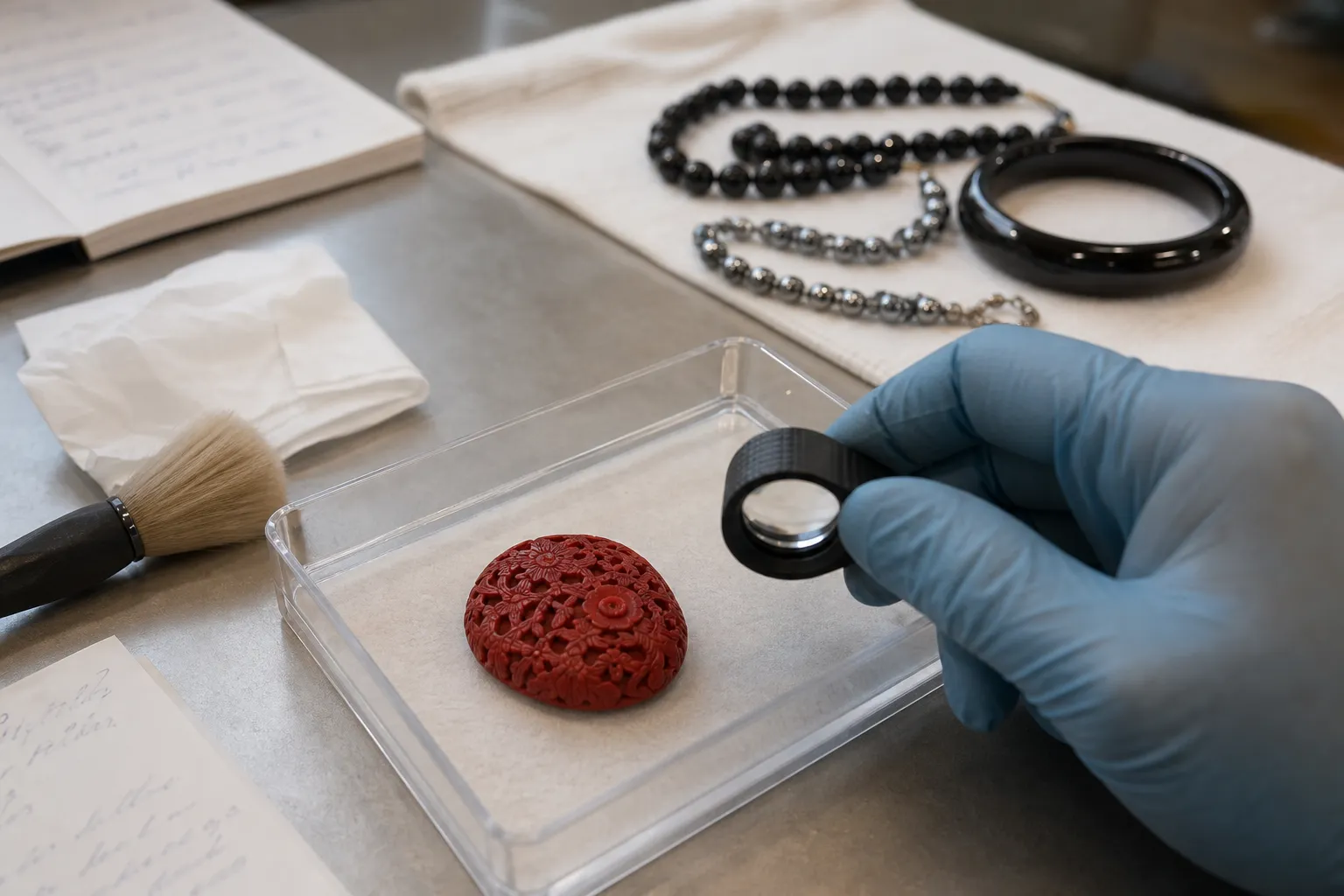
Meaning language: black obsidian, hematite, and cinnabar in crystal use
Searches for black obsidian meaning compared with hematite and cinnabar usually come from readers who want to know whether the stones are used differently in personal crystal routines. A careful answer should separate symbolism from material facts.
Black obsidian
Often described with protection, grounding, reflection, or clearing language.
Material anchor: Volcanic glass.
Better buyer question: Do I want a dark glassy piece, and is it polished well enough for my use?
Hematite
Often described with grounding, steadiness, focus, or strength language.
Material anchor: Iron oxide mineral.
Better buyer question: Do I want a metallic dark stone with a dense feel?
Cinnabar
May be described with intensity, vitality, or transformation-style language in some retail contexts.
Material anchor: Mercury sulfide mineral and historic red pigment.
Better buyer question: Am I prepared to handle uncertainty and surface condition carefully?
Meaning language can be useful if you choose crystals for meditation spaces, symbolic jewelry, display, journaling prompts, or personal reminders. It should stay in that lane. If you are wearing, gifting, cleaning, or storing a piece, material and handling questions come first—especially with cinnabar.
Choosing by use: jewelry, carrying, display, or gifting
A root comparison becomes more useful when you start with the intended use.
Jewelry
Obsidian: Check polish, chips, bead holes, sharp edges, and settings.
Hematite: Expect a metallic look and heavier feel; check coatings and finish wear.
Cinnabar-labeled items: Be selective. Avoid powdery, flaking, abraded, damaged, or unclear pieces. Ask what the item is made of and how the surface is finished.
Pocket or bag carry
Obsidian: Use a pouch; avoid keys and harder objects that may chip it.
Hematite: Use a pouch to reduce scuffs and finish wear.
Cinnabar-labeled items: Do not carry loose where friction may abrade the surface.
Display
Obsidian: Works well as spheres, mirrors, carvings, and palm stones.
Hematite: Shows well where metallic luster catches light.
Cinnabar-labeled items: Often better as a look-but-handle-carefully object, especially if raw, granular, damaged, or uncertain.
Gifting
Obsidian: Easier to explain and handle for most recipients.
Hematite: Also easy to explain if the recipient likes metallic jewelry.
Cinnabar-labeled items: Give only when the recipient understands the label, uncertainty, and careful handling needs.
For most casual buyers, obsidian and hematite are simpler choices for daily wear. Cinnabar belongs in a more deliberate category: know what the seller means, inspect the surface, and avoid rough handling.
How these stones are commonly sold
Marketplace wording causes much of the confusion. A listing title may combine a material name, color word, style term, spiritual phrase, bead size, and marketing label in one line.
Obsidian
Common retail forms: Bracelets, beads, pendants, palm stones, spheres, mirrors, carvings, points.
Wording to read carefully: Variety names, dyed or treated claims, imitation glass concerns, “natural” wording.
Hematite
Common retail forms: Bead strands, bracelets, rings, tumbled stones, cabochons, carvings.
Wording to read carefully: Coated beads, magnetic-style descriptions, dark polish vs red streak confusion.
Cinnabar
Common retail forms: Red specimens, carved beads, decorative pieces, lacquer-style items, pigment-related descriptions.
Wording to read carefully: Whether “cinnabar” means actual mineral, color, lacquer, resin, coating, or style.
Before buying, read listings slowly:
- Is the material clearly named, or only described by color?
- Does the listing mention natural, treated, dyed, coated, man-made, lacquer, resin, composite, or style?
- Are close-up photos provided?
- Does the surface look glassy, metallic, powdery, chipped, coated, or unusually uniform?
- Does the seller separate symbolic meaning from material description?
- For cinnabar-labeled pieces, does the seller explain composition and surface finish?
If a listing leans heavily on dramatic meaning language but gives little physical information, slow down. Good buying decisions come from material details, not only mood words.
What photos can suggest—and what they cannot settle
Photos are useful, but they have limits. They can help you decide what questions to ask, not give certainty.
A clear photo may suggest
- Glassy luster that could fit obsidian
- Metallic luster that could fit hematite
- Vivid red color that could fit cinnabar or cinnabar-style material
- Chips, cracks, powder, flaking, coatings, or polish quality
- Whether a piece appears raw, carved, sealed, or damaged
- Whether a bead strand looks unusually uniform or heavily processed
Photos and seller wording usually cannot confirm
- Exact mineral identity
- Whether a piece is natural, treated, dyed, coated, composite, or imitation
- Whether a red item contains cinnabar or only uses cinnabar as a color or style term
- Whether a surface coating is intact
- Whether a piece is appropriate for skin contact, children, pets, water use, or abrasive handling
- Whether a crystal will create a personal outcome
Lighting changes red tones. Polishing changes luster. Coatings can imitate shine. Weight can be misleading. For certainty, specialized testing or qualified review may be needed.
Mineral guides often mention streak, hardness, and scratch checks. Those methods are not always appropriate for ordinary buyers. Scratching jewelry damages it, and abrading cinnabar-labeled material is especially unwise because it may create dust from an uncertain surface.
Care and storage for a mixed collection
If you own all three, do not store them as one generic “protective stones” group. Store them by surface and handling needs.
A practical setup:
- Keep obsidian away from harder objects that may chip it.
- Keep hematite away from surfaces that may scratch, dull, or mark its polish.
- Keep cinnabar-labeled pieces separate, clearly labeled, and protected from abrasion.
- Use soft pouches, divided boxes, trays, or closed display cases.
- Keep uncertain red mineral pieces away from children, pets, food areas, and water-use routines.
For cleaning, start with the least aggressive method:
- Obsidian: use a soft cloth first; avoid impact and pressure on sharp edges.
- Hematite: wipe gently; avoid harsh chemicals and unnecessary soaking.
- Cinnabar-labeled items: avoid soaking, scrubbing, sanding, polishing compounds, ultrasonic cleaning, and abrasive brushes unless the material and finish have been properly identified.
Do not put these stones into drinkable water preparations. That caution is especially important for cinnabar-labeled material, but it is also sensible for mixed crystal collections where coatings, treatments, and composition may be unclear.
Reader path: where to go next
Use this root page as the map, then narrow your question.
- If you are choosing a dark wearable stone: compare obsidian and hematite by luster, weight, finish, bead quality, comfort, and whether you prefer glassy black or metallic dark.
- If you are comparing red or red-labeled pieces: focus on cinnabar vs hematite color, surface condition, seller wording, and handling uncertainty.
- If you are drawn to meaning language: treat black obsidian, hematite, and cinnabar meanings as personal or cultural symbolism, then let material care guide the purchase.
- If you are buying from photos: use visible clues to ask better questions, not to declare identity.
- If you are considering cinnabar jewelry or a specimen: put composition, surface condition, dust, abrasion, storage, and recipient awareness at the front of the decision.
Bottom line for buyers
Obsidian, cinnabar, and hematite are compared in crystal shopping because they overlap in protective-crystal language, not because they are physically alike.
Obsidian is the dark glassy volcanic material. Hematite is the dark metallic iron-oxide mineral with a red-brown powder or streak association. Cinnabar is the vivid red mercury-sulfide mineral and pigment identity that calls for more careful handling around dust, abrasion, damaged surfaces, and uncertain consumer products.
If you want a dark everyday stone, compare obsidian and hematite by luster, weight, finish, and comfort. If you are considering cinnabar, move handling and composition questions to the front. For all three, let visible cues guide your questions—not your certainty.
Sources
Sources and further reading
Reference links are limited to sources considered suitable for public citation in this page.