ProtectCrystal handling note
Buyer Framework
Identification Clues and Authenticity Limits for Obsidian, Cinnabar, and Hematite
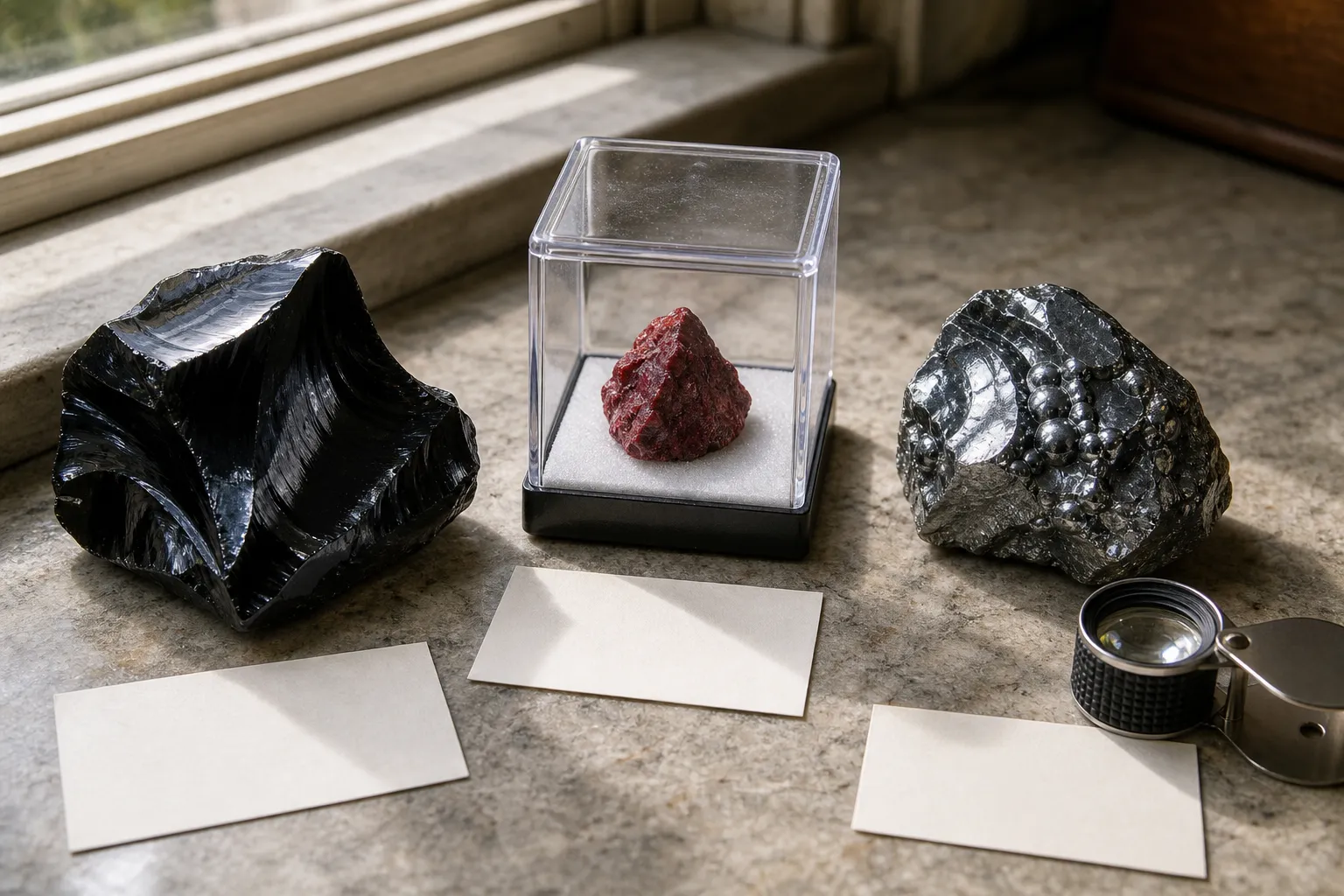
A buyer-level check for obsidian, cinnabar, or hematite should begin with what can actually be observed: texture, surface, edges, weight impression, finish, photo quality, seller wording, and how the piece is meant to be used. These are identification clues and authenticity limits. They can help you decide whether a piece looks plausible, needs more questions, or should be avoided for your purpose. They cannot prove identity on their own.
That distinction matters most when a listing uses broad crystal language, when a piece is polished, dyed, coated, or carved, when “real” or “natural” is used without explanation, or when cinnabar is involved and handling questions deserve extra care. Treat visual checks as a first sorting step. For firmer conclusions, look for better documentation, clearer sourcing, or specialized testing.
The Practical Buyer Framework
Most buyers are not trying to become mineral testers. They are usually trying to answer a few practical questions before buying, wearing, storing, gifting, or comparing a piece:
- Does the item visually match the material name used by the seller?
- Are the photos detailed enough to support a cautious purchase?
- Is the name being used as a material, a color, a style, or a vague sales label?
- Does the piece raise handling questions that should change how it is used?
- Is the seller making certainty or outcome statements that go beyond what the listing shows?
Obsidian, cinnabar, and hematite are often discussed in protective crystal contexts, but they do not ask the same buyer questions. Obsidian usually sends buyers toward glassy texture, edges, and sheen. Hematite often raises questions about weight, metallic-looking surfaces, and magnetism wording. Cinnabar needs a more conservative reading because red decorative objects, look-alikes, and handling concerns can overlap in the marketplace.
A useful first framework is to separate what you see, what the listing says, and what would require stronger support.
Visible Clues
Color, shine, texture, edges, finish, chips, holes, and photo detail can support a first impression or a reason to ask follow-up questions. They cannot prove definite identity.
Listing Clues
Material name, modifiers, treatment wording, origin claims, and photo consistency can show whether the seller is careful or vague. They are not independent verification.
Stronger Support
Clear sourcing, qualified testing, trusted documentation, or a more reliable seller can raise confidence in a material claim. They still do not promise any personal result.
Protective crystal language belongs in the personal, cultural, or symbolic layer. A buyer may choose a piece because it feels meaningful, grounding, beautiful, or fitting for a ritual practice. That does not make the material claim more certain, and it should not be treated as a promise of an outcome.
Start With What You Can See
Buyer-level identification is not about forcing a verdict. It is about noticing whether the object, the description, and the seller’s confidence level line up.
Surface is usually the first clue. A piece may look glossy, metallic, waxy, matte, carved, coated, rough, polished, or unusually uniform. These words are useful because they describe what is visible without pretending the eye can settle the whole question.
Polishing can make a piece more attractive while also making it harder to read. It may soften edges, hide texture, or make unrelated materials look more similar. Rough specimens can show more structure, but roughness is not proof either. If a listing shows only one flattering angle, treat the surface story as incomplete.
When Looking at Photos or an Item in Hand
- Does the finish look consistent across the whole piece?
- Are chips, drilled holes, edges, backs, or undersides visible?
- Does the shine appear to belong to the material, or could it be a coating or lighting effect?
- Are close-up and full-piece photos both provided?
- Is the surface described plainly, or mostly through promotional language?
Edges, chips, and thin areas often reveal more than the polished front. A bead hole, broken corner, carving cut, or underside may show color depth, layering, coating, or a different internal look. These details can suggest that a piece deserves closer attention, especially when the front view looks too smooth or too staged.
Weight impression can also help, especially in person. Hematite is often discussed through weight clues because buyers expect a certain heft from items sold under that name. Still, “feels heavy” is not a test result. Size, shape, filler material, metal components, and expectation can mislead. Online, dimensions and item weight may help you notice mismatches, but they do not identify the material by themselves.
Color is the easiest clue to notice and one of the easiest to over-trust. Lighting, camera settings, polish, dye, coating, and display backgrounds can all change how obsidian, cinnabar, or hematite appears. Uniform color is not automatically good or bad. The better question is whether the seller shows enough angles and detail for you to understand what you are seeing.
How the Three Materials Differ for Buyers
This root page is not meant to replace full identification guides. Its job is to show where each material needs a different kind of caution.
Obsidian
Common buyer focus: whether a dark, glossy piece plausibly matches an obsidian claim.
Useful clues: glassy texture, edges, chips, sheen behavior, and specific variety wording.
Main limit: a glass-like look can suggest a direction but does not settle identity.
Hematite
Common buyer focus: whether a metallic-looking item is being described clearly.
Useful clues: weight impression, surface wear, polish, magnetic wording, and measurements.
Main limit: one cue, especially shine or weight, is not enough.
Cinnabar
Common buyer focus: whether a red item is a mineral, style name, decorative material, or look-alike.
Useful clues: exact wording, backs, holes, worn areas, and carved-object descriptions.
Main limit: red color and carved appearance are too weak to resolve the claim.
For obsidian, buyers often search for how to identify obsidian by glassy texture, edges, and sheen. That is a useful starting point. A glassy surface, dark body color, or reflective sheen can support a possibility, especially when edge details and seller wording are consistent. But heavy polishing, dramatic lighting, carved shapes, and vague black-crystal labels can all reduce confidence. If the piece is expensive or sold as a specific sheen variety, ask for better photos and clearer description.
For hematite, the common search phrase “real hematite vs fake” usually comes from confusion around metallic-looking beads, strong magnetism language, or product titles that mix hematite with other terms. Hematite weight clues can help when comparing similar-sized pieces in person. Hematite surface clues can help you notice coating, wear, or inconsistency. Hematite magnetism clues need careful reading because seller wording may be loose or incomplete. If a listing leans on the word “real” but avoids measurements, close-ups, or plain material description, slow down.
For cinnabar, the first check is not color. It is wording. A listing might say “cinnabar,” “cinnabar color,” “cinnabar style,” “red carved,” “lacquer,” “dyed,” or something similar. Those phrases are not interchangeable. If the item will be worn, handled often, stored with other pieces, or given to someone else, unclear wording matters more. Ask whether the seller is naming a mineral specimen, a carved decorative item, a color style, a coated material, or a trade label. If the answer stays vague, keep the identification unresolved.
Reading Online Listings Without Over-Trusting Them
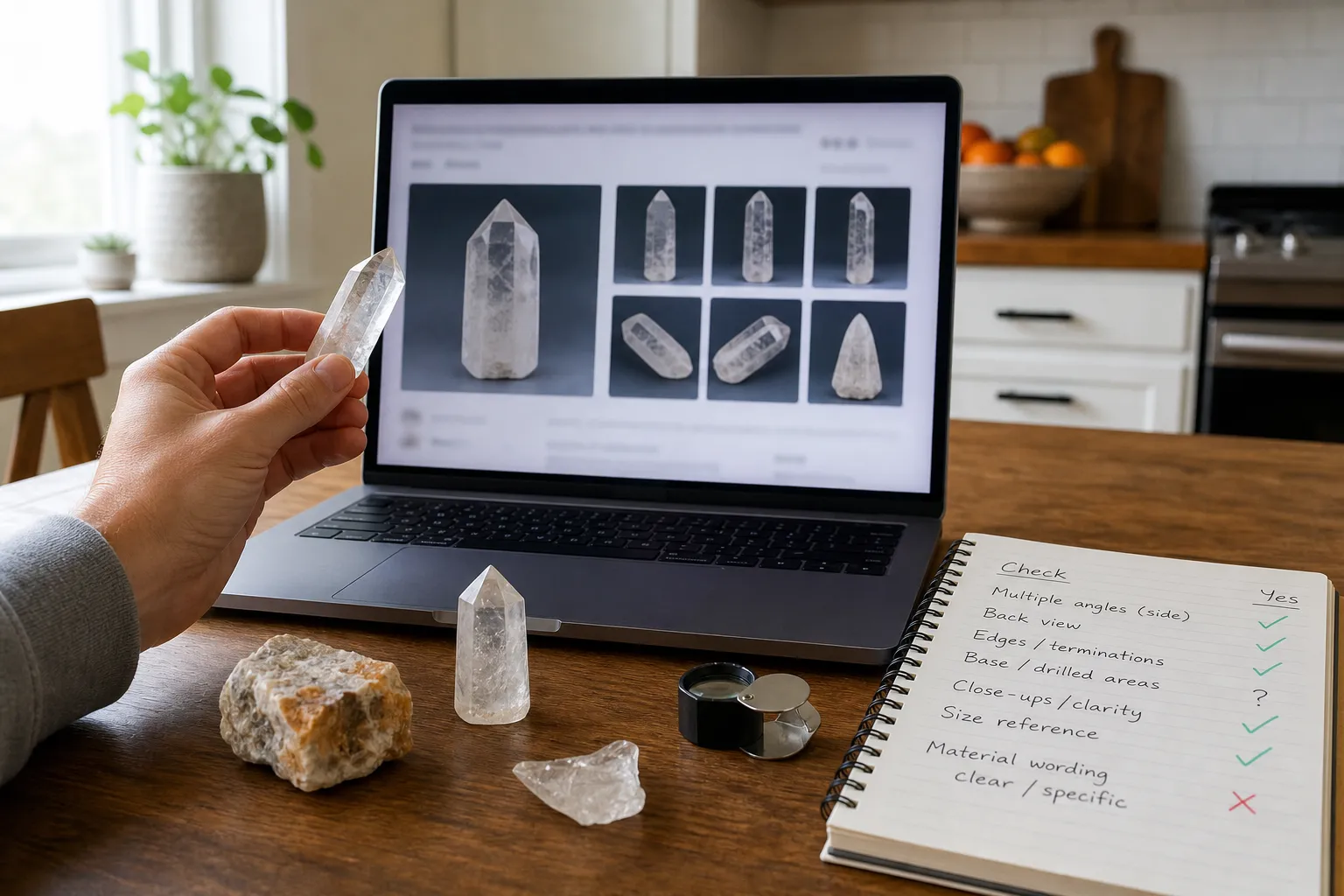
Online shopping compresses a material into a title, a few photos, and seller wording. That makes crystal authenticity checks useful, but limited.
A product title is often a stack of claims. It may include a material name, color, shape, size, style, use context, and confidence language. Instead of reading it as one identity statement, break it apart:
Material
Obsidian, hematite, cinnabar, or a look-alike term.
Appearance
Black, red, metallic, glossy, rainbow, carved, or polished.
Object Type
Bead, pendant, sphere, palm stone, specimen, or carving.
Use Context
Protective crystal, decor, jewelry, altar piece, or gift.
Confidence Wording
Natural, genuine, real, untreated, vintage, or handmade.
The more claims a title makes, the more support the listing should provide. A modest listing with clear photos may be more useful than a dramatic listing that piles on certainty without showing details.
The first photo is designed to attract attention. It is rarely enough for identification. Better listings show the surface, side view, back or underside, scale, drilled holes, chips, carving cuts, worn areas, and the exact piece being sold when possible. If only one angle is shown, the listing gives you less to work with. That does not automatically make the item wrong, but it lowers the confidence you can reasonably place in it.
Watch especially for wording that blurs material and style. A careful listing should help you understand whether a word names the material, the color, the finish, the design tradition, or the seller’s category label. If it does not, ask before buying:
- “Is this being sold as the mineral itself or as a color/style name?”
- “Are the photos of the exact item or a representative sample?”
- “Has the piece been dyed, coated, assembled, or treated?”
- “Can you provide a photo of the edge, back, or drilled area?”
- “What do you mean by magnetic, natural, or genuine in this listing?”
These questions do not need to sound confrontational. They simply move a listing from vague to clearer. If the seller cannot answer, the object may still be decorative or appealing, but authenticity confidence should stay lower.
Where Visual Identification Reaches Its Limit
Appearance alone cannot prove authenticity. That is the central limit of this topic.
Visual crystal identification limits appear whenever a material is polished, carved, dyed, coated, mixed, mislabeled, photographed poorly, or sold with broad marketplace language. The eye can notice clues. It cannot confirm every internal property, treatment, substitution, or naming issue.
The most common mistake is letting one clue carry the whole decision:
“It is shiny, so it must be hematite.”
Shine is only one surface clue. Check wording, wear, measurements, and context.
“It is black and glossy, so it must be obsidian.”
Glassy appearance may fit, but edge detail and seller clarity still matter.
“It is red and carved, so it must be cinnabar.”
Red carved objects can be described in several ways. Clarify the material first.
“It feels heavy, so it is settled.”
Weight can help in person, but it is not a stand-alone identification method.
“The title says natural, so the claim is proven.”
Broad confidence words need specific support.
More support is reasonable when the item is expensive, the material name affects handling or storage, the listing uses high-confidence language without details, the piece is cinnabar-related and intended for frequent handling, photos hide edges or backs, or the item is a gift where the recipient may assume more certainty than you have.
“More support” does not always mean a complex process. It may mean clearer photos, plain seller answers, better provenance, a return option, or choosing a seller who separates material names from style terms. For high-confidence identification, specialized testing may be needed.
Handling and Care While You Are Unsure
The practical question is not only “What is this?” but also “How should I treat it while the answer is uncertain?”
If a piece is not clearly identified, avoid making it a high-contact object right away. This is especially sensible for items described as cinnabar or cinnabar-like, but the habit is useful across uncertain crystal purchases.
A Conservative Routine for Unclear Pieces
- Keep them dry unless you have reliable care guidance for that material.
- Avoid scraping, sanding, drilling, or altering them.
- Store them separately if the surface seems coated, powdery, flaking, or unstable.
- Wash hands after handling pieces that leave residue.
- Keep uncertain stones and decorative objects away from children and pets.
- Ask for better identification before wearing an unclear item against skin for long periods.
Cinnabar-related items deserve extra care because the word can appear across mineral, decorative, carved, vintage, and look-alike contexts. This page should not turn vague listings into detailed safety rules. The practical move is simpler: clarify what is being sold, avoid casual high-contact use while the identity is unclear, and treat unresolved material claims as unresolved.
Protective use should stay in its own lane. A protective-crystal label may explain why someone is drawn to obsidian, cinnabar, or hematite. It does not verify the material, confirm treatment history, or answer handling questions. Keep the four lanes separate:
Meaning
Why the piece matters to the buyer.
Material Clues
What can be observed.
Authenticity Confidence
How well the claim is supported.
Handling Choice
How cautious to be while uncertainty remains.
That separation lets buyers enjoy crystal use without turning personal meaning into a factual certainty.
A Simple Sorting Method Before You Buy
Before purchasing obsidian, cinnabar, hematite, or a piece sold under those names, sort it into one of four confidence zones.
Clear Enough for Casual Interest
Fits a lower-stakes item with modest seller language, several clear photos, and visible surface and edge details. Accept that it is not proven, but the uncertainty may be reasonable for casual use.
Interesting but Needs Questions
Fits an appealing piece with missing angles, vague terms, unclear size or weight, or uncertain material/style wording. Ask for close-ups, edge views, and plain answers.
Too Vague for the Intended Use
Fits an attractive item whose listing does not support how you plan to wear, gift, store, or collect it. Choose a lower-contact use, keep looking, or ask for stronger support.
Needs Stronger Support
Fits a costly piece, cinnabar-related item, frequent-contact use, collecting goal, or strong seller claims without detail. Seek better documentation, a more careful seller, specialized testing, or a different piece.
This method keeps the decision matched to the consequence. A low-cost decorative stone may only need a reasonableness check. A higher-cost piece, a cinnabar-related object, or a listing with strong certainty language deserves more scrutiny.
Common Misreadings to Avoid
A cautious buyer does not need to reject every uncertain listing. The goal is to avoid turning weak signals into stronger conclusions than they can support.
“Natural” Does Not Explain the Whole Object
A listing may use the word while still leaving out important details. Natural relative to what: the base material, color, finish, absence of treatment, or seller category? Ask for specifics.
“Real” Is Not a Test Method
The phrase “real hematite vs fake” captures a genuine buyer concern, but the word “real” in a title is not evidence. It needs support from clear photos, careful naming, and seller transparency. The same applies to obsidian and cinnabar.
“Protective” Is Not an Authenticity Clue
It can describe use context, symbolism, or why a buyer likes the piece. It does not identify the stone or settle handling questions.
“Looks Right” Is Not the Same as “Settled”
A piece can look plausible and still remain uncertain. Buyer-level identification often ends in probability, not certainty. The decision is whether that probability is good enough for your purpose.
Where to Go Next
This root page gives the map. Deeper guides should answer narrower questions without trying to solve the whole topic at once.
How to Identify Obsidian by Glassy Texture, Edges, and Sheen
Use it when you are asking, “Does this look like obsidian, and what should I inspect first?” It should help you decide how to use glassy appearance, edge views, and sheen claims as buyer-level clues.
Real Hematite vs Fake Hematite: Weight, Magnetism, and Surface Clues
Use it when you are asking, “Why do hematite listings mention weight or magnetism?” It should help you compare weight impression, magnetic wording, and metallic-looking surfaces without relying on one sign.
Cinnabar Identification Clues and Common Look-Alikes
Use it when you are asking, “Is this red item actually cinnabar, cinnabar-style, or something else?” It should help you read material wording, carved-object descriptions, and red look-alike clues cautiously.
Crystal Authenticity Checks for Online Listings and Shop Counters
Use it when you are asking, “How do I judge a listing before buying?” It should help you review photos, seller language, treatment wording, and uncertainty.
When Visual Crystal Identification Is Not Enough
Use it when you are asking, “When should I stop guessing from appearance?” It should help you recognize the point where testing, documentation, or a more conservative choice is needed.
These are entry points, not a demand that every buyer investigate everything. Start with the question that matches your item and your intended use.
Evidence Boundary
The research set provided for this draft did not include usable public references suitable for front-facing citation. For that reason, this page stays at the buyer-framework level and avoids detailed claims about mineral properties, testing thresholds, treatment detection, or item-specific safety. A stronger future version should be supported by museum, university, mineralogical, safety-oriented, or credible gem-testing sources before making more specific statements.
Until then, the sound buyer habit is modest and practical: observe carefully, read listings closely, ask direct questions, treat cinnabar-related uncertainty with extra care, and remember that appearance alone cannot prove authenticity.
Bottom Line
Use identification clues as a sorting tool, not a final verdict. Obsidian questions often begin with glassy texture, edges, and sheen. Hematite questions often revolve around weight impression, magnetic wording, and metallic-looking surfaces. Cinnabar questions should begin with exact wording, look-alike awareness, and cautious handling choices.
Match the level of confidence to the level of consequence. If the piece is inexpensive, decorative, clearly photographed, and not sensitive for handling, a modest visual check may be enough for casual enjoyment. If the item is costly, cinnabar-related, intended for frequent contact, or described with unusually strong claims, slow down.
A careful buyer should know what the listing has shown, what it has not shown, and where visual identification reaches its limit.