
ProtectCrystal handling note
What Does Real Cinnabar Stone Look Like in Hand
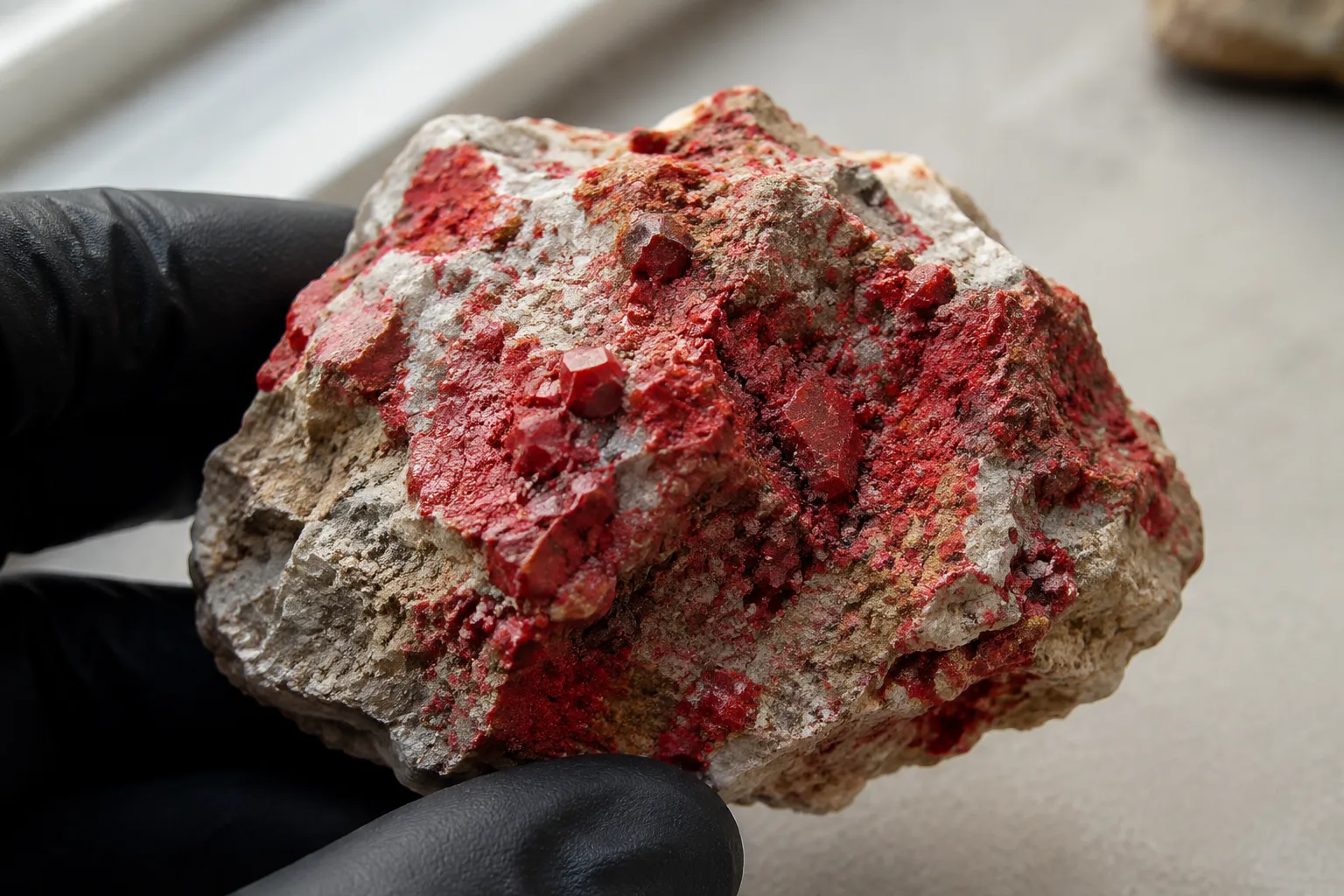
Real cinnabar stone usually looks like a red mercury sulfide mineral, not a perfectly uniform jewelry material. In hand, it may show scarlet, bright red, brick red, brownish red, or earthy red areas. The red can appear as granular patches, crusts, dense massive zones, or small crystal faces on a paler host rock.
A natural specimen can feel surprisingly heavy for its size, and its surface may shift from dull and earthy to brighter on cleaner crystal faces. Those clues can support cinnabar identification, but they do not confirm it by themselves. Red carved bangles, beads, and pendants sold as “cinnabar” may be natural mineral, resin, plastic, lacquer-like material, or another red imitation.
upward
Read the full overview first
Use the broader guide first if you need the full scope before this page.
The In-Hand Look of Natural Cinnabar
Natural cinnabar appearance is not one clean shade of red. Mineral references commonly describe cinnabar across a range from vivid scarlet to brick red, brownish red, and earthy red. A scarlet cinnabar stone can look intense under good light, but many real pieces are quieter: muted red patches in gray, white, tan, or pale matrix should not be dismissed only because they are not bright.
Form matters as much as color. Real cinnabar stone is often described in massive, granular, earthy, encrusting, or crystalline forms. A raw piece may look like red mineral spread through host rock, a powdery-looking red coating, a dense red mass, or small shiny crystals sitting on matrix. It does not have to look like a smooth red bead.
Color range
Scarlet, bright red, brick red, brownish red, or earthy red can all appear in real material.
Form
Massive, granular, earthy, encrusting, crystalline, or matrix-hosted forms may be seen.
Luster
Weathered material may look dull, while cleaner crystal faces can look brighter.
Weight
A true mineral specimen may feel heavy for its size, but weight is only one clue.
Luster changes with the surface. Massive or weathered material may look dull, dusty, or granular. Cleaner crystal faces can look brighter. A polished finish is a weaker clue because many red materials can be made glossy.
Weight can be noticeable. Cinnabar has a high specific gravity, so a true mineral specimen may feel heavy for its size compared with many common crystal-shop stones. Still, heavy feel is only one clue. Other dense materials, fillers, coatings, and mixed objects can also feel weighty.
Color, Texture, Matrix, and Streak Clues
The best buyer check is to read the clues together: color, texture, matrix, luster, weight, and whether the object looks like a natural specimen or a manufactured decorative piece.
- Natural specimen impression: uneven red zones, granular areas, crust-like surfaces, or red material embedded in paler host rock.
- Matrix context: some pieces show white or pale minerals such as calcite or dolomite around the red areas, though matrix is not required.
- Texture clue: earthy, fine-grained, granular, crusty, or crystalline texture is often more useful than brightness alone.
- Streak boundary: red to scarlet streak is reference information, not a routine home test for a questionable piece.
A natural specimen may show uneven red zones, granular areas, crust-like surfaces, or red material embedded in paler host rock. Some pieces show white or pale minerals such as calcite or dolomite around the red areas. That kind of cinnabar matrix can support a natural-specimen impression, but it is not required. A cleaner red crystal or massive red piece may still need closer identification.
Texture is often more useful than brightness. Cinnabar texture may look earthy, fine-grained, granular, crusty, or crystalline. Mineral references place cinnabar around Mohs 2 to 2.5, which is soft compared with quartz and many common decorative stones. That softness is useful background, but scratching a piece at home is not a good casual check. It can damage the object and create powder.
Cinnabar streak is commonly described as red to scarlet. In mineral identification, streak means the color of powdered mineral on a streak plate. Treat that as reference information, not as a routine home test. Because cinnabar is mercury sulfide, avoid powdering, grinding, or abrading a questionable specimen.
The practical pattern is simple: uneven red mineral, possible matrix, earthy or granular texture, heavy feel, and variable luster can suggest cinnabar. They still stop short of proof.
Why Carved Red Jewelry Is Often Confusing
Carved cinnabar jewelry creates confusion because “cinnabar” is used in more than one marketplace sense. A buyer may see a red carved bracelet, bead, bangle, pendant, or decorative object and assume it is natural cinnabar mineral. That assumption is not reliable.
Some red carved pieces are sold in a cinnabar style. The word may point to vermilion color, pigment tradition, lacquer-like carving, resin, plastic, or imitation material rather than a natural mineral specimen. A smooth, glossy, deeply carved red bangle is not automatically real cinnabar stone.
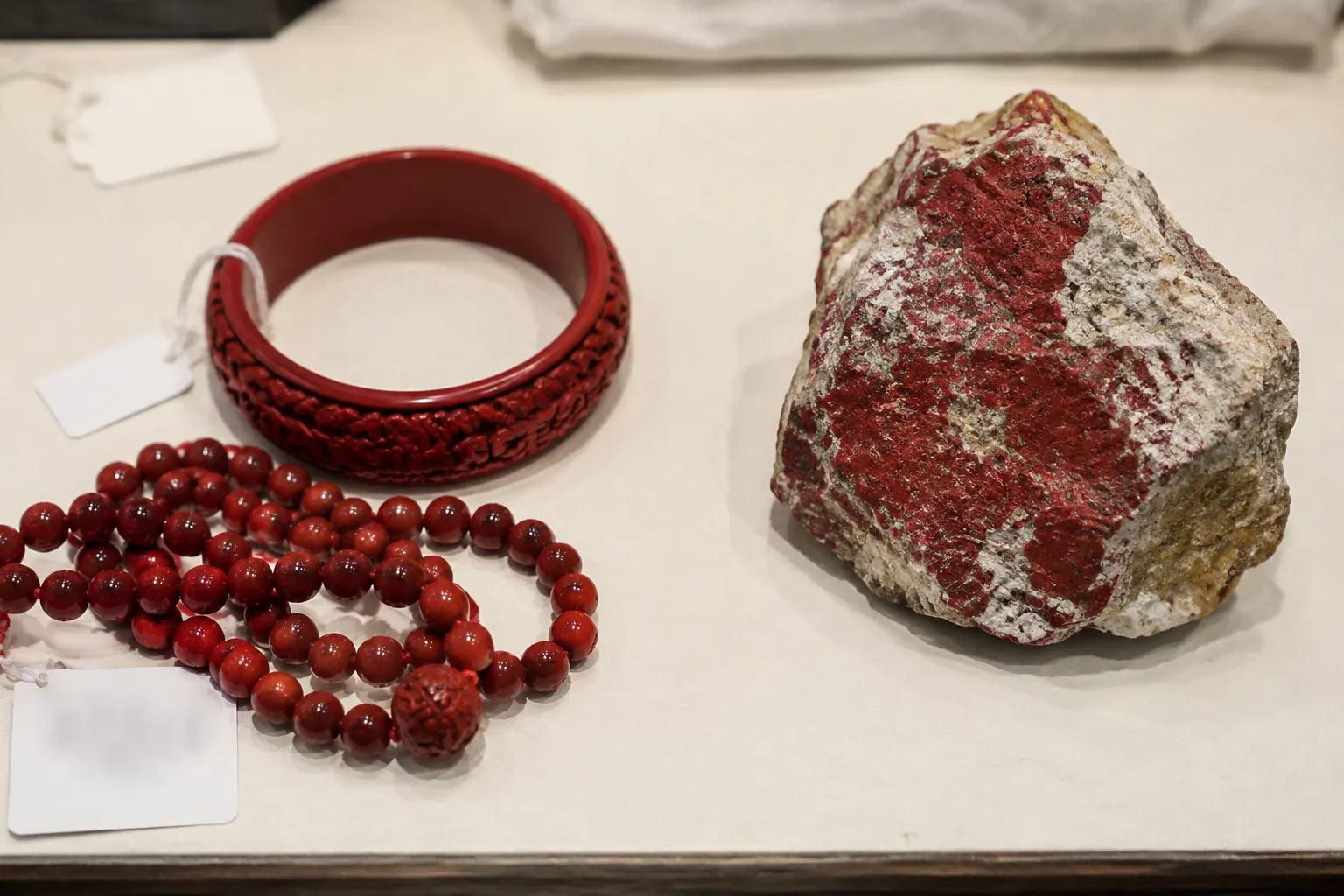
Seller wording can make the object sound more certain than it is. Phrases such as “natural,” “original,” “selected,” “high-purity,” or “real cinnabar bracelet” are labels, not mineral evidence. They may describe how the item is marketed, but they do not show the material, treatment, or provenance. The same caution applies to descriptions that connect cinnabar with protection, luck, or auspicious use. Those are cultural or seller-language claims, not identification clues.
Weight needs the same restraint. A heavy red bangle may raise the question, but it does not answer it. Natural cinnabar can feel heavy for its size, yet a heavy carved object can still be something else.
For carved cinnabar jewelry, the better question is not “Is it smooth and red?” It is “Does the seller provide reliable material information, and does the object look like natural mineral or a manufactured cinnabar-style piece?”
Handling Cinnabar While You Are Looking at It
Because cinnabar is mercury sulfide, handle it more carefully than ordinary tumbled quartz, obsidian, or hematite. This page cannot judge a specific object from appearance alone. The useful habit is conservative handling, especially with raw, damaged, powdery, or uncertain pieces.
Conservative handling habits
- Do not grind, sand, drill, heat, lick, or powder cinnabar.
- Do not wear damaged raw cinnabar directly against skin.
- Wash your hands after handling raw or questionable specimens.
- Keep uncertain pieces away from children and pets.
- If a specimen sheds red dust, has loose granular material, or looks damaged, avoid casual handling until it can be assessed in person by someone qualified to identify minerals.
Some museum-context accounts describe cinnabar specimens being handled with gloves. That supports a cautious approach, but it should not be stretched into a universal statement about every object sold under the name. The practical point is narrower: reduce contact with dust and damaged surfaces, and do not treat questionable cinnabar as carefree wearable material.
Tiny silvery droplets on or near a cinnabar specimen deserve extra caution. If you see that feature, stop handling the piece, keep it away from everyday contact, and seek in-person mineral advice rather than trying to clean, polish, or test it yourself.
What Looks Can Suggest, and What They Cannot Prove
Appearance can narrow the possibilities. It can show whether a piece resembles natural cinnabar mineral, cinnabar on matrix, a polished carved object, or a red imitation item. It can also expose weak claims: a seller label, glossy surface, bright red color, or heavy feel is not enough.
For a raw specimen, useful cinnabar mineral clues include red to brick-red color, earthy or granular areas, possible host rock, heavy feel for size, and luster that changes between dull massive surfaces and brighter crystal faces. For a bead or bangle, those clues are harder to read because the original surface may be hidden by carving, polish, coating, or manufacturing.
There are real exceptions. Cinnabar can be bright or muted, crystalline or massive, matrix-rich or relatively clean. An imitation can be bright, smooth, heavy, or convincing in photos. A natural-looking specimen can still be mislabeled. That is why visual cinnabar identification should be framed as “suggests,” not “settles.”
For certainty, specialized testing, expert mineral identification, or trustworthy provenance may be needed. A careful buyer can read the visible signs, question the seller language, and handle the piece conservatively. Real cinnabar stone has recognizable tendencies in hand, but looks alone cannot settle every case.
FAQ
Is real cinnabar stone always bright red?
No. Real cinnabar may be vivid scarlet, but it can also look brick red, brownish red, or earthy red. Many natural specimens show uneven red areas in paler matrix rather than one bright, even color.
Does a heavy red stone mean it is cinnabar?
Not by itself. Cinnabar can feel heavy for its size, but other dense materials and manufactured objects can also feel heavy. Weight is a supporting clue, not a final answer.
Is carved cinnabar jewelry the same as natural cinnabar mineral?
Not always. Some carved red jewelry is sold in a cinnabar style and may be resin, plastic, lacquer-like material, coated material, or another imitation. Seller wording should be checked carefully.
Should I use a streak test on cinnabar?
A red to scarlet streak is part of cinnabar’s mineral description, but it is not a good casual home test for a questionable piece. Streak testing creates powdered material, and cinnabar should not be ground or abraded casually.
What is the safest first step with an uncertain piece?
Handle it lightly, avoid damaged or dusty areas, wash your hands afterward, and keep it away from children and pets. Do not sand, heat, drill, lick, polish, or powder it while you are still unsure what it is.
Sources
Sources and further reading
Reference links are limited to sources considered suitable for public citation in this page.