ProtectCrystal handling note
Material comparison
Cinnabar vs Red Jasper: Identification Clues That Separate Them
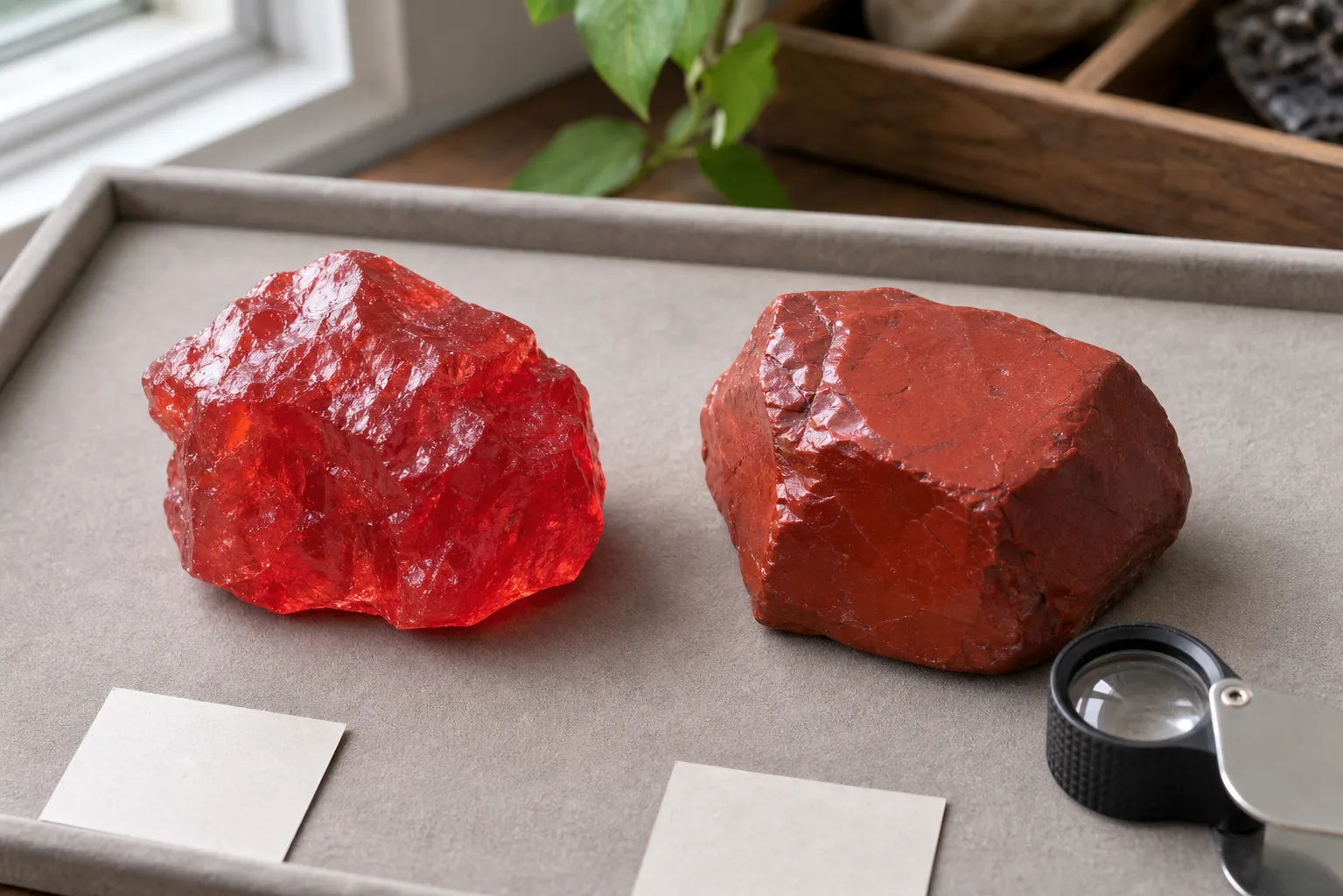
A red stone in a shop tray can look simple until the label says either cinnabar or red jasper. The practical answer for cinnabar vs red jasper starts with material: cinnabar is mercury sulfide, while red jasper is a silica-based jasper commonly placed in the quartz/chalcedony family.
That difference matters. Cinnabar may show a brighter scarlet or vermilion-red look, mineral-style luster, and reference clues such as streak and softness. Red jasper is usually more opaque, earthy, compact, and stone-like. These signs can point you in a direction, but they do not prove identity from appearance alone. If the answer affects wearing, cleaning, storage, or frequent handling, specialized mineral testing may be needed.
upward
Read the full overview first
Use the broader guide first if you need the full scope before this page.
The Fast Separation: Red Color Is Not the Same as Red Material
The easiest mistake is treating “red stone” as a mineral name. Cinnabar and red jasper can overlap in color, especially in photos, polished pieces, beads, or loosely written listings. They are not the same material.
Cinnabar is identified in mineral references as mercury sulfide. That is why a possible cinnabar piece deserves a different handling habit from an ordinary polished red stone. Do not scratch, sand, scrape, powder, or place an uncertain red mineral near the mouth to “test” it. Avoid making dust, and wash your hands after handling an unknown specimen.
Red jasper is commonly described as jasper, a silica-based material related to quartz and chalcedony. For everyday red jasper identification, buyers usually look for an opaque, compact, stone-like appearance. Red jasper may be brick red, brownish red, deep red, or patterned with darker inclusions.
The first split is simple: cinnabar is not just another red jasper, and red jasper is not cinnabar mercury sulfide.
Visual Clues for Cinnabar vs Red Jasper
Start with non-damaging observations. A comparison should not begin with scraping an unknown red piece.
Clue
Cinnabar may suggest
Red jasper may suggest
Material family
Mercury sulfide
Jasper in a quartz/chalcedony context
Color impression
Bright red, scarlet, vermilion-like, sometimes intense
Brick red, brownish red, earthy red, deep opaque red
Surface impression
May show mineral luster, depending on form and finish
Usually opaque, compact, and stone-like
Streak clue
A reference clue for cinnabar, but it can create powder
Less useful for casual buyer checks
Hardness impression
Comparatively softer in mineral references
Harder, as expected from silica-based jasper
Handling concern
Avoid dust, abrasion, powdering, and mouth contact
Normal stone handling is less concerning, though identity can still be uncertain
Cinnabar luster and streak are useful in mineral descriptions, but they are not a reason to rub an unknown red specimen hard against a plate. Streak tests create powder. If cinnabar is possible, skip abrasive home checks and use safer verification.
Red jasper hardness can be a helpful background clue because jasper is much tougher than cinnabar. A red jasper bead, cabochon, or palm stone often feels like a durable opaque stone. Still, destructive hardness tests can damage a finished piece and are a poor choice when cinnabar has not been ruled out.
Visible clues help. They do not settle the case by themselves.
What to Check Before You Trust the Label
Seller wording can tell you what is being claimed, but it should not carry the whole identification. A label such as “cinnabar,” “red jasper,” “vermilion stone,” or “red mineral” may be accurate, simplified, mistaken, or based mainly on appearance.
Use these safer buyer checks first:
- Look for the exact material name, not only a color description.
- Notice whether the listing says cinnabar, red jasper, jasper, chalcedony, or mercury sulfide.
- Treat phrases such as “red protective stone” as meaning language, not mineral identification.
- Avoid pieces where the seller suggests scraping, powder use, ingestion, or mouth contact.
- Ask whether the identification is based on a known source, a test, or only visual sorting.
- If the answer stays vague, handle the piece as uncertain.
Cinnabar look-alikes can include other red minerals, dyed materials, composites, and polished red stones. Red jasper can also be dyed, imitated, or loosely labeled in some selling contexts. The stronger evidence here supports the mineral-family distinction and the cinnabar handling boundary; it does not turn every marketplace label into a verified fact.
Polishing adds another limit. A glossy red object may hide texture, coating, dye, filling, or carving material. That does not automatically make the piece false. It means the label and the visible clues need to be read together.
If the label and the object disagree, keep the identification open.
Handling a Possible Cinnabar Piece While You Decide
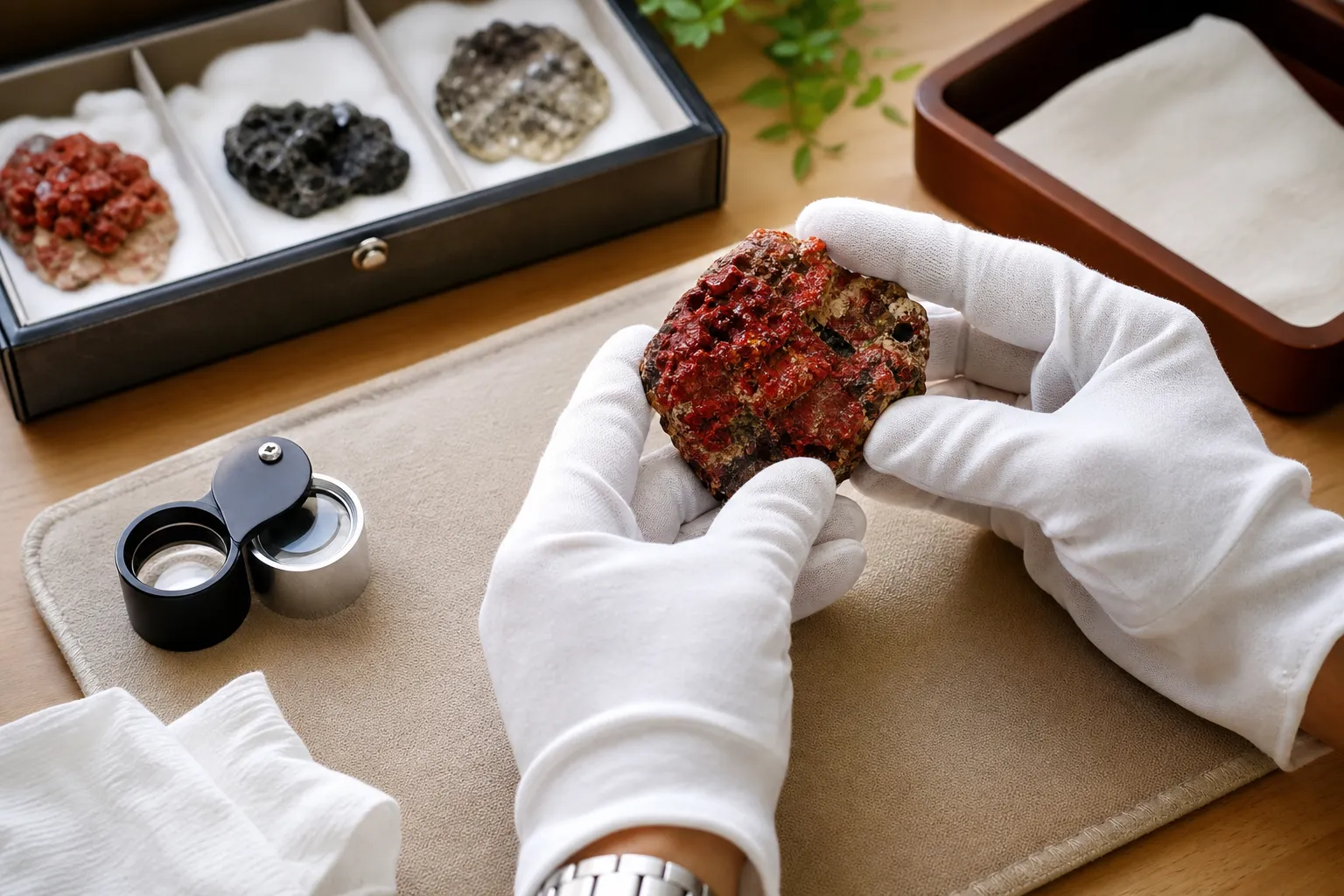
The handling difference is the part of this comparison to take seriously. Red jasper is generally approached like a hard opaque stone. Cinnabar should be approached as a mercury sulfide mineral, especially when it is rough, powdery, damaged, drilled, or uncertain.
For a possible cinnabar specimen:
- Do not sand, grind, scrape, drill, or polish it at home.
- Do not perform a streak test if it creates loose powder.
- Do not clean it with aggressive abrasion.
- Do not put it in water bottles, bath routines, or near the mouth.
- Keep loose, powdery, or uncertain pieces away from children and pets.
- Store it separately if chips or dust could move onto other stones.
For red jasper, the question is usually different: does the piece fit an opaque, compact, silica-based stone? It may still be mislabeled or dyed, but the cinnabar dust concern is not the same.
If you are not sure whether a red specimen is cinnabar, do not abrade it to find out.
When the Clues Point in Opposite Directions
Some pieces will not sort neatly. A specimen may be very red but too polished to read. A listing may call a piece cinnabar while the object looks like jasper. Another may call a bead red jasper while the color, weight, or seller wording raises questions.
Pause when you see these patterns:
- A very bright red mineral specimen with uncertain labeling deserves cinnabar-level care until clarified.
- A hard, opaque, earthy red stone sold as jasper may fit red jasper better, but a photo still cannot prove it.
- A carved or lacquer-like red object may involve finishes or materials outside a simple mineral comparison.
- A damaged red piece that sheds powder should not be handled casually.
- A seller who uses color words but avoids material names is giving limited identification value.
This is where specialized mineral testing becomes the more honest next step. That may mean asking a qualified mineral dealer, using a reputable mineral lab, or relying on documentation that explains how the material was identified. For many buyers, the practical choice may be simpler: avoid uncertain cinnabar-like items if you plan to wear them, handle them often, or keep them around children or pets.
The goal is not to turn a buyer into a lab. It is to avoid treating uncertainty as certainty.
Common Confusion: Meaning, Color, and Identification
Cinnabar and red jasper both appear in crystal-use settings, including personal or cultural language around protective crystals. That context can explain why people compare them, but it does not identify the mineral. A meaning category is not a material test.
A red jasper piece may be chosen for its look, weight, opacity, or personal symbolism. A cinnabar specimen may be collected for its red color and mineral interest, but it carries a different handling boundary. If a listing leans heavily on symbolic or decorative wording while staying vague about the material, treat that as incomplete information.
Color words also cause confusion. “Cinnabar red” can describe a shade, a pigment-like look, or a decorative finish; it does not always mean the object is the mineral cinnabar. “Red jasper” is a familiar crystal-shop category, but it still deserves normal buyer caution if the piece looks dyed, unusually uniform, or poorly documented.
Meaning belongs in personal context. Identification belongs to material clues.
A Compact Buyer Checklist
Use this checklist when comparing red jasper vs cinnabar in a shop, collection, or listing:
- Read the material claim. Does it say cinnabar, mercury sulfide, jasper, chalcedony, or only “red stone”?
- Separate color from identity. Red is a clue, not a conclusion.
- Look at the surface. Cinnabar may show mineral-specific luster; red jasper is usually opaque and stone-like.
- Consider hardness without damaging the piece. Red jasper hardness fits a silica-based stone, but destructive tests are not good buyer habits.
- Avoid powder-producing checks. This matters most when cinnabar is possible.
- Treat uncertainty carefully. If it might be cinnabar, use cinnabar handling precautions.
- Escalate when needed. For certainty, specialized mineral testing may be needed.
A useful comparison narrows the likely identity, protects the piece, and keeps handling choices sensible.
Bottom Line
Cinnabar and red jasper separate most clearly by material family: cinnabar is mercury sulfide, while red jasper is a silica-based jasper in the quartz/chalcedony context. Color tone, luster, texture, hardness impression, and seller wording can guide a buyer, but they cannot prove identity from appearance alone.
If the red stone looks like ordinary opaque jasper and the label is specific, red jasper may be the more likely direction. If the piece is bright red, mineral-like, powdery, poorly labeled, or sold as cinnabar, handle it with more caution and avoid abrasion. When the answer matters for wearing, cleaning, storage, or frequent handling, do not rely on color alone.
Check what you can see, leave room for uncertainty, and treat possible cinnabar more carefully than an ordinary red jasper stone.
Sources
Sources and further reading
Reference links are limited to sources considered suitable for public citation in this page.