
ProtectCrystal handling note
Color clue, not final proof
How to Identify Cinnabar by Color Without Overtrusting Bright Red
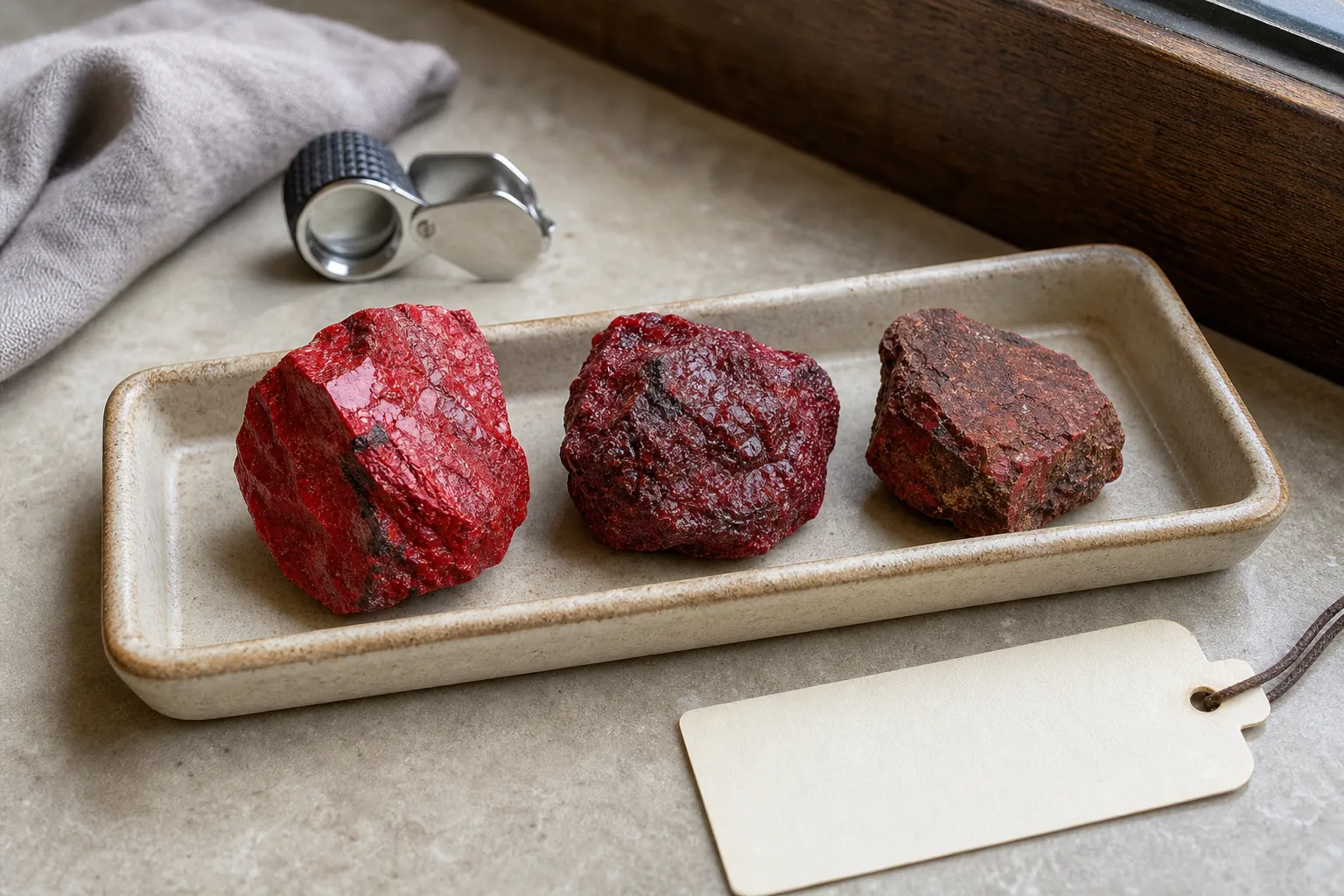
Color can help with cinnabar color identification, but only as a cautious visual clue. A red, dark red, or red-brown surface may fit what buyers expect from cinnabar, while a piece with no reddish character at all may deserve extra questions. Still, color alone cannot confirm the material, its composition, or how it should be handled.
Bright red is the easy trap. It matches the familiar idea of “cinnabar red,” so it can feel more convincing than it really is. Use color to decide whether a piece deserves closer checking, not to make the final call. For certainty, specialized testing may be needed.
upward
Read the full overview first
Use the broader guide first if you need the full scope before this page.
What Color Can Actually Tell You
When a seller describes an item as cinnabar, the first color question is simple: does the piece show a red, red-orange, dark red, or red-brown visual character? If not, that mismatch is worth noticing. If it does, the piece may stay in the “possible” category.
That is the useful part of color. It can help you compare the object, the listing photos, and the seller’s wording. It can also help you slow down before buying something only because the name sounds familiar.
The limit is just as important: a red surface is not a material test. It does not tell you whether the color is natural, altered by finish or lighting, attached to another material, or accurately described by the seller.
Strong red surface
May fit the common expectation of cinnabar red color.
Cannot settle material identity or handling status.
Dark red or red-brown tone
May still be visually plausible.
Cannot show that the piece is definitely cinnabar.
Uneven red in photos
May reflect lighting, polish, matrix, surface change, or natural variation.
Cannot settle the exact cause of the color.
Perfectly vivid red in every image
May be visually appealing.
Cannot show that the color is natural or diagnostic.
The grounded version is simple: color is one clue, not confirmation.
Why Bright Red Is Not Proof
Bright red looks decisive. It photographs well, catches the eye, and matches the phrase many buyers already have in mind: cinnabar is red, so the reddest piece must be the most convincing one.
That shortcut skips the real question: what is the object made of? Visual identification depends on more than hue. Luster, texture, surface finish, weight impression, matrix, wear, object type, and seller language all affect how a piece reads to a buyer. Even together, those observations remain limited.
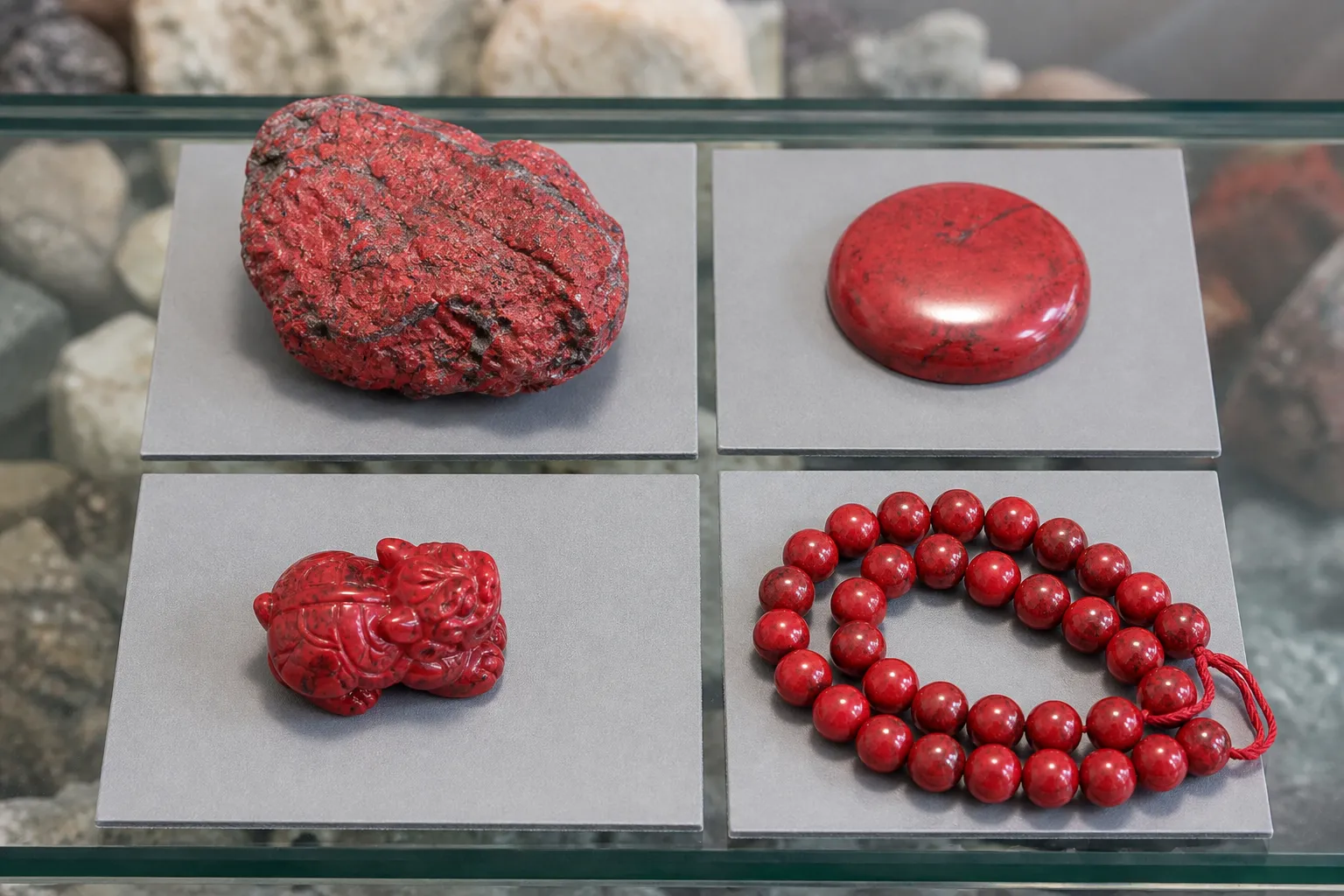
A rough specimen, polished bead, carved charm, glossy decorative piece, or powdery-looking surface may show red in very different ways. Lighting can intensify the color. Camera settings can push saturation. Polish or moisture can make a surface look richer than it does when dry or unworked. A listing photo can make red look more even or dramatic than it appears in person.
The opposite mistake also happens. Dark red cinnabar should not be dismissed only because it is not scarlet or neon-looking. A darker tone may still be visually plausible, but it needs the same restraint: it can suggest, not confirm.
If the whole argument for a piece is “it is very red,” the argument is too thin.
A Careful Color Check Before Buying or Handling
A color check is not a lab method. It is a way to decide whether to pause, ask better questions, or keep your confidence low.
Start with the color family
Is the piece red, red-orange, dark red, red-brown, or something else? Look at the whole object when possible, not just the brightest patch in one photo.
Notice evenness and variation
A completely uniform red surface may look appealing, but uniformity does not verify the label. Uneven red areas can also be hard to interpret without more context.
Compare the object type
A rough mineral specimen, polished cabochon, carved object, and bead strand should not be judged by the same visual expectation.
Read the seller language
Phrases built around “bright red,” “traditional red,” “powerful red,” or similar appeal may describe the look or the marketing angle, but they do not verify the material.
From a buyer’s position, the honest answer is often “this needs closer checking,” not “this settles it.” The more processed the object appears, the less useful color becomes on its own, because carving, polishing, coating, or display choices can change how the surface looks. If the description gives no useful detail beyond color, keep your confidence low.
A practical buyer check
- Treat red as a starting signal, not a conclusion.
- Compare more than one photo when available.
- Watch for lighting that makes every surface look unusually vivid.
- Be cautious when the description depends only on color language.
- Avoid turning either bright red or dark red into a material claim.
- Seek more reliable verification when the material identity matters.
This does not make you an expert. It simply prevents the most common overreach: seeing red and calling the question settled.
Where Color-Based Identification Breaks Down
Cinnabar visual identification breaks down when the question changes from “does this look possibly consistent?” to “is this definitely cinnabar?” Color cannot carry that second question.
It also becomes weaker when the piece has been heavily shaped, polished, photographed under strong lighting, or sold with vague wording. The more the surface has been prepared for appearance, the more careful you should be about reading color as mineral evidence. A glossy red object may be beautiful or meaningful to its owner, but appearance does not verify material identity.
Color also cannot answer handling questions. A red object sold as cinnabar should not be treated as low-concern just because it looks familiar, smooth, sealed, or decorative. Without stronger information, appearance cannot settle composition or safety-sensitive decisions. Be especially cautious with items that may be worn against skin, handled often, cleaned aggressively, scraped, heated, or given to children.
That is the practical boundary for this page: color may guide suspicion, but it cannot confirm the piece. When the decision depends on what the material actually is, visual checking is not enough.
How to Use the Color Clue Without Overclaiming
Keep three statements separate:
- “This piece is red.” That is an observation.
- “This red color may be consistent with cinnabar as commonly expected.” That is a cautious interpretation.
- “This is cinnabar.” That is a material claim, and color alone should not carry it.
This makes the buying decision calmer. You can like the appearance without overstating what it shows. You can ask a seller for more detail without turning the conversation into an accusation. You can skip a listing when the whole case depends on a dramatic red photo. You can also keep a piece in a “not yet verified” category instead of forcing a yes-or-no answer from color.
If you already own a red piece labeled cinnabar, do not scrape, grind, heat, or aggressively clean it to test the color. Those actions can create new concerns and still may not give a reliable answer. A more conservative next step is to document what you can see, keep the item separate if you are unsure how it should be handled, and look for more reliable identification help if the material matters.
For shopping, the better question is not “Is it bright red enough?” It is: “What else supports the label besides the color?” If the answer is unclear, keep your confidence low.
Quick Answers About Cinnabar Color
Can you identify cinnabar by color alone?
No. Color can suggest that a piece belongs in the possible visual range a buyer associates with cinnabar, but it cannot confirm cinnabar by itself. Specialized testing may be needed when certainty matters.
Is bright red cinnabar more reliable than dark red cinnabar?
Not by color alone. Bright red can look convincing, but vivid color is not proof. Dark red may also be visually plausible, yet it still does not confirm the material.
What should I do if a seller only mentions the red color?
Treat that as incomplete information. Color-focused wording may describe appearance or marketing appeal, but it should not be treated as verification of composition, material identity, or handling status.