ProtectCrystal handling note
Identification guide
Cinnabar Identification Clues and Common Look-Alikes
A buyer usually looks up cinnabar identification after seeing a red stone, bead, carving, or rough specimen labeled “cinnabar” and wondering whether the name is being used precisely. The hard part is that a red surface can suggest possibilities, but it cannot confirm mineral identity, treatment history, or handling suitability by itself.
The current source packet for this page does not include public, citable mineral references, safety sources, verified marketplace examples, or firsthand reviews. So this guide stays in a narrow, practical lane: it helps you separate what you can observe from what a seller is claiming, notice where look-alikes and trade names create confusion, and decide when a more qualified review or specialized testing is needed.
upward
Start with the broader guide
Use the broader guide first if you need the full scope before this page.
What Appearance Can Tell You — and What It Cannot
Cinnabar identification often begins with color because red is the first thing buyers notice. Someone sees a red object and wants to know whether it is cinnabar mineral, dyed stone, a carved imitation, a decorative material, or another red mineral entirely.
Color is useful as a first sorting clue. It is not a final answer.
For this page, the available research does not support a firm checklist of cinnabar’s diagnostic color range, luster, streak, density, crystal form, or texture. A careful buyer should treat visual clues as sorting signals rather than confirmation.
Surface color
May help you ask whether the item broadly matches the seller’s description, but it cannot confirm exact mineral identity.
Polish or finish
May help you ask whether the object has been shaped, coated, sealed, or altered, but it cannot confirm whether the material is natural or untreated.
Seller wording
May show how the object is being marketed, but it cannot confirm whether the label is mineralogically precise.
Bead or carving form
May suggest the item is decorative rather than a raw specimen, but it cannot confirm that it is made from cinnabar mineral.
Price, origin, or trade name
May tell you that more questions are needed, but it cannot confirm composition, handling suitability, or reliable identification.
The more the answer matters, the less you should rely on appearance alone. If your question is, “Does this red object visually match what the seller calls cinnabar?” a cautious visual review may help you decide whether to keep researching. If your question is, “Is this definitely cinnabar mineral?” or “Is this suitable for close wear or frequent handling?” appearance is not enough.
What Does Cinnabar Look Like in Hand?
Many searchers want a direct answer: what does cinnabar look like when you hold it? A responsible answer has to start with the limit. This page’s research packet does not provide source-backed physical descriptors that can be turned into a reliable buyer checklist. Without those sources, it would be misleading to say that cinnabar must show one exact shade, surface feel, weight impression, streak behavior, or polish response.
You can still examine an item in a structured way.
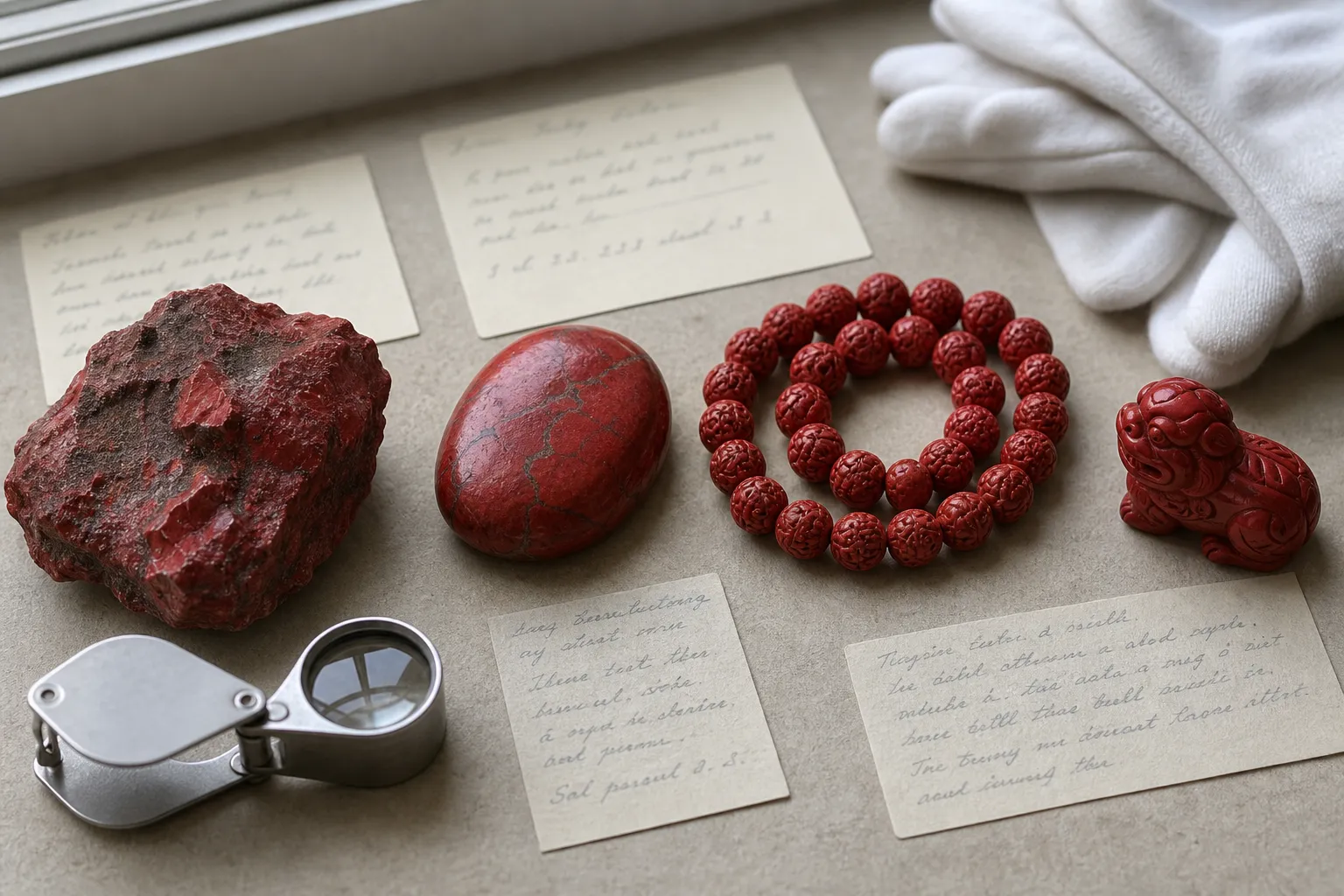
Look at it under steady, neutral light rather than relying only on edited seller photos. Notice whether the red appearance is even or varied, whether the surface looks natural, polished, coated, carved, painted, or sealed, and whether the color appears throughout visible chips and edges or mainly on exposed surfaces.
Those observations are useful because they sharpen your questions. They do not settle the label.
“The piece is sold as cinnabar, but from the photo I can only see a red polished object. I would need stronger provenance, testing, or a qualified mineral review before treating the label as certain.”
That is not overly cautious. It is the correct level of confidence when the available evidence is thin.
How to Use Color Without Overtrusting Bright Red
Bright red is one reason cinnabar attracts attention in crystal and mineral listings. It is also one reason cinnabar look-alikes become confusing. The name may appear near red beads, red carvings, pigment-colored objects, decorative pieces, or trade descriptions that are not clear about material identity.
Because the current source packet does not support a firm color range, this page cannot say that a specific red, brown, gray, dull, orange, or mixed appearance confirms or rules out cinnabar. That includes common buyer questions such as:
- Can cinnabar look brown, gray, or dull instead of bright red?
- Does a red streak settle the identification?
- Is a vivid red bead more likely to be cinnabar than a muted specimen?
- Does a polished red surface mean the material is natural?
Color can raise a question. It should not close the case.
If a seller relies only on phrases such as “deep red,” “vermilion,” “Chinese cinnabar,” or similar color-forward wording, ask what the item is claimed to be materially. Is it a mineral specimen, a carved decorative object, a lacquered item, a dyed stone, a composite, a bead made from another material, or something else?
If the seller cannot separate color language from material identity, keep the conclusion open.
Raw Cinnabar Identification Clues Buyers Can Check Carefully
Raw cinnabar identification is different from evaluating a polished bead or carving because a rough specimen may show more natural surface variation. Even then, visible inspection remains limited.
For a raw piece, document what is visible without turning the notes into a verdict:
- Overall color zones, including whether the red appearance is patchy or uniform
- Surface condition, including whether it looks freshly broken, weathered, coated, or dusty
- Matrix or host material, if another material appears attached
- Obvious signs of artificial shaping, paint-like coating, or glued construction
- Seller-provided provenance, kept separate from what the object itself shows
None of these points confirms cinnabar. They help you decide whether the seller’s label deserves more confidence, more questions, or more skepticism.
Handling also matters, but not as an invitation to scratch, grind, heat, wash aggressively, or try improvised home checks. Cinnabar is safety-adjacent because buyers commonly associate it with mercury-bearing mineral discussions, and this page does not have the source support needed to give detailed handling procedures. The conservative buyer approach is to avoid destructive checks and avoid creating dust or residue while the material is uncertain.
If you are comparing two raw red specimens, the best next step is not to invent a certainty shortcut. Record clear photos, preserve seller information, and seek identification from someone qualified to evaluate minerals.
Polished Cinnabar Identification: What Changes After Cutting or Tumbling
Polished cinnabar identification has a different problem: the surface has already been changed. Cutting, tumbling, carving, sealing, coating, or bead-making can remove or hide clues a buyer might hope to use from a natural surface. A polished object can look cleaner, brighter, smoother, or more uniform than a rough specimen, and that presentation can make different materials look more similar in photos.
This does not mean polished items are automatically mislabeled. It means the identification path changes.
Instead of asking only “Does this look like cinnabar?” ask:
- What exactly does the seller say the polished object is made from?
- Is “cinnabar” being used as a mineral label, a color label, a carving style, or a decorative trade term?
- Does the listing distinguish natural mineral material from imitation, dyed, coated, or composite material?
- Are there photos of unpolished areas, drill holes, chips, backs, or edges?
- Is the seller willing to explain how the item was sourced or made?
Polishing can make a buyer overconfident because the object looks finished and intentional. A finished surface is still not a verified identity. If the piece is expensive, intended for close wear, or sold with strong material claims, the need for better evidence increases.
Cinnabar Beads: Mineral, Dyed Stone, or Imitation Material?
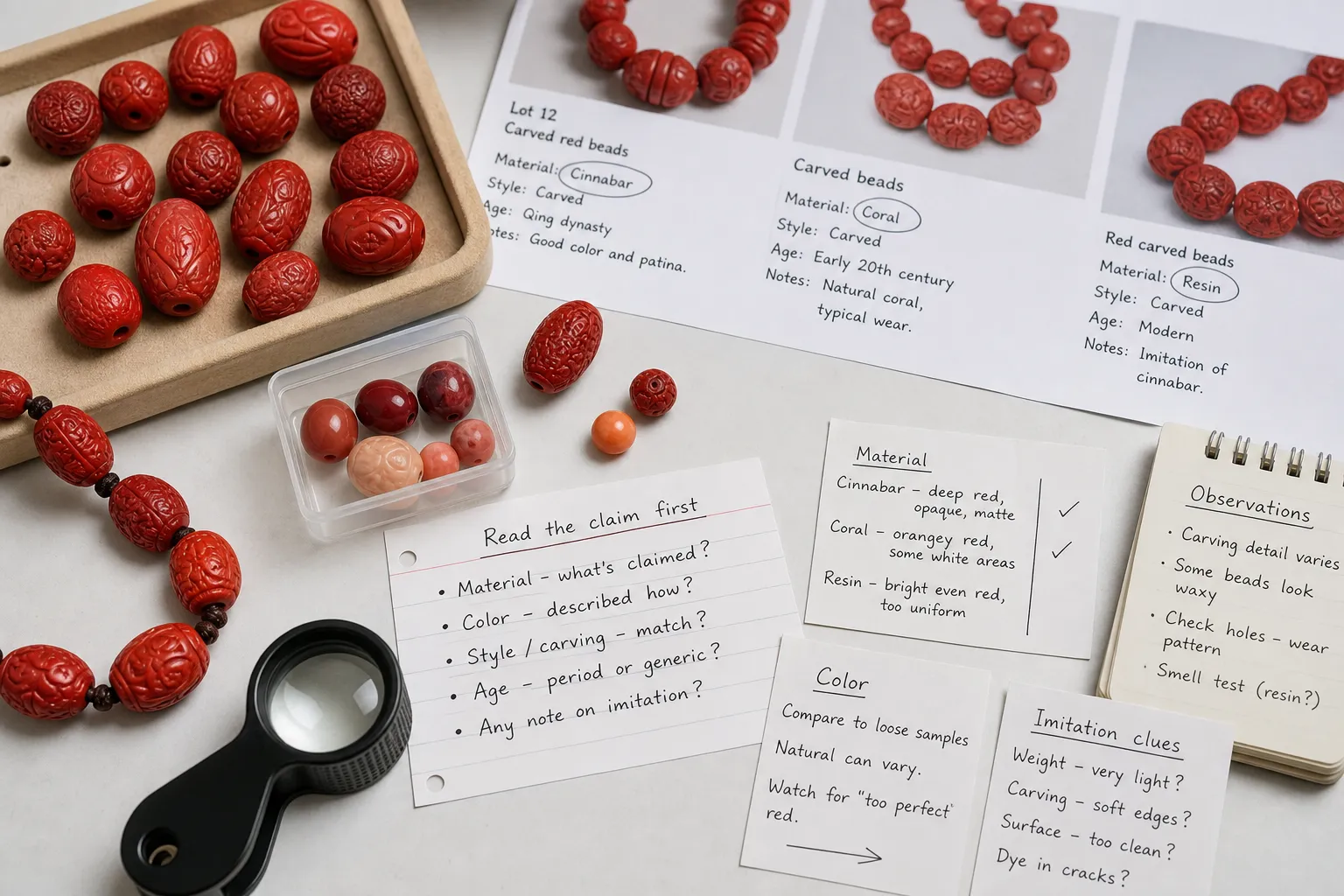
Cinnabar beads need extra care because the word “cinnabar” may be used in several ways. A bead listing might refer to mineral content, red color, carved style, older decorative tradition, or modern imitation. This page’s source packet does not include verified examples, so it cannot state which bead types dominate the market or how to identify them by sight.
Before asking whether a bead is “real,” ask what kind of reality is being claimed.
“Cinnabar beads”
Does this mean mineral cinnabar or a red decorative bead style?
“Chinese cinnabar”
Is this a cultural, decorative, lacquer, color, or mineral description?
“Natural cinnabar”
What evidence supports the material claim?
“Cinnabar color”
Is this only a color description?
“Vintage cinnabar”
Is the age claim separate from the material claim?
The phrase “Chinese cinnabar” deserves special care. In buyer language, it may point to cultural or decorative associations as well as mineral language. Chinese cinnabar meaning in a marketplace context is not the same as precise mineral identification.
For beads, drill holes, worn edges, chips, and surface consistency may raise useful questions, but they still do not confirm identity. If the bead will be worn against skin or handled often, uncertainty matters more. Look for stronger documentation or choose a material with clearer handling information.
Cinnabar Look-Alikes and Why Red Names Get Mixed Together
Cinnabar look-alikes are not confusing only because materials resemble one another. They are confusing because sellers and buyers often mix material names, color names, cultural names, and decorative styles.
This page cannot provide a verified diagnostic comparison between cinnabar vs red jasper, cinnabar vs realgar, or cinnabar vs vermilion-colored imitations because no citable sources were retrieved to support those details. The useful boundary is simpler: these comparisons should not be settled by one red surface.
Cinnabar vs Red Jasper
The cinnabar vs red jasper question often appears when a red polished stone is being evaluated. A quick visual trait is not enough here. Start with the claim type. Is the seller presenting a mineral specimen, a bead strand, a carved object, or a color-based crystal listing?
If the listing does not explain why the item is cinnabar rather than another red stone, the label remains uncertain.
Cinnabar vs Realgar
Cinnabar vs realgar is a higher-caution comparison because both names may appear in discussions of red or orange minerals. Without reliable source support in the packet, this article should not give handling or identification rules for either mineral.
The practical takeaway: when a red or orange mineral name carries handling implications, do not use casual appearance checks as your final answer. Seek qualified identification before close handling, alteration, or jewelry use.
Cinnabar vs Vermilion-Colored Imitations
“Vermilion” can function as a color description, a pigment-related word, or a decorative cue in ordinary language. A vermilion-colored object is not automatically cinnabar mineral.
This is where buyers often get pulled off track. The word feels specific, so the object feels more certain than it is. Specific color language is still not material evidence.
Does a Red Streak or Mercury Claim Settle It?
Searchers often want one decisive clue: a red streak, a composition statement, or a mention of mercury. The problem is that decisive-sounding clues can be misused when repeated without context.
For this page, the research packet does not support instructions for streak testing, scratch testing, chemical testing, or any procedure that alters the object. It also does not provide a reliable basis for using mercury-related language as a buyer test. Do not perform or rely on improvised checks from an unsourced listing or casual comment.
A red streak claim may sound convincing, but a buyer still needs to know how the observation was made, by whom, under what conditions, and whether the method was appropriate for the object. If the answer is only “the seller says it streaks red,” that is weak evidence.
The same applies to composition language. If no reliable test result, source, or qualified identification is provided, a mercury-content statement remains a claim rather than confirmation.
A Practical Decision Frame for Cautious Crystal Buyers
A cautious buyer does not need to become a mineral lab. The goal is to avoid turning weak clues into certainty.
- Name the object type. Is it a raw specimen, polished stone, bead, carving, pigment-colored object, or decorative piece?
- Separate color from material. Red, vermilion, dark, dull, bright, or mottled appearance may describe the surface, not the identity.
- Read the seller’s wording literally. “Cinnabar style,” “cinnabar color,” and “cinnabar mineral” are different claims.
- Look for support beyond the label. Provenance, qualified identification, and clear material description matter more than dramatic wording.
- Avoid destructive checks. Do not scratch, grind, heat, or alter an uncertain material based on casual advice.
- Escalate when stakes rise. Jewelry, frequent handling, high price, resale, or safety-sensitive use calls for better evidence.
This frame does not promise that a buyer can identify cinnabar from photos. It helps you decide when the available clues are enough for casual curiosity and when they are not enough for purchase confidence.
When “Unconfirmed” Is the Most Accurate Answer
The most useful cinnabar identification answer is sometimes not yes or no. It may be “unconfirmed from the available information.”
- The item is shown only in edited seller photos.
- The listing relies on color words without material evidence.
- The object is a bead or carving where the term may describe style.
- The seller does not separate mineral identity from decorative language.
- The buyer wants certainty about composition or handling suitability.
- The available information would require specialized testing to confirm.
For crystal buyers, this can feel unsatisfying. But it is better than false precision. A red object can be attractive, meaningful to its owner, or useful as a decorative piece without being confirmed as cinnabar mineral. Personal or cultural associations may explain why someone likes the item, but they do not establish identity or handling suitability.
If you are deciding whether to buy, the grounded conclusion is this: appearance can help you form better questions, not final certainty. For cinnabar, that distinction matters. The label carries enough identification and handling weight that a careful buyer should ask for stronger support before treating a red stone, bead, or carving as confirmed cinnabar.