
ProtectCrystal handling note
Practical handling decision
Should Cinnabar Be Worn or Kept on Display
For most cinnabar pieces, display is the more cautious choice. If you are asking should cinnabar be worn or displayed, the practical answer is: keep it on display unless the item is intact, stable, polished or sealed, and you are treating wear as occasional, higher-contact use.
Raw, dusty, crumbly, cracked, powdery, old, unsealed, or uncertain cinnabar should not be worn against the skin.
The reason is material, not mystical. Cinnabar is commonly identified as mercury sulfide, also called mercuric sulfide. That does not mean every intact object creates the same exposure situation, but it does mean cinnabar deserves more caution than a typical polished quartz pendant or bead bracelet.
upward
Start with the broader guide
Use the broader guide first if you need the full scope before this page.
Display is the better default when the surface is uncertain
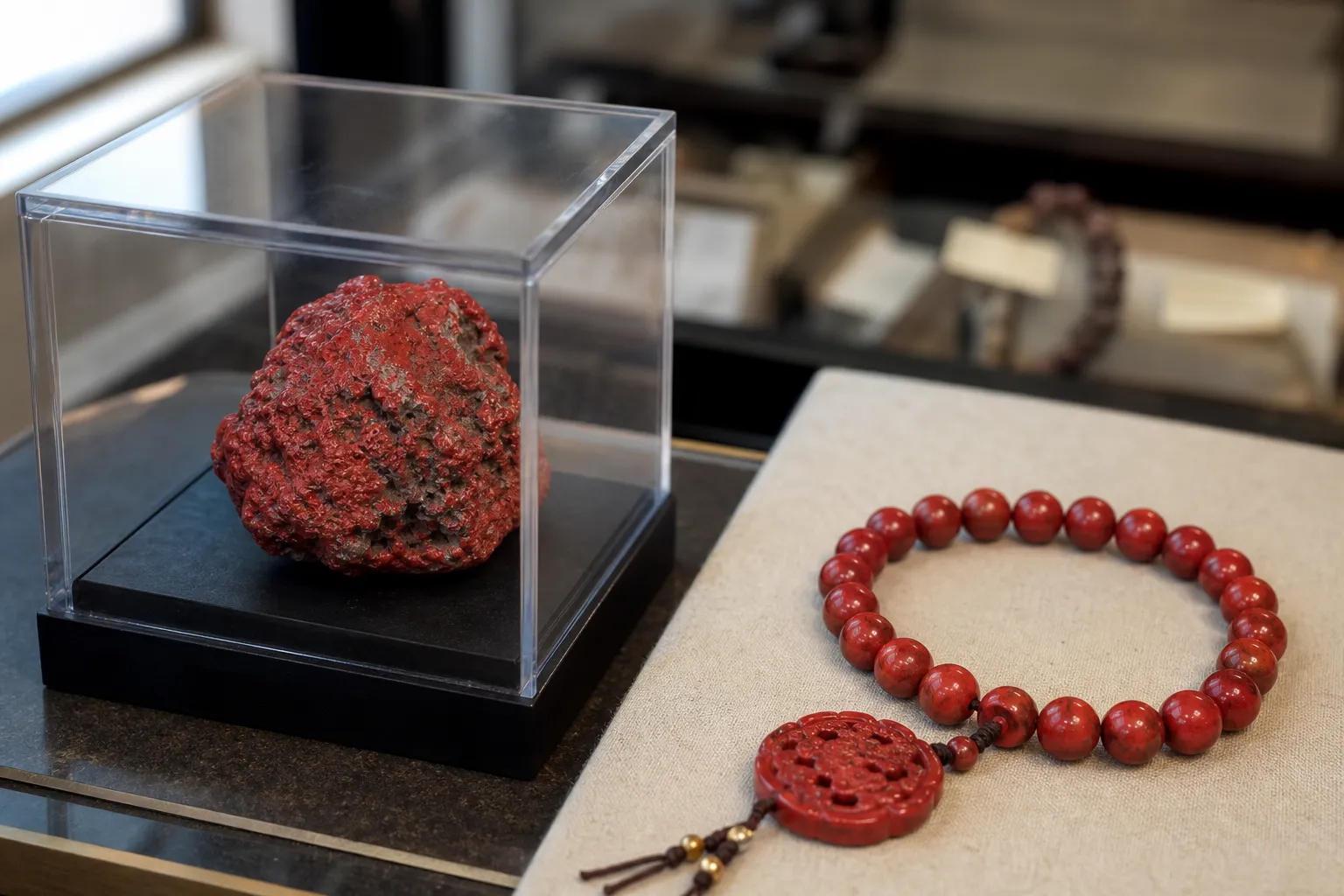
A cinnabar specimen kept on a shelf, in a closed display case, or inside a stable storage box usually involves less contact than a bracelet, pendant, ring, or bead strand. Less rubbing, less handling, and less chance of breakage are the main advantages.
Display is especially the better choice when you notice any of these signs:
- A raw mineral surface rather than a sealed or polished finish
- Red dust, powder, or residue on the item, bag, box, or fingers
- Crumbly edges, flaking, chips, cracks, or loose grains
- Old beads or carvings with worn-through coating
- A drilled bead that looks fractured around the hole
- Vague seller wording such as “red cinnabar style” or “natural cinnabar” without clear material details
- A piece that children, pets, guests, or curious visitors may touch
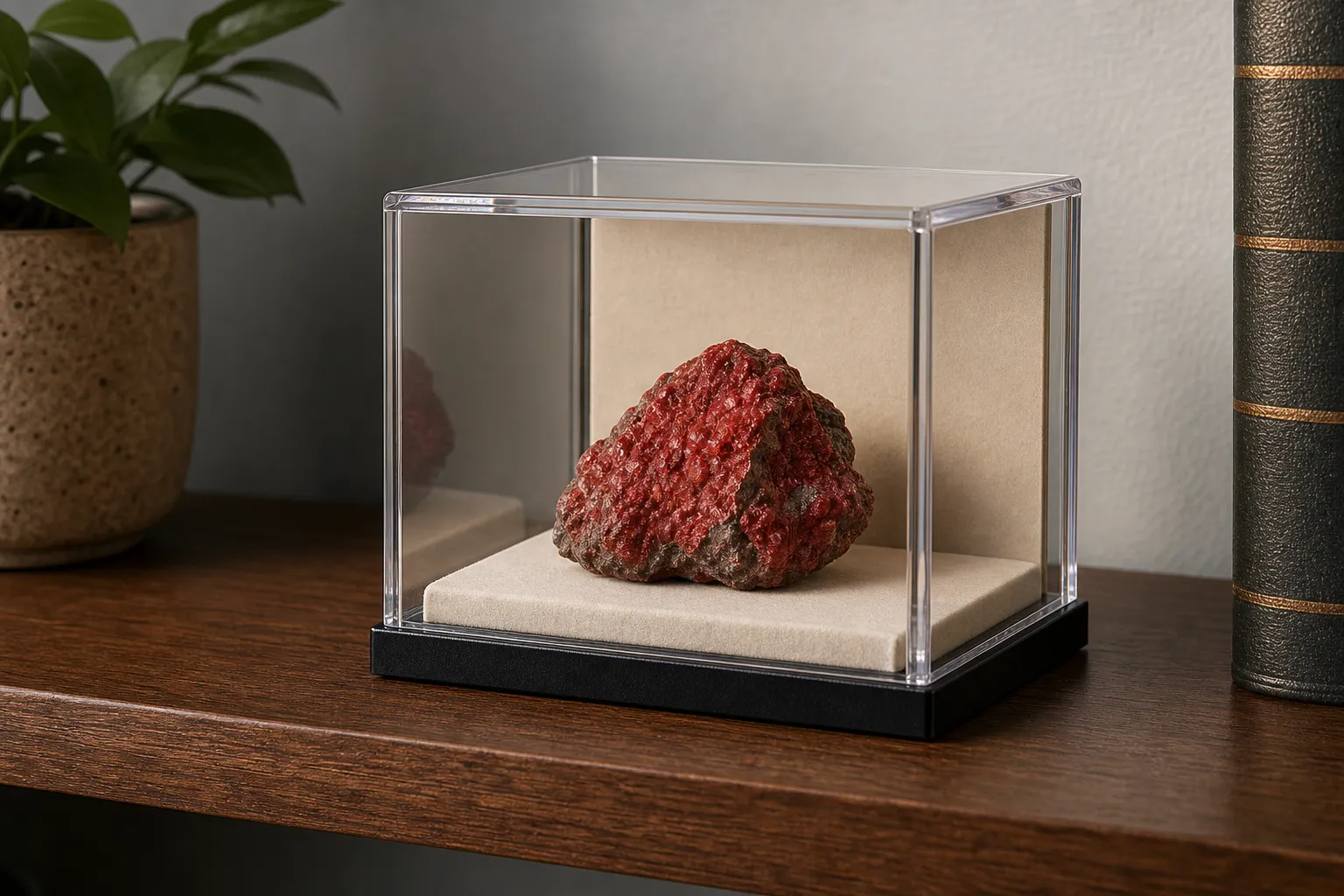
Cinnabar display safety is mostly about reducing contact and abrasion. Put the piece somewhere it will not be knocked over, scraped, mouthed, handled near food, or repeatedly picked up. A small enclosed display box is usually more sensible than a loose raw specimen sitting on a desk.
If the item already leaves color on your hands or wrapping, treat it as display-only and avoid casual handling. Do not brush, sand, drill, polish, or “clean up” powdery material at home.
Why cinnabar jewelry is a higher-contact choice
Cinnabar is used in jewelry and ornament making, especially in bracelets, carved beads, pendants, necklaces, and decorative pieces. In shops, though, the word “cinnabar” can mean different things: actual cinnabar-containing material, red lacquer-style carving, dyed or coated beads, resin, plastic, or simply a cinnabar-colored item. Appearance alone cannot settle that.
Jewelry changes the handling question because it adds:
- Skin contact for hours at a time
- Friction from movement
- Pressure from wrists, necklines, clasps, or elastic cord
- Contact with sweat, lotions, soap, water, and cleaning products
- Impact from doors, desks, bags, harder beads, metal charms, or other jewelry
This does not prove that every intact cinnabar jewelry item has the same concern. The stronger public references support cinnabar’s mineral and chemical identity, mercury-compound handling boundaries, and dust or powder precautions. They do not give a simple consumer rule that compares every modern cinnabar bracelet with every home display specimen. Because that specific gap remains, the more practical choice is to reduce contact rather than assume daily wear is fine.
If you still choose to wear a cinnabar item, keep the use narrow:
- Wear only an intact, stable, polished or sealed piece.
- Keep wear brief rather than all day, every day.
- Remove it before sleeping, bathing, swimming, exercising, cleaning, cooking, or rough activity.
- Do not wear it against broken or irritated skin.
- Keep it away from the mouth, eyes, nose, and open wounds.
- Do not let it rub against harder stones, metal edges, or abrasive surfaces.
- Wash your hands after handling it, especially if the surface is uncertain.
- Stop wearing it if you see chips, cracks, powder, residue, or surface breakdown.
A raw cinnabar specimen should not be turned into casual jewelry just because it looks attractive. Drilling, sanding, grinding, or reshaping cinnabar can create dust, which is exactly the kind of situation to avoid.
When display is the clear choice
Some situations make wearing the weaker option. This is not about judging a crystal practice; it is about contact, damage, and control.
| Situation | Better choice | Why it matters |
|---|---|---|
| Raw or crumbly specimen | Display | Loose particles and fragile edges increase handling concerns. |
| Powder or red residue appears | Display only, minimal handling | Dust and powder should not be inhaled, swallowed, or rubbed into skin. |
| Cracked bead or damaged pendant | Do not wear | Damage can worsen with movement and friction. |
| Children or pets may touch it | Enclosed display or stored away | Small objects and mineral surfaces can be mouthed, dropped, or scratched. |
| You want sleep wear | Do not wear | Sleeping adds long contact, pressure, sweat, and uncontrolled movement. |
| Exercise or daily bracelet wear | Avoid | Sweat, impact, and abrasion make the piece harder to control. |
| Unknown material or seller claim | Treat cautiously | Visual cues and marketing language do not prove composition or handling suitability. |
Cinnabar around children and pets deserves extra care. A display case placed out of reach is more sensible than an open bowl, a low shelf, or a dangling ornament. The concern is not that every displayed object is automatically a problem; it is that children and animals make contact unpredictable.
Pregnant people and anyone with specific health concerns should avoid casual wearing or handling of uncertain cinnabar pieces. For personal medical questions, ask an appropriate professional rather than relying on seller language or crystal-use advice.
How to display cinnabar at home
A good display setup is simple: stable, dry, low-touch, and away from food areas.
Use a small case, lidded box, specimen tray, or dedicated shelf where the piece will not be bumped. If the cinnabar is raw or delicate, avoid loose handling and do not place it where heat, humidity, sunlight, or repeated touching becomes part of the routine. A small label can also help keep other people from picking it up casually.
For cinnabar specimen handling
- Handle over a soft surface so a fall is less likely to chip it.
- Touch it as little as practical, especially if it is raw or unsealed.
- Do not blow dust off the surface.
- Do not use abrasive brushes, polishing cloths, ultrasonic cleaners, harsh chemicals, or soaking routines.
- If cleaning is needed, keep it minimal: clean around the display area rather than scrubbing the mineral itself.
- Wash your hands after handling.
Avoid placing cinnabar in kitchens, dining areas, bathrooms, children’s rooms, pet-accessible shelves, or anywhere it may be mistaken for a toy, bead, cosmetic pigment, or craft material.
If a piece becomes damaged, do not repair it by sanding, drilling, gluing loose powder, or reshaping it. Place it in a small bag or container, reduce handling, and consider asking a mineral conservator, local mineral club, or qualified hazardous-materials resource for next steps if there is visible powder or widespread breakage.
Seller claims and color clues have limits
Cinnabar seller claims can mix material words, cultural meanings, and jewelry marketing. You may see phrases such as “natural cinnabar,” “high purity,” “feng shui bracelet,” “auspicious ornament,” “left-hand wear,” or “right-hand wear.” Those phrases may describe belief-based use or sales positioning, but they do not prove safety, authenticity, or any promised result.
Color also has limits. Cinnabar is often associated with vivid red to dark red material, and “cinnabar” is also used as a color name. A red object can be called cinnabar-colored without being the mineral cinnabar. Some pieces may be dyed, coated, carved from other materials, made from resin, or sold in a traditional red style.
Visible cues may raise questions, but they cannot confirm the item:
- Very bright or uniform red may suggest dye, coating, or imitation, but does not prove it.
- A plastic-like feel may suggest a non-mineral material, but does not identify it.
- Weight, density, surface shine, and small reflective particles can be suggestive, not conclusive.
- A low price can be a reason to ask more questions, not a test result.
- Seller wording such as “real,” “natural,” or “high purity” is not the same as independent verification.
For certainty, specialized testing may be needed. For a wear-versus-display decision, though, you do not need perfect identification to act cautiously. If the piece is uncertain, damaged, powdery, or promoted with exaggerated claims, display it with minimal handling or avoid using it.
A practical decision rule
Keep cinnabar on display if you are unsure. Wear it only if the piece is stable, intact, polished or sealed, and you are comfortable limiting contact.
Do not wear raw, dusty, cracked, powdery, crumbly, or old unsealed cinnabar. Do not grind, sand, drill, scrape, or sleep in it. Keep it away from children, pets, food areas, the mouth, eyes, nose, and open wounds.
Cultural meanings can still matter to a collector or crystal user as personal symbolism. They just should not override the material handling question. With cinnabar, the grounded choice is usually simple: admire it with less contact rather than turning every beautiful red piece into daily jewelry.
Sources
Sources and further reading
Reference links are limited to sources considered suitable for public citation in this page.