
ProtectCrystal handling note
Handling note
Can You Wear Cinnabar Jewelry Safely
You can wear cinnabar jewelry cautiously, but only when the piece is intact, smooth, well-finished, and not shedding dust or powder. The answer is not a clean yes or no because “cinnabar jewelry” can mean true mineral cinnabar, cinnabar-colored resin, carved lacquer, dyed beads, or a style name in a seller listing.
The main concern with real cinnabar is not the red color itself. Cinnabar is commonly identified as mercury sulfide, so the practical question is exposure: Is the piece stable? Is it rubbing, chipping, flaking, or producing residue? Could it touch the mouth, broken skin, food, children, or pets?
A conservative everyday rule is simple: wear only stable pieces occasionally, keep them away from the mouth and children, avoid abrasion, and display questionable pieces instead of using them as daily jewelry.
upward
Read the full overview first
Use the broader guide first if you need the full scope before this page.
Intact cinnabar jewelry is different from damaged cinnabar jewelry
A smooth pendant worn over clothing is not the same as chipped cinnabar beads grinding against each other on a tight bracelet. Mineral and chemical references identify cinnabar as mercury sulfide, while toxicology discussions make a key point that matters for jewelry owners: form and exposure route matter.
For wear, that translates into one practical rule: avoid dust, powder, loose particles, and worn material.
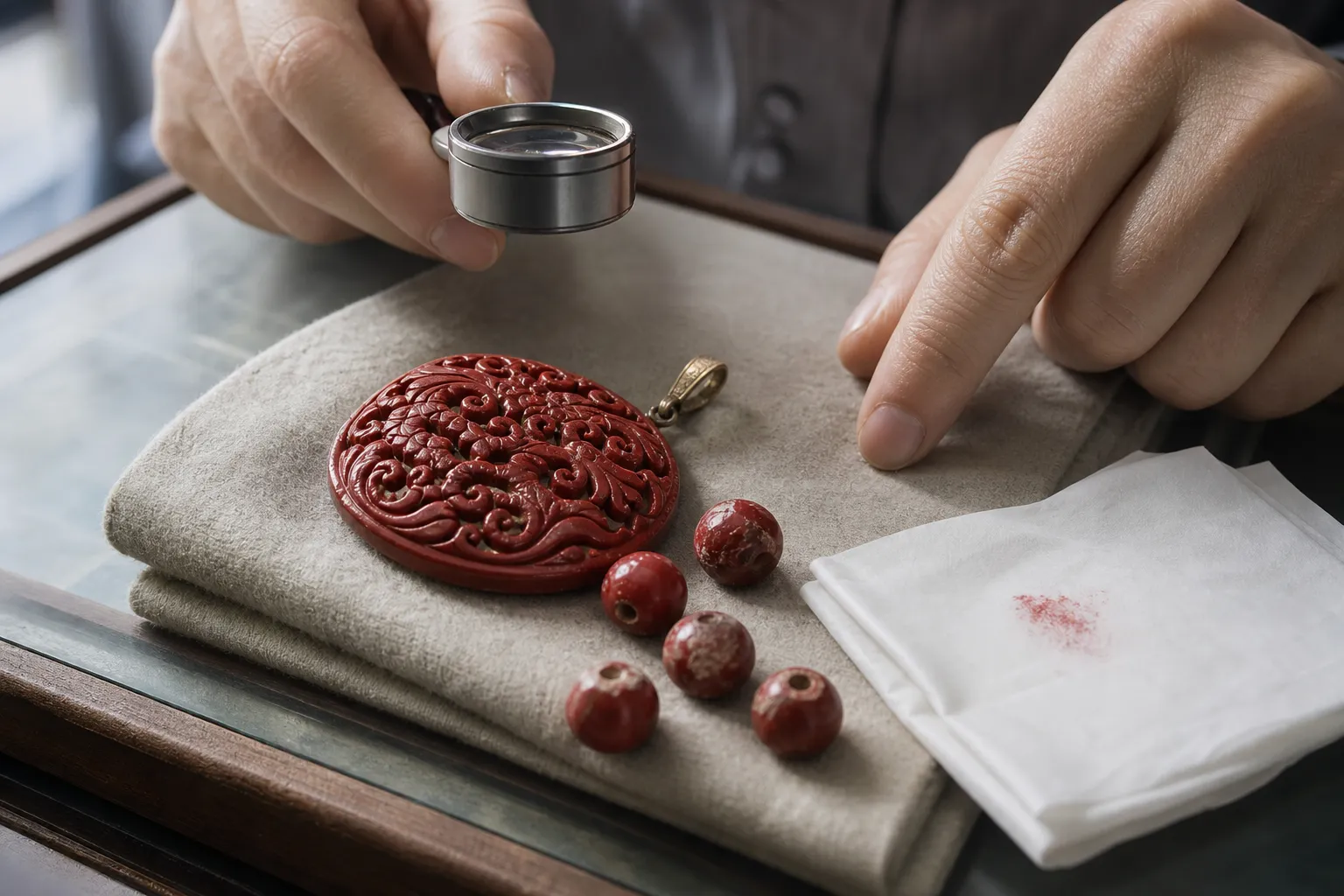
Before wearing a cinnabar bracelet, necklace, pendant, or bead strand, check for:
- a smooth, stable surface with no powdery feel;
- no chips, cracks, crumbling edges, or exposed rough areas;
- no red residue on skin, cloth, tissue, or storage material;
- bead holes that are not dusty, enlarged, or breaking down;
- no tight rubbing against metal spacers, sharp bead caps, or harder stones;
- no chance that the piece will be chewed, sucked, or handled by a child;
- seller wording clear enough to tell whether it is mineral cinnabar, lacquer, resin, dyed material, or something else.
If any of those points fail, do not wear it. A damaged cinnabar bracelet or chipped cinnabar beads are not just a cosmetic problem; they increase the chance of loose material moving onto skin, hands, clothing, bedding, or nearby surfaces.
This does not make every intact piece automatically harmless. It means condition changes the decision. The more rubbing, breakage, powder, heat, or uncertainty involved, the less suitable the piece is for wear.
What to avoid when wearing a cinnabar necklace, bracelet, or pendant
Most cinnabar jewelry safety advice comes down to avoiding the wrong routes of contact. Whether someone wears cinnabar as a collector piece, decorative strand, or personal amulet, the material-handling precautions stay the same.
Mouth contact
Do not chew, lick, suck on, kiss, or hold cinnabar jewelry in the mouth. This matters especially for pendants, prayer-style beads, loose beads, or bracelets that children may grab.
Dust and powder
Do not sand, drill, grind, crush, file, burn, or intentionally scrape cinnabar beads or pendants. Cinnabar dust exposure and cinnabar powder exposure are the scenarios to take most seriously in ordinary handling.
High-friction wear
Do not stack cinnabar tightly with harder stones, rough metal, sharp bead caps, or bracelets that knock against desks and counters all day. Friction can wear down softer or coated surfaces.
Sleeping and exercise
Remove cinnabar jewelry before sleeping, workouts, showering, bathing, swimming, cleaning, gardening, or rough work. These are practical ways to reduce pressure, moisture, impact, and abrasion.
Face, eye, nose, and wound contact
Keep cinnabar away from eyes, nose, lips, broken skin, and open cuts. If a piece seems dusty or has loose particles, handle it minimally and wash your hands afterward.
Food settings
Do not wear loose, unstable, or residue-shedding cinnabar jewelry while cooking, eating, or handling food.
For earrings, be extra selective. Earrings sit close to the face and may contact pierced skin. If the material is uncertain, powdery, poorly finished, or visibly worn, choose another red material instead.
Children, pets, pregnancy, and sensitive situations
Cinnabar jewelry around children and pets calls for a stricter answer: do not give cinnabar beads, bracelets, pendants, or loose pieces to children as wearable jewelry or play objects. Children are more likely to put jewelry in the mouth, chew beads, break pieces, or handle them without washing. Pets may mouth, crack, or swallow small objects.
A cinnabar bead strand on a bedside table can become a handling issue even if the adult owner never meant for anyone else to touch it.
For pregnancy, known mercury sensitivity, skin reactions, kidney-related concerns, or any personal health situation where individual risk matters, this page cannot give personal medical guidance. The cautious choice is to avoid uncertain cinnabar jewelry and ask a qualified professional if you have a specific concern. This is especially true for pieces sold as natural cinnabar, raw cinnabar, high-purity cinnabar, or old cinnabar beads with visible wear.
A useful rule: if the wearer cannot reliably avoid mouth contact, breakage, rough handling, or frequent touching, cinnabar is not a good wearable choice.
Seller wording can change what “cinnabar jewelry” means
People often ask “is cinnabar jewelry safe to wear” because the word cinnabar is used loosely in the market. It may refer to a mineral, a red pigment history, carved lacquer, resin beads, dyed material, or simply a bright red jewelry style. A listing that says “cinnabar bracelet” does not automatically tell you what the beads are made of.
Read common phrases carefully:
“Natural cinnabar”
May suggest mineral material, but it does not prove composition or handling suitability.
“Cinnabar-colored”
Usually points to color or style, not necessarily real mineral cinnabar.
“Cinnabar lacquer”
May refer to carved red lacquer traditions rather than mineral beads.
“High purity” or “carefully selected”
These are seller claims unless supported by meaningful testing.
“Protective crystal,” “lucky amulet,” or similar wording
Describes cultural, spiritual, or personal-use language, not material safety evidence.
Visible cues can help you decide whether to ask more questions, but they cannot verify safety. Red color, darker red tones, fine carving, heaviness, a slightly metallic look, or visible particles may suggest possibilities. They do not prove real cinnabar, purity, or lower exposure concern. For certainty, specialized testing may be needed.
If a seller cannot explain whether the piece is mineral cinnabar, resin, lacquer, dyed stone, or another material, treat the item as uncertain. For regular wear, uncertainty is a good reason to choose something else.
Cleaning cinnabar jewelry safely
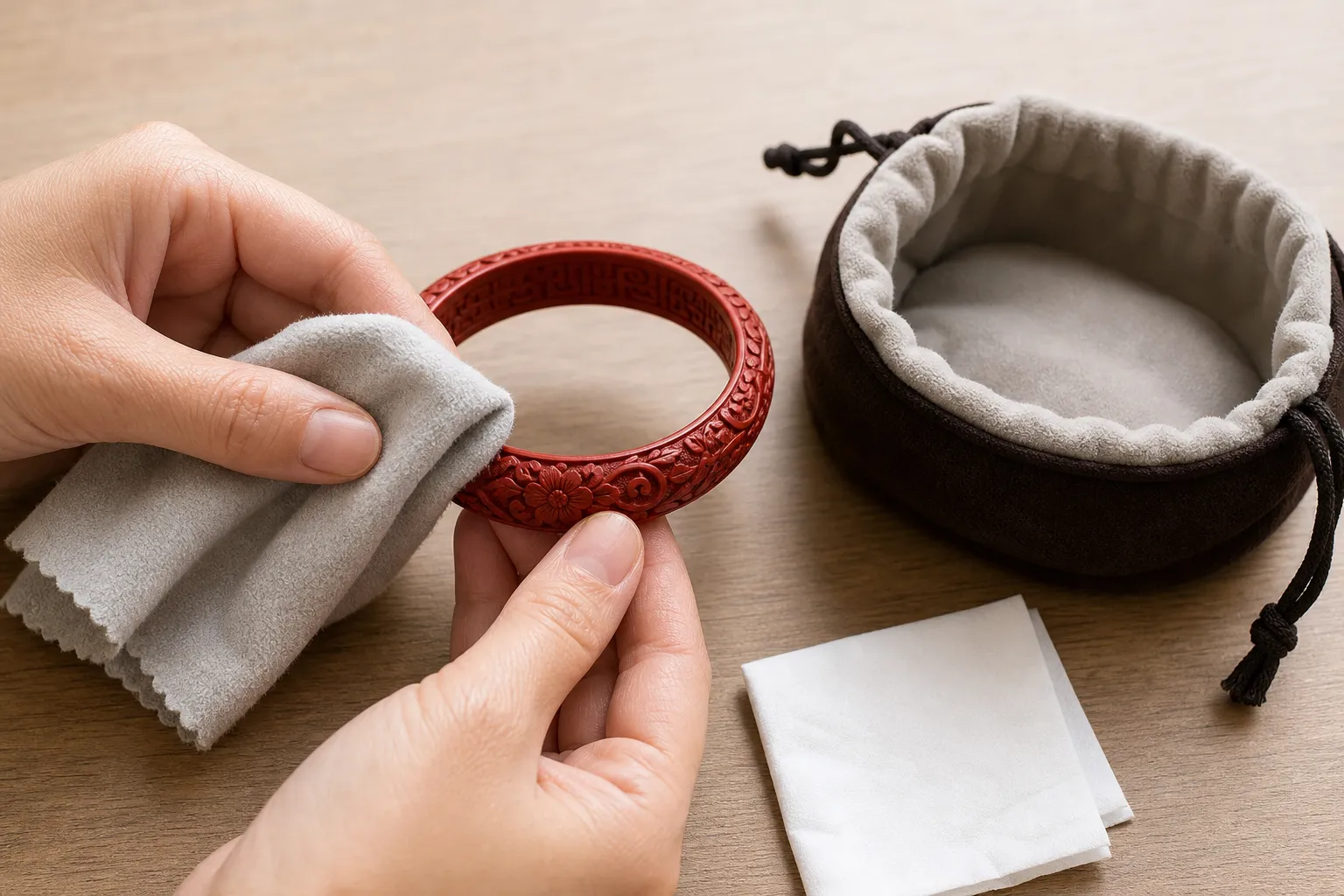
Cleaning cinnabar jewelry safely should be gentle and uneventful. Use a soft, dry cloth and minimal handling. Do not turn cleaning into polishing, scraping, soaking, or aggressive “cleansing.”
For an intact piece:
- Place the jewelry on a clean, washable or disposable surface.
- Wipe lightly with a soft dry cloth.
- Do not scrub carved grooves or rough areas.
- Check the cloth for red residue or powder.
- Wash your hands after handling, especially if the piece is old, worn, or uncertain.
- Store it separately so it does not rub against harder jewelry.
Avoid soaking, salt water, vinegar, acids, alkaline cleaners, alcohol, solvents, ultrasonic cleaners, steam, heat, perfume, cosmetics, polishing compounds, and abrasive cloths. Salt or water cleansing may appear in crystal or seller language, but they are not good default care methods for questionable cinnabar jewelry.
If grime is trapped in carved recesses and you cannot clean it without scrubbing, do not force it. A piece that needs abrasion to look clean is not a good candidate for frequent wear.
When to stop wearing cinnabar jewelry
Stop wearing a piece if you notice any change that could increase contact with loose material, including:
- red dust or residue on skin, cloth, bedding, or storage boxes;
- a bead chipped near the drill hole;
- cracks spreading through a pendant, bead, or bangle;
- flaking coating or rough exposed areas;
- a powdery feel after handling;
- irritation where the jewelry touches skin;
- uncertainty after a drop, impact, or repair.
Bead jewelry often wears around drill holes first. Even when the outside looks polished, the cord channel may be rough, and movement can create abrasion over time. If bead holes look crumbly, enlarged, or dusty, stop wearing the strand.
For a sentimental piece, the next step does not have to be dramatic. You can store it as a display object, place it in a secure container, or keep it away from frequent handling. The point is to stop using a questionable piece as close-contact jewelry.
How to store cinnabar jewelry
Storing cinnabar jewelry is mostly about preventing friction, breakage, and accidental access. Keep it separate from harder stones such as quartz, hematite, and metal-heavy bracelets that may scratch or abrade surfaces.
Good storage habits include:
- one piece per pouch or compartment;
- no loose storage with sharp metal findings;
- no humid bathroom storage;
- no sunny windowsill or heat source;
- no storage near food, cosmetics, or children’s items;
- clear labeling if other people may handle your collection.
If a piece is damaged, wrap it so loose particles do not spread, place it in a secure container, and avoid repeated inspection. Curiosity can turn into unnecessary handling.
Cultural meaning is not the same as material safety
Cinnabar appears in many cultural, historical, and marketplace descriptions. Some sellers and crystal writers associate it with protection, auspiciousness, calm, vitality, wealth, hand-wearing rules, zodiac language, or ritual placement. Those descriptions explain why people are drawn to the material, but they do not answer whether a cinnabar pendant or bracelet is suitable to wear.
For this question, the relevant details are physical: what the material is, whether the surface is stable, whether it sheds dust, how it is worn, who can access it, and whether the seller wording is clear. Personal symbolism may be meaningful to a wearer, but it should not override handling caution.
Bottom line
If you are asking “can you wear cinnabar jewelry,” the cautious answer is: only wear an intact, smooth, non-powdery, well-finished piece, and avoid rough daily use.
Do not wear damaged cinnabar jewelry, chipped cinnabar beads, flaking surfaces, or anything that leaves residue. Keep cinnabar away from the mouth, eyes, nose, wounds, children, pets, food, heat, and abrasive cleaning.
When the material identity is unclear, choose a non-cinnabar red alternative for regular wear. With cinnabar, a careful “maybe, under limited conditions” is more honest than a blanket yes.
Sources
Sources and further reading
Reference links are limited to sources considered suitable for public citation in this page.