ProtectCrystal handling note
Pocket carry comparison
Obsidian or Hematite for Everyday Carry: Which Holds Up Better
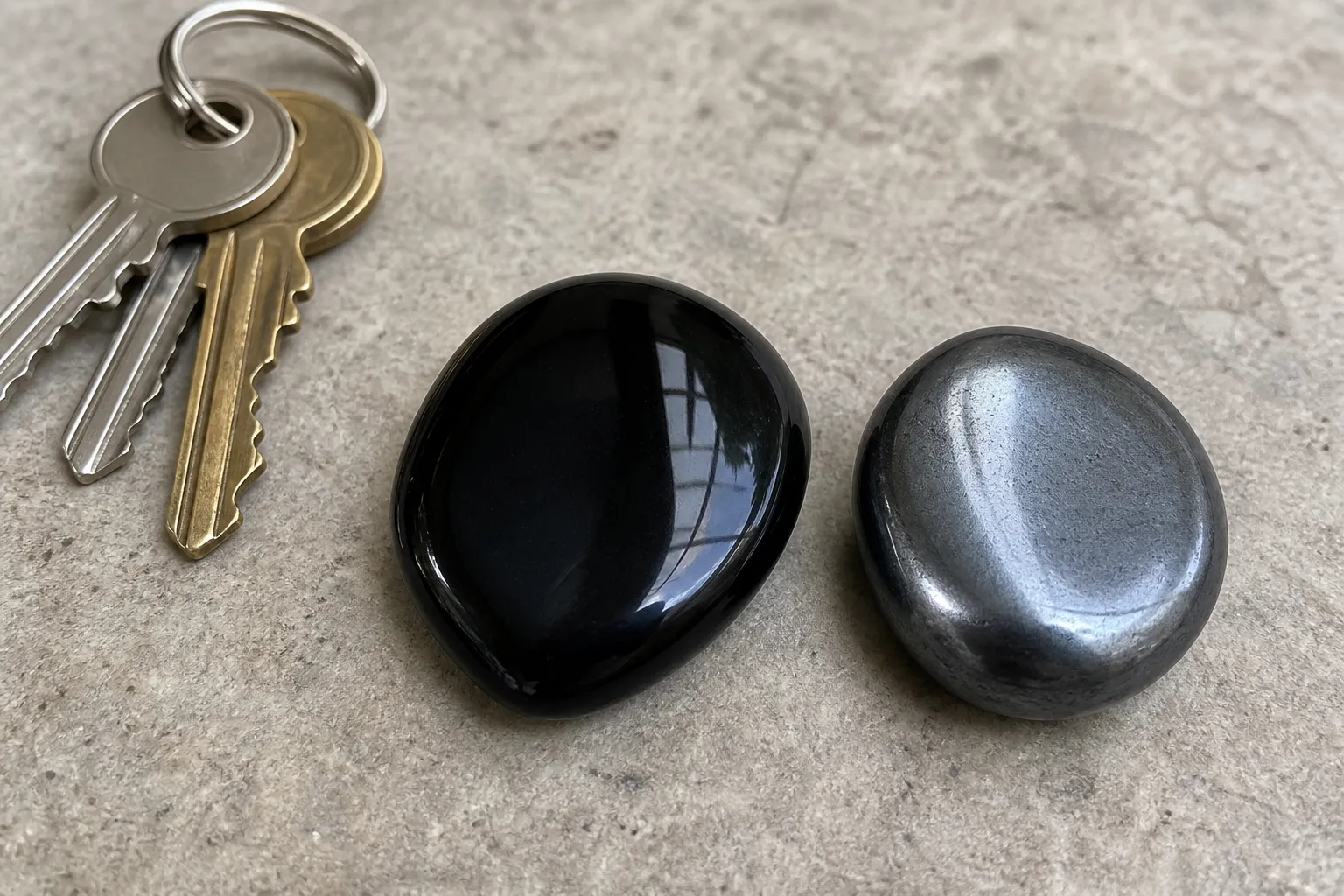
If you are choosing obsidian or hematite for everyday carry, hematite is usually the more forgiving pocket stone when it is a solid, polished piece. It feels dense, smooth, and less glass-like in daily handling. Obsidian can also be carried daily, but it needs more care because it is volcanic glass; chips can happen, and a chipped edge may feel sharp.
That does not mean hematite always wins. A rounded obsidian worry stone kept in a pouch may hold up better than a coated hematite bead carried loose with keys. The better question is not only “which stone is harder?” It is how the exact piece handles rubbing, impact, edges, finish wear, and your carry habit.
upward
Start with the broader guide
Use the broader guide first if you need the full scope before this page.
Quick comparison for pocket carry
For a durable crystal for carrying, choose shape and carry method before choosing by name alone. A rounded, solid piece in a small pouch will usually outlast a pointy, thin, chipped, coated, or loosely carried stone.
Why Mohs hardness does not settle it
Many buyers look up Mohs hardness scratch resistance and expect the higher number to identify the better everyday carry stone. That helps, but only up to a point.
The Mohs scale is mainly about resistance to scratching. It does not fully explain whether a stone will chip if it knocks against a key, whether an edge will break, whether a polish will dull, or whether a surface treatment will wear away.
That matters because obsidian and hematite tend to show wear in different ways.
Obsidian wear pattern
Obsidian is commonly described in geology sources as volcanic glass. Glassy materials can take a beautiful polish, but they can also break with curved, shell-like fracture patterns. In a pocket, the practical issue is not just scratches. It is obsidian chipping risk, especially along corners, points, or thin edges.
Hematite wear pattern
Hematite is an iron oxide mineral, often noted for metallic to submetallic luster in many forms and a red-brown streak. Solid polished hematite can feel sturdy because it is dense and weighty. Still, a hematite pocket stone can pick up hematite surface marks, dull patches, or finish changes, especially if it is a bead, coated piece, imitation, or highly polished commercial item rubbing against metal.
A more practical everyday-carry test
- What will the stone rub against?
- Is the shape rounded or angular?
- Is the surface natural-looking, polished, coated, or plated?
- Is it carried loose, or kept in a pouch?
Where obsidian holds up well
Obsidian can be a good daily pocket stone when the piece is rounded, polished, and protected from hard contact. A smooth black obsidian palm stone, snowflake obsidian tumble, or small worry stone in a fabric pouch is a more sensible choice than a raw shard or thin point.
When carrying obsidian daily, check for
- small chips along the edge;
- new sharp spots you can feel with a careful fingertip check;
- cracks that catch the light;
- dull or abraded patches on the polish;
- pointed corners that hit the same area of the pocket repeatedly.
Do not carry a sharp broken obsidian piece loose in a pocket. If it chips and develops a cutting edge, retire it from pocket carry or store it separately. That is not about overthinking the stone; it is basic handling for a glassy material.
Obsidian is also less forgiving in a loose carry with keys situation. Keys, coins, pocket knives, zipper pulls, and metal hardware create repeated impact and rubbing. Even if the stone does not visibly break, its polish can become marked over time.
Obsidian makes the most sense for everyday carry when
- you prefer a smooth, glassy black pocket stone;
- the piece is rounded rather than angular;
- you keep it in a pouch or separate pocket;
- you inspect it occasionally for chips;
- you choose it for personal symbolism rather than expecting a guaranteed result.
In crystal-shop language, obsidian is often described as a grounding or protective stone. For this page’s decision, the material point is simpler: obsidian is attractive and carryable, but it should be protected from impact.
Where hematite holds up well
Hematite is often the more practical answer for an everyday carry pocket stone because a solid polished piece feels compact, smooth, and weighty. Many people like that dense feel because it is easy to notice in the hand or pocket during a commute, work break, school day, or travel routine.
But “hematite” in the marketplace can describe different-looking items. Some pieces are solid polished stones; others are beads, magnetic-style products, coated pieces, or items sold with a high-shine finish. Appearance can suggest what you have, but it cannot prove exact identity or treatment. For certainty, specialized testing or a reputable mineral source may be needed.
For hematite finish wear, check for
- bright polish becoming dull in one area;
- gray or silvery rubbing marks;
- worn coating on beads or jewelry components;
- chips around drilled holes;
- surface changes where the stone rubs against metal.
A hematite pocket stone can feel strong without being indestructible. It may tolerate ordinary handling better than a sharp-edged obsidian piece, but a polished surface can still show wear if it spends months scraping against keys or coins.
Hematite makes the most sense for everyday carry when
- you want a heavier hand-feel;
- you prefer a smooth palm stone or worry stone;
- you plan to carry it often;
- you can avoid constant metal-on-stone rubbing;
- you are not relying on a coating or delicate jewelry finish to stay perfect.
If you are comparing an obsidian and hematite bracelet instead of pocket stones, the same material logic applies, but the wear pattern changes. Bracelets deal with skin contact, bead holes, stringing, desk knocks, and finish wear. That is a different test from a loose pocket stone.
The carry method changes the answer
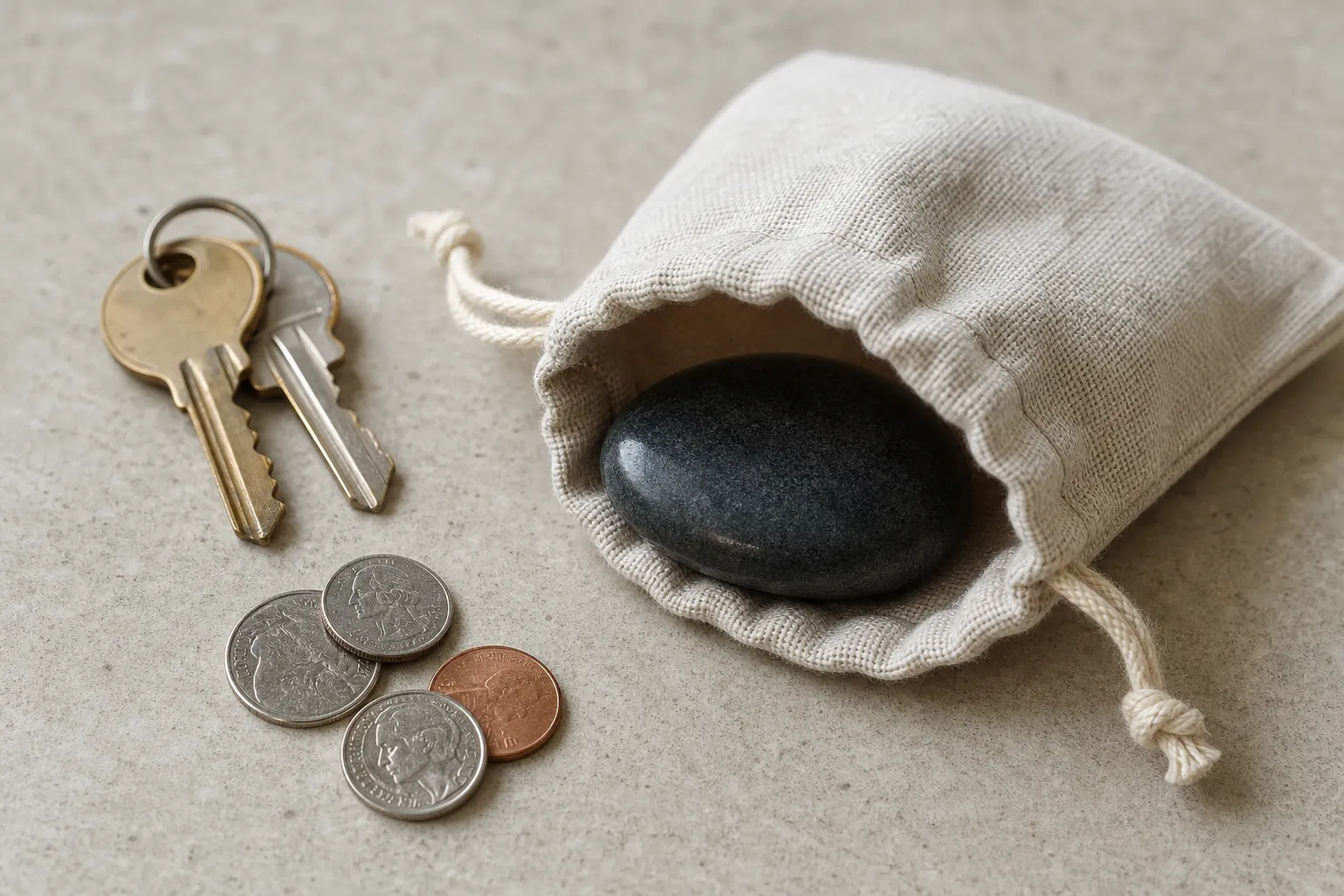
Pocket carry is not one condition. A stone in a soft pouch has a very different life from a stone dropped into the same pocket as a key ring.
For either obsidian or hematite
- Use a small pouch if the stone shares space with metal. A pocket stone in pouch reduces direct rubbing and small impacts.
- Choose rounded shapes. Tumbled stones, palm stones, and worry stones are usually better for daily carry than raw points, thin chips, or sharp-edged fragments.
- Keep one stone in one pocket. Multiple stones knocking together can create marks even when each stone seems durable by itself.
- Inspect the surface weekly at first. Look for chips, cracks, sharp edges, polish loss, surface marks, and worn finishes.
- Keep small stones away from children and pets. Do not leave pocket stones where swallowing could realistically occur.
A protected pocket carry approach does not make either stone immune to wear, but it reduces the most common pocket problems: metal abrasion, repeated impact, and edge damage.
Common confusion: is hematite the same as obsidian?
No. Hematite and obsidian are not the same material.
Obsidian is volcanic glass. Hematite is an iron oxide mineral. They can both appear dark, polished, and similar in crystal-shop displays, which is why people compare them. But their material behavior is different.
The confusion gets stronger because both are often sold with similar wording: grounding stone, pocket crystal, daily carry stone, or meditation companion. Those phrases describe personal or marketplace use. They do not prove that the stones behave the same physically, and they should not be treated as a promise of any personal outcome.
Material layer
Glassy fracture, polish, weight, chipping, surface marks.
Personal meaning layer
What the stone represents to you, how you use it as a reminder, or why you like carrying it.
You can carry hematite and obsidian together if you like the pairing, but do not let them knock against each other loose in a pocket. Use a divided pouch or separate pockets.
Final recommendation
Choose hematite if you want the more practical everyday pocket choice: dense feel, smooth handling, and generally less concern about sharp glassy chips when the piece is solid and polished. Still watch for surface marks and finish wear.
Choose obsidian if you specifically want the glassy look, deep black appearance, or personal symbolism, and you are willing to carry it with more care. A rounded obsidian stone in a pouch is much more sensible than a raw, chipped, or pointed piece loose with keys.
Choose neither for rough loose carry if your pocket also holds keys, coins, a multitool, or other hard objects every day. In that case, the better answer is not simply obsidian versus hematite. It is a rounded stone, protected in a pouch, inspected for wear, and replaced or retired when chips or sharp edges appear.
Sources
Sources and further reading
Reference links are limited to sources considered suitable for public citation in this page.