ProtectCrystal handling note
Material choice guide
Choosing Obsidian, Cinnabar, or Hematite for Jewelry, Carrying, or Display
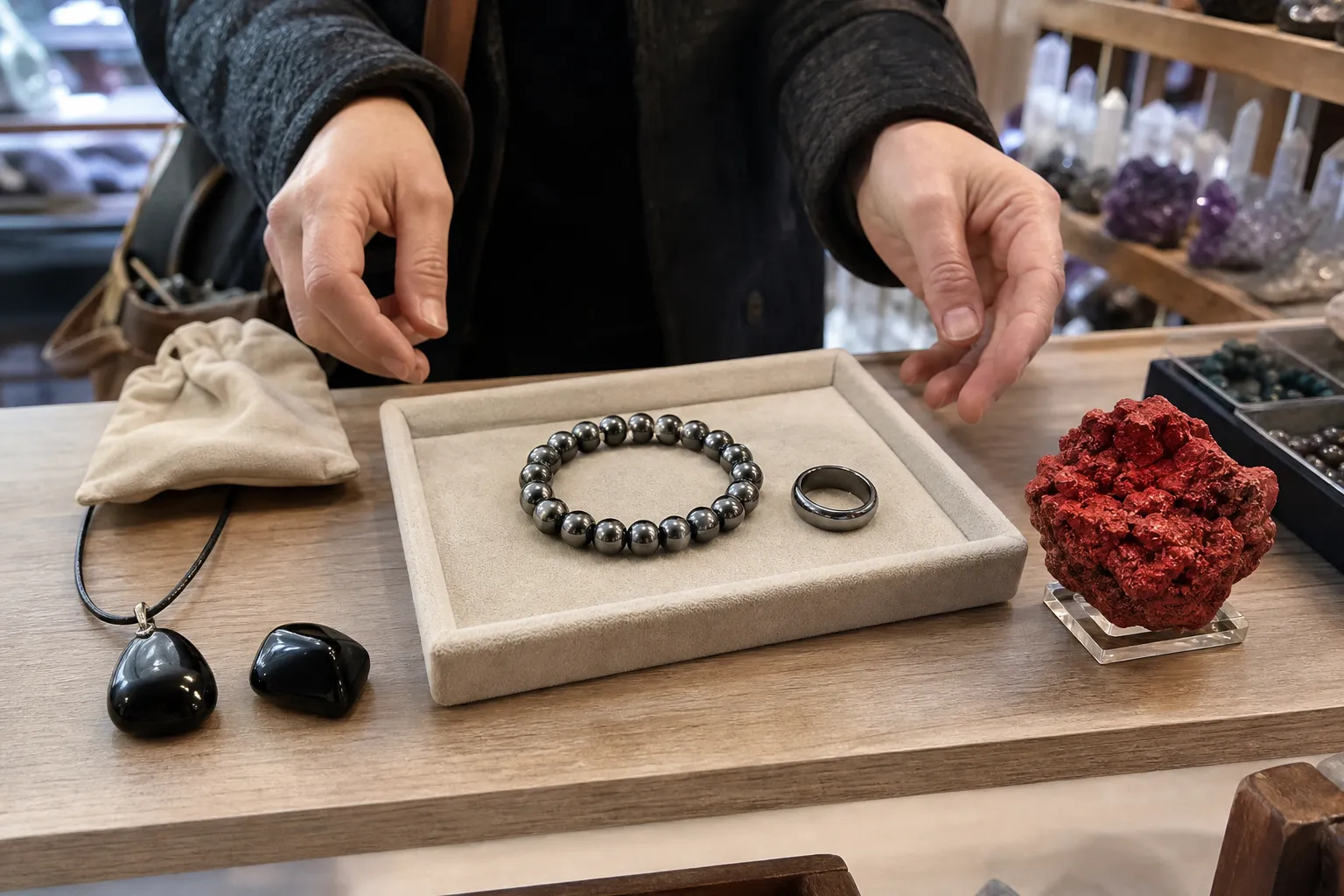
If you are comparing a glossy black stone, a metallic gray-black stone, and a vivid red material at a crystal counter, the right choice depends less on the label and more on how the piece will be used. For daily jewelry, obsidian and hematite are usually the simpler options: obsidian for a polished volcanic-glass look, hematite for a heavier metallic shine. For display, cinnabar may be attractive because of its strong red color and cultural symbolism, but it needs the most careful handling of the three.
This guide to choosing obsidian cinnabar or hematite focuses on what you can observe, what questions to ask before buying, and where appearance or seller wording cannot prove identity, durability, or suitability for close contact.
upward
Start with the broader guide
Use the broader guide first if you need the full scope before this page.
The quick choice: match the material to the use
Do not start by asking which stone is “stronger” in a crystal-symbolism sense. Crystal shops often describe obsidian and hematite as grounding or protective, while cinnabar is often sold with red auspicious or prosperity language. Those meanings may matter personally, but they do not tell you whether a bracelet will chip, feel too heavy, rub against skin, or need stricter handling.
Use the material first, symbolism second.
Bracelet
- Obsidian: Good if beads are smooth, secure, and checked for chips.
- Hematite: Often practical if the weight feels comfortable and the finish is smooth.
- Cinnabar: Highest caution; avoid damaged or powdering pieces, and ask exactly what the material and coating are.
Necklace or pendant
- Obsidian: Works well for glossy black contrast; check edges and setting.
- Hematite: Works if the weight does not pull and the surface is comfortable near skin.
- Cinnabar: More cautious near skin; vague “sealed” wording is not enough.
Ring
- Obsidian: Less forgiving because rings hit hard surfaces often.
- Hematite: Often more practical than obsidian if the finish and setting are comfortable.
- Cinnabar: Usually a poor high-contact choice unless the construction is very clearly explained.
Pocket carry
- Obsidian: Reasonable as a smooth tumbled stone kept away from hard objects.
- Hematite: Reasonable if the weight and surface feel right.
- Cinnabar: Not ideal loose in a pocket or bag where abrasion can occur.
Shelf display
- Obsidian: Easy to display; avoid unstable edges and drops.
- Hematite: Easy to display; weight may require a stable base.
- Cinnabar: Often more sensible as display than daily wear; keep away from children, pets, food areas, heat, and frequent handling.
In short: choose obsidian for a dark glassy look, hematite for metallic weight and shine, and cinnabar mainly when the red color or cultural symbolism is the point and you are prepared to treat it as a careful-handling material.
What you can actually observe before buying
A buyer cannot prove mineral identity from looks alone, especially from online photos. Still, visible cues can help you ask better questions and avoid obvious mismatches.
Obsidian: glossy volcanic glass with chip checks
Obsidian is volcanic glass. That matters more than the fact that it is often black. A polished piece may look smooth and mirror-like, while broken or chipped areas can behave more like glass than like a granular rock. In jewelry, a chipped bead, pendant point, or ring edge can become sharp.
When looking at obsidian jewelry or a carrying stone, check:
- Edges and holes: bead holes, pendant tips, drilled areas, and points should not feel sharp.
- Surface finish: a smooth polish is more comfortable for bracelets and pocket stones.
- Setting security: pendants and rings should protect exposed edges from knocks.
- Variety wording: black, mahogany, snowflake, rainbow, or sheen terms may describe appearance, but they do not prove identity by themselves.
If you are asking “which obsidian is best,” the answer depends on the use. For everyday carrying or a bracelet, a simple rounded polished piece is usually more practical than a delicate point, thin carving, or raised ring shape. For display, more dramatic forms can work if they are stable and not handled often.
Hematite: metallic luster, weight, and gray-black shine
Hematite is commonly recognized by its metallic gray to black appearance, dense feel, and mineral-property cues such as metallic luster and reddish-brown streak. In a store, you may not be doing formal streak testing, and many sellers will not want products scratched. The more useful buyer cue is that hematite often feels heavier than a similarly sized piece of many other stones and has a gunmetal-like shine when polished.
For jewelry, pay attention to:
- Weight: hematite beads can make a bracelet or necklace feel heavier than expected.
- Surface comfort: a metallic-looking finish should still feel smooth against skin.
- Stringing strength: heavy beads put more demand on elastic, cord, or wire.
- Lookalike language: a metallic appearance can suggest hematite, but it does not prove it.
Hematite is often paired with obsidian in bracelets because black glassy surfaces and metallic gray beads look good together. Practically, the question is whether the bracelet is too heavy, whether the beads rub against each other, and whether the stringing suits the weight.
Cinnabar: red appeal with a stricter handling threshold
Cinnabar is a mercury sulfide mineral, which is why it belongs in a different handling category from obsidian and hematite. The practical caution is straightforward: do not grind, sand, drill, heat, ingest, mouth, or casually scrub cinnabar, and do not continue using a piece that is cracked, powdery, flaking, or leaving residue.
Marketplace wording can make this harder. “Cinnabar” may refer to actual mineral cinnabar, cinnabar-colored lacquer, resin, dyed material, or another red decorative product. That does not automatically make the item better or worse, but it changes the questions you should ask.
Before buying cinnabar jewelry, ask:
- Is this actual mineral cinnabar, cinnabar-colored material, lacquer, resin, or another substitute?
- If the listing says “sealed” or “stabilized,” what exactly is sealed or stabilized?
- What is the coating material, and what conditions can damage it?
- Should the piece be kept away from water, sweat, heat, friction, or impact?
- What should the buyer do if the surface chips, flakes, powders, or leaves residue?
A seller’s reassurance is not the same as independent testing. A general buyer usually cannot verify whether a specific cinnabar bead, coating, or pendant is suitable for daily skin contact.
Jewelry: bracelet, necklace, or ring changes the answer
A protective crystal jewelry comparison becomes more useful when it separates jewelry types. A bracelet, necklace, and ring expose the material to different amounts of friction, impact, sweat, and handling.
Which is better for a bracelet: obsidian, hematite, or cinnabar?
For most readers, an obsidian or hematite bracelet is the more straightforward choice.
Choose obsidian if you want a glossy black look and a lighter visual feel. Check every bead for chips, especially around drill holes. Obsidian can be elegant, but because it is glass-like, rough edges are not just cosmetic.
Choose hematite if you like a metallic gray-black bracelet with noticeable weight. The main comfort issue is heaviness, especially in larger bead sizes. Hematite beads can feel substantial, which some people like and others find tiring.
Treat cinnabar as the caution choice. Daily bracelets rub against desks, sleeves, bags, water, and skin. If the item is actual cinnabar and the coating or construction is unclear, display or occasional low-contact use is the more conservative decision.
Obsidian or cinnabar necklace: what changes near skin?
A necklace or pendant has less impact than a ring, but it may sit near skin for long periods. For obsidian, the main checks are edge smoothness, secure mounting, and whether a pendant point or carved edge scratches the wearer.
For cinnabar, near-skin use raises more questions. Is the red material exposed or enclosed? Does the piece have a coating? Does the seller warn against moisture, heat, or friction? Is the back surface touching skin the same material as the front? If the answers are unclear, approach a cinnabar necklace as a special-use or display-oriented piece rather than an everyday pendant.
Hematite necklaces can work well visually, but weight matters. A strand of hematite beads may feel much heavier than it looks online. A small pendant or mixed-material design may be more comfortable than a full heavy strand.
Obsidian vs hematite rings: which material makes more sense?
Rings take more knocks than bracelets or pendants. They hit counters, door handles, phones, bags, and hard surfaces throughout the day.
Between obsidian and hematite, hematite often makes more practical sense for ring styles where the surface is protected and comfortable. Obsidian rings can be beautiful, but the glass-like nature of obsidian makes chips and sharp edges especially important. If the obsidian is raised, thin, pointed, or poorly protected by the setting, it may be less practical for daily hand wear.
Cinnabar is the weakest fit for a high-contact ring unless the item is clearly not exposed mineral cinnabar and the construction is well explained. A ring is too likely to abrade, chip, or contact water and hard surfaces.
Carrying stones: pocket, pouch, bag, or tumbled piece
For everyday carry, the best choice is usually the one that can tolerate normal handling without creating sharp, powdery, or uncomfortable problems.
A tumbled obsidian stone can be a good carry piece if it is smooth and not cracked. Keep it separate from keys or hard metal objects that could chip it. If an obsidian piece breaks, do not keep carrying it while sharp edges remain exposed.
A hematite carry stone can feel satisfying in the ordinary tactile sense: dense, cool, smooth, and weighty in the hand. That is a physical preference, not a promised result. Hematite may be more comfortable as a palm stone than as a large pocket stone if weight bothers you.
A cinnabar carry piece needs more caution. Loose carry in a pocket, purse, or bag is not ideal if the piece can rub against coins, keys, zippers, or other stones. If someone wants cinnabar for symbolic reasons, a contained display piece, a clearly enclosed pendant, or a pouch that prevents abrasion is more conservative than letting it tumble loose. Do not carry cinnabar that is cracked, shedding residue, powdery, or flaking.
Children and pets also change the decision. Obsidian and hematite should not be treated as toys because small objects can be swallowed and broken materials can have sharp or rough edges. Cinnabar deserves stricter access control: keep it away from mouthing, licking, food surfaces, and casual handling by children or pets.
Display: when shelf placement is the better answer
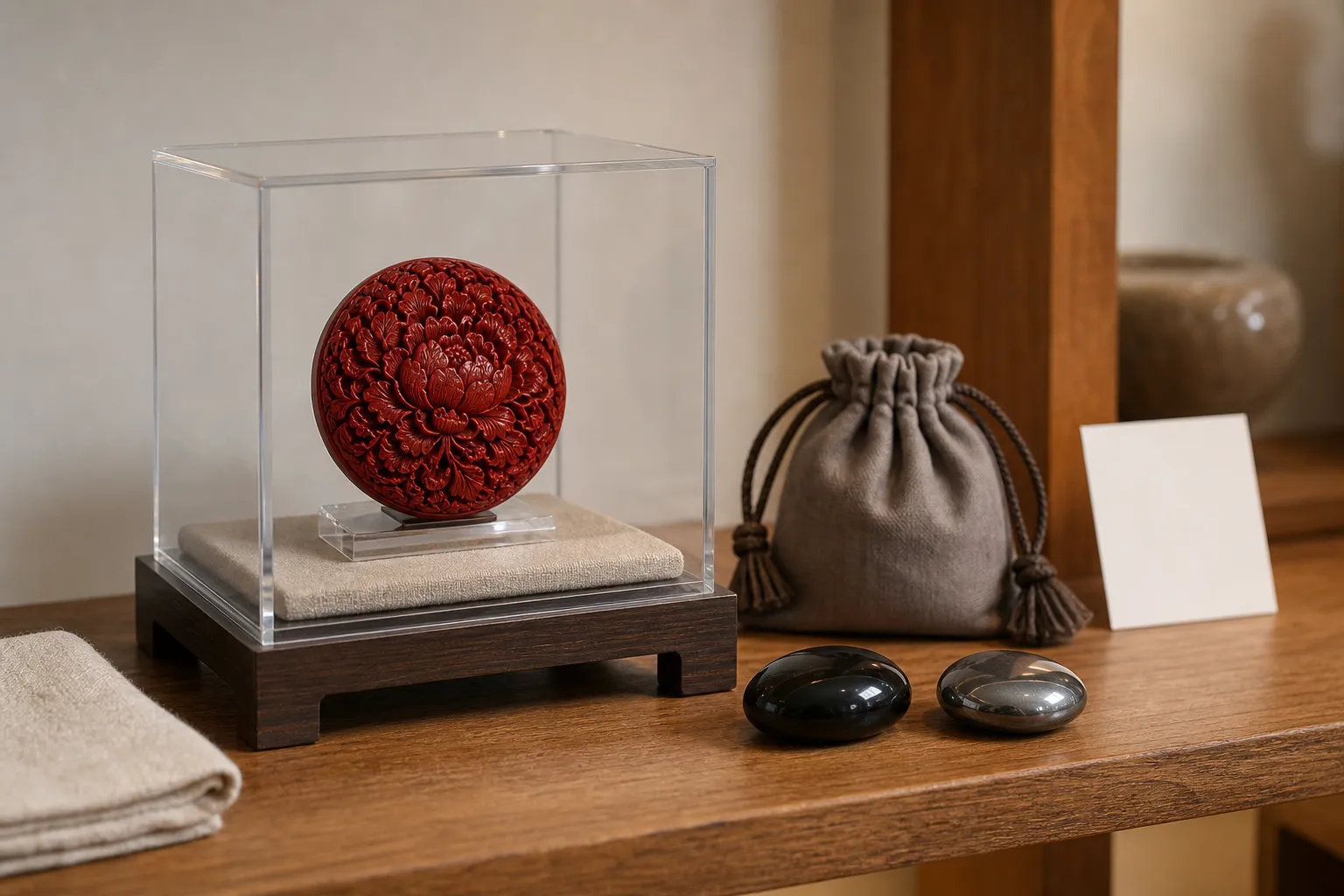
Display changes the decision because the material is not being rubbed against skin, flexed on elastic, knocked as a ring, or carried with keys. That makes display especially relevant for cinnabar.
For an obsidian and cinnabar display shelf, separate the goals. Obsidian can provide a dark glossy contrast. Cinnabar can provide red color or symbolic presence. Hematite can add metallic gray balance and weight. The practical shelf question is simple: can each piece sit securely, stay clean, and avoid unnecessary handling?
A good display habit for these materials:
- Put heavy hematite pieces on a stable lower shelf or secure stand.
- Keep obsidian away from edges where a fall could chip it.
- Keep cinnabar away from heat, frequent handling, children, pets, and food preparation areas.
- Avoid storing cinnabar loose with harder or rougher pieces that may scratch or wear its surface.
- If a cinnabar specimen becomes dusty, powdery, or damaged, do not blow dust around or scrub it casually.
Cinnabar worn or displayed is not an all-or-nothing question. The more contact, friction, heat, moisture, and uncertainty involved, the more display begins to make sense.
Meaning vs material: use symbolism without letting it make the decision
Many readers arrive at this comparison because they have seen obsidian, hematite, and cinnabar described as protective crystals. That language is common in crystal culture. Obsidian is often associated with black, reflective, shielding symbolism. Hematite is often described through grounding and steadiness. Cinnabar’s red color is often connected with vitality, luck, or auspicious display in some market contexts.
Those meanings can be part of how someone chooses a gift, bracelet, or shelf arrangement. They should not replace material judgment.
If you are choosing obsidian and cinnabar as gifts, the practical difference is large. Obsidian is easier to give as a polished tumbled stone, pendant, or display piece, as long as chips and edges are checked. Cinnabar is more complicated because the recipient must understand handling limits. It is not the best surprise gift for a household with young children, pets, or someone who may wear it constantly without reading care notes.
If you are choosing black obsidian and hematite together, the decision is simpler. Their combination is usually about contrast: glossy black with metallic gray-black. For a bracelet, check weight and stringing. For a shelf, check stability and surface contact. The symbolic pairing can be personal, but the physical questions are still comfort and care.
Seller wording that should slow you down
Some listing language is useful; some is too vague. These phrases should not automatically stop a purchase, but they should lead to follow-up questions.
“Sealed cinnabar”
Ask what material is sealed, what the coating is, whether the cinnabar is actual mineral cinnabar, and what conditions may damage the seal. A coating claim without details does not establish daily-wear suitability.
“Stabilized”
Ask whether stabilization means resin, lacquer, surface coating, composite material, or simply a seller’s description. The word can mean different things in different markets.
“Natural hematite”
Ask more questions if the price, magnetic behavior, coating, or appearance seems unusual. Visual inspection can suggest possibilities, but it cannot prove identity.
“Real obsidian”
Look for glassy appearance and sensible seller detail, but do not rely on a single cue such as color or coolness. Some black materials can look similar in photos.
“Protective” or “grounding”
Treat this as cultural or personal-use language. It does not answer whether a bead is chipped, whether a bracelet is too heavy, whether a coating is durable, or whether a material should be kept away from children.
A practical decision path before you buy
Use this sequence when choosing obsidian, cinnabar, or hematite online or in person.
- 1. Start with the use.
Daily bracelet, occasional pendant, pocket stone, and shelf display are different decisions. - 2. Choose the material feel.
Obsidian gives a glassy black look. Hematite gives metallic shine and weight. Cinnabar gives red color with more careful handling. - 3. Check the contact level.
Rings and bracelets are high-contact. Pendants are moderate-contact. Display is lower-contact. - 4. Look for damage.
Avoid sharp obsidian chips, uncomfortable hematite finishes, and any cinnabar that is cracked, powdery, flaking, or shedding residue. - 5. Question vague handling language.
Especially for cinnabar, ask about material identity, coatings, care limits, and what happens if the surface is damaged. - 6. Keep symbolism optional.
If protective-crystal meaning matters to you, let it guide style or placement, not claims about outcomes. - 7. Accept uncertainty.
Appearance may suggest obsidian, hematite, or cinnabar, but it cannot prove authenticity or suitability. For certainty, specialized testing may be needed.
Bottom line
For most everyday jewelry and carrying, obsidian and hematite are the more practical comparison. Choose obsidian when you want glossy black volcanic-glass beauty and are willing to check for chips. Choose hematite when you want metallic gray-black shine, a denser feel, and a smooth comfortable finish. Choose cinnabar when the red color or symbolic display value matters enough to accept stricter handling questions.
If the piece will touch skin often, be knocked around, sit near children or pets, or rely on vague “sealed” wording, cinnabar should move down the wearability list and toward careful display. The best choice is not the stone with the strongest marketing language; it is the one whose material, construction, care needs, and handling limits match how you actually plan to use it.
Sources
Sources and further reading
Reference links are limited to sources considered suitable for public citation in this page.