
ProtectCrystal handling note
Do Obsidian, Cinnabar, and Hematite Need Separate Storage Pouches
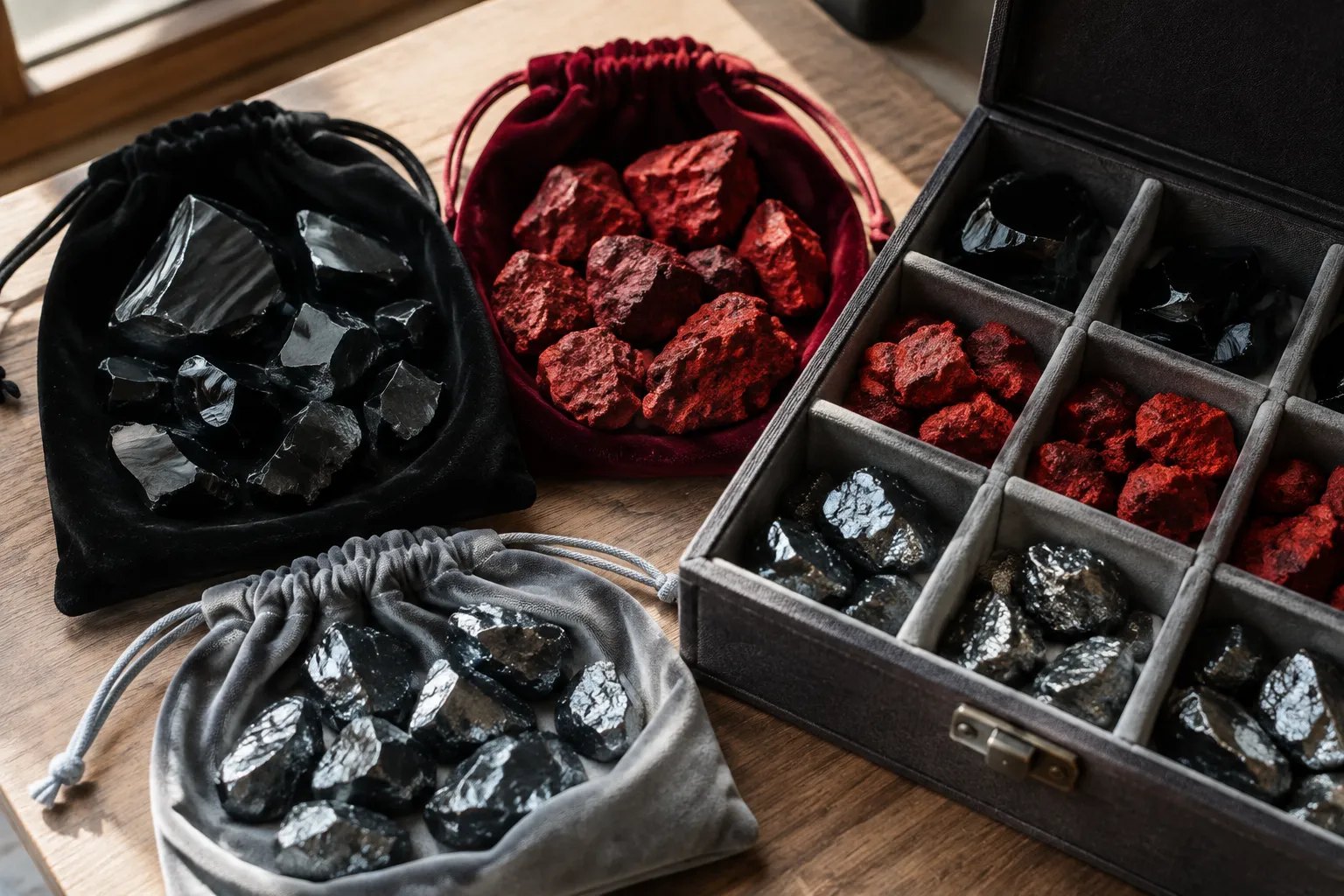
Usually, separate crystal storage pouches are a practical choice for obsidian, cinnabar, and hematite, but they are not required for every piece. The useful question is whether the items can rub, knock together, catch on one another, or shed loose material during storage or transport.
A smooth, intact item in a stable compartment may not need its own pouch. A sharp point, polished finish, projecting setting, chipped edge, or dusty specimen deserves more distance from neighboring pieces. Separate storage manages contact and reduces abrasion. It does not prove authenticity or settle the handling needs of a particular specimen.
upward
Read the full overview first
Use the broader guide first if you need the full scope before this page.
When Separate Crystal Storage Pouches Make Sense
Movement is the main reason to store crystals separately. Items that slide inside a crowded box or fabric bag can press against different surfaces, edges, settings, or finishes. General gemstone-care guidance from the Gemological Institute of America supports protecting items according to their construction and vulnerability, rather than applying one rule to every mineral.
Before choosing individual crystal pouch storage, check:
- Movement: Will the pieces shift when the container is carried or opened?
- Surface: Is one item polished, coated, matte, or rougher than the others?
- Edges and settings: Does either piece have points, corners, prongs, chains, or projecting parts?
- Condition: Is anything chipped, loose, friable, or visibly dusty?
- Value of the finish: Would a mark on the polish or surface be difficult to accept?
A clean, soft pouch or a divided compartment may be suitable for ordinary storage. The available sources do not establish one universally required fabric, lining, thickness, or storage sequence, so a particular pouch should not be presented as a technical guarantee.
How the Three Stones Change the Decision
The name of the mineral is only part of the storage decision. Shape, finish, setting, condition, and movement can matter just as much. The table below is a practical guide, not a laboratory-tested rule for every item.
| Item condition | Separate pouch is more practical when... | Main reason |
|---|---|---|
| Polished obsidian | It has exposed corners, a point, a glossy finish, or contact with rough pieces | Reduce rubbing against edges and uneven surfaces |
| Cinnabar | It is chipped, loose, friable, visibly dusty, or likely to be disturbed | Manage contact and limit the spread of particles |
| Hematite | It has a vulnerable finish, projecting shape, setting, or frequent movement | Limit abrasion between differently constructed items |
| Any of the three | It will travel, be handled often, or sit in a crowded container | Reduce shifting and direct contact |
Obsidian
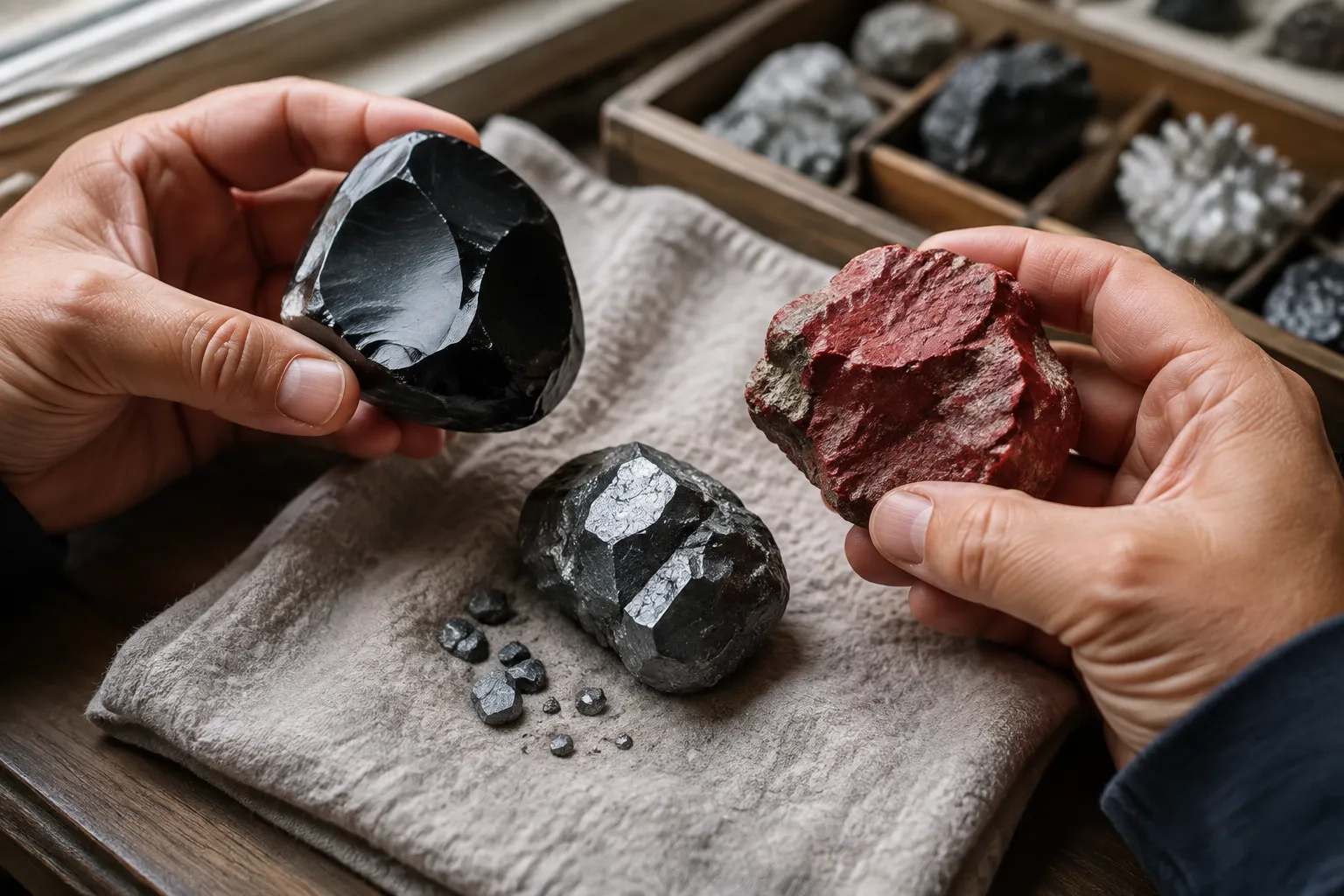
Obsidian is commonly sold as a polished palm stone, cabochon, bead, point, carving, or rough specimen. Those forms do not present the same storage conditions. A smooth piece without an exposed point may sit well in a divided tray. A sharp point or rough fragment is more likely to catch or rub against nearby items.
Black, glassy-looking obsidian can show surface marks under some lighting, but appearance alone does not reveal exactly how a finish will respond to contact. If the piece has a valued polish, decorative coating, or delicate edge, individual storage is a sensible precaution. A pouch still cannot confirm that the item is genuine or show the full durability of its surface.
Cinnabar
Cinnabar needs the clearest handling boundary in this comparison. The U.S. Geological Survey describes it as the primary ore of mercury. That mineralogical fact provides relevant context, but it does not determine the exposure profile of every specimen, bead, carving, or commercial item.
Store cinnabar separately when doing so can reduce rubbing, breakage, or contact with loose material. Avoid handling that creates dust, and do not ingest particles. Use extra care with chipped, loose, friable, or visibly dusty material. Keep it away from situations where particles could transfer to hands or nearby objects.
The Agency for Toxic Substances and Disease Registry provides general mercury-exposure information that includes pathways such as dust, particles, breakage, and ingestion. This supports a cautious handling approach; it does not establish a particular risk level for every intact cinnabar item.
A pouch may reduce movement and contact. It does not neutralize mercury, verify what a product contains, or make every cinnabar item appropriate for every use. If a piece is damaged or shedding visible material, avoid shaking or brushing it in a way that could spread dust. For suspected exposure or concern about damaged material, seek appropriate local health or professional guidance instead of relying on the storage container alone.
Hematite
Hematite is commonly sold as polished pieces, beads, cabochons, carvings, and metallic-looking specimens. A separate pouch can be useful when the surface finish matters, the shape may rub against other pieces, or a setting protrudes from the item.
The supplied evidence does not provide a complete hardness comparison among hematite, obsidian, and cinnabar. It also does not test particular finishes against particular pouch materials. Avoid saying that one of these stones will always scratch another. Look at the actual objects instead: rough areas, corners, mounted parts, loose debris, and signs of movement are more useful storage cues than the mineral label alone.
Should Crystals Be Stored Separately in the Same Collection?
Not necessarily. Storing crystals separately is most useful when a collection combines different shapes, finishes, and conditions. Three smooth, stable pieces in a divided tray may need less protection than a sharp point, a polished cabochon, and a damaged specimen moving together in one bag.
A practical arrangement is to group items by contact risk:
- Keep sharp points and rough fragments away from polished surfaces.
- Give mounted jewelry enough space that prongs, chains, or settings cannot press against another piece.
- Keep visibly dusty or loose material from rubbing against clean items.
- Use individual pouches or secure compartments for pieces that may shift during transport.
- Check the storage area for particles before returning other objects to it.
This does not mean obsidian, cinnabar, and hematite must always occupy three different containers. It means each item should have a stable place where its surface, edges, construction, and condition do not create an avoidable contact problem.
A seller may describe a pouch as “protective” or as a way to “keep energies separate.” Those phrases can reflect personal or cultural use, but they are not evidence that a pouch changes a crystal’s physical properties, confirms authenticity, or guarantees an outcome. For physical storage, movement and material condition are the useful checks.
What to Check Before Choosing a Pouch
The available material supports general separation and handling principles, but it does not evaluate specific pouch fabrics, linings, treatments, humidity conditions, or commercial specimens. Use this short check before placing an item in storage:
- Examine the item without rubbing it against another piece. Look for chips, loose material, exposed edges, dust, and projecting settings.
- Note the finish. Is the surface polished, rough, coated, matte, or otherwise presented as finished? A visible finish can suggest a need for contact control, but it does not reveal every treatment or durability limit.
- Assess the storage situation. Will the item slide, knock against another piece, or be compressed when the container moves?
- Separate where the consequence matters. A valued polish, fragile edge, mounted piece, or damaged cinnabar specimen warrants more space.
- Inspect after transport. Check for new particles, marks, displaced settings, or damage before returning the item to the collection.
A soft, clean pouch or separate compartment may be appropriate for ordinary organization. When cinnabar is dusty, broken, or shedding particles, the handling concern comes before the storage arrangement.
What Separate Storage Cannot Tell You
A pouch solves a narrow problem: it can reduce movement and direct contact. It cannot answer questions that require specimen-specific examination or specialized testing.
In particular, a pouch cannot:
- prove that obsidian, cinnabar, or hematite is authentic;
- establish the exact composition of a commercial item;
- determine the exposure profile of a particular cinnabar specimen;
- confirm that a finish, coating, treatment, or setting will remain intact;
- make damaged or dusty material suitable for unrestricted handling;
- establish physical, emotional, or spiritual protection.
Color, luster, texture, polish, and shape are useful visual cues for describing what a buyer or seller can see. They can suggest what deserves closer attention, but they do not replace testing when certainty matters. With cinnabar, the mineral name supplies geological context, not a complete specimen-specific handling assessment.
The practical answer is narrow: use separate pouches when contact, abrasion, movement, exposed edges, settings, or damaged material make shared storage questionable. Obsidian and hematite can often be organized according to their actual finish and shape. Cinnabar warrants added care when it is chipped, loose, friable, or dusty. The pouch manages storage; it does not settle authenticity or specimen-specific exposure questions.
Sources
Sources and further reading
Reference links are limited to sources considered suitable for public citation in this page.