
ProtectCrystal handling note
Temporary containment
How to Store an Unidentified Red Crystal That Might Be Cinnabar
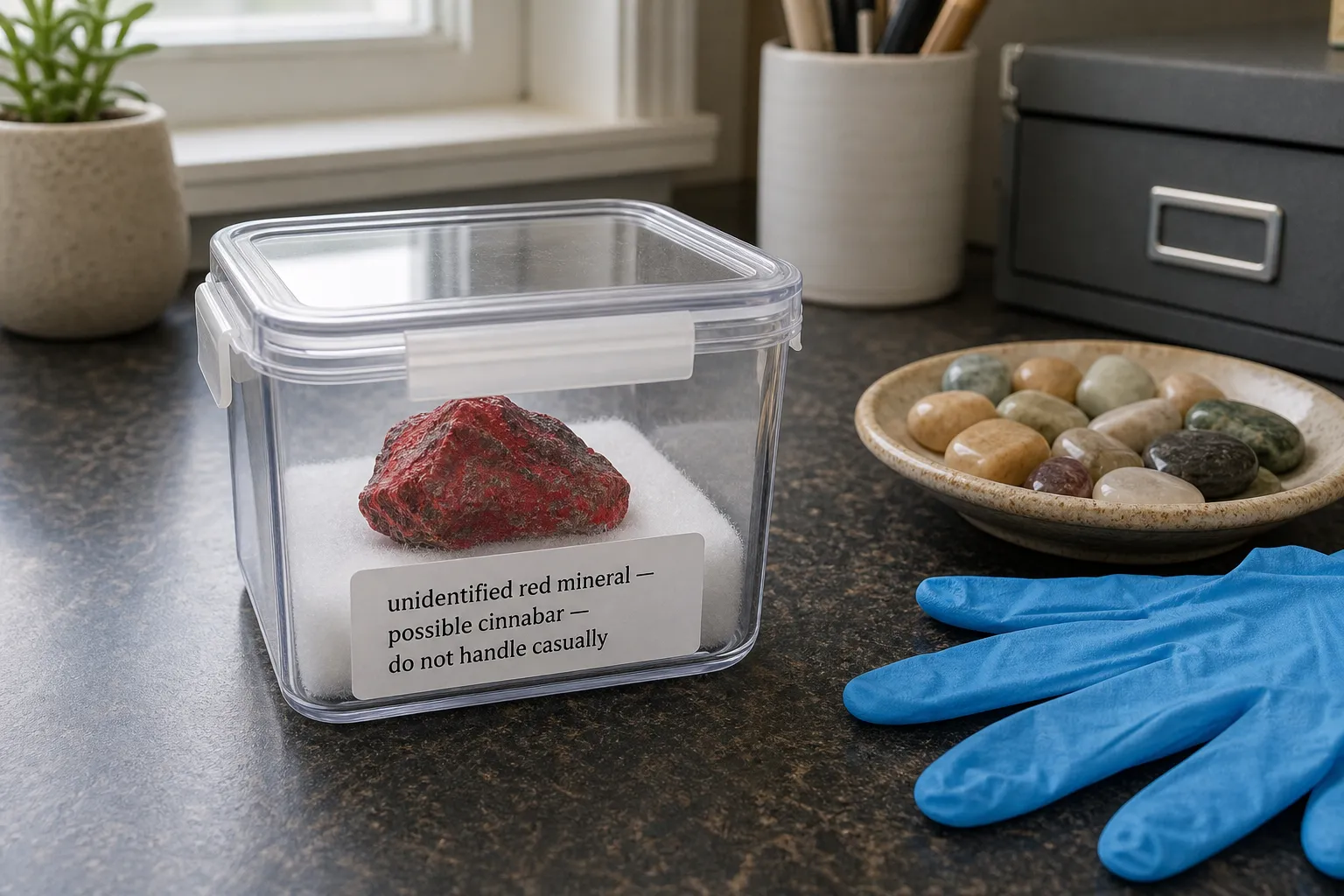
If you have an unidentified red crystal that might be cinnabar, treat it as a material to isolate now and identify later. Stop casual handling, keep it away from your other stones, place it in a clean sealed bag or rigid lidded container, and label it clearly: “unidentified red mineral — possible cinnabar.” Store it in a cool, dry, stable place away from direct sun, heaters, strong display lamps, food areas, children, and pets.
That label does not prove the stone is cinnabar. A red surface, seller name, or dramatic “dragon’s blood” description is not enough for identification. Temporary storage has a simpler job: reduce contact, contain loose dust or residue, and keep the specimen from becoming part of everyday crystal use before you know what it is.
upward
Read the full overview first
Use the broader guide first if you need the full scope before this page.
The safest temporary setup
Use containment that is plain, visible, and hard to misunderstand. A clean zip-top bag can work for a smooth, intact piece. A rigid lidded container is better if the crystal has sharp edges, rough matrix, crumbly spots, loose grains, or red powder. If you use a bag, place that bag inside a second labeled box so the specimen is not squeezed, dropped, or handled by mistake.
Do not treat the container as a permanent answer. A sealed bag for cinnabar is an interim caution, not proof that the specimen is fully understood. It helps keep loose material contained while you decide whether better identification is worth pursuing.
If you want to display it before identification, use a closed display case rather than an open shelf. Place the case away from direct sunlight, heat sources, and strong lamps. Even then, avoid frequent opening and handling. Display should not replace caution.
Practical setup
- Put the red crystal in a clean sealed bag or lidded container.
- Add a label saying “unidentified — possible cinnabar — do not handle casually.”
- Keep it separate from jewelry, tumbled stones, altar pieces, pocket stones, and water-use items.
- Store it in a cool, dry, low-traffic place.
- Keep it away from children, pets, food preparation areas, and open display trays.
- Wash your hands after any necessary handling.
Why possible cinnabar deserves extra caution
Cinnabar is commonly described in mineral references as mercury sulfide, with the chemical composition HgS, and as an important ore of mercury. That is why possible cinnabar safety should be handled differently from ordinary unidentified quartz, jasper, or dyed decorative stone. The concern is not that every red crystal is cinnabar. The concern is uncertainty.
Mineral descriptions often place cinnabar in a bright red, scarlet, brick-red, reddish-brown, dull massive, granular, encrusting, or more lustrous crystal range. Those visible cues may point in a direction, but they cannot confirm identity at home. Other red minerals, coatings, pigments, dyes, resin pieces, and decorative products can overlap in color.
The storage logic is conservative: until the material is clearer, avoid unnecessary contact and contain anything loose. Mercury-compound references and safety documents for mercuric sulfide or fine cinnabar material support caution around dust, ingestion, inhalation, and avoidable skin contact. For a crystal buyer, that means simple limits: do not grind it, sand it, drill it, polish it, lick it, put it in water, or wear it against the skin while it remains unidentified.
Cinnabar belongs in a handling boundary, not in a casual pocket-stone routine.
Signs that should raise the caution level
Some unidentified red crystal storage is straightforward: an intact, non-powdery piece can be isolated, labeled, and left alone until you decide what to do next. Other pieces deserve more care because their surface condition makes dust or residue more likely.
That last cue deserves special attention. Some collector notes describe cinnabar specimens that may show small silvery droplets of elemental mercury. A shiny bead that looks like liquid metal is not a normal “sparkle” to rub, test, or clean. If you see that, stop handling the specimen, keep it contained, and seek qualified local guidance rather than trying to wipe, wash, or scrape it.
A red crystal can leave residue for many reasons, including pigment, coating, soft matrix, or mineral powder. The residue does not prove cinnabar. It does mean the piece should not be handled like a polished hematite bead or a smooth obsidian palm stone.
What not to do while it is unidentified
The biggest mistakes are actions that create dust, increase contact, or move the unknown material into body-contact crystal use. Keep the question narrow: you are not trying to stress-test the stone. You are trying to avoid making the uncertainty harder to manage.
Avoid altering it
Do not grind, sand, saw, drill, tumble, polish, burn, or heat the piece. Do not place it under a hot lamp to “bring out the color.” Do not scrub it aggressively if powder is present.
Avoid body-contact use
Do not use it in crystal water, bath rituals, elixirs, mouth contact, skincare routines, or anything involving food containers. Do not hand it to children as a curiosity object.
Avoid mixing it back in
Obsidian, hematite, jasper, and red decorative stones are often stored together by appearance or protective-crystal meaning. Possible cinnabar should be separated by material uncertainty, not by color theme.
Avoid wearing possible cinnabar as jewelry unless the material has been identified and assessed for that use. Marketplace descriptions can blur natural cinnabar, cinnabar-colored resin, lacquer-style decorative objects, dyed beads, and mineral specimens. A pendant, bead, or carving being sold under a red cinnabar name does not automatically answer the material question.
How to label it and choose the next step
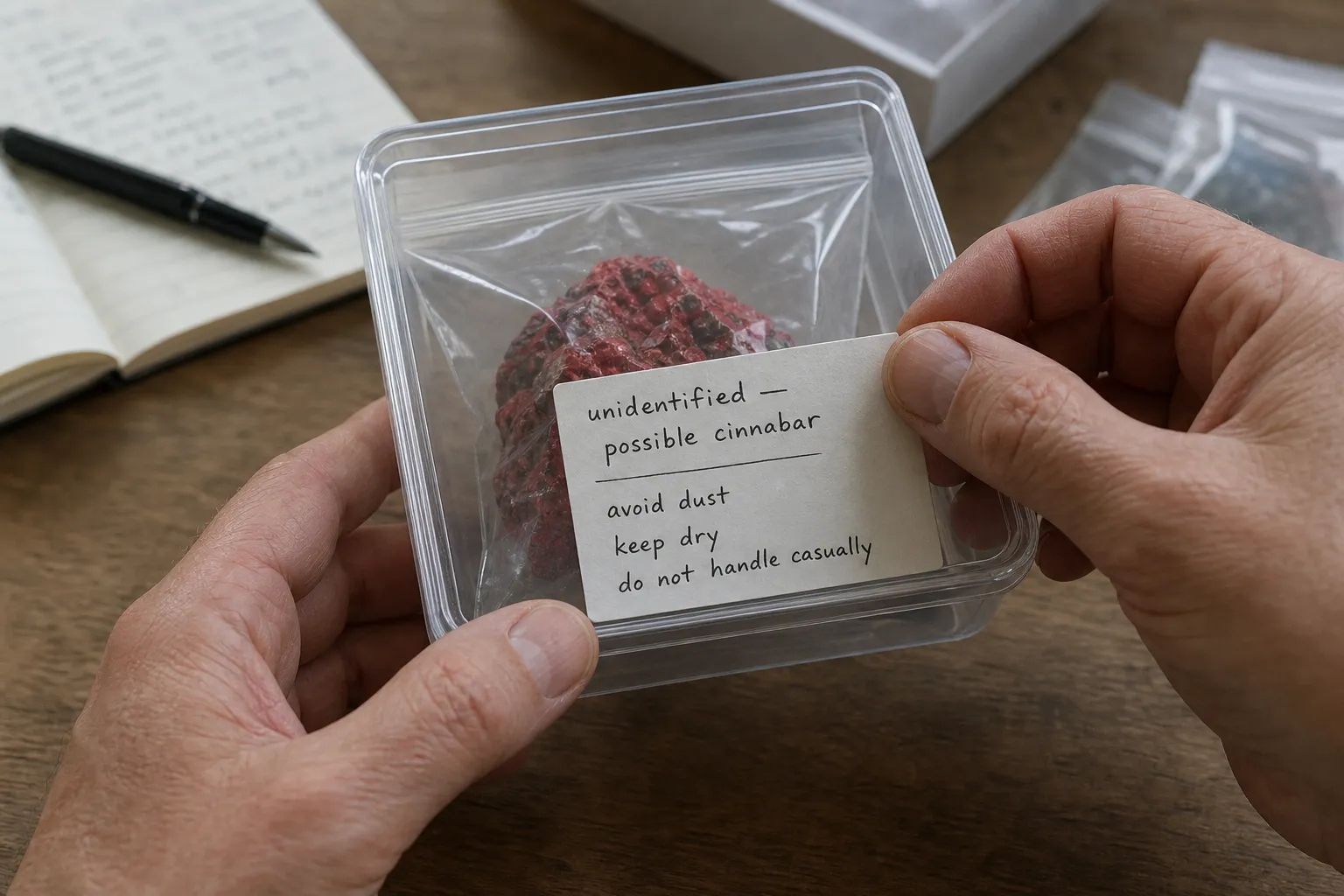
A label is more useful than a dramatic warning. It should tell future-you what the object is, what is unknown, and what not to do. Plain wording works best:
“Unidentified red mineral. Possible cinnabar. Keep sealed. Avoid dust, heat, water use, jewelry use, and casual handling.”
Add the date you stored it and any known seller wording. If it came with a tag that says cinnabar, vermilion, Chinese Red, dragon’s blood, mercury ore, cabinet specimen, or natural cinnabar, keep that tag in a separate small bag or folded note. Seller language is not proof, but it can be useful context later.
The next step depends on condition and purpose. If the piece is intact, contained, and not important to you, leaving it isolated may be enough for now. If you want to display, wear, sell, clean, gift, or place it with other crystals, get a more reliable identification before changing how you use it. A local mineral club, geology department outreach contact, experienced mineral dealer, or qualified hazardous-materials resource may be more appropriate than a crystal shop description alone, especially if the piece is powdery or shows metallic droplets.
For certainty, specialized mineral identification may be needed. Visual checks can narrow possibilities, but they do not turn an unknown red mineral into a confirmed material.
Common confusion around red “cinnabar” pieces
Color is not identity
Bright red, brick-red, scarlet, and reddish-brown surfaces appear in many materials. Cinnabar can fall in that range, but color alone is not identity. A polished red bead, carved red pendant, or lacquer-like ornament may be something else entirely.
Commerce uses the word broadly
The word “cinnabar” can appear in mineral specimen listings, pigment history, decorative objects, jewelry descriptions, and metaphysical crystal language. Words connected to personal meaning, luck, passion, or protection may explain why buyers search, but they do not establish composition, storage needs, or suitability for body contact.
A container is not a final finding
A bag, box, or glass display case can reduce handling and help contain dust. It should not be treated as a final safety finding. The better thought is: contained, labeled, undisturbed, and pending clearer identification.
Not every red unknown is cinnabar
Appearance alone does not support assuming every red unknown is cinnabar. The balanced approach is to store the piece as possible cinnabar without claiming it is cinnabar.
Quick storage checklist
Before you walk away from the specimen, check these points:
- Is it separated from the rest of your crystal collection?
- Is it inside a sealed bag or rigid lidded container?
- Is the container labeled as unidentified possible cinnabar?
- Is it away from heat, sun, lamps, food areas, children, and pets?
- Have you avoided grinding, washing, drilling, polishing, wearing, or water use?
- Did you wash your hands after handling it?
If the answer is yes, you have taken a reasonable temporary containment step for an unknown red mineral. The remaining question is identification, not more casual handling.
The bottom line
Store an unidentified red crystal that might be cinnabar by isolating it, sealing it, labeling it, keeping it cool and dry, and avoiding heat, dust, water use, jewelry use, and unnecessary contact. Use stronger caution if it is powdery, crumbly, leaves red residue, or shows shiny liquid-metal-looking droplets.
This approach does not prove the stone is cinnabar and does not make a permanent safety claim. It gives the material a cautious holding place until you can decide whether identification, qualified guidance, or removal from your active crystal collection is the better next step.
Sources
Sources and further reading
Reference links are limited to sources considered suitable for public citation in this page.