
ProtectCrystal handling note
Open Shelf vs Display Box for Obsidian, Cinnabar, and Hematite
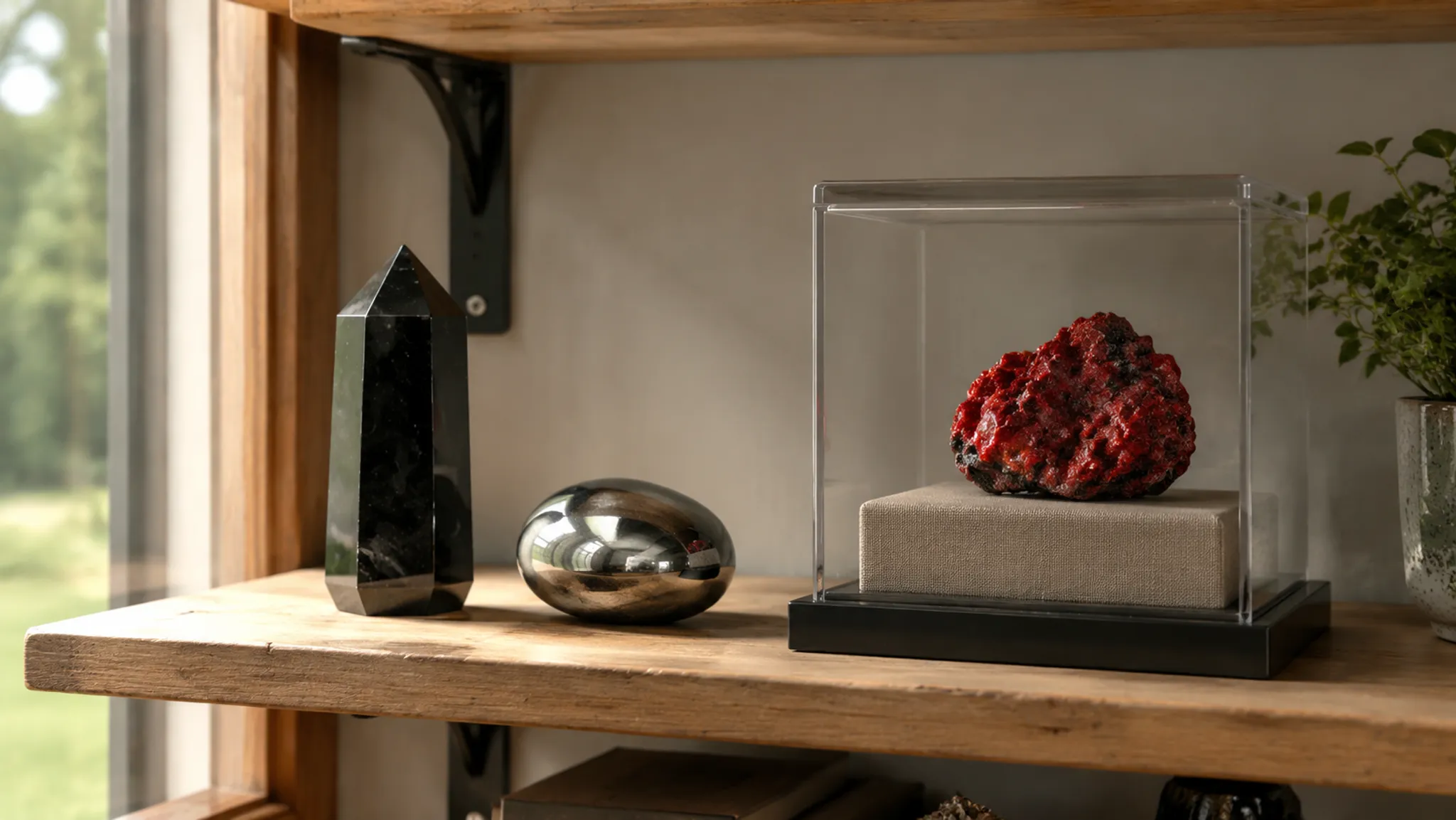
A polished obsidian point can sit well on an open shelf. A red cinnabar specimen usually belongs behind a cover. The practical answer to open shelf vs display box for crystals is simple: an open shelf works for stable, low-touch obsidian and hematite pieces in a calm room, while a covered display box is the more sensible choice for cinnabar, fragile specimens, sharp-edged pieces, dusty rooms, and homes where children, pets, guests, or frequent cleaning increase contact.
A display box does not prove a crystal is authentic, and it does not remove every handling concern. It mainly reduces dust, fingerprints, falls, and accidental contact.
For many home displays, that is the real difference.
upward
Start with the broader guide
Use the broader guide first if you need the full scope before this page.
The short rule
Choose an open shelf for crystals when the piece is stable, easy to dust around, and unlikely to be touched by accident. That can work for a sturdy hematite palm stone, a smooth obsidian sphere on a secure stand, or a polished piece that sits away from doors, elbows, cords, and window ledges.
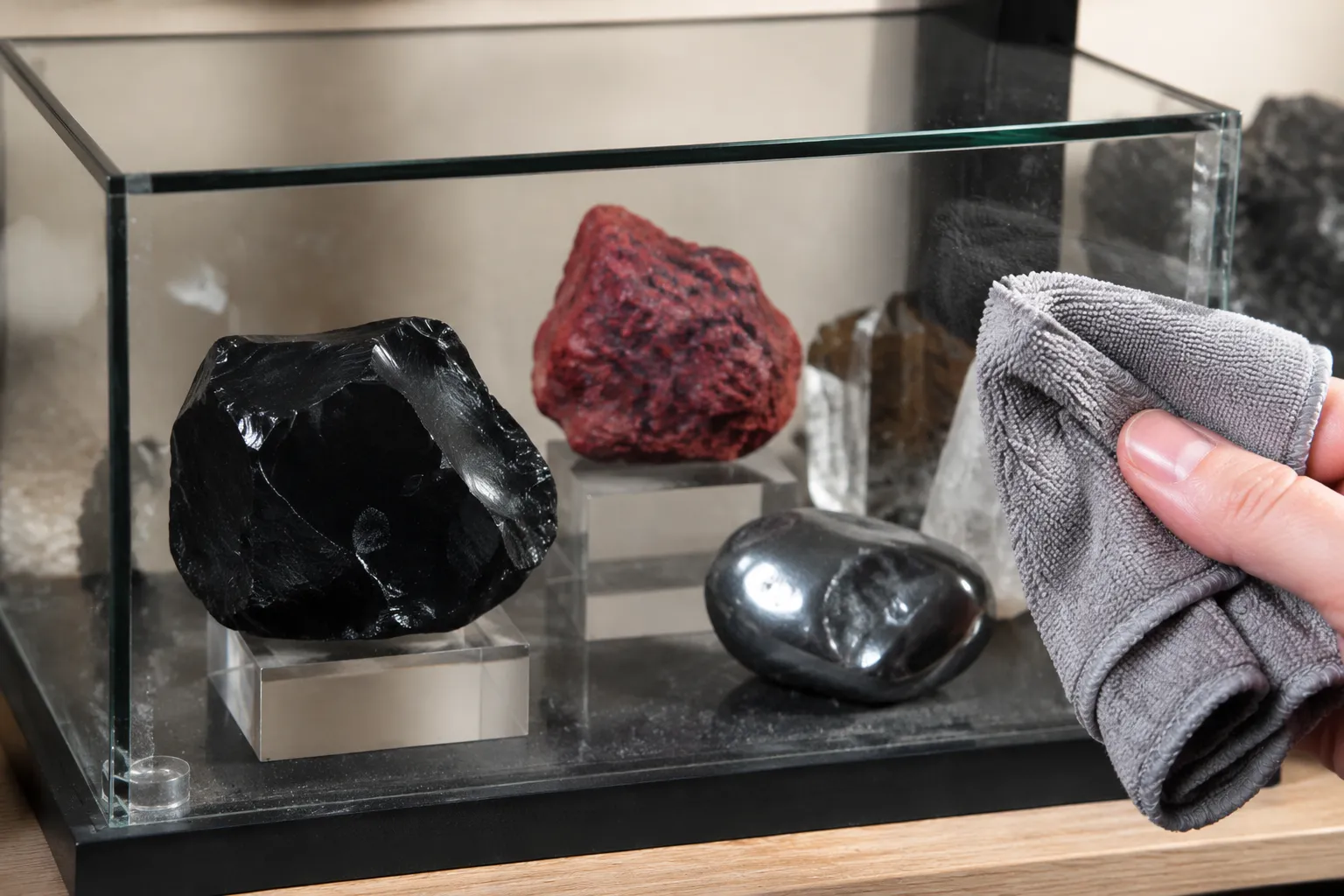
Choose a display box for crystals when the main issue is control. A covered crystal display reduces direct handling, slows dust buildup, and makes the arrangement less tempting to touch. That matters more when the piece is fragile, powdery, unusually sharp, hard to clean, or safety-sensitive.
A useful home rule is this: if the crystal can sit securely, be cleaned without much handling, and is not a cinnabar or uncertain red specimen, an open shelf may be reasonable. If the piece makes you think, "Please do not touch that," use a crystal display box, curio cabinet, shadow box, or another closed area.
How obsidian, cinnabar, and hematite change the answer
Obsidian is volcanic glass, so the open-shelf question is mostly about surface, edge, and placement. Polished black obsidian shows fingerprints and smudges easily, and chipped or flaked edges can be sharp. An obsidian open shelf can work when the piece has a stable base, does not sit near a traffic path, and does not need constant repositioning during cleaning. If the piece is thin, pointed, chipped, or tempting to pick up, a covered case is the better display habit.
Black shelves also make dust more visible. That can make a display look untidy faster, which usually leads to more cleaning and more handling. For obsidian, fewer unnecessary touches are usually better for both the finish and the edges.
Cinnabar needs the narrowest handling margin. Mineral references identify cinnabar as mercury sulfide, and mineral keys often describe it by its vermilion to dark red color, dark red streak, relatively low hardness, and high specific gravity. Those cues can help explain why a red specimen raises caution, but they should not become a home testing routine. Do not scrape, grind, polish, or make dust from cinnabar to check it.
For a cinnabar display box, think in plain home terms: covered, separated, stable, away from food areas, away from heat and direct sun, and not easy for children, pets, or visitors to handle. Wash hands after handling. If the piece is raw, dusty, damaged, or uncertain, keep it covered and handle it less. The box reduces contact and dust, but it does not certify the specimen.
Hematite usually sits between obsidian and cinnabar in this decision. It is commonly sold for its metallic gray look, dense feel, polish, and luster. A hematite display case makes sense when the piece is glossy enough to show fingerprints, small enough to roll or slide, or part of a bead strand or carving that gets handled often. An open shelf can still work for a stable hematite specimen or palm stone, provided it rests on a secure surface and does not sit where it can be knocked down.
For hematite, visible cues can suggest finish and condition, but they do not prove naturalness, coating type, or exact identity. Display choice should solve the home problem in front of you: dust, touch, stability, and access.
When an open shelf is reasonable
An open shelf for crystals is most reasonable when the display passes four checks.
- The piece should be physically stable. Spheres need stands, towers need flat bases, and irregular specimens may need a low support, cushion, or shallow tray. Museum storage guidance often emphasizes stability, restraint, cushioning, and protection from falls. In a home crystal shelf, that means no wobbling, no leaning towers near the edge, and no crowded rows where one piece can push another.
- The surface should be easy to clean without moving every crystal each time. Dust and fingerprints are not just cosmetic issues. They create repeated handling. If a shelf needs constant wiping, a covered display box may be more practical than an open arrangement that has to be dismantled every week.
- The shelf should not invite accidental contact. A practical safe crystal display is about location as much as the mineral. Avoid narrow hallway shelves, unstable bookcases, windowsills with strong sun, and low tables where a hand, bag, sleeve, or pet can hit the display. For sharp obsidian, small hematite pieces, or any uncertain specimen, placement matters as much as the container.
- The support materials should be gentle and stable. Unknown foams, sticky pads, painted surfaces, adhesives, rough fabric, and decorative liners can be questionable when they touch specimens for long periods. A soft, clean, non-abrasive support is usually better than a surface that sheds fibers, transfers color, or leaves residue. That matters especially in a shadow box display or fabric-lined case.
If an open shelf fails more than one of these checks, a covered option is usually the cleaner choice.
When a covered display box is the better choice
A covered display box is the better choice when the crystal needs separation more than access. That includes cinnabar, sharp obsidian, crumbly or dusty specimens, small rolling pieces, fragile carvings, and pieces that attract frequent handling. It also includes homes where visitors are likely to pick things up, or where children and pets can reach the shelf.
For cinnabar, a covered or closed display is usually the more sensible default. The reason is not that every red specimen can be judged from appearance or that every case has special protective properties. The reason is simpler: cinnabar is tied to mercury sulfide identity, and cautious handling means reducing touch, dust disturbance, and casual access. Keep it out of food-prep areas. Do not clean it with aggressive rubbing. Do not heat it, scrape it, or place it where direct sun and temperature swings are part of the display.
For obsidian, a box becomes useful when the piece has sharp edges, a fragile tip, or a high-gloss surface that shows every fingerprint. A covered display can also help when black obsidian sits on dark shelving and dust is visually distracting. The box reduces the cleaning cycle.
For hematite, a hematite display case is practical when the piece is polished, small, heavy for its size, or arranged with other pieces that could knock against it. Hematite can look sturdy, but a dense stone rolling off a shelf can still damage flooring, furniture, or the specimen itself. Stable placement matters before styling.
A curio cabinet can work well when you want visibility with reduced access. A small specimen case can work for one sensitive piece. A shadow box display can work for flat-backed or supported pieces, provided the backing and attachments do not rub, shed, or leave residue. The product name matters less than whether the setup prevents falls, dusting problems, and casual handling.
Common misunderstandings
The phrase "safe crystal display" can be misleading in shopping language. A case can make a display more controlled, but it cannot make broad promises about a mineral's identity, condition, or suitability for every home. Retail terms such as crystal display box, protective case, storage box, fabric bed, or adjustable display case describe format and presentation. They do not prove that the materials touching the specimen are appropriate for cinnabar, obsidian, or hematite.
"Airtight" is another phrase that can create confusion. Some readers arrive at cinnabar display questions after seeing anxious online comments about glass, heat, sunlight, and vapor. The available material supports caution around cinnabar handling and avoiding dust-producing actions, heat, and unnecessary contact, but it does not support a universal rule that every home cinnabar specimen requires an airtight case. If a specimen's identity, condition, or safety is genuinely uncertain, a cautious closed display and less handling are reasonable, and specialized advice may be needed for certainty.
Another misunderstanding is that display choice proves authenticity. It does not. A covered box can protect an arrangement from dust and fingers, but it cannot verify cinnabar, obsidian, or hematite. Visible signs may include color, luster, texture, polish, and weight impression, but these can suggest rather than prove. For certainty, specialized testing may be needed, especially when a seller description, coating, dye, or composite material is in question.
Protective crystal meaning belongs in the personal or cultural layer of the display. You can arrange obsidian, cinnabar, and hematite in a way that fits your practice or symbolism, but the shelf or box should be chosen for material handling, access, dust, and stability. The display should not be treated as a guaranteed outcome.
Quick check before you decide
Look at the exact spot, not just the crystal.
If the display is high, stable, dry, away from food, away from strong direct sun, and not in a traffic path, an open shelf may work for sturdy obsidian or hematite. Use stands or low supports where needed, leave space between pieces, and avoid placing heavy or sharp specimens near the front edge.
If the display is low, crowded, dusty, near a window, close to a kitchen area, or easy for others to touch, move sensitive pieces into a covered crystal display. That is the better route for cinnabar and for any specimen that would need a warning every time someone visits. A closed cabinet or display box is also easier when cleaning the room would otherwise require lifting and resetting many pieces.
Check the base, the edge, and the cleaning routine. Those three details usually decide more than the label on the case.
FAQ
Is an open shelf fine for obsidian?
Yes, if the piece is stable, not too sharp, and not in a high-traffic spot. If it shows fingerprints easily or has a fragile tip, a covered case is easier to live with.
Should cinnabar always be in a display box?
A covered display is usually the more cautious choice. It reduces handling and dust, which is the main point for a mercury sulfide specimen.
Does a display box make a crystal safe by itself?
No. It can reduce contact and dust, but it does not verify identity or remove every concern.
The best choice is not the most dramatic case or the most open arrangement. It is the setup that keeps the piece stable, reduces unnecessary handling, and leaves uncertainty where it belongs: visible, cautious, and not overstated.
Sources
Sources and further reading
Reference links are limited to sources considered suitable for public citation in this page.