
ProtectCrystal handling note
Display and storage decisions
Safe Display and Storage Around Crystal Handling Risks
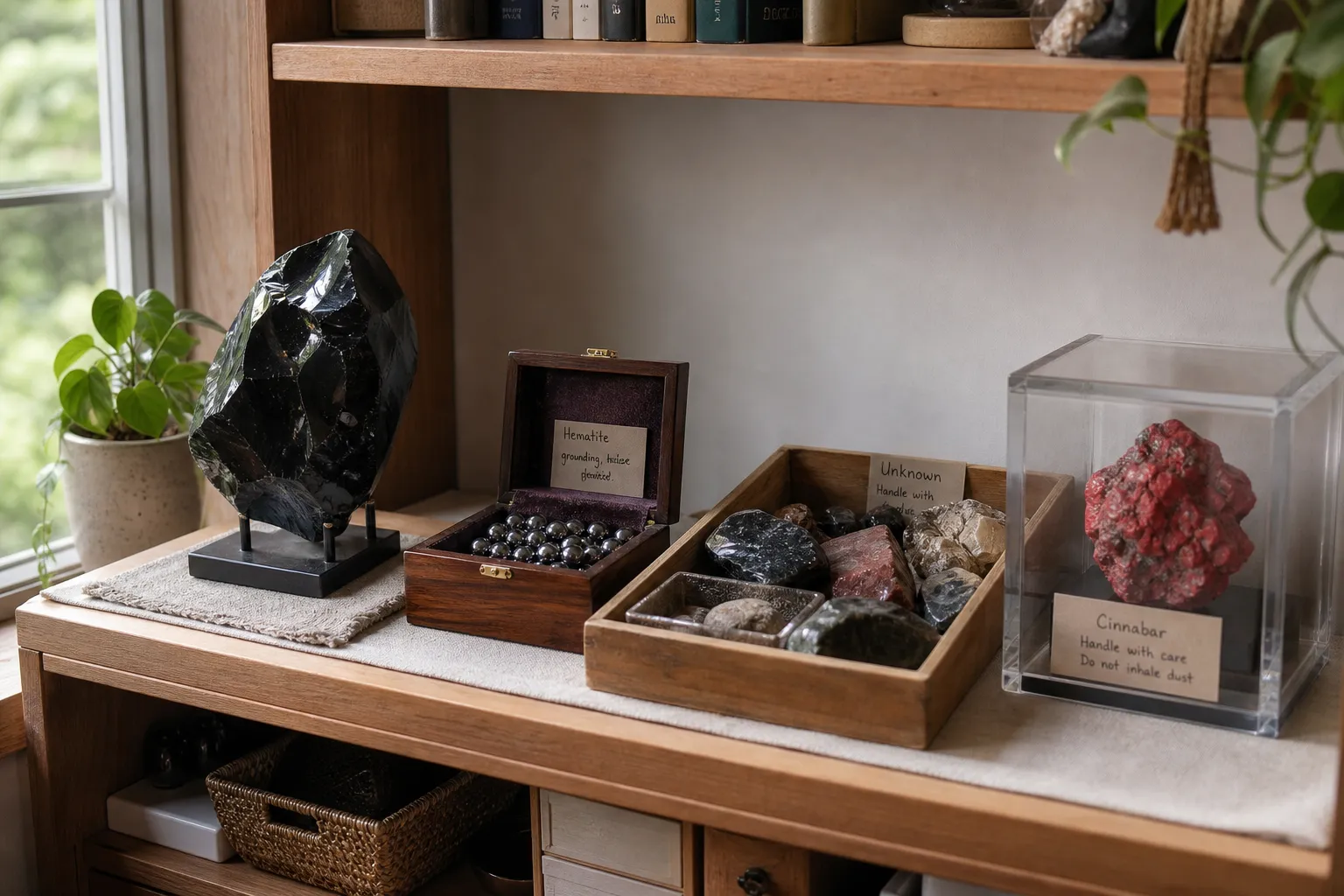
A mixed crystal shelf can look calm while holding very different handling questions: a glossy obsidian point with a chipped edge, a red specimen sold as cinnabar, loose hematite beads, and dusty unknown stones resting in the same bowl. Safe crystal display and storage is less about making a collection look cautious and more about deciding which pieces can be touched casually, which need a barrier or label, and which should wait in separate storage until you know more.
The answer changes most when a piece is cinnabar-labeled, powdery, broken, small enough to swallow, handled often, or easy for children or pets to reach. Protective crystal language may describe personal or cultural meaning, but it cannot prove identity, material condition, authenticity, or handling suitability.
upward
Read the full overview first
Use the broader guide first if you need the full scope before this page.
Start With Access, Not Meaning
Before arranging obsidian, cinnabar, and hematite together, sort the collection by handling concern rather than by color, intention, or shelf theme. A display can still look personal and beautiful, but higher-concern pieces should not sit where guests naturally pick them up.
Cinnabar-labeled specimen
Better display choice: closed display case or clearly labeled separate container. The answer changes because cinnabar is commonly described as mercury sulfide and a mercury ore, so casual touch display is a poor default.
Unknown red dusty mineral
Better display choice: enclosed, labeled as unknown, and kept separate. Red color can suggest possibilities but cannot prove identity.
Broken obsidian
Better display choice: stable stand, padded box, or separated tray. Sharp edges and falling pieces are the main concern.
Loose hematite beads
Better display choice: closed pouch, bead box, or lidded organizer. Small bead access matters around children and pets.
Polished low-dust stones with stable edges
Open shelf display may be reasonable when access, dusting, and stability are controlled.
This is not a lab identification system. It is a household triage method: what can sit openly, what should be enclosed, what needs a warning label, and what should stay out of the main touch area.
For cinnabar, be stricter. For obsidian and hematite, match storage to shape, size, surface condition, and access.
Should Cinnabar Be Stored in a Closed Display Case?
A cinnabar closed display case is usually the more cautious household choice when a piece is labeled as cinnabar, looks dusty or soft, has loose particles, or may be handled often. Conservation research and museum collection guidance support extra care around cinnabar-containing or mercury-containing objects, especially around handling, storage, exhibition, transport, and labeling. Those sources do not test a collector’s exact specimen, but they do support a careful home boundary.
Cinnabar is commonly described as mercury sulfide. It may appear bright scarlet, brick red, granular, earthy, massive, or crystalline. It is also often described as relatively soft, around Mohs 2 to 2.5. A soft, dusty, scraped, or powdery surface changes the handling question more than color alone.
A closed case does not make a cinnabar display free of concern. It reduces casual contact, helps contain loose particles, and gives you a place to keep a clear label visible. If the piece is shedding, damaged, recently cleaned with unknown products, or described with uncertain seller wording, separation matters more than styling.
Avoid these actions with cinnabar-labeled or unknown red mineral pieces
- Do not cut, grind, sand, polish, or drill them at home.
- Do not heat them or place them near high-heat display lighting.
- Do not use acid cleaning or harsh chemical experiments.
- Do not place them near food, drink, mouths, or children’s activity areas.
- Do not brush dust aggressively into the air.
- Do not rely on seller reassurance alone.
If ingestion, suspected exposure, inhaled dust, broken-skin contact, or a child or pet incident is involved, do not use a crystal article as care guidance. Contact poison control, local hazardous-material guidance, appropriate veterinary or medical help, or a qualified safety professional for your location.
Cinnabar belongs in a limited-handling display plan, not in a passing-around tray.
Can You Display Cinnabar With Obsidian and Hematite?
You can visually arrange cinnabar, obsidian, and hematite in the same display theme, but they do not all need the same physical access. The display can be shared; the handling zone should not be.
For example, a shelf might show black obsidian, metallic-looking hematite, and red cinnabar together as protective crystals in a personal or cultural sense. The better arrangement is to place the cinnabar-labeled piece inside a small closed case or lidded acrylic box, while polished obsidian and larger hematite stones sit on stable stands nearby. The color story stays intact, but the higher-concern material is not part of an open touch display.
A mixed crystal bowl is a different choice. Keeping cinnabar in a mixed bowl is a poor default because bowls invite rummaging, rubbing, dust transfer, and unlabeled handling. If a red stone might be cinnabar, or if the label has been lost, place it in its own small container with a temporary note such as “unknown red mineral — limit handling.” That wording does not prove danger or identity. It preserves caution until better identification is possible.
Obsidian and hematite do not need separate pouches simply because they are different stones. Separate them when the reason is practical: sharp obsidian edges, polished surfaces you want to protect, loose beads, or pieces that scratch each other. Hematite beads and small tumbled stones are better in a closed pouch or bead box when children or pets can access the area.
The display question is not only “Can these stones be near each other?” It is “Who can touch them, how often, and what happens if one breaks, sheds, rolls, or falls?”
How to Label Cinnabar in a Crystal Collection
A label for a cinnabar crystal collection should be plain, visible, and useful to someone other than you. Museum-style guidance often emphasizes labeling and object tracking for mercury-containing materials; a household version can be simpler without becoming vague.
Use two labels when possible: one near the display position, and one on the storage container. The label should record what you know and what remains uncertain.
- “Sold as cinnabar”
- “Cinnabar-labeled specimen”
- “Unknown red mineral — do not handle casually”
- “Keep enclosed; limit dust and contact”
- “Do not cut, polish, heat, or clean with acids”
Avoid labels that sound more certain than your evidence. A seller name, red color, or old handwritten tag can suggest an identity, but it cannot settle the question by itself. For certainty, specialized testing may be needed.
Labeling also helps when the collection changes hands, moves house, or gets rearranged. A red specimen without context can easily become a casual touch object later. A clear label prevents storage choices from depending on memory.
For cinnabar, the label is part of the storage system.
Open Shelf vs Display Box for Obsidian, Cinnabar, and Hematite
Open shelf vs display box decisions work best when you compare access, dust, stability, and handling frequency. Beauty matters. So does the route a hand, paw, sleeve, duster, or falling object might take through the shelf.
An open shelf can work well for larger polished stones that are stable, clean, and not easily swallowed. It also works when the shelf is away from heavy traffic and the pieces are not constantly picked up. Obsidian on an open shelf needs attention to edges and balance. A polished palm stone is a different storage problem from a thin blade-like shard or chipped point.
A display box is better when a piece should be visible but not touched often. This is the stronger default for cinnabar-labeled specimens, unknown dusty minerals, fragile fragments, loose beads, and items that need a label attached to their position. Clear boxes and stands can keep the collection visible while reducing unnecessary handling.
A drawer or closed storage box is better when a piece is waiting for identification, shedding dust, broken into small parts, or not stable enough for display. Chipped crystal piece storage should prevent cuts, mixing, and lost context. Wrap sharp obsidian fragments separately, avoid shaking them together with polished stones, and add a temporary note if the material or condition is uncertain.
Display stands can make handling easier when they reduce tipping, rolling, and repeated repositioning. They can also create a false sense of control if the stand is too small, placed near an edge, or used for a piece that sheds. Match the stand to the stone’s weight, base shape, and traffic around the shelf.
A good display does not invite every stone to be touched.
Where Not to Display Cinnabar at Home
Where not to display cinnabar is easier to answer than where it belongs. Do not place cinnabar-labeled or unknown red powdery pieces where contact is frequent, labels are hidden, or cleaning is rough.
Poor choices include
- Kitchen counters, dining areas, or drink stations
- Children’s rooms, pet-accessible shelves, and low tables
- Open bowls used for mixed crystal handling
- Sunny windowsills with heat buildup
- Near candles, incense burners, hot lamps, or heat-heavy display lights
- Bathrooms or areas where cleaning sprays and humidity are common
- Crowded shelves where pieces scrape or fall during dusting
Online cinnabar discussions often narrow the issue to heat. Heat matters, but it is not the only household variable. Dust, abrasion, cleaning methods, mouth contact, uncertain identity, children, pets, and repeated handling also change the decision. A closed case may reduce contact, but it should still be stable, labeled, and kept away from heat or rough cleaning.
If a cinnabar-labeled specimen is powdery or damaged, do not try to improve it by polishing or washing it without qualified advice. Store it separately and reduce disturbance.
For cinnabar, display location is part of handling control.
How to Dust Around a Crystal Display Without Extra Handling
Dusting is where display choices become handling choices. A shelf that looks low-contact may still require frequent lifting, wiping, and rearranging. That matters most for cinnabar-labeled pieces, unknown dusty minerals, sharp obsidian, and tiny beads.
For lower-concern polished stones, remove one piece at a time, wipe the shelf gently, and return the piece to the same stable position. Avoid rushing through a crowded arrangement where stones knock into each other. If a stone has a fragile point, a chipped edge, or a slippery polished base, use both hands and keep it low over a soft surface.
For cinnabar-labeled or unknown red minerals, avoid dry brushing that pushes particles into the air. Do not blow dust off the specimen. Do not use abrasive cloths, polishing compounds, acids, or cleaning experiments. If the display case is dusty, clean the outside first and limit opening it unless necessary.
For hematite beads, dusting often becomes a spill problem. Beads roll, scatter, and disappear under furniture. Keep loose beads in a lidded organizer, pouch, or compartmented box rather than on an open tray. If beads are part of jewelry, store them where clasps, elastic, and loose strands can be checked before handling.
The easiest display to clean is usually the one with fewer touch points.
Visual Identification Limits: Red, Black, and Metallic Are Not Enough
Crystal storage safety often fails when a visual cue becomes a conclusion. Red does not automatically mean cinnabar. Metallic gray or black does not automatically mean hematite. Glassy black does not settle every obsidian question either.
Open geology education materials commonly teach mineral identification through multiple properties, not color alone. Streak, luster, hardness, density, crystal habit, fracture, and other features can all matter. Even then, home observation may only suggest a possibility. It may not prove identity, treatment, coating, or safety.
Hematite is a useful example because it can appear dull red in some forms and metallic silvery black in others. That variation makes color-based sorting unreliable. Cinnabar can also appear in several red forms, and red decorative objects may be sold with names that do not give enough material certainty. Seller wording is a clue, not a final answer.
Use visual cues for sorting, not overconfidence
- Red, soft-looking, dusty, or cinnabar-labeled pieces go into a higher-caution group.
- Metallic-looking beads go into a small-object access group.
- Glassy broken obsidian goes into a sharp-edge group.
- Unknown specimens with missing labels go into a separate “identify later” group.
If a piece would change how you handle, display, sell, gift, or clean it, uncertainty is enough reason to pause. You do not need certainty before choosing a more cautious container.
A Simple Arrangement Framework for Mixed Crystal Shelves
The visible low-contact zone
This zone is for stable, larger, clean pieces that do not need frequent moving. Polished obsidian, larger hematite stones, and other sturdy display pieces may fit here if they are not sharp, unstable, or accessible to children and pets.
The enclosed caution zone
This zone is for cinnabar-labeled specimens, unknown red minerals, dusty stones, fragile pieces, and anything with a label that should stay attached. Use a closed display box, specimen case, or lidded container. Keep the label visible.
The sorting zone
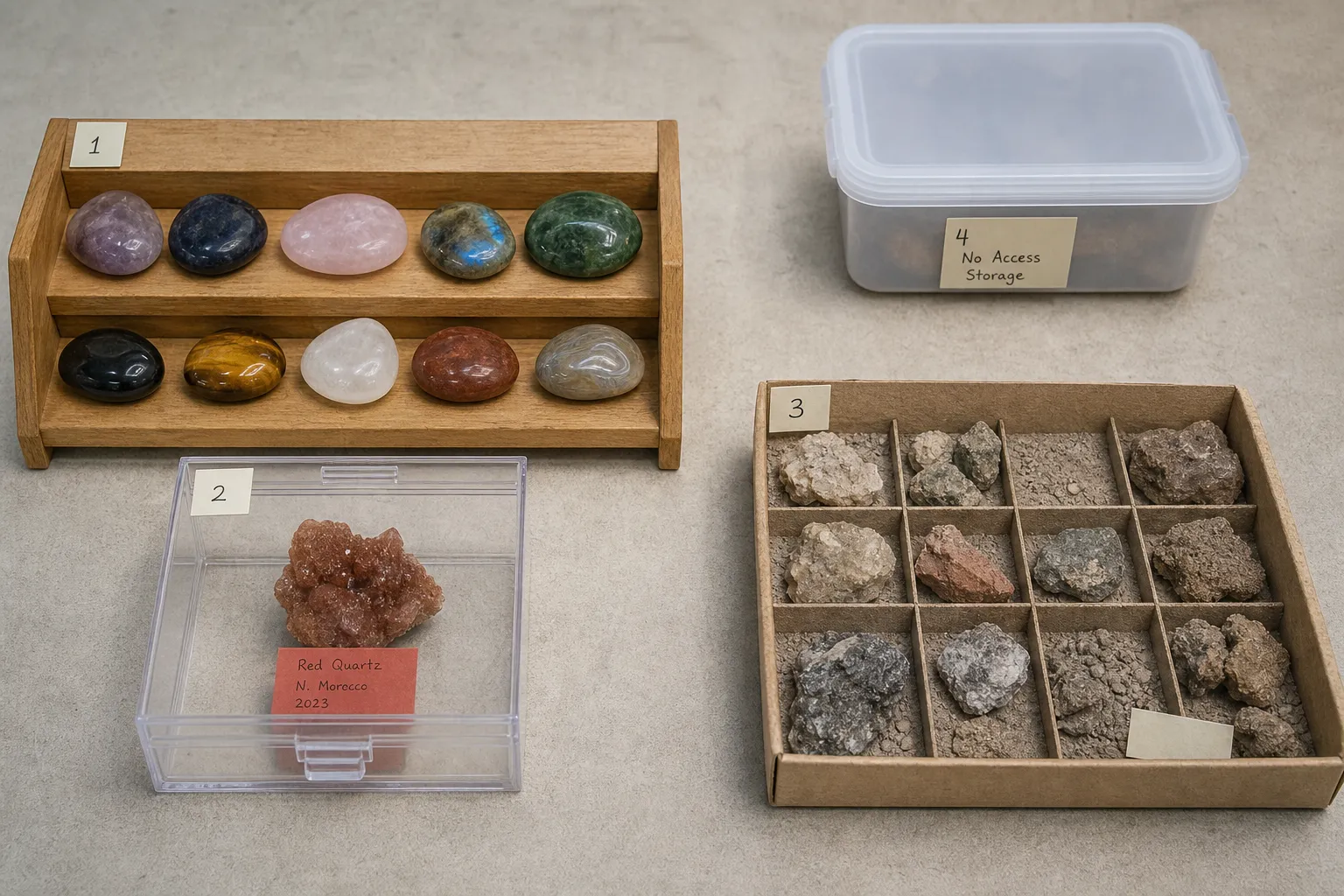
This temporary storage is for chipped crystal pieces, unknown minerals, broken strands, loose beads, and items that need better notes. This box should close securely and should not become a decorative mixed bowl.
The no-access zone
This zone is for pieces that should not be reached casually: small beads, sharp fragments, powdery material, and anything connected to suspected ingestion, dust inhalation, or uncertain exposure. If the situation has already moved beyond display, seek appropriate local guidance.
This framework keeps aesthetics in the room while stopping the most uncertain pieces from becoming the most handled pieces.
Common Mix-Ups That Lead to Poor Storage Choices
One common mix-up is treating a display case as purely decorative. A case can showcase a collection, but for higher-concern pieces it also controls access, dust movement, handling frequency, and label visibility. If it does not do those things, it is only a cover.
Another mix-up is treating “not heated” as the whole cinnabar rule. Heating is a meaningful concern, but it is not the only household variable. Dust, abrasion, cleaning methods, children, pets, mouth contact, and uncertain identity still matter.
A third mix-up is assuming that protective crystal meaning changes material handling. A collector may choose obsidian, cinnabar, or hematite for personal symbolism, tradition, or display intention. That context does not replace physical checks. Sharp edges still cut. Loose beads still roll. Cinnabar-labeled pieces still deserve caution.
The last mix-up is using seller confidence as storage confidence. Marketplace names and old labels can help you decide what to investigate, but they cannot prove identity or rule out handling concerns. When the label and the material condition disagree, store by the more cautious interpretation.
Better storage starts when meaning, marketing, and mineral condition stay in separate lanes.
Practical Answers to Leftover Display Questions
Can you keep cinnabar in a mixed crystal bowl?
A mixed bowl is a poor default for cinnabar-labeled pieces because it encourages rubbing, rummaging, and unlabeled handling. Use a separate closed container or display case with a clear label instead.
How should you store an unidentified red crystal that might be cinnabar?
Treat it as an unknown higher-caution specimen: keep it enclosed, label it as unknown, avoid dust-making actions, and do not cut, polish, heat, or acid-clean it. If the identification affects a serious decision, seek qualified help.
Do obsidian and hematite need separate storage pouches?
Not always. Separate them when obsidian has sharp or chipped edges, when polished surfaces may scratch, or when hematite beads are small enough to spill, roll, or be swallowed by children or pets.
Can crystal display stands make handling safer?
They can help when they reduce rolling, tipping, and repeated repositioning. They are not enough for dusty, cinnabar-labeled, unstable, or poorly labeled pieces that need enclosure or separation.
The Safer Display Rule
A safer crystal display is not the one with the most expensive case. It is the one where each piece’s access level matches its condition: open for stable low-contact stones, enclosed for cinnabar-labeled or uncertain pieces, separated for sharp fragments, and secured for small beads.
You can check color, luster, texture, shape, dust, edges, labels, and seller wording. You cannot prove identity, safety, or authenticity from those cues alone. When the material is cinnabar-labeled, dusty, unknown, broken, or easy to mishandle, choose the storage option that limits contact first and styling second.
Sources
Sources and further reading
Reference links are limited to sources considered suitable for public citation in this page.