
ProtectCrystal handling note
Where Not to Display Cinnabar in a Home Crystal Setup
A red cinnabar specimen can look striking beside black obsidian or metallic gray hematite, but it belongs in a lower-contact part of the home. The practical answer to where not to display cinnabar is: avoid kitchens, dining surfaces, bathrooms, children’s rooms, pet-accessible shelves, bedside handling spots, open trays, pocket-stone bowls, high-traffic ledges, humid windowsills, and any place where the piece may be touched often, scratched, dropped, dampened, or cleaned aggressively.
A better cinnabar home display is dry, stable, labeled, and handled rarely. A closed display case, a labeled storage box, or a steady collector shelf makes more sense than a frequently rearranged altar, desk object, or tray of touch stones.
upward
Start with the broader guide
Use the broader guide first if you need the full scope before this page.
Why Cinnabar Needs a Different Placement Rule
Cinnabar is not just a decorative red stone name. Mineral references such as Mindat describe cinnabar as a mercury sulfide mineral, and PubChem identifies mercury sulfide as a chemical compound. That is the reason cinnabar storage precautions are more cautious than the routine care used for many polished quartz, obsidian, or hematite pieces.
The main home-display issue is not that a quiet specimen behind glass is automatically a problem. The practical concern is disturbance: dust, residue, damaged surfaces, abrasion, repeated handling, and breakage. NIOSH/CDC material on mercury compounds supports a conservative handling boundary for that material family, especially where dust or repeated contact may be involved. A crystal shelf does not need to become a workplace safety setup, but the mineral identity still argues against casual, high-touch placement.
The short rule is simple: keep cinnabar dry, intact, low-touch, away from food, and out of reach of children and pets.
Places to Avoid in a Cinnabar Home Display
Kitchen Counters, Dining Tables, and Food Areas
Do not display cinnabar near food preparation, drink stations, spice shelves, fruit bowls, dining tables, or serving trays. Kitchen objects get moved, wiped, splashed, handled with damp hands, and set beside food-contact items. A cinnabar specimen should not share that zone.
This also applies to open shelving above counters or coffee stations. Even if the specimen is not touching food, the shelf may still collect cooking residue, steam, and cleaning spray. Cinnabar near food adds avoidable contact and cleaning problems.
For a home crystal setup, keep cinnabar separate from eating and preparation surfaces.
Bathrooms, Sinks, and Humid Windowsills
Bathrooms are poor display locations for cinnabar because they combine moisture, cleaning products, towels, and frequent wiping. A bathroom shelf may seem quiet, but it is still a damp, high-cleaning environment. Cinnabar moisture exposure is an easy condition to avoid.
The same caution applies to windowsills that collect condensation, plant water, or direct cleaning spray. A sunny ledge can also be unstable if plants, curtains, or daily opening and closing disturb the area. The concern is not sunlight symbolism; it is moisture, movement, and surface stress.
Dry placement is the better habit.
Children’s Rooms and Pet-Accessible Shelves
Cinnabar around children and pets should be treated conservatively. Do not place it in a child’s bedroom, play area, low shelf, open basket, bedside tray, or any spot where it may be picked up out of curiosity. The same applies to cat-accessible shelves, low tables, windowsills, and open display boards.
This is not about assuming every specimen will behave the same way in every home. It is about removing predictable handling routes. Small, bright mineral pieces can invite touching, carrying, mouthing, dropping, or mixing with toys and other stones. Pets can also knock pieces down or drag them into places where residue and fragments become harder to manage.
If children or pets can reach it, choose a different location.
Bedside Tables, Meditation Trays, and Pocket-Stone Bowls
Cinnabar is sometimes sold or arranged within protective crystal language, but that use context should not override material handling. Avoid putting cinnabar in places designed for frequent contact: bedside bowls, palm-stone trays, pocket-stone dishes, under-pillow setups, carry pouches, or rotating grids that you handle every day.
This is where cinnabar differs from a polished obsidian worry stone or a hematite bead strand. Obsidian and hematite still have care limits, but cinnabar gives you a stronger reason to avoid repeated skin contact, rubbing, and casual handling. A cinnabar specimen is better treated as a display or collector object than as a touch object.
Personal meaning can stay personal. Physical placement should stay low-contact.
High-Traffic Ledges and Unstable Collector Shelves
Avoid narrow ledges, hallway shelves, crowded mantels, leaning bookcases, speaker tops, and any surface where a bump could send the specimen down. A drop can chip edges, expose fresh surfaces, or create small fragments. Cinnabar scratched or abraded is exactly the condition a careful display should avoid.
A stable collector shelf can work better, but only if it is not crowded with pieces that scrape against one another. Do not place cinnabar loose in a mixed bowl of tumbled stones, and do not let it rest where harder minerals may rub against it during rearranging. If a specimen is soft, crumbly, powdery, or already damaged, store it more cautiously instead of making it an open display piece.
The safer display is steady, separated, and rarely moved.
Better Places for Cinnabar
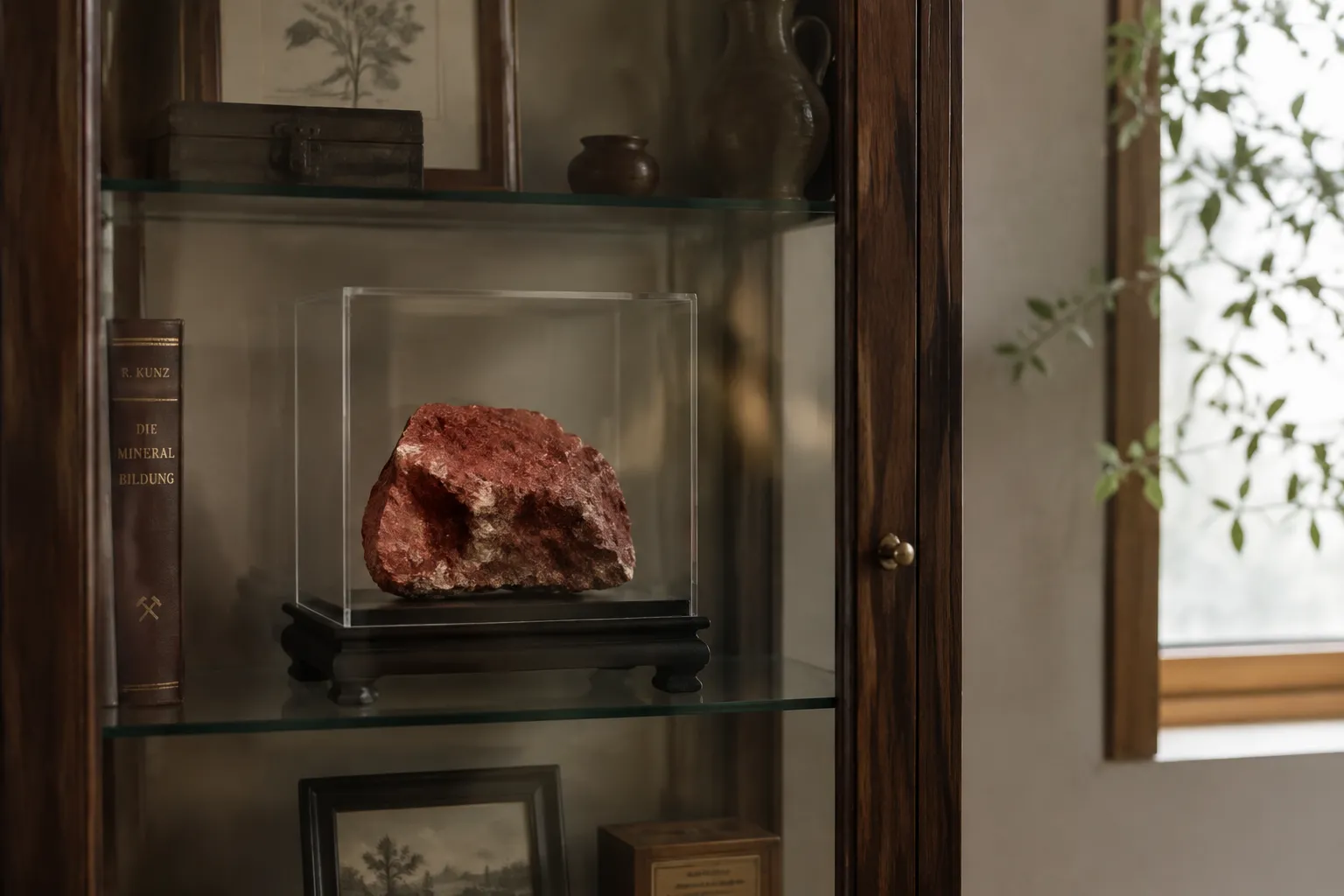
A closed cinnabar display case is usually the clearest placement choice for a home crystal setup. It keeps the specimen visible while reducing casual touching, dusting, pet contact, and shelf movement. The case does not need to be elaborate; the important features are stability, separation, and a lid or door that limits handling.
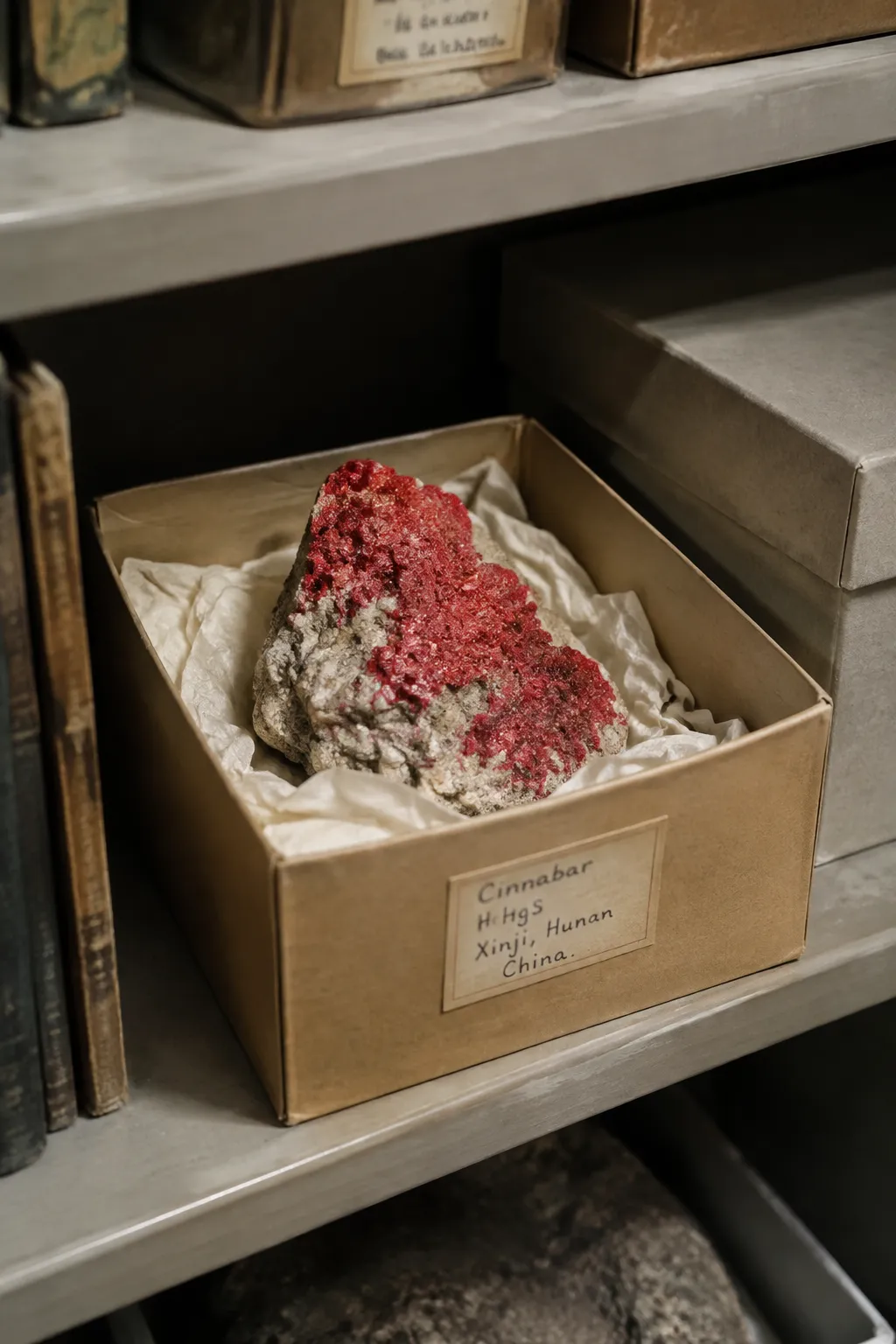
A cinnabar labeled storage box is another good option, especially for small pieces, rough specimens, beads, or items sold as cinnabar without formal testing. Use a label that makes the handling rule obvious: cinnabar, keep dry, handle minimally. A label helps future you, visitors, or family members avoid treating it like an ordinary red pocket stone.
A stable collector shelf can also be reasonable if the specimen is set back from the edge, away from food areas, away from moisture, and not mixed into a loose tray. If the piece sits on a small stand, make sure the stand does not scrape it. If you use a liner, choose something clean and dry rather than fabric that sheds fibers or invites frequent washing.
For safe cinnabar placement in a practical sense, think: visible if desired, but not interactive.
What Changes the Answer
The placement rule becomes stricter when the cinnabar is loose, rough, powdery, chipped, scratched, or mounted in a way that encourages touch. A polished surface or decorative carving does not prove that the item is low-concern, and seller wording does not settle the question. Many pieces are commonly sold as cinnabar, but appearance alone cannot confirm identity, composition, or handling suitability. For certainty, specialized testing may be needed.
The rule also becomes stricter in homes where display objects are often moved, cleaned by multiple people, handled by guests, or arranged in active crystal routines. If you rebuild your crystal grid every week, dust shelves often, or keep stones in open bowls for tactile use, cinnabar does not fit that format well.
The answer may be less restrictive for a clearly labeled, intact specimen kept behind glass in a dry, stable cabinet. Even then, the evidence here does not support exact household exposure thresholds or a promise that any particular display is acceptable in every home. The sources support cautious placement logic, not personalized exposure conclusions.
When the setup invites touch, choose a different stone for that role.
Common Confusion About Cinnabar Placement
One common confusion is treating cinnabar like any other red crystal because it appears in protective crystal displays. Crystal meanings can be part of personal or cultural practice, but they do not change mineral identity. If a display is meant to feel protective, that does not make frequent handling, food proximity, or damp placement a good idea.
Another confusion is assuming that polished cinnabar beads, carvings, or lacquer-like red items are automatically the same thing as a stable mineral specimen. Marketplace language can be loose. Some items are often described as cinnabar, some may be imitation or composite material, and some may involve other red substances entirely. Visual signs may include strong red color and a distinctive mineral look, but that can suggest, not prove, what the object is.
A third confusion is overreacting in the other direction and treating every existing display as a crisis. The available source set supports conservative placement precautions, not panic. If you already own cinnabar, the practical step is to reduce avoidable contact: move it away from food, moisture, children, pets, and high-traffic surfaces; avoid rubbing or scratching it; and place it in a labeled, dry, stable location.
Caution is the point. Drama is not needed.
A Quick Placement Check
Before adding cinnabar in a home crystal setup, ask these questions:
- Will anyone touch this piece often?
- Could a child or pet reach it?
- Is it near food, cups, dishes, or preparation surfaces?
- Will it be exposed to sink spray, bathroom humidity, plant water, or condensation?
- Could it fall, scrape against other stones, or be knocked from the shelf?
- Does the surface look dusty, crumbly, chipped, scratched, or damaged?
- Would someone clean the area with sprays, wet cloths, or vigorous wiping?
- Is the piece labeled clearly enough that another person would know not to handle it casually?
If any answer points toward frequent contact, moisture, abrasion, or confusion, do not use that location. Put cinnabar in a closed display case, labeled storage box, or stable low-touch collector shelf instead.
Evidence Limits
The visible support for this advice comes from three source types: mineral identity references for cinnabar, chemical identification for mercury sulfide, and conservative safety guidance around mercury compounds. That is enough to support careful home placement boundaries around dust, damage, abrasion, moisture, repeated contact, food proximity, children, and pets.
It is not enough to give exact household exposure thresholds, personalized health guidance, legal conclusions, formal specimen authentication, or claims about real-world outcomes from a specific crystal display. This page also does not treat cinnabar’s protective meaning as a verified effect. It treats that language as a reason readers may own or arrange the stone, while the placement advice stays grounded in material handling.
The useful home rule remains narrow: do not display cinnabar where it will be touched, dampened, scraped, dropped, cleaned aggressively, or placed near food or vulnerable reach zones. Keep it dry, labeled, stable, and low-contact.
Sources
Sources and further reading
Reference links are limited to sources considered suitable for public citation in this page.