ProtectCrystal handling note
Buyer reading guide
How to Read Crystal Seller Meaning Claims for Black Obsidian, Hematite, and Cinnabar
When a listing says black obsidian is for “protection,” hematite is for “grounding,” or cinnabar supports “abundance,” read that as seller meaning language first. It may reflect a common crystal-use tradition, but it does not prove a result, prove the stone’s identity, or settle whether the item is appropriate for every kind of handling.
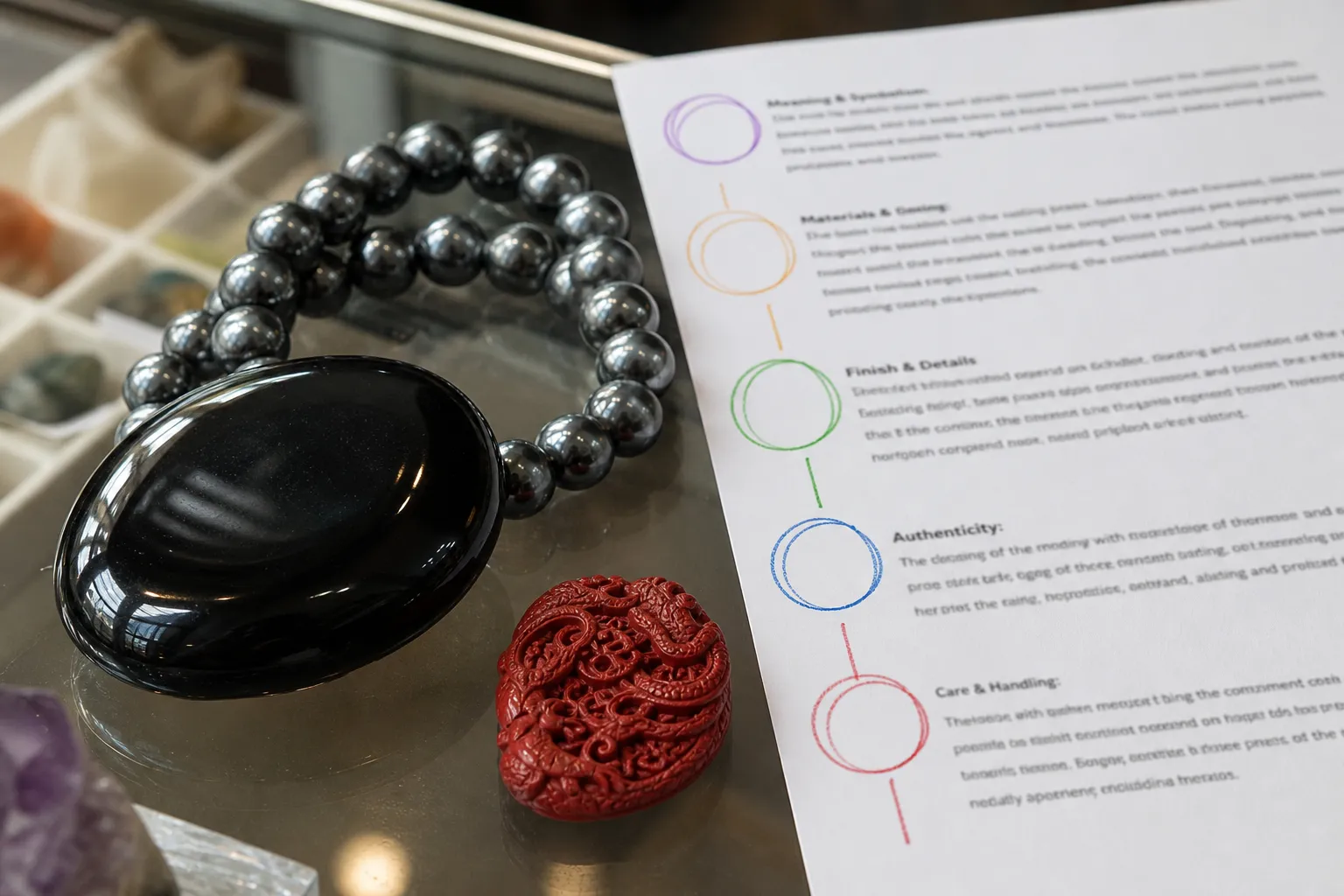
A useful way to read crystal seller meaning claims black obsidian hematite cinnabar listings is to sort the wording into five groups:
upward
Read the full overview first
Use the broader guide first if you need the full scope before this page.
Sort seller wording before you trust it
| Listing wording | How to read it | What it can actually help with |
|---|---|---|
| “Protection,” “grounding,” “transformation,” “vitality,” “abundance” | Spiritual, cultural, or personal-use framing | Shows how the seller positions the item |
| “Volcanic glass,” “iron oxide,” “mercury sulfide” | Material identity wording | Useful if supported, but not proven by the label alone |
| “Polished,” “matte,” “metallic,” “coated,” “dyed,” “resin,” “lacquer-style” | Observable or construction wording | Helps you inspect what is being sold |
| “Original,” “genuine,” “natural,” “authentic” | Authenticity marketing or disclosure wording | Needs supporting detail; photos alone have limits |
| “For water,” “powder,” “daily wear,” “skin contact,” especially with cinnabar | Handling-relevant wording | Needs extra caution; seller confidence is not enough |
This does not mean every meaning-heavy listing is bad. A seller can use familiar crystal language and still give a clear, useful description. The problem starts when the meaning copy replaces material details, handling notes, or honest uncertainty.
Black obsidian: read “protection” as meaning, not verification
Black obsidian is often described in listings with words such as “protection,” “shielding,” “clearing,” “grounding,” and “transformation.” Those phrases are best read as common metaphysical associations. They may explain why the piece is sold as a bracelet, palm stone, talisman, or meditation object. They do not tell you that the item will produce a specific effect.
The more useful material statement is that obsidian is volcanic glass. That gives you a practical visual frame: polished black obsidian often looks glossy, reflective, deep black, and sometimes slightly translucent at thin edges depending on lighting and thickness. These visible signs can support the listing description, but they cannot prove identity by themselves.
Be careful with phrases like “original black obsidian bracelet.” “Original” may sound like a verification term, but many listings use it as marketing language. A stronger listing usually gives concrete details such as bead size, finish, whether the beads are sold as natural obsidian or another black material, whether there is a coating, and what return or testing information is available.
A cleaner read looks like this
- “Protection” = meaning language.
- “Volcanic glass” = material description, useful but not self-proving.
- “Glossy black polished beads” = visible cue to compare with photos.
- “Original” = seller wording that needs support.
- Broad outcome language = not something the listing can verify.
The common mistake is treating the protective meaning as proof that the bracelet is genuine, better made, or more effective. Those are separate questions.
Hematite: “grounding” tells you the story, not the bead construction
Hematite is commonly sold with “grounding,” “balance,” “focus,” “strength,” or “stability” language. As with black obsidian, those phrases are best treated as personal-use or spiritual framing rather than product evidence.
Hematite is generally described as an iron oxide mineral. In bead and crystal listings, it often appears dark gray, blackish, silvery, metallic-looking, or highly polished. Some items sold in the hematite category may be coated, treated, composite, or marketed with magnetic wording. Because seller photos do not settle all of those possibilities, keep the interpretation conservative.
For a hematite listing, give more weight to details such as:
- whether the seller says natural hematite, magnetic hematite, coated hematite, or hematite-colored beads;
- whether the photos show a metallic-looking surface or a very uniform coating;
- whether bead size, finish, and weight impression are described clearly;
- whether “magnetic” is presented as a material feature rather than a spiritual benefit;
- whether the listing gives material information instead of relying only on grounding copy.
“Magnetic hematite” deserves a closer read. Magnetism wording may describe a product feature, but it is not a complete identity check. A heavy, shiny, dark bead may suggest a hematite-style product, but appearance alone does not prove natural hematite.
A practical interpretation would be: the grounding claim tells you how the seller frames the item; the stated material, finish, coating disclosure, bead description, and magnetism wording tell you more about what you may actually receive.
Cinnabar: separate symbolism from handling immediately
Cinnabar listings need a different level of attention. Natural cinnabar is mercury sulfide, so the material question matters more than it does with ordinary meaning copy. At the same time, not every red carved bead called “cinnabar” is a natural cinnabar mineral specimen. In jewelry and decorative markets, the word may also appear in lacquer-style, resin, carved-bead, pigment, or trade-description contexts.
Seller copy may connect cinnabar with “transformation,” “vitality,” “abundance,” alchemical symbolism, red pigment history, or cultural traditions. Read those as cultural, spiritual, or marketing associations. Do not let that language imply that cinnabar should be swallowed, infused in water, powdered, drilled, sanded, burned, or used in any practice that creates dust or liquid contact.
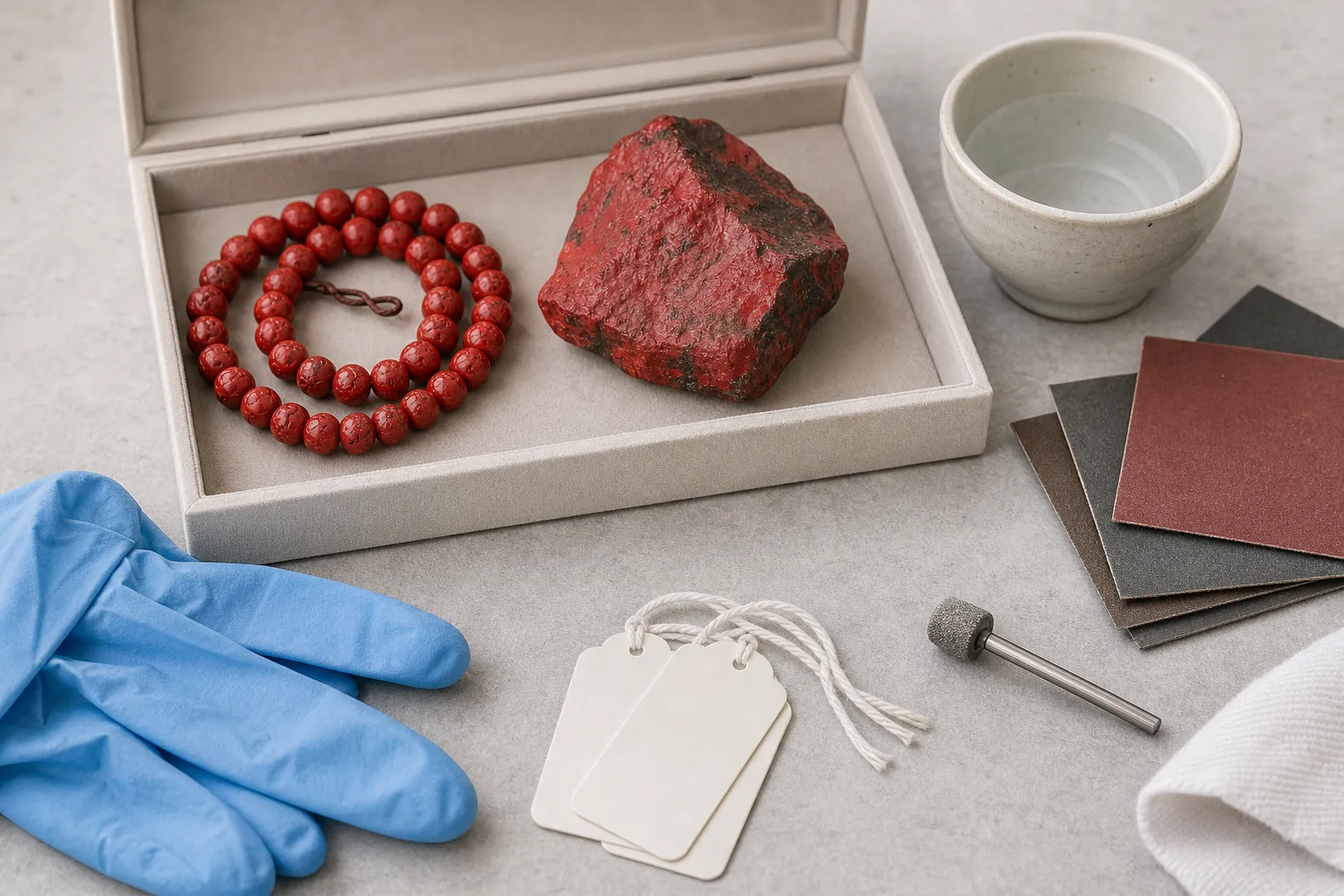
For cinnabar, separate three things before you trust the listing
- Meaning language: “vitality,” “abundance,” “transformation,” “life force,” or alchemy-themed copy.
- Material disclosure: natural cinnabar, cinnabar-style bead, lacquer, resin, pigment, composite, or unclear material.
- Handling relevance: whether the piece is raw, powdery, damaged, drilled, carved, sealed, worn against skin, placed in water, or sold for liquid-contact use.
Plain buyer rule
Do not ingest cinnabar, do not make crystal water with it, do not sand or drill it, avoid dust from damaged or powdery pieces, wash hands after handling uncertain specimens, and keep questionable pieces away from children and pets. A polished or sealed decorative object may not be the same situation as a crumbly raw specimen, but a listing photo is not enough to declare the item suitable for all uses.
If a seller leans heavily on cinnabar crystal meaning claims while giving little material detail, slow down. Ask whether “cinnabar” is being used as a color or style term, or as a mineral identity. If the listing describes real mineral cinnabar, handling guidance should not be missing.
What a listing can tell you—and what it cannot
A seller description can help you decide whether a product is worth considering, but each type of wording has limits.
A listing can reasonably show or state
- color, shape, bead size, polish, carving, and finish;
- whether the item is sold as black obsidian, hematite, cinnabar, or a style name;
- whether the piece is raw, polished, coated, drilled, carved, or set in jewelry;
- whether the seller provides care or handling notes;
- whether the seller discloses uncertainty, treatment, imitation, resin, or composite material.
A listing cannot reliably prove, from meaning language alone
- that black obsidian will produce a protective effect;
- that hematite will produce a grounding effect;
- that cinnabar will create abundance, vitality, or transformation;
- that “original” means verified material identity;
- that a red carved bead is natural cinnabar rather than cinnabar-style material;
- that a cinnabar item is appropriate for every form of wear, cleaning, storage, or water contact.
For certainty about mineral identity, specialized testing may be needed. That does not mean every buyer needs lab testing for every bead. It means the seller’s spiritual wording should not be used as material verification.
A quick buyer checklist
Before trusting a meaning-heavy crystal listing, ask five simple questions.
1. Can I separate the meaning from the material?
If the listing says “black obsidian for protection,” mark “protection” as meaning language and “black obsidian” as the material claim. Then look for actual material details.
2. Are there visible or stated material cues?
For black obsidian, look for glassy black appearance and finish details. For hematite, look for metallic-looking luster, coating disclosure, bead description, and any magnetism wording. For cinnabar, look for whether the item is mineral, resin, lacquer-style, carved, sealed, raw, or powdery.
3. Is handling addressed where it matters?
This is most important for cinnabar. A listing that uses cinnabar symbolism but avoids material and handling details leaves too much uncertainty.
4. Is “authentic” supported by anything concrete?
Words like genuine, original, natural, and authentic are not useless, but they are not enough on their own. Better listings provide clearer descriptions instead of leaning on broad benefit language.
5. Is the meaning copy doing all the work?
If the page depends almost entirely on protection, grounding, abundance, vitality, or transformation copy, with little about the object itself, treat it as weak buyer information.
Side-by-side reading
Black obsidian
Meaning copy often centers on protection and transformation. The more grounded material cue is volcanic glass, often sold in glossy black polished forms.
Hematite
Meaning copy often centers on grounding, balance, and strength. More useful listing details include metallic-looking finish, coating, bead construction, weight impression, and any magnetism claim.
Cinnabar
Meaning copy often centers on vitality, abundance, transformation, and cultural symbolism. The material and handling question is more serious because natural cinnabar is mercury sulfide, and “cinnabar” may also be used as a style or trade term.
Bottom line
Read crystal seller meaning claims as context, not proof. “Protection,” “grounding,” “abundance,” “vitality,” and “transformation” are common phrases in black obsidian, hematite, and cinnabar listings, but they do not verify outcomes, authenticity, or handling suitability.
For black obsidian, look past protection language to material disclosure and visible glassy finish cues. For hematite, treat grounding claims as framing and focus on stated material, luster, coating, finish, and magnetism wording. For cinnabar, separate symbolism from the physical material right away: natural cinnabar is mercury sulfide, and seller language should never be read as permission for ingestion, water use, dust-making, sanding, drilling, or casual handling.
A good listing helps you understand both the story and the object. If it gives you only the story, keep asking material questions before you buy.
Sources
Sources and further reading
Reference links are limited to sources considered suitable for public citation in this page.