ProtectCrystal handling note
Comparison guide
Cinnabar Meaning for Prosperity Compared With Black Obsidian Protection
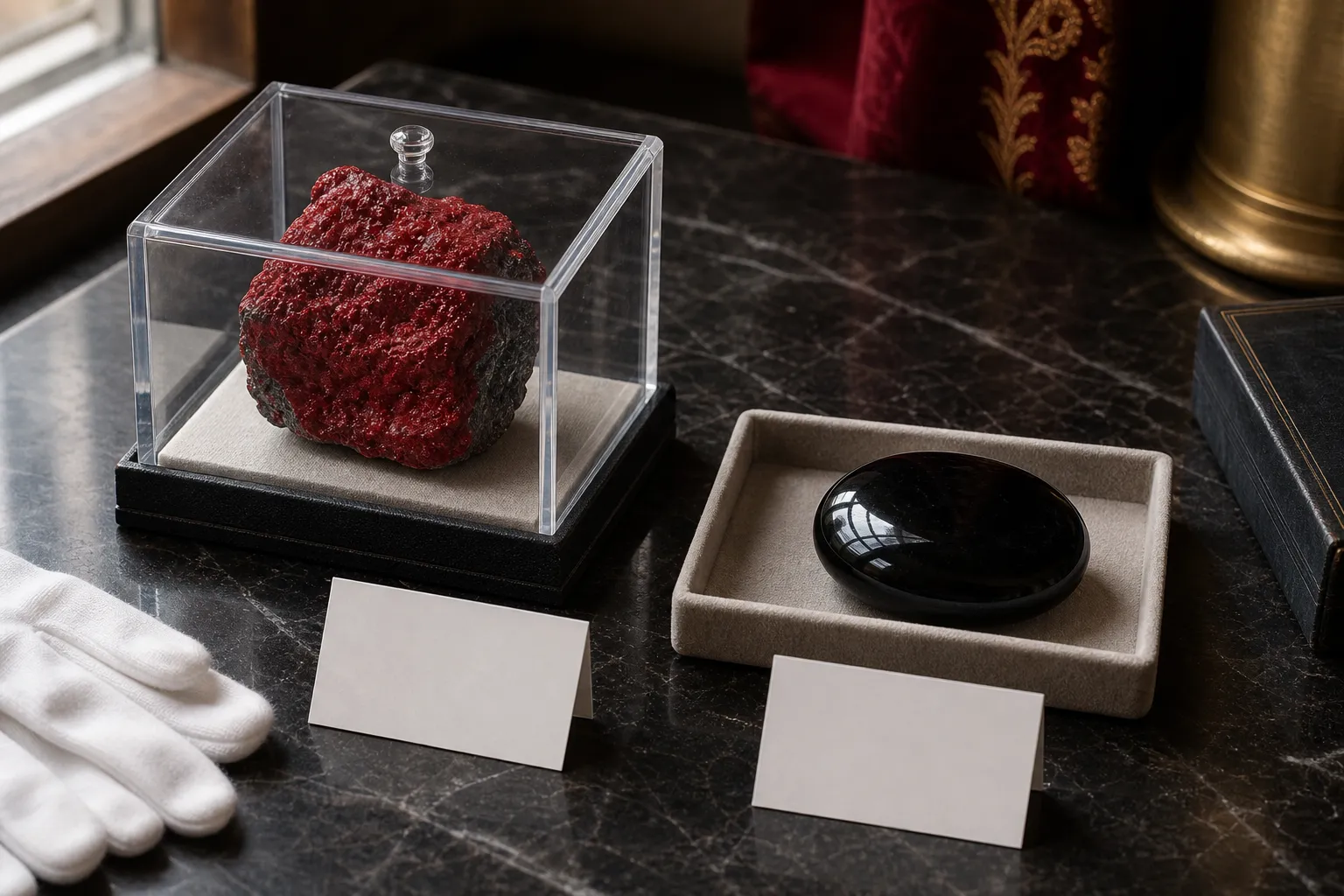
Cinnabar and black obsidian are compared because they occupy different roles in crystal-meaning language. Cinnabar is often described around prosperity, ambition, creative drive, and symbolic wealth. Black obsidian is often described around protection, grounding, release, and boundaries.
The practical answer to cinnabar prosperity meaning compared with black obsidian protection is this: choose cinnabar if you want an intention object that points toward growth and momentum; choose black obsidian if you want one that points toward steadiness and containment. Treat both meanings as symbolic, not as promised results. The material facts are separate, especially with cinnabar, because cinnabar is associated with mercury sulfide and needs more careful handling.
upward
Read the full overview first
Use the broader guide first if you need the full scope before this page.
Quick comparison: prosperity language versus protection language
Question
Common crystal-shop theme
Cinnabar
Prosperity, ambition, vitality, creative power, transformation
Black obsidian
Protection, grounding, boundaries, release, reset
How people often use the meaning
As a reminder of goals, growth, motivation, or symbolic wealth
As a reminder to stay centered, guarded, or clear about limits
Material identity boundary
Cinnabar is tied to mercury sulfide, so handling caution matters
Obsidian is volcanic glass; its “protection” meaning is symbolic
Main buyer caution
Do not let prosperity wording distract from material caution
Do not treat protection wording as a promise of safety or outcome
Plain-language takeaway
“This represents drive and prosperity intention.”
“This represents grounding and personal boundaries.”
This comparison works best when “meaning” is understood as intention language. A stone can be a personal reminder, desk object, collection piece, or symbolic gift without being treated as something that changes finances, events, relationships, or safety outcomes.
Seller descriptions often blend three things: what the material is, what it is said to represent, and what the buyer may hope it will do. Keep those separate.
What cinnabar prosperity meaning usually points to
The cinnabar prosperity meaning seen in crystal-shop language is not always limited to money. It is often framed more broadly around movement, ambition, visible confidence, creative momentum, and the desire to turn intention into action.
A grounded reading looks like this:
- Prosperity may refer to financial hopes, but it can also mean effort, opportunity, confidence, or personal expansion.
- Ambition points to the desire to move forward, not a promise that a stone will produce success.
- Transformation can describe a symbolic shift in focus or identity.
- Power is usually a crystal-shop word for presence, intensity, or intention.
Cinnabar’s vivid red color helps explain why it gathers strong language. Historical and material references discuss cinnabar/vermilion as a mercury-based red pigment in older decorative and cultural contexts. That background can explain the intensity of the symbolism, but it does not prove modern prosperity effects.
For a buyer, the better question is not “Will cinnabar bring prosperity?” It is: “Do I want an intention object that reminds me of ambition, growth, and directed effort—and am I prepared to handle cinnabar cautiously?”
What black obsidian protection meaning usually points to
The black obsidian protection meaning sits in a different emotional register. Instead of expansion and prosperity, black obsidian is commonly associated with grounding, boundaries, shielding language, release, reset, and inner reflection.
A careful translation into practical terms:
- Protection can mean a personal reminder to set limits.
- Grounding can mean choosing an object that visually or symbolically feels steady.
- Boundaries can mean using the stone as a cue to pause, step back, or say no.
- Release/reset can mean a symbolic fresh start.
Materially, black obsidian is volcanic glass. Its dark, glassy appearance may fit symbolism around depth, reflection, and boundaries, but the protection meaning is not proven by the material identity. Obsidian being volcanic glass makes it a real material with a recognizable look; it does not make it a protective device.
There is also a simple physical note: chipped or broken obsidian may have sharp edges. A polished black obsidian palm stone and a fractured raw piece should be handled differently.
The material difference that changes the buying decision
The biggest difference between cinnabar vs black obsidian is not the meaning. It is the handling context.
Cinnabar is associated with mercury sulfide. Mineral and chemical references support that basic material boundary. Toxicology discussions also note that chemical form matters, so cinnabar should not be casually treated as identical to every other mercury compound. For a crystal buyer, though, the practical answer remains conservative.
If you are considering a cinnabar specimen, bead, carving, or decorative object, avoid unnecessary contact and anything that could create dust:
- Do not ingest cinnabar or use it in drinking-water practices.
- Do not lick it, place it near the mouth, or use it where children or pets may mouth it.
- Do not grind, sand, drill, burn, heat, or powder it.
- Avoid creating dust from unknown red mineral material.
- Wash hands after handling rough, dusty, or uncertain cinnabar pieces.
- Store questionable pieces away from food areas, children, and pets.
- Do not assume a polished surface makes a piece suitable for every type of wear.
This is not a statement that every cinnabar object has the same handling concern in every setting. It is a buyer boundary: prosperity symbolism should not override the material caution.
Black obsidian does not carry the same mercury-sulfide concern. Its practical caution is simpler: it is glassy, and broken edges can cut. Its protection meaning may be meaningful to the owner, but it does not replace ordinary judgment about jewelry, breakage, storage, or personal safety.
Why sellers often pair transformation and protection language
Some readers compare these stones because they have seen them mentioned together: cinnabar for transformation or prosperity, black obsidian for protection or grounding. In crystal-shop language, that pairing can sound like “move forward, but stay contained.”
As symbolism, the contrast is easy to understand:
- Cinnabar represents action, growth, ambition, or visible change.
- Black obsidian represents grounding, limits, or personal containment.
- Together, the language suggests transformation with boundaries.
The problem begins when pairing language is treated as proof. Commercial crystal descriptions often use strong wording because they are trying to make the objects feel meaningful and desirable. That does not make the symbolism useless, but it also does not make it evidence of an outcome.
A careful buyer can read the pairing this way: “This is a story about momentum and boundaries.” That is different from reading it as a promise.
Common confusion when reading crystal-shop language
The most common mistake is treating “prosperity” and “protection” as if they are the same type of statement as “cinnabar is associated with mercury sulfide” or “obsidian is volcanic glass.” They are different categories.
Material identity
What the object is, such as cinnabar or volcanic glass.
Visible cues
Color, luster, texture, polish, chips, dust, or seller wording.
Symbolic meaning
Prosperity, protection, grounding, ambition, transformation.
Outcome language
Wording that implies the stone will cause a specific life result.
Material identity can sometimes be supported by mineral or chemical references. Visible cues can help you ask better questions, though they may not prove authenticity. Symbolic meaning belongs to crystal-use culture and personal interpretation. Outcome language needs the most caution.
A seller may describe cinnabar as a prosperity stone, but that does not verify financial, career, or business results. A seller may describe black obsidian as a protection stone, but that does not verify a protective effect. A seller may mention history, pigment use, or dramatic lore, but those details should not be used as proof that a modern crystal meaning works in a predictable way.
There is also an authenticity limit. A red carving, red bead, or red-filled object is not automatically natural cinnabar. A black polished stone is not automatically black obsidian. Visible signs may suggest possibilities, but for certainty, specialized testing may be needed.
A practical way to choose between them
If your question is mainly about intention, choose the stone whose language matches the role you want the object to play.
Choose cinnabar symbolism if you want a reminder of:
- ambition
- purposeful work
- symbolic wealth
- creative drive
- visible momentum
- transformation through action
Choose black obsidian symbolism if you want a reminder of:
- grounding
- boundaries
- steadiness
- release
- reflection
- keeping your limits clear
If your question is about handling, the answer changes. Black obsidian is usually the simpler object to keep as a pocket stone, desk piece, or polished display item, as long as it is not broken or sharp. Cinnabar requires more thought: what form is it in, is it rough or dusty, could children or pets access it, and does the seller clearly separate material description from spiritual language?
If your question is about pairing them, keep the pairing symbolic. Cinnabar plus black obsidian can be read as “growth with boundaries” or “transformation with grounding.” That can be useful for intention work, journaling, display, or gifting. It should not be treated as a safety plan, financial plan, or substitute for ordinary decision-making.
Bottom line
Cinnabar prosperity meaning and black obsidian protection meaning are best understood as two different intention labels. Cinnabar is commonly described around prosperity, ambition, vitality, and symbolic wealth. Black obsidian is commonly described around protection, grounding, release, and boundaries. Those meanings may be personally useful, but they are not verified outcomes.
The material distinction is the more concrete part of the comparison: cinnabar is associated with mercury sulfide and deserves conservative handling, while black obsidian is volcanic glass and its main practical concern is its glassy nature if chipped or broken. Let the symbolism guide the intention, but let the material facts guide how you handle, store, and question the piece.
Sources
Sources and further reading
Reference links are limited to sources considered suitable for public citation in this page.