ProtectCrystal handling note
Look and feel comparison
How to Tell Black Obsidian from Hematite by Look and Feel
If you are comparing two polished dark stones, start here: black obsidian usually looks like smooth black glass, while hematite usually looks like dark metal. For black obsidian vs hematite identification, the useful clues are luster, weight, possible streak, and any existing chips—not black color alone.
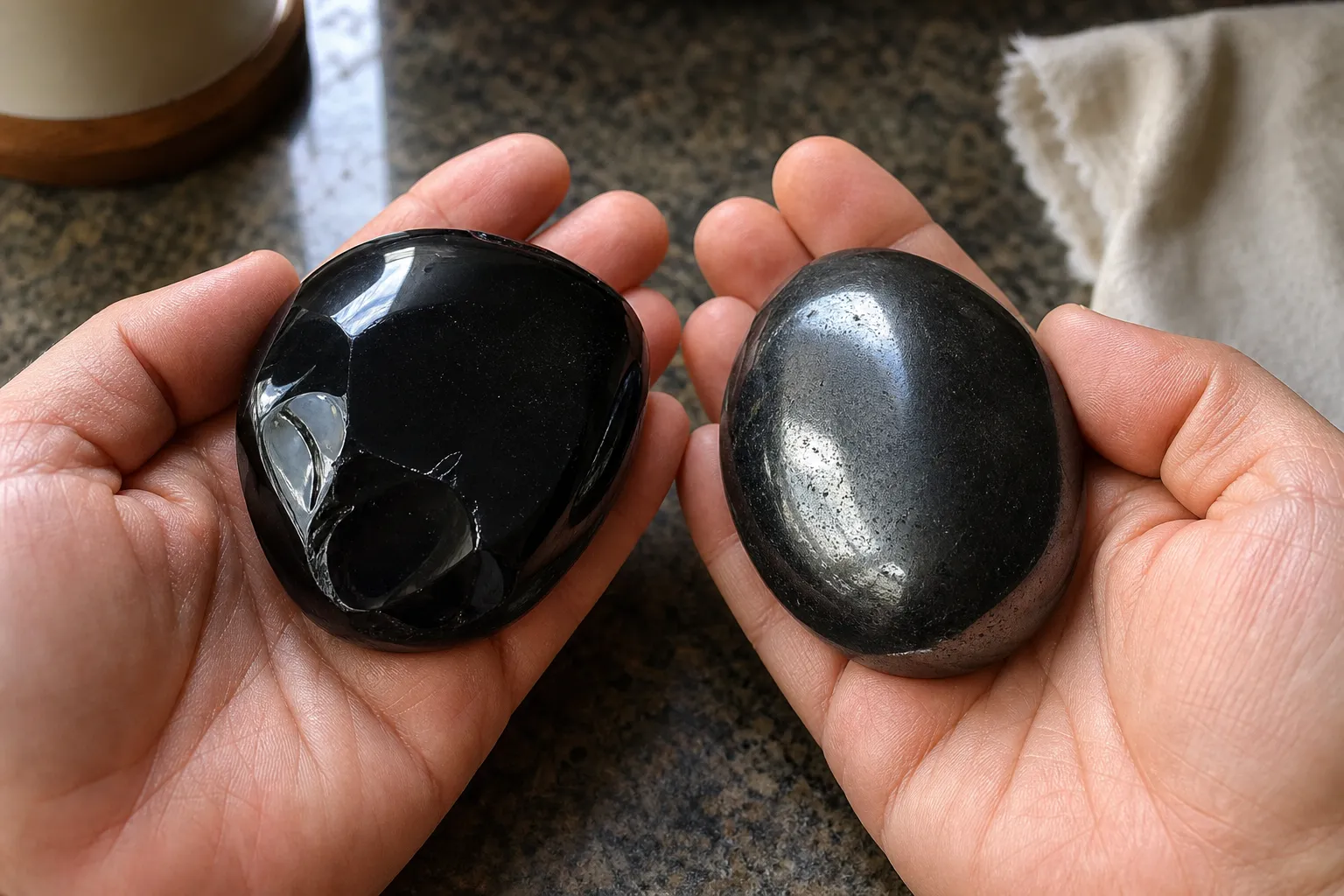
A glossy, inky black stone that feels fairly light for its size points more toward obsidian. A gunmetal gray-black stone with a metallic shine and a surprisingly heavy feel points more toward hematite. These clues can make one label more plausible, but they do not prove identity from appearance alone.
upward
Read the full overview first
Use the broader guide first if you need the full scope before this page.
Quick comparison cues
Start with shine, not black color
Color is the weakest clue in polished black stone identification. In photos, both obsidian and hematite can look black, especially in small beads, bracelets, or tumbled sets. Bright display lighting can hide a metallic surface, while reflections can make glossy obsidian look gray.
Luster gives you more to work with.
Hematite is commonly described in mineral references as dark gray to black, often with a metallic look. In polished beads or worry stones, that can appear as a cool gunmetal shine: gray-black, reflective, and metal-like rather than simply glossy.
Black obsidian is often described in buyer and collector language as volcanic glass. For this comparison, the useful cue is a glassy black surface—smooth, glossy, and often more uniformly dark than hematite. Because visual obsidian checks can overlap with other black materials, treat this as a clue, not a final answer.
Try this under the same light
- Tilt the stone slowly near a window or lamp.
- Ask whether the reflection looks more like glass or polished metal.
- Notice the body color: deep black leans obsidian; dark gray-black with metallic flash leans hematite.
- Avoid deciding from one product photo or one angle.
If a tumbled set has one pitch-black glossy stone and another dark gray, sparkly, metallic-looking stone, the first may be the obsidian candidate and the second may be the hematite candidate. That is a useful starting point, not a complete identification.
The hand test: hematite often feels heavy
Weight is one of the easiest in-person clues. Hematite is an iron oxide mineral and is known for its density. In everyday buyer terms, hematite feels heavy: a small bead strand, palm stone, or tumble can feel surprisingly weighty for its size.
Black obsidian, as volcanic glass, often feels lighter than a same-sized hematite piece. This difference is easiest to notice when you compare two similar beads or tumbled stones side by side. A single piece is harder to judge.
A quick check
- Choose two pieces close in size.
- Hold one in each hand.
- Notice whether one feels notably denser.
- Look again at the shine: does the heavier piece also look metallic?
When weight and luster agree, the clue is stronger. A heavy, dark gray-black, metallic stone is a good hematite candidate. A lighter-feeling, glossy black stone points more toward obsidian.
Bracelets complicate this. Metal spacers, charms, elastic, mixed beads, or large findings can change the weight impression. In that case, compare individual beads if you can.
Magnetism also needs caution. Some beads sold with “magnetic hematite” language may be processed or made from hematite-like material. A magnetic response by itself is not a clean mineral ID.
The reddish-brown streak clue for hematite
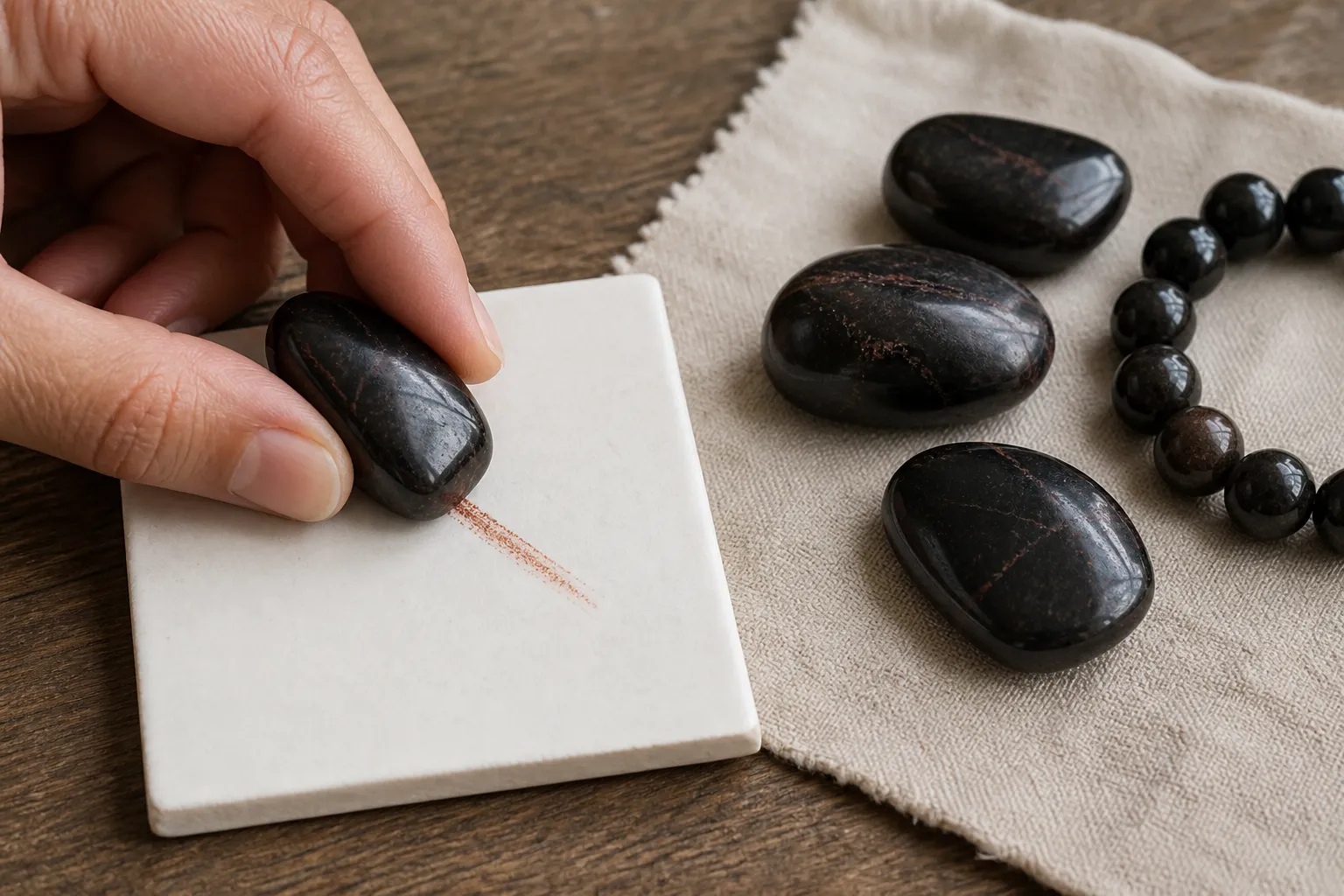
A streak test checks the color of a mineral’s powder when rubbed on an unglazed porcelain streak plate. Hematite is well known for a reddish-brown streak, even when the visible surface looks black, gray, or metallic.
For someone deciding between obsidian or hematite, a reddish-brown streak is one of the stronger practical clues toward hematite. It matters because polished surfaces can be buffed, coated, photographed, or lit in ways that hide the material underneath.
Use this test only when a small mark is acceptable
- It can mark the streak plate.
- It may scuff or dull a polished stone.
- It is not a good idea for jewelry you plan to return.
- It does not prove the whole object is natural, untreated, or correctly labeled.
If you own the piece and accept the possibility of a mark, gently rub an inconspicuous area on an unglazed streak plate. A reddish-brown mark makes hematite more plausible. In a shop, ask first. For borrowed, gifted, or returnable jewelry, skip the test and stay with non-marking clues.
For obsidian, streak is usually less helpful in this exact comparison. Its more useful buyer cues are a glassy surface, lighter feel compared with hematite, and any existing glass-like chip.
Existing chips can help, but do not break the stone
Fracture can be useful only when the stone already has a chip, nick, or broken edge. Obsidian may show conchoidal fracture—a curved, shell-like break similar to glass. On an existing damaged edge, this can look like a small curved flake or glassy chip. Thin chipped edges may sometimes look slightly translucent in strong light, but that is not guaranteed.
Do not break a bead, pendant, or tumble to check this. Obsidian can form sharp glass-like edges.
Hematite chips usually fit its metallic mineral character more than a glassy shell-like break, but small polished pieces can be difficult to read. Tumbling, drilling, and surface finish can hide fracture details.
Use chips as a supporting cue
- Existing curved, glass-like chip: more consistent with obsidian.
- Existing metallic gray-black interior: more consistent with hematite.
- No visible chip: do not create one.
- Sharp edge on any dark stone: handle it carefully.
The pattern matters more than one clue. Glassy surface plus lighter feel plus glass-like existing chip leans obsidian. Metallic shine plus heavy feel plus reddish-brown streak leans hematite.
Seller wording can help, but not all wording is material evidence
Listings for bracelets and tumbled stones often include symbolic crystal language. Words such as “grounding,” “protection,” or “energy” may describe how the item is marketed or personally used, but they do not identify the material.
More useful wording describes physical traits:
- “Black volcanic glass” points toward obsidian language.
- “Glassy,” “smooth,” “inky black,” or “mirror black” may fit obsidian.
- “Hematite,” “iron oxide,” “metallic,” “gunmetal,” or “steel gray” fits hematite.
- “Heavy,” “dense,” or “metallic shine” supports hematite if the stone also looks that way.
Be careful with titles that stack several black-stone names, such as “obsidian hematite black stone bracelet,” without explaining the bead pattern. A bracelet can include both materials, but the listing should make clear which beads are which. If every bead looks identical and the seller claims several materials, ask for a closer description.
Photos can also blur the answer. Hematite may photograph as plain black when the metallic reflection is not visible. Obsidian may photograph as gray if it reflects a pale wall or sky. If you are buying online, ask for a close-up in indirect natural light.
A quick non-marking check for beads, bracelets, and tumbled stones
- Look at the shine. Glassy black suggests obsidian; metallic gunmetal suggests hematite.
- Compare the weight. If pieces are similar size, the heavier one is more likely hematite.
- Check the color tone. Deep black leans obsidian; steel-gray or dark gray-black leans hematite.
- Inspect existing chips only. Curved glass-like chips lean obsidian; metallic-looking breaks lean hematite.
- Save streak testing for owned pieces. A reddish-brown streak supports hematite, but the test can leave marks.
- Read seller wording carefully. Physical descriptions matter more than symbolic claims.
This works best when you have the stones in hand. It is weaker for a single photo, a tiny bead, a coated piece, or a mixed bracelet. Other dark materials—such as onyx, black tourmaline, jet, shungite, smoky quartz, or manufactured glass—can also confuse the picture. If the stone does not clearly fit either the glassy-obsidian pattern or the heavy-metallic hematite pattern, keep the label tentative.
What look and feel cannot prove
Look and feel can make one answer more likely, but they cannot prove exact identity, origin, treatment, or seller accuracy. A polished surface may hide texture. A bead may be coated, dyed, magnetized, mixed, or mislabeled. Reliable mineral identification uses several properties together, and some questions require a qualified mineral dealer, gem lab, geology department, or other appropriate testing route.
For a careful buyer, the best conclusion usually sounds like this:
- “This looks more like hematite because it is heavy, metallic, dark gray-black, and gives a reddish-brown streak.”
- “This looks more like obsidian because it is smooth, glossy, deep black, and has a glass-like existing chip.”
- “I cannot confirm from appearance alone.”
That last answer is not a problem. It is the honest limit of black stone identification by hand and eye.
Short answers to common buyer questions
Is black obsidian the same as hematite?
No. Hematite is an iron oxide mineral. Black obsidian is commonly described as volcanic glass. In polished jewelry, both can look dark, so luster, weight, streak, and existing chips are more useful than color alone.
Can a black bracelet contain both obsidian and hematite?
Yes. A bracelet may include both, but the bead pattern should be clear. Glassy black beads may be obsidian, while metallic gray-black heavier beads may be hematite. If all beads look the same, ask the seller which beads are which.
What is the best home clue for hematite?
The strongest practical pattern is metallic gunmetal shine, heavy feel, and a reddish-brown streak. The streak clue is useful, but it can mark a polished stone, so it is not always appropriate for finished jewelry or returnable items.
Sources
Sources and further reading
Reference links are limited to sources considered suitable for public citation in this page.