ProtectCrystal handling note
Buyer surface check
Polished Cinnabar vs Polished Hematite: Surface Clues Buyers Can Check
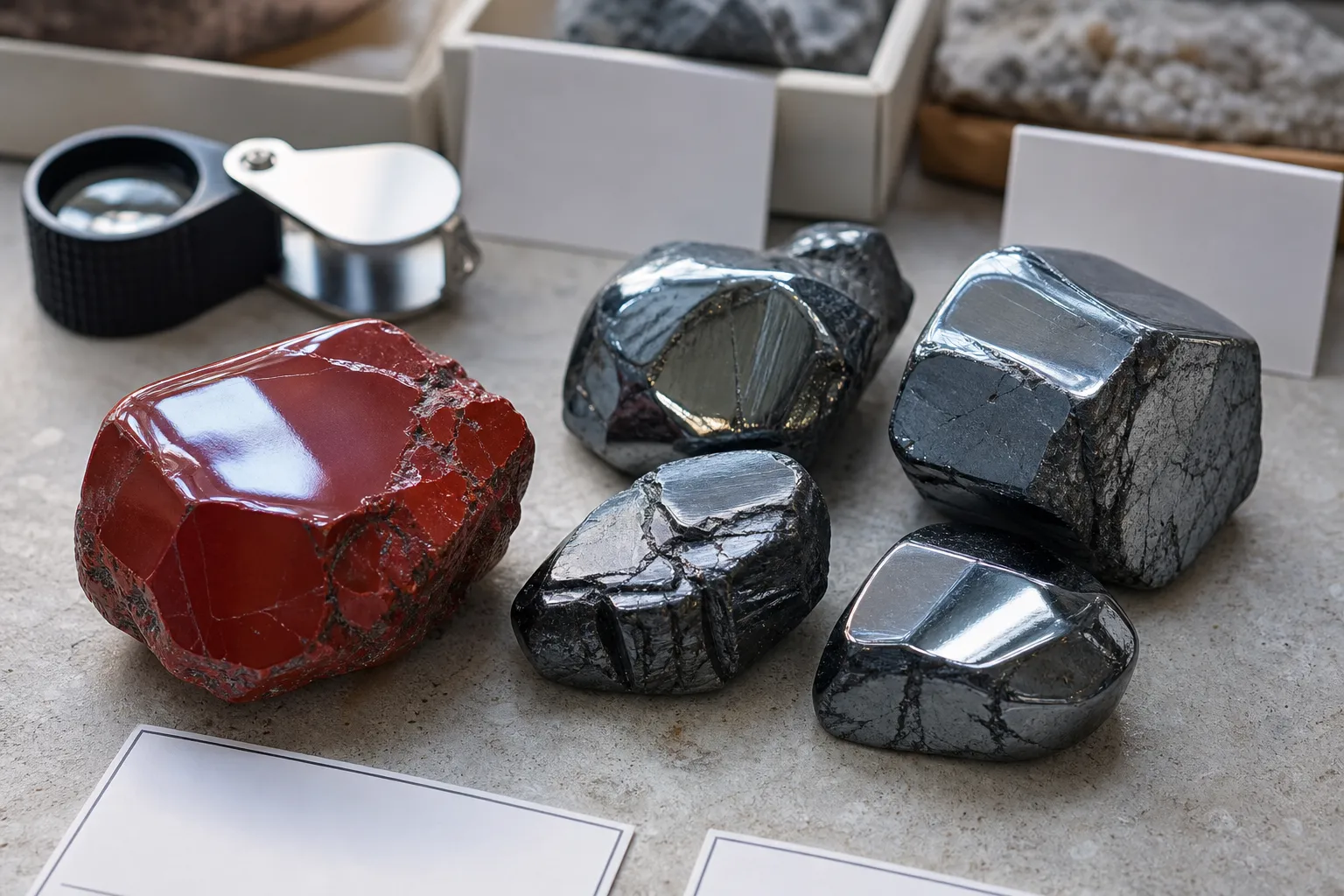
If you are comparing polished cinnabar vs polished hematite at a shop counter, in a listing, or in a collection tray, start with the surface picture. Polished hematite is usually sold as a dark gray, black, steel-like, or mirror-metallic stone. A polished cinnabar stone is more often associated with red, vermilion, or darker red tones.
That split is useful, but it does not prove identity. Polish, lighting, coatings, photography, substitutes, and loose seller wording can all blur the comparison. The better buyer approach is to use non-destructive clues first—color family, shine, surface uniformity, cracks, weight impression, magnetism caveats, and listing language—then treat the result as suggestive rather than certain.
upward
Read the full overview first
Use the broader guide first if you need the full scope before this page.
Quick surface comparison buyers can use
Surface clue
Polished cinnabar may suggest
Polished hematite may suggest
What to remember
Main color family
Red, vermilion, deep red, sometimes darker red
Dark gray, black, steel-gray, metallic silver-black
Color alone does not identify either mineral.
Shine and luster
Glossy, rich, or sometimes softer than a hard mirror finish
Often strong metallic or mirror-like polish
A mirror polish can be real hematite or a substitute.
Red-brown hints
Red is usually part of the main surface color
Red to reddish-brown clues may appear in streak context or existing breaks
Do not make powder from an unknown piece to check.
Surface uniformity
Carved, coated, resin-like, or lacquer-like wording needs caution
Very uniform black metallic beads deserve closer label reading
Uniformity is a prompt to ask questions, not proof of imitation.
Weight impression
Not a reliable separator by itself
Hematite often feels dense for its size
Weight can help spot some light imitations, but it is not proof.
Magnetism
Not a useful casual clue
Strong magnetism may point to magnetized or substitute material
Magnetism is not a simple natural-versus-unnatural test.
Seller wording
“Cinnabar-style,” “lacquer,” “resin,” or “cinnabar color” may not mean natural cinnabar mineral
“Hematine,” “Hemalyke,” or “magnetic hematite” should be read carefully
Ask what the material is, not only what style it resembles.
The strongest practical answer is this: polished hematite clues usually lean metallic-dark and weighty; polished cinnabar color usually leans red to vermilion; but cinnabar vs hematite identification from polished surfaces remains limited. If the identity matters for value, handling, display, or resale, visual inspection should be followed by better documentation or specialized testing.
Color and shine are the first split, not the final answer
The most obvious cinnabar and hematite surface clues begin with color. Cinnabar is a mercury sulfide mineral commonly associated with vivid red to vermilion material, though actual specimens and polished objects can appear darker, uneven, or altered. Hematite, an iron oxide mineral, is often familiar to crystal buyers as a dark metallic-looking polished stone: black, charcoal, gunmetal, steel-gray, or silver-black.
At a glance, the comparison is straightforward. A dominantly red polished piece is not behaving like the usual polished hematite bead or palm stone. A dominantly black-gray, mirror-metallic piece is not behaving like the usual red cinnabar presentation.
The caution is that polished stone visual identification can mislead. A red object may be resin, lacquer, dyed material, red jasper, another red mineral, or a decorative item using “cinnabar” as a style word. A dark metallic bead may be hematite, hematine, Hemalyke-type material, magnetized material, or another polished substitute. Seller photos can also deepen shadows, intensify red color, or make a modest shine look like a hard mirror finish.
When looking in person, rotate the piece under steady light. Hematite’s polish often reflects with a crisp metallic flash. Cinnabar’s red surface may look rich and glossy, but a polished red appearance is not a material guarantee. If the surface looks coated, painted, waxy, or plasticky, give less weight to the visual clue and read the label more closely.
Check cracks, surface breaks, and red-brown clues without damaging the piece
A polished surface can hide natural features, but it may still show small clues: cracks, veins, pits, crevices, inclusions, polish variation, or places where the surface is not perfectly uniform.
For polished hematite, buyers often look for a dense metallic face combined with occasional reddish-brown hints in cracks, chips, or worn areas. Hematite is widely associated in mineral identification with a red to reddish-brown streak, even when the main mass looks dark and metallic. That does not mean you should scrape a bead or rub an unknown piece across a plate at the counter. It means red-brown context can be part of the hematite clue set when it appears in existing breaks or in credible mineral information.
For polished cinnabar, red is more central. The surface itself may be red, vermilion, dark red, or red mixed with matrix-like features. But a red polished stone is not automatically cinnabar. Some decorative “cinnabar” items are carved lacquer, resin, dyed material, or “cinnabar-style” pieces. Those may be attractive and honestly sold as decorative objects, but they are not the same claim as a natural polished cinnabar mineral specimen.
Uniformity is worth noticing. A tray of perfectly identical, highly reflective black beads may still be sold as hematite, but the sameness should make you read the description carefully. Real polished hematite can be smooth and mirror-like, so uniformity does not settle the question. It simply moves the item from “looks plausible” to “ask more questions.”
Weight and magnetism are secondary checks
Hematite often gives buyers a strong weight impression. A small polished hematite bead or tumble may feel heavier than expected because hematite is a dense iron oxide. That can help you notice lightweight plastic, resin, or glass-like substitutes when pieces of similar size feel very different in the hand.
Weight is still only a rough clue. Some substitutes are also dense. Coatings, settings, bead construction, or mixed materials can change how a piece feels. A cinnabar-bearing piece in matrix also will not compare neatly with a polished hematite bead of the same size. Use weight after color, luster, surface details, and seller wording—not instead of them.
Magnetism needs even more caution. Many shoppers hear that hematite is magnetic or that magnetic behavior proves hematite. That is too simple. Natural hematite may be weakly magnetic, seem nonmagnetic to a casual buyer, or behave differently depending on inclusions and handling. Strongly magnetic “hematite” jewelry may be magnetized material or a hematite-like substitute.
A small magnet can raise questions, but it should not be treated as a pass/fail test. Strong magnetism does not automatically mean natural hematite, and lack of obvious magnetism does not automatically rule it out. For cinnabar, magnetism is not a practical identifying clue for ordinary buyers.
Handle suspected cinnabar cautiously while comparing it
Cinnabar needs more careful handling than hematite because it is mercury sulfide. A polished surface does not let a buyer declare the item suitable for every use, wearer, or setting. The practical point is simple: avoid actions that create dust, powder, broken fragments, or unnecessary contact.
When comparing a suspected polished cinnabar stone, do not scratch, grind, sand, drill, heat, crush, or aggressively clean it. Do not lick, mouth, or taste a specimen. Do not run a casual streak test on suspected cinnabar, because streak testing damages the surface and can create powder. If you have handled an uncertain cinnabar-labeled piece, wash your hands afterward, especially before eating. Keep uncertain red mineral pieces away from children and pets unless the material is clearly identified and stored appropriately.
These cautions also affect how you read seller behavior. If a seller suggests proving cinnabar by scraping, powdering, heating, or otherwise damaging the item, that is not a buyer-friendly verification step. A careful seller should be able to discuss labeling, source information, whether the piece is natural mineral or decorative material, and what handling limits apply.
For hematite, the usual concern is less about mercury-bearing dust and more about accurate labeling, coatings, substitutes, and normal care. Still, destructive tests are not casual buyer checks.
Seller wording can answer more than the surface does
For many buyers, the label is as important as the stone. Marketplace language can use mineral names loosely, especially in beads, carvings, pendants, and decorative listings.
With cinnabar, slow down when you see:
- “Cinnabar-style” — often points to appearance or design, not necessarily natural cinnabar mineral.
- “Cinnabar color” — may describe red color only.
- “Lacquer cinnabar” — commonly refers to carved lacquer tradition or decorative material.
- “Red resin” or “carved resin” — not the same claim as natural cinnabar mineral.
- “Natural cinnabar” with no handling detail — ask what evidence, source, or material description supports the label.
With hematite, read carefully around:
- “Hematine” or “Hemalyke” — terms often used for hematite-like manufactured material.
- “Magnetic hematite” — strong magnetic behavior may point to magnetized or substitute material.
- “Hematite color” — may describe appearance rather than mineral identity.
- Broad real-or-imitation claims — one simple home clue rarely settles the matter.
Good seller wording does not need to sound dramatic. It should make the material claim plain: natural hematite, hematite-like manufactured bead, lacquer-style cinnabar, resin carving, cinnabar-bearing specimen, or unknown red polished stone. If a listing mixes spiritual, decorative, and mineral terms without saying what the object is made of, treat the surface clues as incomplete.
What visible clues cannot settle
Surface clues are useful because they are non-destructive and available before purchase. They are also limited. Mineral identification can involve color, luster, reflectance, texture, inclusions, streak, hardness, density, and other properties, but polishing removes or masks many diagnostic features. Lighting, coatings, tarnish, alteration, and photography can change what you see.
That is why a polished cinnabar vs polished hematite comparison should end with a confidence level, not a declaration. You might reasonably say:
- “This looks more like polished hematite because it is dark, metallic, mirror-polished, and heavy for its size.”
- “This looks more like a cinnabar-labeled red decorative piece, but the wording suggests style or lacquer rather than natural mineral.”
- “This red polished piece could be cinnabar, but appearance alone is not enough, and I would not scratch or powder it.”
- “This black metallic bead may be hematite, but strong magnetism or hematine wording means I should not assume natural hematite.”
For certainty, specialized testing or evaluation by a mineral professional may be needed. Instrumental methods used in mineral and conservation contexts can distinguish materials more confidently than casual surface inspection, but that level of testing is usually beyond a normal shop-counter decision.
A cautious buyer’s short checklist
Before buying or handling a polished piece labeled cinnabar or hematite, ask:
- What is the main color family? Red or vermilion leans toward cinnabar-style possibilities; dark metallic gray-black leans toward hematite-style possibilities.
- What does the shine look like? Hematite often has a steel-like or mirror-metallic polish; cinnabar is judged more by red color and material context.
- Are there cracks, veins, or uneven surface details? Existing red-brown clues can support hematite context, but do not create powder to check.
- Does the weight feel consistent with the label? Useful as a rough clue, not proof.
- Is magnetism being used as a selling point? Treat strong magnetism as a reason to read the material description carefully.
- Does the seller wording say mineral, style, lacquer, resin, hematine, or magnetic substitute? The wording may answer more than the surface does.
- Would the next test damage the piece or create dust? If yes, do not treat it as a casual buyer check, especially with suspected cinnabar.
The practical takeaway: polished hematite clues usually cluster around dark metallic shine, dense feel, and possible red-brown mineral context. Polished cinnabar color usually clusters around red to vermilion surfaces and more careful handling. Neither set of clues proves identity from appearance alone. Use the surface to decide what questions to ask next, not to force certainty where the material does not give it.
Sources
Sources and further reading
Reference links are limited to sources considered suitable for public citation in this page.