
ProtectCrystal handling note
Material comparison
Cinnabar vs Hematite: Color, Weight, and Handling Differences
A red or metallic-looking stone can be confusing when a shop tag says “cinnabar,” “hematite,” “red hematite,” “cinnabar bead,” or simply uses protective crystal language. The useful question in cinnabar vs hematite is not just “Which one looks red?” It is: which clues still hold up after lighting, polish, coatings, matrix, bead construction, and seller wording get involved?
Cinnabar is a mercury sulfide mineral. Hematite is an iron oxide mineral. That material difference affects color range, streak, luster, weight impression, surface residue, and handling. Visual clues can narrow the possibilities, but they cannot prove identity, authenticity, or suitability for wear on their own. If the piece is expensive, powdery, altered, carved, or intended for jewelry, keep the conclusion cautious.
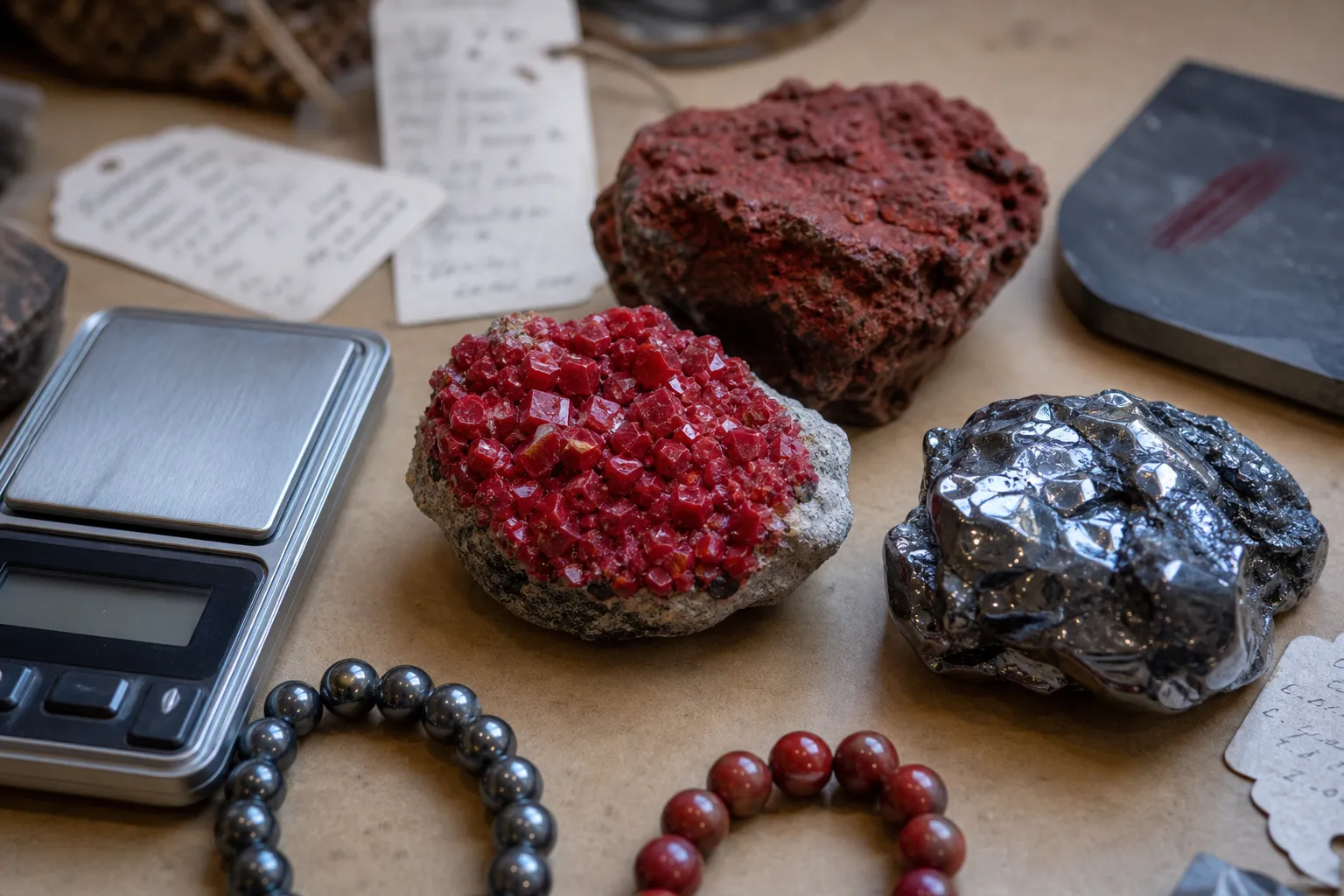
upward
Start with the broader guide
Use the broader guide first if you need the full scope before this page.
The quickest practical comparison
Use this as a first pass, not as a certificate of identity. One clue can point you in a direction; several consistent clues are more useful.
| Feature | Cinnabar | Hematite | What can mislead you |
|---|---|---|---|
| Core material identity | Mercury sulfide, commonly described as HgS | Iron oxide, Fe2O3 | Seller labels may use trade names loosely |
| Common color impression | Bright red to reddish, sometimes in lighter or darker host rock | Steel-gray, black, metallic, reddish-brown, earthy red, or red in powdery forms | Lighting, polish, dye, coating, oxidation, and matrix can change the look |
| Streak | Often red to scarlet-red in mineral references | Commonly red-brown to reddish-brown | Streak testing can damage the item and may create powder |
| Luster | Can be bright to dull depending on crystal quality and surface condition | Metallic to earthy; polished hematite can be very reflective | Coatings and polish can imitate shine |
| Weight impression | Can feel heavy for its size because cinnabar has high density | Often feels substantial compared with many common stones | Size, resin, hollow beads, carving style, and attached matrix distort hand feel |
| Magnetism | Not identified by magnetism | Natural hematite is not usually the strongly magnetic bead material implied by many listings | “Magnetic hematite” is often a trade or manufactured product phrase |
| Handling approach | More cautious, especially if raw, chipped, powdery, carved, or uncertain | Ordinary mineral care is usually enough, though dust and abrasion still matter | Appearance does not settle handling questions |
Mineral references list cinnabar as mercury sulfide and hematite as iron oxide. That is why this comparison is not only about color.
How to tell cinnabar from hematite by color
Color is the first clue most buyers notice, and one of the easiest to overread.
Cinnabar is often associated with vivid red. In specimens, it may show as bright red crystals, red granular areas, or red mineral patches in a contrasting host rock. Some pieces look saturated and jewel-like; others look duller because of surface wear, impurities, weathering, or matrix.
Hematite has a wider visible range. Many buyers recognize it as a polished, metallic, dark gray or black stone. But hematite can also be reddish-brown, earthy red, or powdery red. That is why red hematite vs cinnabar is a real source of confusion: a red surface does not automatically mean cinnabar.
A better buyer check
- Is the red color part of the mineral body, a powdery surface, a coating, or stained matrix?
- Are there metallic gray-black areas often associated with hematite?
- Is the red bright and concentrated, or more earthy and brownish?
- Does the seller say natural mineral, carved bead, pigment, lacquer, dyed stone, “cinnabar-style,” or “red hematite”?
Even then, color is only suggestive. Mineral education sources commonly treat color as useful but limited because different minerals can share similar colors, and one mineral can appear in several forms. Streak, luster, hardness, density, and context often matter more than surface color alone.
Conservation research on cinnabar- and hematite-based pigment systems also shows that red appearance can be affected by material context and surface condition. That research is about controlled paint mock-ups, not consumer jewelry or loose crystals, so it should not be stretched into everyday jewelry claims. The practical takeaway is narrower: red color is not a standalone identification method.
Cinnabar vs hematite streak: useful, but not always worth doing
Streak is the color of a mineral’s powder when rubbed on an unglazed porcelain plate. In mineral identification, streak can be more stable than surface color. Hematite is especially known for a red-brown streak, even when the specimen itself looks metallic gray or black. That is one reason hematite surprises buyers: a shiny dark piece may still leave a reddish mark.
Cinnabar is also associated with a red streak. So a red streak can support the possibility of cinnabar, but it does not solve the whole comparison. If both candidates can produce red-toned streaks, shade, surface condition, matrix, and other clues still matter.
Before doing a streak test, weigh the cost of the test
- It can scratch or visibly mark a polished surface.
- It can release powder from the specimen.
- It is a poor choice for suspected cinnabar if the piece is crumbly, dusty, carved, or uncertain.
- It may not work cleanly on coated beads, resin-filled items, lacquered surfaces, or composite materials.
For a low-value rough hematite specimen, a careful streak test may be reasonable if you accept the mark. For suspected cinnabar, especially a piece you may keep, wear, or store, avoid creating dust. If a seller provides a streak result, treat it as one clue rather than proof. If a listing only says “bright red cinnabar” without mineral details, the color language is weak support.
Weight, luster, and surface feel: what hand checks can and cannot show
In a shop, buyers naturally pick up a stone and think, “This feels heavy,” or “This shine looks like hematite.” Those impressions can help, but they need limits.
Cinnabar vs hematite weight
Both cinnabar and hematite can feel substantial compared with many decorative stones. Cinnabar has high specific gravity in mineral references, and hematite is dense enough that polished pieces often feel pleasingly heavy. Hand weight, however, is not a clean separation method.
A small dense piece can feel lighter than a larger less-dense one. A raw specimen may include quartz, calcite, clay, or other matrix minerals. A bead may be hollow, filled, coated, dyed, or made from composite material. A carved ornament may include lacquer, binder, or backing. A heavy bracelet sold as “hematite” may not be simple natural hematite.
Does cinnabar shine like hematite?
Sometimes cinnabar can shine, but usually not in the familiar way buyers associate with polished hematite.
Hematite is widely recognized for metallic luster in many specimens. Polished hematite beads and palm stones can look mirror-like, dark, and reflective. Earthy hematite, on the other hand, may look dull and reddish-brown rather than metallic.
Cinnabar can have a bright luster in good crystals, but many consumer-facing pieces are not clean crystal faces. Raw cinnabar may appear granular, massive, dull, or mixed with matrix. Carved or polished items sold with cinnabar-related wording may involve surface treatments or non-mineral materials.
Surface feel and powdery material
A powdery red surface needs careful interpretation. Hematite can produce red dust or reddish marks, especially in earthy forms, so red residue is not automatically cinnabar. But if cinnabar is possible, avoid rubbing, sanding, drilling, or testing in ways that create more powder.
This is where identification and handling overlap: the clue you are trying to observe may be created by an action you should avoid.
Use weight as a consistency check
- If a supposedly solid hematite bead feels unusually light, ask whether it is coated, synthetic, composite, or another material.
- If a red item feels very heavy for its size, that may fit cinnabar, but it does not prove cinnabar.
- If a raw specimen includes a lot of host rock, hand feel may mostly reflect the matrix.
- If a listing gives only weight but no dimensions, photos, or material description, the number is hard to interpret.
Weight can raise questions. It should not close the case. The better question is not “Does it shine?” but “What kind of shine is it, and where is it coming from?” A metallic gray-black shine supports hematite more than cinnabar. A bright red glossy coating on a bead is not enough to identify either material.
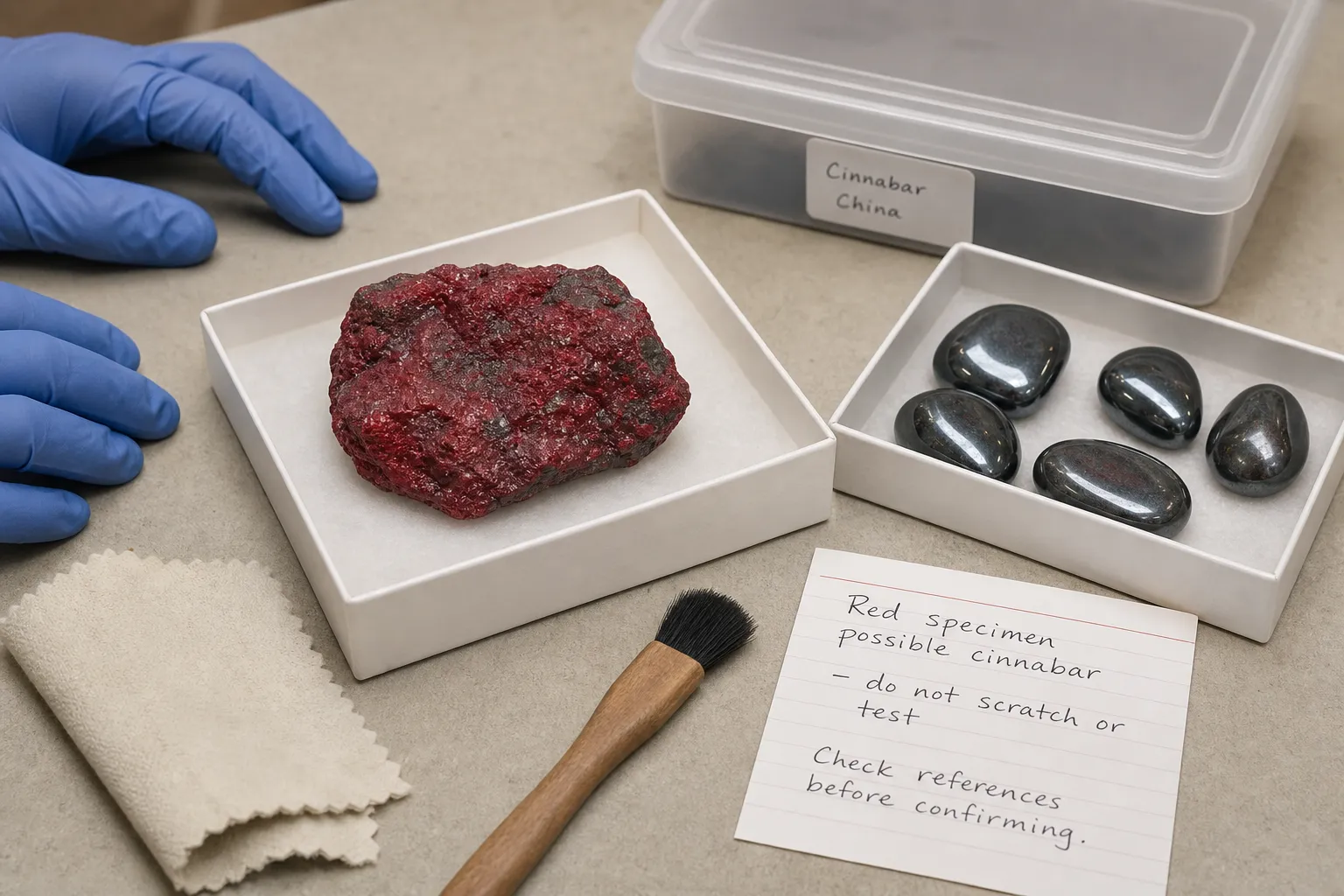
Raw cinnabar vs raw hematite: handling differences for specimens
Raw specimens are where the difference matters most.
Cinnabar is a mercury sulfide mineral, and museum and conservation references treat mercury-containing mineral materials with caution. For a crystal buyer, the practical translation is simple: do not turn suspected cinnabar into dust, do not use it in drinking water, and do not treat it like a rough quartz point.
For raw cinnabar, especially if it is powdery, chipped, carved, crumbly, or poorly labeled
- Handle it minimally.
- Wash hands after touching it.
- Keep it away from children and pets.
- Do not lick, mouth, soak, grind, sand, drill, or tumble it.
- Store it in a closed container or display case where loose particles are less likely to spread.
- Avoid placing it where harder stones can rub against it.
Hematite does not carry the same mercury-mineral concern, but rough hematite still deserves ordinary mineral care. Avoid inhaling dust from any mineral. Do not sand, grind, or drill stones casually. Keep small pieces away from children and pets. The distinction is not “hematite needs no care”; it is that cinnabar calls for a more conservative routine.
If a shop allows customers to handle a raw red specimen freely and the label says cinnabar, it is reasonable to ask how it was identified, whether it is stable, and how the seller recommends storing it. If the answer shifts into symbolic claims instead of material information, it has not helped you identify the specimen.
Polished cinnabar vs polished hematite: what buyers can check
Polish changes the comparison because it can hide texture, reduce visible powder, and make different materials look more similar.
A polished hematite piece often appears dark gray to black with a metallic or submetallic shine. It may feel cool and heavy in the hand, and many bead strands sold as hematite use this visual language. Still, not every shiny dark bead is natural hematite, and many magnetic “hematite” products are not simple natural hematite in the mineralogical sense.
Polished cinnabar is more complicated in the consumer market. Some items described as “cinnabar beads” are not mineral cinnabar at all. The word may refer to carved red lacquer style, cinnabar-colored resin, dyed material, or a decorative look. Other listings may use “cinnabar” to suggest red mineral identity without showing enough information.
When comparing polished items, check
- Material wording: Does the listing say natural mineral cinnabar, cinnabar lacquer, cinnabar color, cinnabar-style, red hematite, magnetic hematite, or coated hematite?
- Surface continuity: Is the color throughout the bead, only on the surface, or concentrated in carved recesses?
- Wear points: Do edges, holes, or raised areas show a different color underneath?
- Weight and size together: Do the beads feel consistent with dense stone, or unusually light for their dimensions?
- Residue: Does red material rub off onto skin, cloth, or packaging?
- Use context: Is the item meant for display, occasional handling, or direct skin contact?
For suspected mineral cinnabar jewelry, stay conservative. Public mineral and museum safety sources support careful handling of cinnabar as a mercury sulfide material, but they do not provide a simple consumer rule that every cinnabar bead, carving, or pendant is suitable for every wearing situation. If you cannot tell whether “cinnabar” means mineral, lacquer, dyed resin, or trade description, ask for clarification before treating it as a body-worn stone.
Magnetic hematite, bright red hematite, and other common mix-ups
Several marketplace phrases blur the comparison.
“Red hematite”
“Red hematite” may refer to earthy hematite, red-brown hematite, iron oxide material, or a hematite-rich stone. Hematite can be red or reddish-brown, so bright or earthy red color does not automatically point to cinnabar.
“Magnetic hematite”
“Magnetic hematite” is often a trade phrase. Natural hematite is not typically identified by strong magnetism in the way many bead sellers use the term. If magnetism is the main selling point, the item may be manufactured, altered, or another iron-containing material. Magnetism does not identify cinnabar, and it does not prove natural hematite.
“Cinnabar and gold”
“Cinnabar and gold” may describe a specimen with metallic-looking associated minerals, a decorative color pairing, or seller styling. Gold-colored flecks are not proof of gold, and they do not identify cinnabar. Metallic-looking inclusions may be pyrite, other sulfides, mica-like reflections, coating, or photography effects.
Crystal meanings and unfamiliar names
Cinnabar crystal meanings belong to personal, cultural, or marketplace language, not identification. Some buyers choose stones based on symbolism or protective associations, but those associations do not tell you whether a red bead is mercury sulfide, iron oxide, lacquer, resin, or dyed stone. “Cinnabarite” is sometimes used online in confusing ways. If a seller uses an unfamiliar name, bring the conversation back to material identity: What is the composition? Is it natural cinnabar, cinnabar-colored material, or a trade name?
A stronger buying habit is to separate three questions
- What is the material?
- How was it identified?
- How should it be handled or stored?
A listing that answers only with color, symbolism, or dramatic sales language has not answered the practical questions.
Cleaning and storage: what changes because of cinnabar handling caution
Cleaning is where a casual comparison mistake can become a handling problem.
For hematite, avoid harsh treatment, prolonged soaking, and abrasive scrubbing, especially on polished or coated items. Coatings and finishes may be more fragile than the mineral itself. A dry soft cloth is usually the simplest first step for a polished display piece or bead strand.
For suspected cinnabar, keep cleaning drier and gentler
- Do not soak it in water, especially not for drink-related crystal use.
- Do not use ultrasonic cleaning, tumbling, sanding, polishing compounds, or abrasive brushes.
- Do not scrape powdery surfaces to “see the real color.”
- Use minimal handling and a soft, dry approach if dust is not being disturbed.
- Store it separately so harder stones do not abrade it.
- If the piece sheds powder or residue, contain it rather than repeatedly wiping particles around.
This does not mean every red object labeled cinnabar has the same composition or condition. It means the label creates enough uncertainty that conservative handling is appropriate until the material is better understood.
When appearance is not enough
A careful visual comparison can narrow the possibilities, but it cannot replace more reliable identification when the stakes are higher. Color, streak, luster, weight, magnetism, and seller wording all have failure points. A coated bead can imitate color. A matrix specimen can distort weight. A polished surface can hide texture. A trade name can blur mineral identity. A streak test can create powder and still leave ambiguity.
For ordinary low-cost decorative hematite, cautious buyer judgment may be enough. For expensive cinnabar, powdery red specimens, jewelry intended for skin contact, items sold with unclear wording, or pieces kept near children or pets, seek better identification or avoid the purchase.
The grounded answer in the cinnabar vs hematite comparison is layered: hematite is iron oxide and often appears metallic gray-black, earthy red, or red-brown with a red-brown streak; cinnabar is mercury sulfide, often red, and deserves more careful handling. If the visible signs conflict, the label is vague, or the item sheds material, do not force a confident answer from color alone.
Sources
Sources and further reading
Reference links are limited to sources considered suitable for public citation in this page.