ProtectCrystal handling note
Material comparison
Cinnabar vs Hematite Weight: What Hand Feel Can and Cannot Show
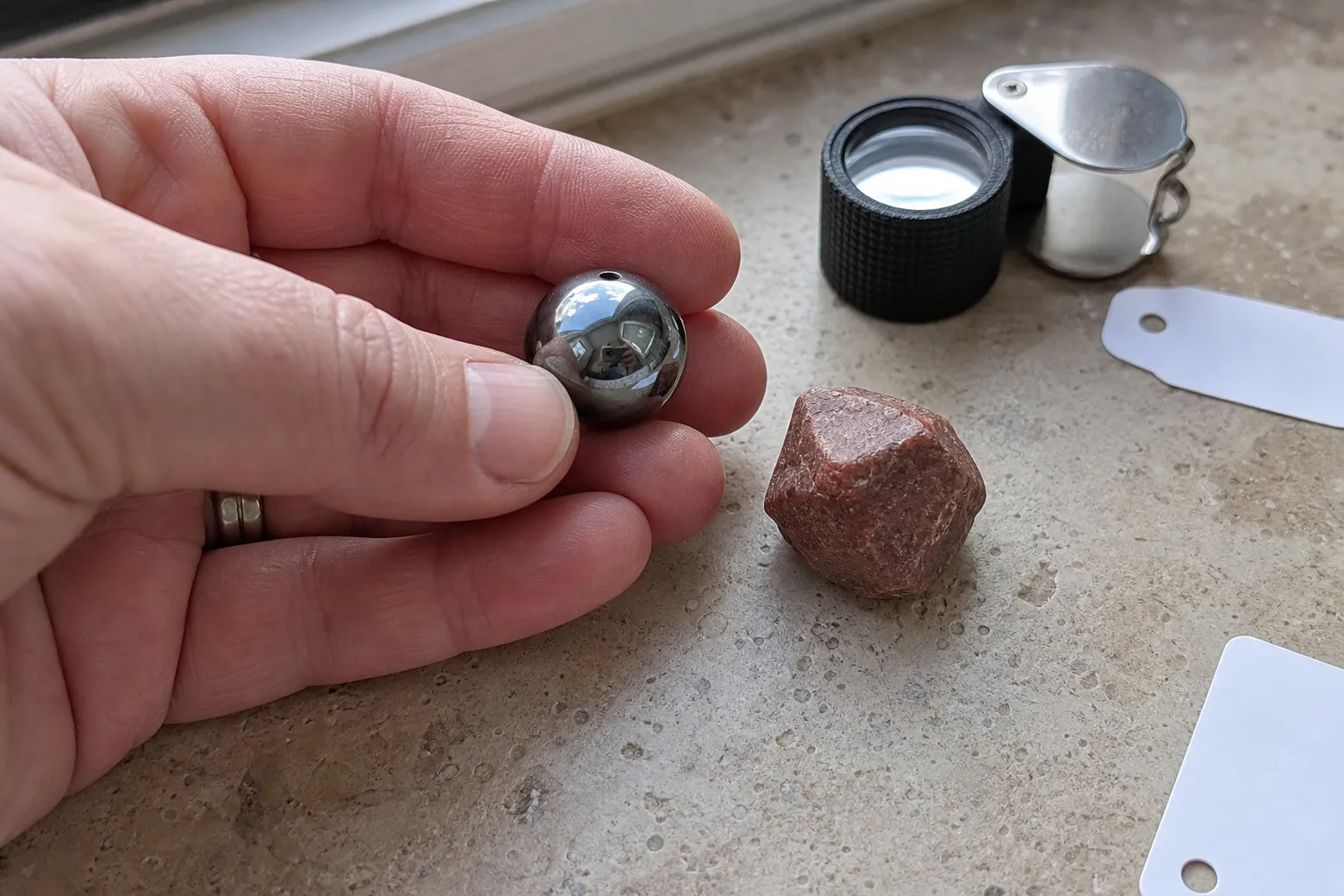
If you are comparing cinnabar vs hematite weight, your hand can notice something useful, but it cannot finish the identification for you.
Hematite is often noticed as “heavy for its size,” especially when it has a compact body and metallic gray shine. Cinnabar can also be dense, and because cinnabar is mercury sulfide, a possible cinnabar piece deserves more careful handling than an ordinary dark bracelet stone.
The practical answer is simple: a weighty feel can support a possibility, not prove a mineral identity. It does not tell you whether a bead, carving, or specimen is natural, treated, manufactured, coated, mislabeled, or suitable for repeated handling.
upward
Read the full overview first
Use the broader guide first if you need the full scope before this page.
The quick hand-feel answer
At a crystal counter, weight helps most when you compare it with size, color, surface, and seller wording at the same time.
| What you notice | What it may suggest | What it cannot prove |
|---|---|---|
| A dark metallic gray piece feels heavy for its size | Hematite is possible, especially if the surface looks steel-gray or metallic | That it is natural hematite, untreated, or free from lookalike materials |
| A red to reddish-brown mineral feels dense | Cinnabar may be possible if color, form, and context also fit | That it is cinnabar, or that it should be handled casually |
| A listing says “hematite,” “magnetic hematite,” “hematine,” or “Hemalyke” | The seller is giving you a term to question | That all of those words mean the same material |
| A bracelet feels weighty but looks extremely uniform | It may still be a dense manufactured, coated, or hematite-style material | That weight alone answers a real vs fake hematite question |
Weight works best as one clue in a small group: size, luster, color, surface finish, form, and wording. It works poorly as a stand-alone test.
Why hematite often feels heavy
Hematite is an iron oxide mineral, and many buyers notice its dense, compact feel. In polished jewelry, it is commonly associated with a dark steel-gray or metallic gray shine. That is why a shiny dark bracelet often leads to the question: “Does hematite feel heavy?”
That instinct is useful, but it needs limits.
Several details can change hematite hand feel:
- Form matters. A solid bead, thin chip, mounted cabochon, mixed bracelet, or hollow setting will not feel the same.
- Small pieces can fool the hand. A small dense bead may feel more convincing than a larger but lighter stone, even if neither item is exactly what the listing claims.
- Finish changes expectation. Polished hematite, coated stones, metallic-looking glass, and plated surfaces can all give a dense, shiny first impression.
- Marketplace names overlap. Hematine, Hemalyke or Hemalike, magnetic hematite, and hematite-style beads are often discussed near hematite, but they should not be treated as identical to a natural hematite specimen.
- Magnetism adds confusion. Strongly magnetic hematite-style jewelry is a separate warning sign to read carefully. Magnetism by itself does not settle the identification.
So if your main observation is “this hematite feels heavy,” you have noticed a relevant clue. A more careful conclusion would be: the piece may be consistent with hematite or a hematite-like material, but weight has not confirmed it.
Cinnabar density and the extra handling issue
Cinnabar is commonly described in mineral references as mercury sulfide, written as HgS. For a buyer, that puts cinnabar in a different category from most dark bead materials. It may feel dense, but weight is not the part that matters most. The bigger point is that cinnabar identification and cinnabar handling should not depend on hand feel.
A red or reddish-brown mineral that feels heavy is not automatically cinnabar. Other minerals, dyed pieces, coated surfaces, composite materials, matrix specimens, and “cinnabar-colored” items can enter the same shopping space. Rough specimens may also include matrix, coatings, altered areas, or mixed material, all of which affect weight and appearance.
Hematite weight questions
Usually ask whether a dark shiny item is hematite or a lookalike.
Cinnabar weight questions
Also raise a handling question because cinnabar is associated with mercury sulfide.
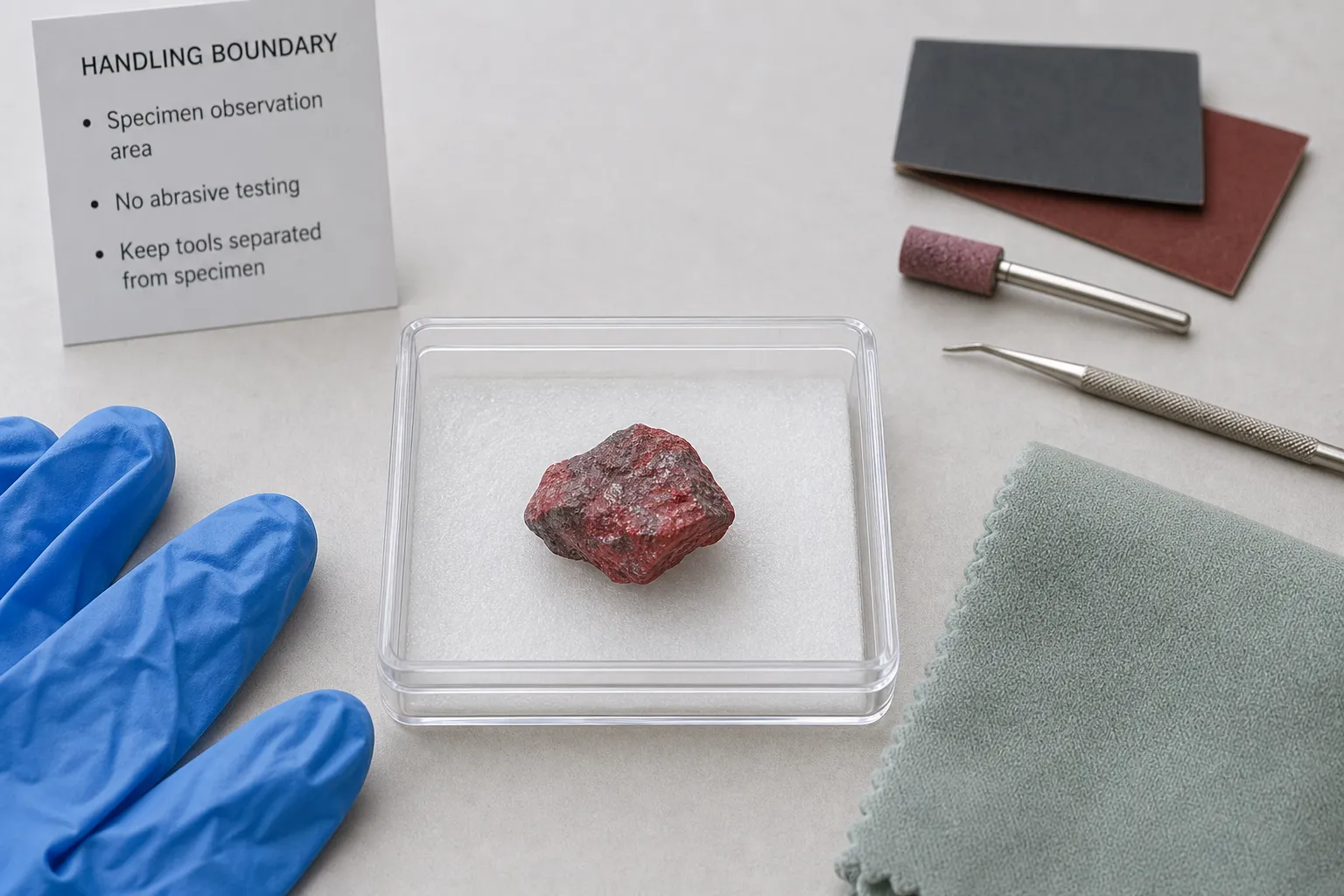
That does not mean every cinnabar-labeled object should be treated with panic. It does mean rough home checks are a poor fit. Avoid scratching, sanding, grinding, drilling, powdering, mouthing, or letting children or pets handle a suspected cinnabar piece casually. If a test would create dust or fresh abrasion, skip it and seek better identification instead.
Weight may help you notice that a red specimen is not a light plastic imitation. It cannot tell you whether the material is cinnabar, whether it contains mercury-bearing material, or whether it has been stabilized, coated, mixed, or mislabeled.
Where hand feel breaks down
A crystal weight comparison feels convincing because your hand gives an immediate answer. Mineral identification is less simple. Weight, color, luster, streak, hardness, crystal form, magnetism, and context all matter, and polished jewelry often hides or limits several of those clues.
Here are the main places where hand feel reaches its limit.
Two dense materials can feel similar
If two materials are both dense, your hand may not separate them reliably, especially in small beads or mounted jewelry. A few grams can be hard to judge without a scale and a volume measurement. Even then, stringing material, metal findings, glue, coatings, and mixed stones can distort the comparison.
Shape changes the impression
A flat cabochon, round bead, chunky tumble, and rough specimen do not sit in the hand the same way. Compact shapes often feel heavier than open, irregular, or porous-looking forms. That impression can be useful, but it is not the same as measuring mineral specific gravity.
Lookalikes share the same shelf
Hematite lookalike materials may appear near obsidian, tourmaline, terahertz-style beads, hematine, magnetic hematite, coated stones, plated finishes, and glossy dark glass. Some look convincing in photos. Some feel weighty enough to keep the question open.
That is why weight alone cannot answer every hematite authenticity question. It belongs in the chain of clues, not at the end of the chain.
Some classic tests are not buyer-friendly
Streak and hardness can be useful in mineral identification, but they can damage polished items. With suspected cinnabar, abrasion is especially unsuitable as a casual check because it may create dust or expose fresh material. If the item is valuable, polished, wearable, or labeled as cinnabar, do not turn a weight question into a damaging experiment.
A practical way to use weight before buying or keeping a piece
Use hand feel as a sorting step, not a verdict.
-
Compare weight to size.
Ask whether the piece feels unusually heavy for its size, average, or surprisingly light. That is the only thing your hand directly tells you.
-
Match weight with surface clues.
Hematite is often associated with metallic gray shine. Cinnabar is approached through red to reddish mineral appearance. If the color, shine, and weight all conflict with the seller label, ask more questions.
-
Read the exact wording.
“Hematite,” “magnetic hematite,” “hematine,” and “Hemalyke” should not be treated as interchangeable. “Cinnabar,” “cinnabarite,” “cinnabar-colored,” and “cinnabar-style” may also point to different things.
-
Keep crystal-use language separate from material identity.
Some buyers use hematite or cinnabar in personal or cultural crystal practices. That meaning does not identify the material or establish its physical properties.
-
Handle possible cinnabar gently.
If the piece may be cinnabar, avoid abrasion, dust, food surfaces, mouths, children, and pets. Store it so it will not be rubbed, chipped, or handled repeatedly without thought.
-
Use specialized testing when the answer matters.
If value, resale wording, collection records, or handling decisions depend on the answer, hand feel is not enough. Mineral and heritage-material work may use methods such as X-ray fluorescence, X-ray diffraction, or Raman spectroscopy. The buyer takeaway is simpler: reliable confirmation can require more than weight, photos, or a label.
When weight is enough to act
Weight is enough to make a low-stakes buying decision more cautious.
If a bracelet sold as hematite feels very light, has a plastic-like surface, and uses vague listing terms, you may decide not to buy it. If a red specimen is sold as cinnabar and the seller encourages rough handling or casual wear without explanation, you may decide to avoid it or ask for clearer information.
Weight is not enough when the result affects material identity, value, safety-sensitive handling, resale wording, or a serious collection record.
A dense feel can support a suspicion. A metallic gray shine can support a hematite possibility. A red dense mineral can raise the cinnabar question. None of those observations proves identity on its own. For cinnabar especially, the better habit is to handle gently unless proper identification and handling context are clear.
Quick answers
Does hematite usually feel heavy?
Often, yes. Hematite is commonly noticed as heavy for its size, especially in compact polished pieces with a metallic gray shine. That clue is useful, but not conclusive.
Can cinnabar feel heavy too?
Yes, cinnabar can feel dense. But a heavy red mineral is not automatically cinnabar, and suspected cinnabar should not be scratched, ground, or tested destructively as a casual home check.
Can I tell cinnabar vs hematite by weight alone?
No. Weight can help you sort possibilities, but color, luster, form, seller wording, and sometimes specialized testing are needed for a more reliable answer.
Sources
Sources and further reading
Reference links are limited to sources considered suitable for public citation in this page.