ProtectCrystal handling note
Buyer comparison
Obsidian vs Hematite Properties: Physical Differences Buyers Can Check
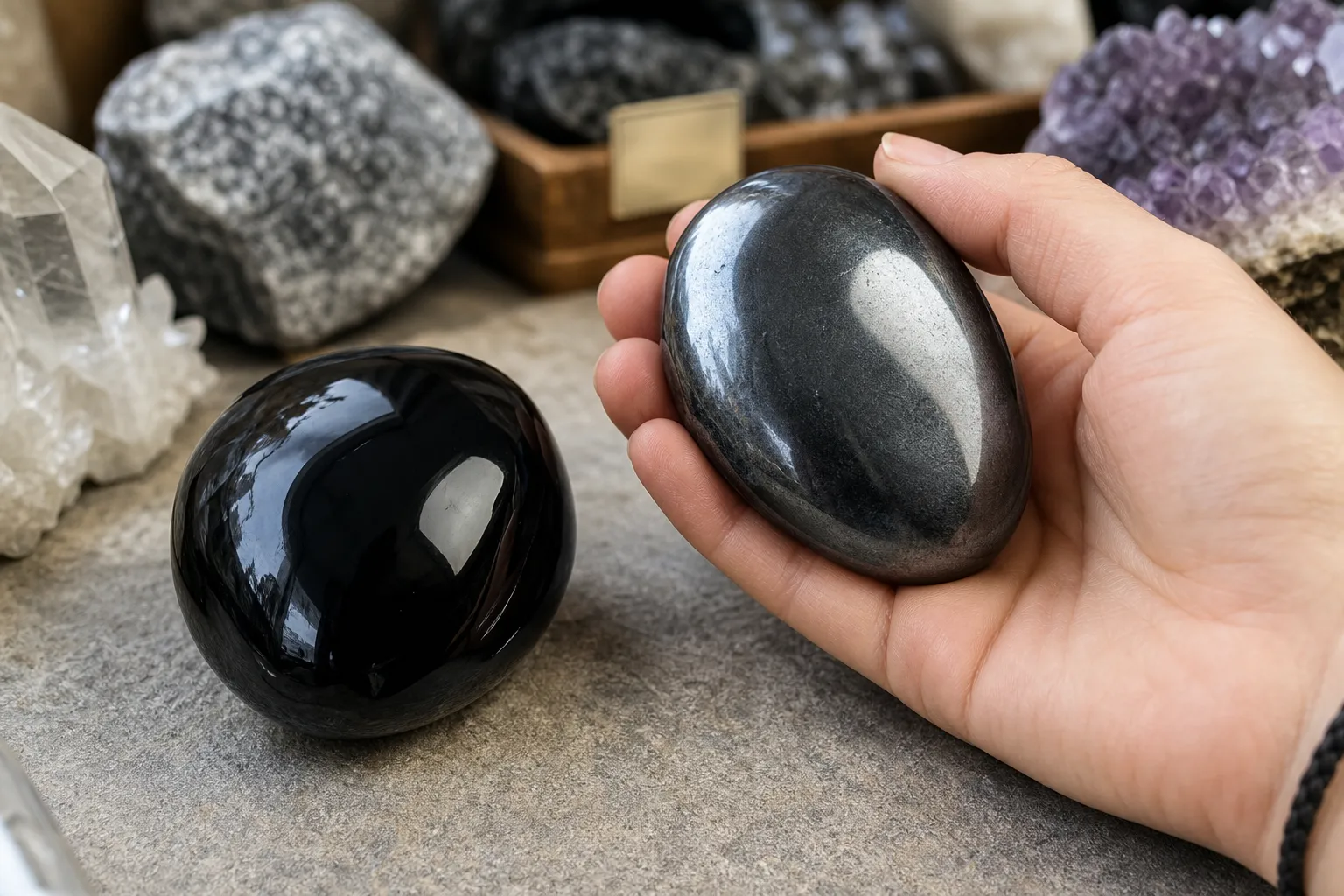
Obsidian usually looks and feels like dark volcanic glass: glossy, often deep black, and sometimes marked by smooth, curved chips on broken edges. Hematite usually reads more like a dense iron-oxide mineral: metallic to submetallic, gunmetal gray to dark silvery gray, and noticeably heavy for its size.
For a practical obsidian vs hematite properties check, start with four things you can observe without damaging the piece: luster, color tone, weight impression, and any already-exposed chip or edge. These clues can be very useful, but they do not confirm identity by themselves. Polish, coatings, lighting, imitation beads, mixed jewelry, and vague seller labels can all blur the comparison.
upward
Read the full overview first
Use the broader guide first if you need the full scope before this page.
Quick buyer comparison: obsidian vs hematite at the counter
If you are holding two dark tumbled stones, beads, or bracelet pieces, the useful question is simple: what can you actually check in hand?
| Buyer-checkable cue | Obsidian | Hematite |
|---|---|---|
| Material type | Natural volcanic glass | Iron-oxide mineral |
| Common visual impression | Deep black, smoky black, sometimes brownish, gray, or patterned depending on variety | Gunmetal gray, steel gray, dark silvery gray, or reddish brown in some forms |
| Luster | Glassy to glossy; polished pieces may look like black glass | Metallic to submetallic; polished pieces may look like dark metal |
| Weight impression | Moderate for size; often lighter than hematite when pieces are similar in size | Often heavy for size because hematite has relatively high density |
| Streak clue | Not usually the main buyer check for polished obsidian | Hematite is known for a reddish to reddish-brown streak, but testing can mark finished pieces |
| Chip or edge clue | Broken edges may look glassy, curved, and sharp | Chips may look more metallic, granular, dull, or earthy depending on the piece |
| Common confusion | Black glass, dyed glass, onyx-like stones, and very dark volcanic materials | Other metallic-looking stones, coated beads, and hematite-like jewelry materials |
A weight comparison only makes sense when the pieces are close in size and shape. A 10 mm hematite bead and a 10 mm obsidian bead may feel noticeably different; a large obsidian tumble and a small hematite bead will not give a fair comparison.
Start with luster: glassy versus metallic
The easiest first clue is often the surface shine.
Obsidian is volcanic glass, so a polished piece commonly has a smooth, glassy appearance. Under neutral light, it may reflect like black glass: glossy, dark, and mirror-like. Some pieces show a smoky or slightly translucent look along a thin edge, although many polished pieces will not show this clearly.
Hematite points in another direction. It is commonly described as metallic or submetallic. A polished hematite bead or tumble may reflect light like dark metal rather than glass. Instead of looking truly black, it often leans gunmetal, steel gray, or dark silvery gray. Some hematite specimens are reddish brown or earthy rather than shiny, but polished jewelry pieces are often the metallic-looking ones buyers notice first.
This is why “black stone” can be misleading. Obsidian is often black. Hematite may be grouped with dark stones in retail language, but in hand it commonly looks more gray-metallic than pure black. Product photos can flatten that difference: low light can make hematite look nearly black, while a strong highlight on polished obsidian can make it look almost metallic.
Use this check
- Put the piece under soft daylight or a neutral lamp.
- Rotate it slowly.
- Ask whether the reflection looks more like glass or dark metal.
- Look at the body color, not only the brightest highlight.
- Compare several beads or surfaces if the piece is part of jewelry.
Surface finish can still interfere. Coatings, wax, polishing compounds, and imitation materials may change how a piece reflects light.
Weight: hematite often feels heavy for its size
Weight is the next useful clue. Hematite has relatively high density, so a small polished bead or tumble can feel surprisingly weighty. That “heavy for size” impression is one of the reasons buyers often notice hematite in bead strands and bracelets.
Obsidian, as natural glass, usually does not have the same dense, metal-like hand feel. A large obsidian palm stone can still feel substantial, but when two pieces are similar in size, hematite commonly feels heavier.
This comparison works best when you compare
- bead to bead,
- tumble to tumble,
- pendant to pendant,
- similar size,
- similar shape,
- no heavy metal setting attached.
Where it works poorly
It works poorly when one piece is much larger, mounted in metal, drilled differently, or mixed with spacers and other beads. A bracelet may feel heavy because of its full construction, not only because of the stone.
Weight is a clue, not a final answer. A heavy dark bead may suggest hematite, but it does not rule out other dense materials. A lighter black bead may suggest obsidian, but it does not confirm natural volcanic glass.
Chips, edges, and fracture behavior
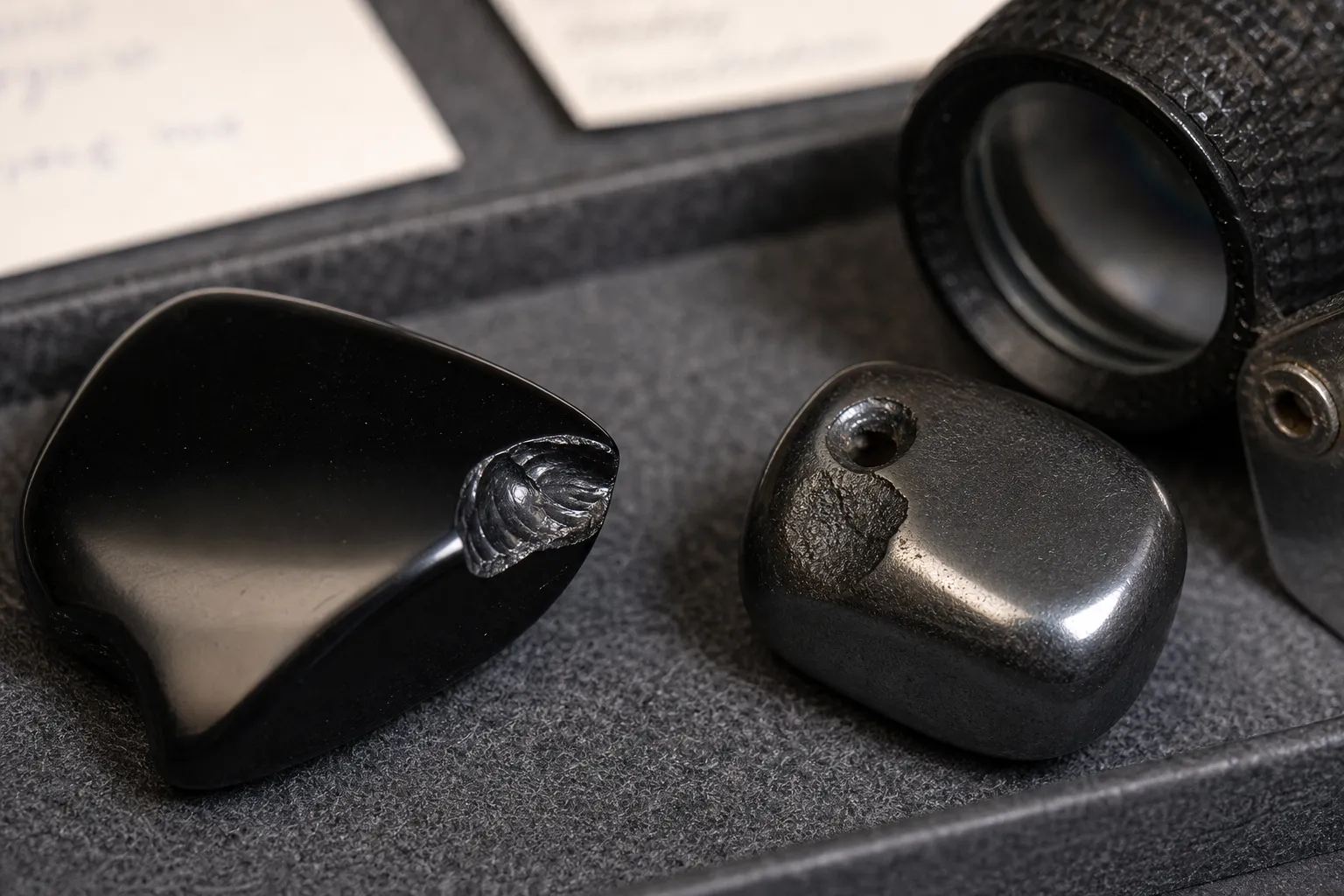
Obsidian fracture behavior can be a strong material clue, but it should not become a destructive test. Obsidian is glassy volcanic material and is known for conchoidal fracture: curved, shell-like break surfaces. Broken obsidian can also form sharp glass-like edges.
For a buyer, the point is not to break or scratch the stone. Look only at surfaces that are already exposed:
- a tiny chip on a tumble,
- an unpolished back on a pendant,
- a natural edge on a specimen,
- a damaged bead hole,
- a flake-like surface on rough material.
On obsidian, chips may look smooth, curved, glassy, and sharp. On hematite, damaged areas may look more metallic, granular, earthy, or dull depending on the specimen and finish.
If you see a sharp glassy edge, handle the piece carefully. Do not run your finger firmly along a suspicious chip. Look first, and if you are shopping in person, ask before handling a damaged piece.
Finished beads and tumbled stones often hide fracture clues because the surfaces have been rounded and polished. If there is no useful edge to inspect, luster and weight are usually more practical.
Streak tests: useful, but not always buyer-friendly
A hematite streak test is a classic mineral-identification clue. Hematite is known for leaving a reddish to reddish-brown streak on an unglazed porcelain streak plate, even when the specimen itself looks dark gray or metallic.
For a crystal buyer, the problem is damage. Streak testing can abrade a stone, mark the surface, or ruin polish. It is not appropriate for a finished bracelet, a bead you do not own, a display piece, or a collector specimen unless permission is clearly given.
If you already own an inexpensive rough piece and accept the chance of marking it, a streak plate may provide a useful clue. For most polished crystal-shop pieces, use a less invasive sequence:
- 1. Check luster and body color first.
- 2. Compare weight only with similar-sized pieces.
- 3. Inspect existing chips or bead holes.
- 4. Read the seller wording carefully.
- 5. Ask what the identification is based on if the listing is vague.
- 6. Seek a knowledgeable mineral dealer or testing service if the identity matters.
Scratch tests have the same issue. Hardness is useful in mineral identification, but using a knife, steel point, quartz point, or another stone on a polished bead can leave permanent marks.
Seller labels and crystal meanings are not physical evidence
Many buyers reach hematite vs black obsidian comparisons through crystal-shop language. Both stones are commonly sold in symbolic, personal-use, or ritual contexts. That language may explain why the stones are compared, but it is separate from physical-property identification.
A card that says “hematite,” a bead strand labeled “black obsidian,” or a listing that describes a stone’s intended use does not by itself verify the material. Seller labels can be correct, but they can also be copied from supplier descriptions, applied loosely, or attached to mixed materials.
Watch for wording that blurs identity:
- “hematite color” rather than hematite,
- “hematite-like” or similar style wording,
- “black stone” without a material name,
- “volcanic glass look” without saying obsidian,
- “magnetic hematite” used as a simple selling point,
- “natural” without explaining what was checked.
Magnetism deserves caution. Some jewelry-market materials sold near hematite are described as magnetic or hematite-like, but magnetism is not a simple at-home proof of hematite identity. Treat magnetic wording as a reason to ask more questions, not as a shortcut.
Practical checklist for comparing two dark pieces
Use this when you have a dark gray or black piece in hand and want to know whether it is more suggestive of obsidian or hematite.
- 1. Compare under neutral light.
Daylight or a neutral lamp makes black versus gunmetal tone easier to see. - 2. Rotate the surface.
Obsidian usually gives a glassy shine. Hematite often gives a metallic or submetallic reflection. - 3. Check the body color.
Do not judge from one bright highlight. Obsidian often reads deep black; hematite often leans steel gray or dark silvery gray. - 4. Compare weight only with similar pieces.
Hematite often feels heavy for size, but the comparison is useful only when dimensions and settings are similar. - 5. Inspect existing chips or bead holes.
Glassy, curved, sharp-looking chips suggest obsidian. Metallic, granular, or earthy chip texture may point away from obsidian, though polished surfaces can hide this clue. - 6. Be cautious with streak or scratch tests.
A reddish-brown streak is a known hematite clue, but testing can damage polished pieces. - 7. Treat labels as clues.
The label should line up with the material’s appearance and feel. If the wording is vague, ask for clarification. - 8. Stop before the check becomes destructive.
If identification matters for collecting, resale, or a higher-value purchase, use a more qualified opinion rather than forcing home tests.
When the answer remains uncertain
Some pieces will not give a clean answer. A glossy photo can make hematite look black. A matte obsidian bead can look less glassy than expected. A coating can imitate another surface. A mixed bracelet may contain both obsidian and hematite, especially if one is used as a black bead and the other as a metallic accent.
Natural variation also matters. Obsidian is often black and glassy, but it can show different tones, inclusions, banding, or translucency depending on the material. Hematite can be shiny and metallic, dull and earthy, reddish brown, or dark gray. The polished jewelry version is only one common presentation.
A grounded reading looks like this
- Glassy, deep black, sharp glass-like chip: more suggestive of obsidian.
- Metallic, gunmetal gray, heavy for size, reddish-brown streak if appropriately tested: more suggestive of hematite.
- Only a seller label or dark product photo: not enough to judge.
- High-stakes identification: ask for specialist testing or a knowledgeable mineral opinion.
For everyday crystal buying, these checks are often enough to spot whether a piece matches its description or deserves a second look. The value of comparing obsidian properties and hematite properties is practical: the two materials can look similar in listings, but in hand they often differ in shine, tone, weight, and chip behavior.
Sources
Sources and further reading
Reference links are limited to sources considered suitable for public citation in this page.