
ProtectCrystal handling note
Display shelf placement
Placement for Obsidian, Hematite, and Cinnabar on a Crystal Display Shelf
For obsidian hematite cinnabar display shelf placement, the most practical arrangement is simple: put cinnabar in the most controlled, lowest-touch position; keep sharp or chipped obsidian away from the shelf edge; use hematite as a visible anchor only when it is contained and stable.
A balanced home shelf usually looks like this: cinnabar enclosed or labeled in the back, obsidian on a stable stand or tray in the middle, and hematite toward the front or lower shelf only if it cannot roll or slide. If children or pets can reach the display, move cinnabar into a closed cabinet or secured case, and keep sharp obsidian out of hand, paw, and tail range.
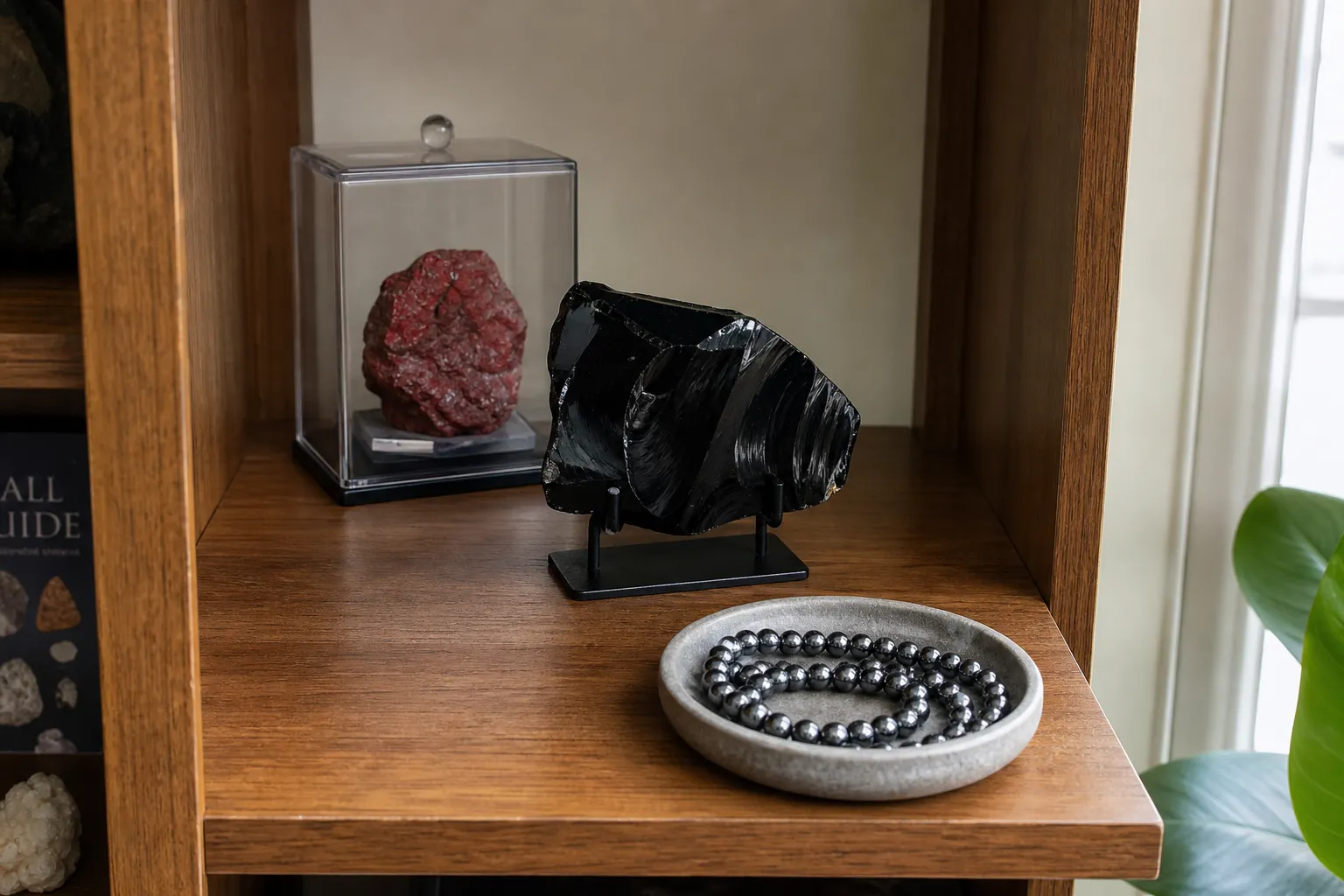
upward
Read the full overview first
Use the broader guide first if you need the full scope before this page.
A practical shelf layout for the three pieces
Think in shelf zones, not just in color or “protective crystal” meaning. The most dramatic piece is not always the best front-row piece.
Cinnabar
Better position
Back row, lidded box, enclosed display case, labeled tray, or closed cabinet.
Why it works
Cinnabar is mercury sulfide and is best treated as a low-touch display specimen, especially if raw, dusty, crumbly, damaged, or unsealed.
Obsidian
Better position
Middle row, stable stand, shallow tray, or case if chipped.
Why it works
Raw, broken, or chipped obsidian can have sharp edges, so it should not sit where hands, sleeves, pets, or cleaning cloths can brush it.
Hematite
Better position
Front or lower shelf only if supported.
Why it works
Hematite can visually “ground” a display, but beads, small tumbles, and smooth pieces may roll or knock into neighboring stones.
This is a cautious home-display approach, not an official storage standard for these three minerals together. Museum and mineral-care sources support general points about handling, labeling, storage, and caution with mercury-bearing specimens, but they do not prescribe one exact home shelf arrangement for obsidian, hematite, and cinnabar.
Put cinnabar where it can be viewed, not handled
Cinnabar is the piece that should shape the rest of the shelf plan. Mineral references identify cinnabar as mercury sulfide, and toxicology literature around cinnabar-containing materials gives good reason to avoid practices that create dust, powder, heat, ingestion, or repeated contact.
For a home crystal shelf, translate that into one placement rule: display cinnabar as a specimen, not as a touch stone.
Good cinnabar display positions include:
- Inside a small acrylic, glass, or lidded display box.
- In the back row of an open shelf, not at the front lip.
- On a labeled tray that signals “view, don’t casually pick up”.
- In a closed cabinet if the room is shared with children, pets, or frequent guests.
- Separated from stones that are regularly handled, rearranged, or used in personal routines.
Raw cinnabar handling deserves extra care. If the specimen looks powdery, crumbly, damaged, or leaves residue, do not place it where it can be bumped, dusted around roughly, or passed from hand to hand. Gloves can be useful for handling that kind of specimen, and washing hands afterward is a sensible habit. Avoid scraping, sanding, drilling, cutting, grinding, or any action that creates dust. Do not use cinnabar in drinking-water practices, body-contact routines, or anything that encourages ingestion or repeated skin contact.
A polished or sealed-looking cinnabar item may appear cleaner than a raw specimen, but appearance alone does not prove what it is, how it was treated, or how durable a coating may be. Seller words such as “natural,” “raw,” “powder,” “lacquer,” “resin,” or “jewelry” should not be treated as proof of household suitability. For certainty about identity or coating, specialized testing may be needed.
Place obsidian for edge control
Obsidian is often discussed in crystal spaces as a protective stone, and many people like placing it where it looks visually strong. On a shelf, though, the practical issue is the edge condition.
Obsidian is commonly described as volcanic glass. A polished sphere, tower, or palm stone may be smooth and easy to display, while a raw, broken, or chipped piece can have sharp edges. That does not make every obsidian display difficult; it just means damaged edges need a better position.
For sharp obsidian shelf placement:
- Do not put broken or chipped obsidian at the front lip of the shelf.
- Turn sharp or pointed edges inward, away from casual reach.
- Use a stand, dish, or shallow tray so the piece does not slide.
- Place chipped pieces behind sturdier stones instead of using them as front-row accents.
- Avoid crowded arrangements where another item can knock obsidian forward.
Polished obsidian display placement can be more open if the piece is stable and undamaged. A sphere, tower, or palm stone can sit where it is easy to see, but it still needs support if it can roll or tip. If a polished piece chips, treat the damaged area like any other sharp edge: turn it away from contact or move the piece into a tray or case.
“Polished” is a finish description, not a complete handling answer. It may reduce roughness, but it does not prevent later chips, falls, or unstable placement.
Use hematite as an anchor only when it cannot roll
Hematite does not need the same level of caution as cinnabar on this shelf. Mineral references commonly identify hematite as an iron oxide mineral, and there is no need to invent special display rules beyond ordinary stability, weight, finish, and contact concerns.
Hematite is often sold as beads, tumbled stones, small carvings, polished metallic-looking pieces, or novelty magnetic-style items. On a display shelf, the main question is whether the form stays put.
Use hematite toward the front or lower part of the display if:
- It has a flat base or stable stand.
- Beads are kept in a bowl, groove, tray, or compartment.
- It will not roll into cinnabar, glass, or sharp obsidian.
- It is not pressed tightly against polished stones that may scratch.
- The shelf can support the combined weight of the display.
Hematite beads and small tumbles are easy to underestimate. A strand can slide, loose beads can drop, and small polished pieces can shift when the shelf is dusted. If you want hematite visible in the front row, contain it first. A shallow dish, lined tray, bead bar, or small divided box can keep the display intentional without letting pieces wander.
Open shelf or enclosed cabinet?
The right placement changes with the room. An adult-only study is different from a living room where guests, children, pets, or cleaning routines increase contact.
If it is an open shelf
An open shelf can work if it reduces casual handling.
- Cinnabar: back row, labeled, preferably inside a lidded box or small case.
- Obsidian: middle area, with sharp or chipped edges turned inward.
- Hematite: front only if contained and stable.
- Labels: readable without picking up the specimen.
- Spacing: enough room to dust around pieces without knocking them together.
An open shelf is not the best choice for raw, dusty, or fragile cinnabar if the display is frequently touched or rearranged. A closed display box is usually a better compromise: the specimen stays visible, but casual handling is less likely.
If it is an enclosed cabinet
An enclosed cinnabar display case or cabinet is the more sensible option when the specimen is raw, crumbly, dusty, damaged, or visually tempting. A small case also communicates that the piece is for viewing rather than handling.
- Children or pets can reach the general display area.
- The cinnabar specimen is raw, powdery, or damaged.
- Guests often pick up stones without asking.
- The shelf is in a high-traffic room.
- The collection includes several red or metallic specimens that could be confused.
A home display case is not a museum conservation system. For this narrow shelf task, the useful point is simpler: an enclosure reduces casual contact and keeps a labeled cinnabar specimen separate from pieces people handle more often.
If children or pets can access the shelf
If children or pets can reach the display, cinnabar should not be reachable. Put it in a closed cabinet, secured case, or inaccessible location. Sharp obsidian should also be moved away from hand, paw, and tail range. Hematite beads and small tumbles should be contained so they cannot roll off and become objects of curiosity.
The goal is not to make the shelf look severe. It is to match the arrangement to the household.
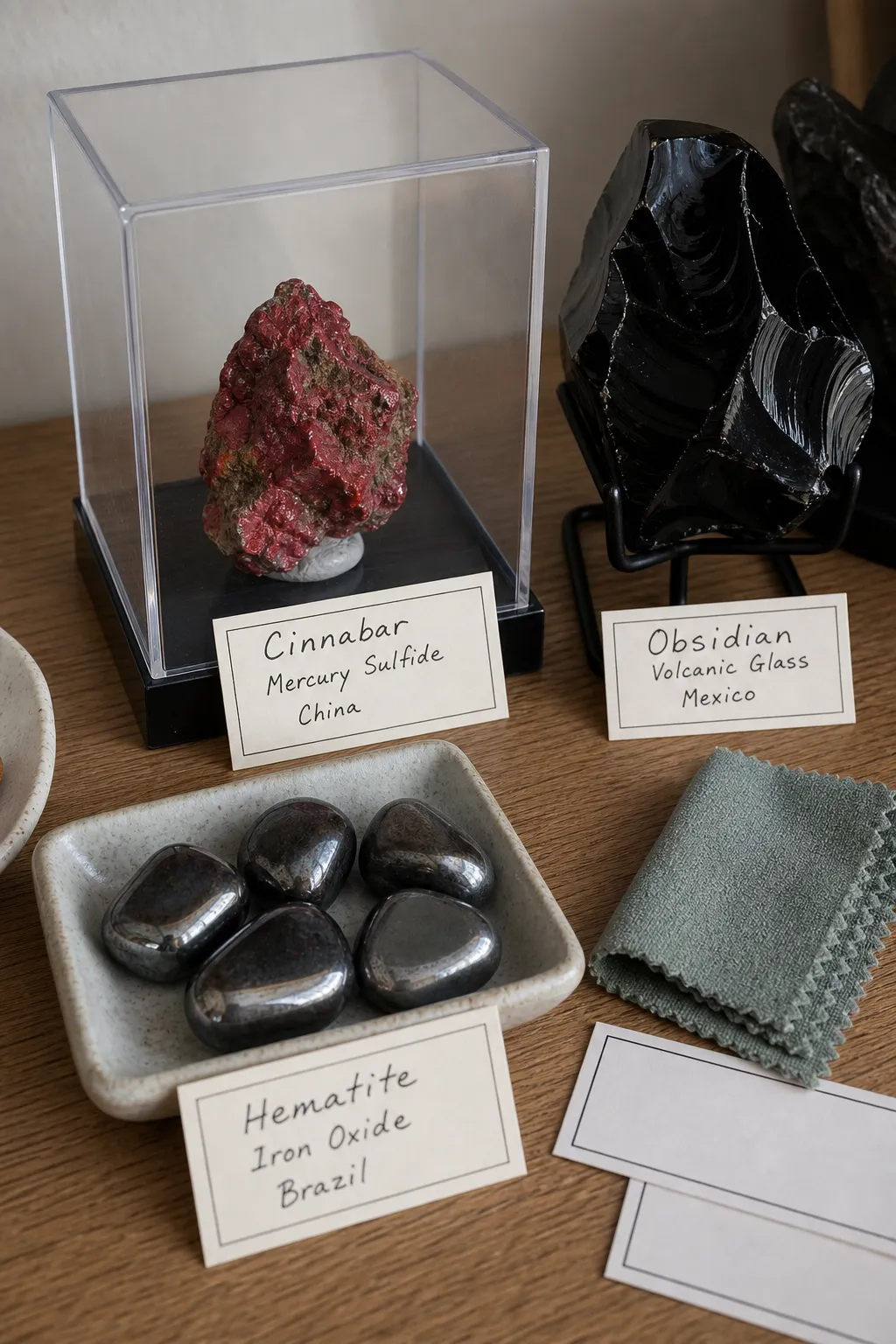
Labeling makes the display easier to manage
A labeled cinnabar specimen is especially useful in a mixed crystal display. Cinnabar can be visually attractive, and red specimens tend to draw attention. A small label can reduce unnecessary handling by visitors or household members who do not know which piece is which.
Plain labels work best:
- “Cinnabar — display specimen”
- “Cinnabar — low-touch, wash hands after handling”
- “Raw cinnabar — do not handle casually”
- “Chipped obsidian — sharp edge”
Labels also help when cleaning or rearranging the shelf. If you remove pieces to dust, labels make it easier to return cinnabar to the controlled position instead of accidentally moving it to the front.
A label is not proof of identity. It records what the piece was sold or identified as; it does not verify composition, coating, treatment, or authenticity. If certainty matters, visual inspection is not enough.
Common misunderstanding: meaning does not decide placement
Many readers group obsidian, hematite, and cinnabar together because they are sold in protective-crystal or power-focused language. That personal or cultural framing may be part of why the shelf matters to you. It should not be what decides the handling plan.
For placement, focus on:
- How often the piece will be touched.
- Whether it can roll, slide, or fall.
- Whether an edge can cut or snag.
- Whether dust or residue may be disturbed.
- Whether children, pets, or guests can reach it.
- Whether a label would prevent casual handling.
A display can still feel meaningful without putting the most sensitive item in the most reachable position. Let cinnabar be visible from a protected place. Give sharp or chipped obsidian a stable position away from the shelf edge. Contain hematite beads or small tumbles before using them as front-row accents.
Quick placement checklist
Before you finish the shelf, check these points:
- Cinnabar is not at the front edge.
- Raw, dusty, or damaged cinnabar is enclosed or placed in a low-touch spot.
- Cinnabar is kept away from children and pets.
- Cinnabar is labeled clearly enough that guests will not handle it casually.
- Sharp or chipped obsidian edges face inward or sit in a tray or case.
- Polished obsidian is stable and cannot tip or roll.
- Hematite beads or tumbles are contained.
- Heavy hematite pieces sit on a shelf that can support them.
- Pieces are spaced so cleaning does not push them into each other.
- The display does not depend on crystal effects as a substitute for practical handling.
The simplest balanced arrangement is: cinnabar enclosed and labeled in the back, obsidian stable with edges controlled in the middle, and hematite contained and supported toward the front or lower shelf. That keeps the shelf readable, attractive, and easier to maintain without turning a small home display into a broad safety manual.
Sources
Sources and further reading
Reference links are limited to sources considered suitable for public citation in this page.