
ProtectCrystal handling note
Raw obsidian handling
Should You Wear Gloves When Handling Raw Obsidian
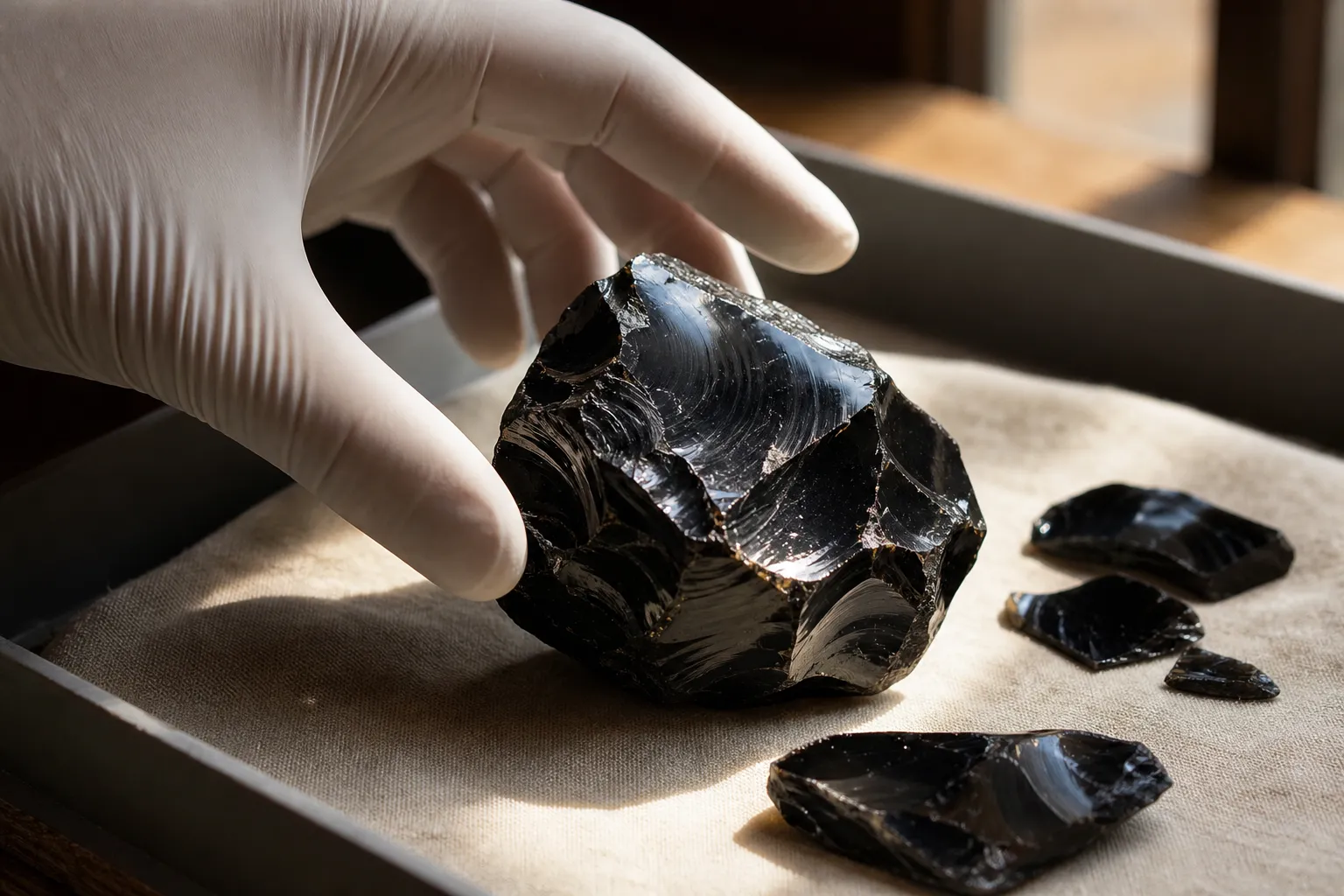
Raw obsidian can look glossy and calm from a distance, then show a thin edge, chip, or broken point once you turn it in the light. The practical answer is: wear gloves handling raw obsidian when the piece is rough, chipped, freshly broken, flaked, pointed, or not yet inspected.
If the piece is smooth, stable, and already checked from several angles, brief bare-hand handling may be reasonable. That is different from sorting rough pieces, cleaning dust from broken edges, or handling fragments you do not know well.
The glove question is not answered by crystal meaning, seller wording, or the word “natural.” It is answered by the surface in front of you. Raw obsidian is often described as volcanic glass, and sharp glass-like fragments deserve slower handling.
upward
Read the full overview first
Use the broader guide first if you need the full scope before this page.
When Gloves Make Sense
Gloves are most useful before you know how the piece will behave in your hand. A newly bought specimen, a loose parcel of rough raw obsidian, or a piece pulled from storage may have small chips, thin flakes, or broken points that are easy to miss.
Use obsidian handling gloves when you are:
- Sorting several raw pieces in a tray or box
- Cleaning dust from rough raw obsidian
- Packing or unpacking raw obsidian
- Photographing a specimen with uneven edges
- Checking chipped obsidian edges
- Handling freshly broken obsidian or sharp glass-like fragments
The glove does not need to be dramatic for casual crystal handling. The useful quality is a barrier between your skin and an uncertain edge. A thin glove may help with light inspection; a sturdier glove may be better when the piece has obvious points, flakes, or broken raw obsidian edges.
Gloves reduce direct contact, but they do not make sharp volcanic glass handling careless. Do not slide your fingers along an edge just because your hand is covered.
When Bare Hands May Be Reasonable
Not every obsidian piece calls for gloves every time. Smooth obsidian handling is different from handling raw, chipped, or freshly fractured material. A polished palm stone, a tumbled piece, or a stable display specimen that has already been inspected may be comfortable to pick up briefly with clean, dry hands.
The key word is inspected. Look before you grip. Turn the piece slowly under light. Check for thin ridges, tiny points, loose flakes, and sharp-looking corners. A surface can appear glossy and still have a small broken area near the side or base.
Bare-hand handling is more reasonable when the piece is:
- Polished or tumbled rather than rough
- Free of visible chips, flakes, or splintery points
- Stable enough that you do not need to squeeze it
- Already checked from several angles
- Handled briefly rather than cleaned, sorted, or packed
These signs can suggest a lower cut concern, but they do not prove the piece is harmless. If you are unsure, choose gloves.
Surface Cues to Check Before Touching Raw Obsidian
Read the surface rather than the label. Seller descriptions may say “raw,” “natural,” “rough,” “black obsidian,” or “protective crystal,” but those words do not tell you whether a specific edge is sharp.
Start with the outline. Points, hooks, jagged corners, and thin projecting edges deserve more caution than rounded surfaces. A raw obsidian edge that narrows into a fine line may catch skin more easily than a broad, dull surface.
Then check the faces. Flakes may look like shallow scales or fresh glossy scars. Chipped areas may show small steps or bright reflective spots where material has broken away. Freshly broken obsidian can look cleaner and sharper than older worn surfaces, though appearance alone cannot tell you exactly how it will feel.
Also check the base. Many pieces are photographed from the front, while the bottom edge may be rougher than the display side. If the stone rocks, tips, or requires a tight grip, gloves become more sensible.
A simple handling sequence works well
- 1. Place the piece on a stable surface.
- 2. Look at the edges before lifting it.
- 3. Rotate it by holding broader, duller areas.
- 4. Avoid dragging fingers along edges.
- 5. Use gloves if any point, chip, or flake looks uncertain.
This is a buyer check, not an authenticity test. It helps you decide how to handle the piece, not whether the obsidian is verified by appearance alone.
Raw, Polished, and Broken Pieces Are Not the Same
The word “obsidian” can cover very different handling situations. A polished pendant, a tumbled stone, a carved piece, and a fresh rough fragment should not be treated as if they have the same surface behavior.
Raw obsidian is where gloves are most often sensible, especially when the specimen has uneven edges or has been transported loosely. Rough pieces may have ridges, chips, and points from breakage or trimming. Even when the main face feels smooth, an edge or underside may be the part that matters.
Polished obsidian is usually easier to handle because the surface has been smoothed. That does not mean every polished item is perfect. A polished piece can still have a damaged corner, a drilled area, or a small chip from use or shipping.
Freshly broken obsidian deserves the most caution in this narrow question. If a piece has just snapped, cracked, or shed sharp glass-like fragments, use gloves and handle the fragments as small cutting hazards. Do not brush them away with bare fingers. Do not press the broken edge to test it.
The more raw and broken the surface looks, the stronger the case for gloves.
Common Confusion Around Obsidian, Gloves, and Protection Language
Obsidian is often discussed as a protective crystal in shops, collections, and personal practice. That language may matter to a reader as personal or cultural context, but it is not evidence that the material protects your hands from cuts. Crystal meaning and raw obsidian safety are separate questions.
Another confusion is assuming that “natural” means gentle to handle. Natural surfaces can be smooth, rough, dull, sharp, weathered, chipped, or freshly broken. The word does not settle the glove decision.
The reverse mistake is assuming all raw obsidian is too dangerous to touch. That is also too broad. Some inspected obsidian pieces may have stable, duller areas that can be handled carefully without gloves for a short moment.
The better approach is conditional: look first, then decide.
A Compact Decision Check
Fresh break, pointed edge, or loose flakes
Wear gloves
The surface is uncertain and may catch skin.
Chipped obsidian edges or jagged corners
Wear gloves
Small broken areas can be easy to miss.
Rough raw obsidian in a mixed lot
Wear gloves
Sorting increases contact with multiple edges.
Smooth, polished, inspected piece
Gloves optional for brief handling
The surface has fewer obvious rough contact points.
Unknown surface in poor light
Wear gloves or wait
You cannot judge the edge clearly.
This table is not a guarantee. It is a practical sorting tool for handling raw obsidian safely when the surface condition is the main concern.
What This Page Can and Cannot Claim
The available source set for this page did not include usable public authority references, technical handling guidance, or curated firsthand handling reports. That limits how strongly the advice should be stated.
The narrow, supportable answer is cautious and inspection-based: gloves are sensible for rough, chipped, freshly broken, flaked, or uncertain raw obsidian; they may be unnecessary for every brief touch of a smooth, stable, inspected piece.
This page is not workplace safety guidance, medical advice, or a lab-style material assessment. It also cannot verify authenticity from photos, labels, shine, color, or edge shape. If certainty would require specialized testing, this page cannot supply it.
Check the surface. Choose gloves when the edge is unknown. Slow down around broken pieces.
Final Answer
You should wear gloves when handling raw obsidian if the piece has rough raw obsidian edges, chips, flakes, broken points, fresh fractures, or any surface you have not inspected closely. Gloves are also sensible when sorting, cleaning, packing, or photographing raw pieces because your hands may contact edges you did not notice at first.
You may not need gloves for every brief touch of smooth, polished, stable, inspected obsidian, but inspect the piece before relying on bare hands. Avoid sliding fingers along edges, and treat sharp glass-like fragments with extra care.
For raw obsidian, the best rule is not “always gloves” or “never gloves.” It is: inspect first, use gloves when the surface gives you a reason, and do not let crystal meaning replace material caution.