ProtectCrystal handling note
Buyer note
Why Hematite Beads Are Often Sold as Magnetic or Non-Magnetic
Hematite bead strands are sold as “magnetic” or “non-magnetic” because the bead market uses hematite-related labels for materials that can look alike but respond differently to a magnet.
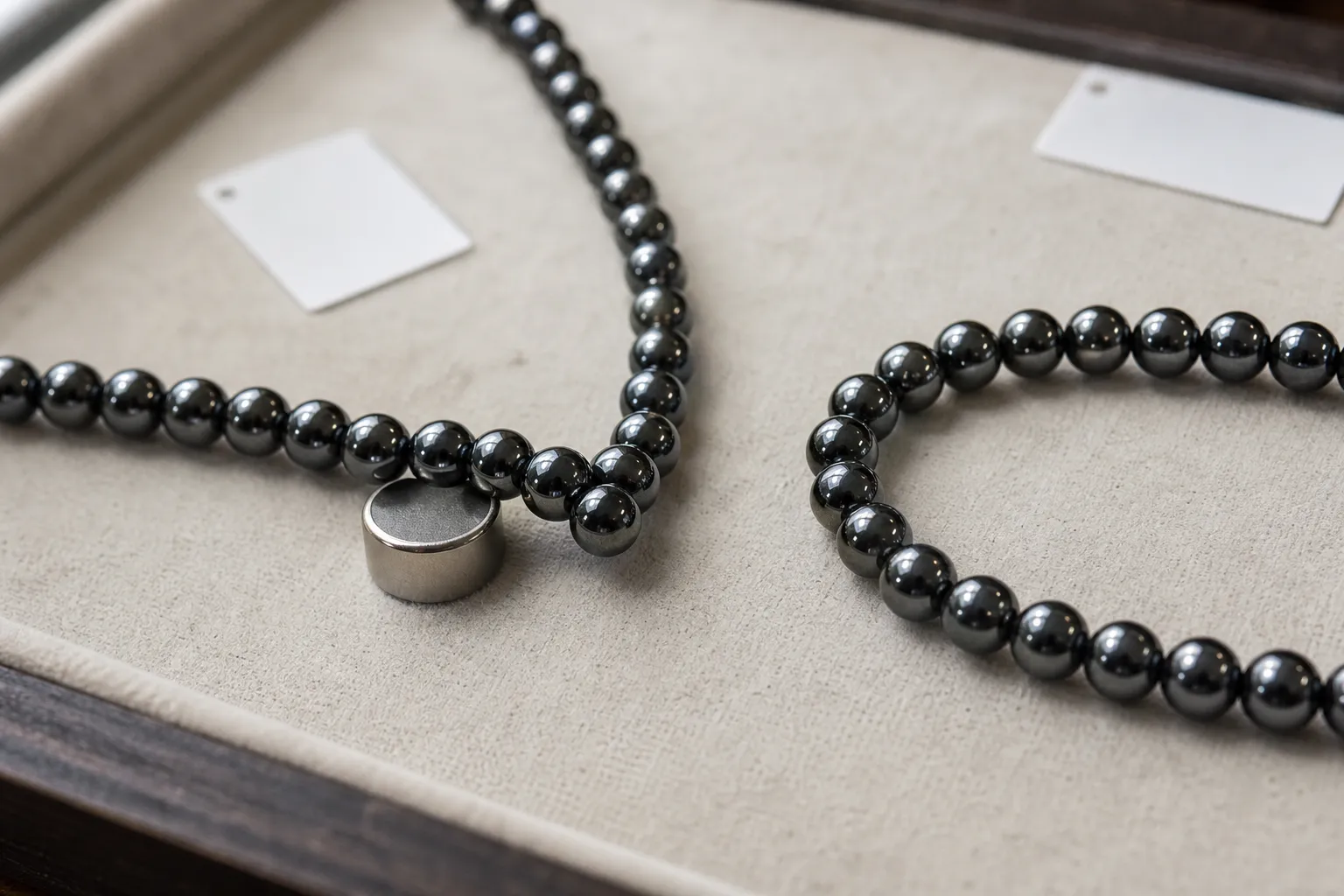
Ordinary hematite is an iron oxide mineral and is generally described as weakly magnetic, not strongly “snap-to-a-magnet” magnetic. Strong magnetism in hematite beads can suggest synthetic hematine, magnetite-rich material, mixed iron oxides, a manufactured bead material, or loose seller wording. Non magnetic hematite beads are more consistent with ordinary hematite, but that still does not prove natural origin, lack of treatment, or exact identification.
A magnet test is useful. It is not a certificate.
upward
Read the full overview first
Use the broader guide first if you need the full scope before this page.
What the seller label is usually trying to say
When a strand is listed as magnetic hematite beads, the seller is usually pointing to a noticeable pull toward a magnet. You may see this wording on round beads, twist beads, rainbow-finished beads, bracelet strands, necklaces, magnetic bead balls, and bulk jewelry-making supplies.
The issue is that “magnetic hematite” is often a marketplace phrase, not a precise mineral identification. In listings, it may refer to:
- A manufactured hematite-look bead with strong magnetism
- Synthetic hematine, a common bead-market term for hematite-like material
- Magnetite-rich or mixed iron oxide material
- Dark, metallic, heavy-feeling beads sold under a familiar hematite name
- A color or style label rather than a verified mineral identity
By contrast, “non-magnetic hematite” usually means the strand does not show a strong pull to the magnet the seller or buyer used. That fits better with ordinary hematite behavior, but it still leaves questions. The beads could be natural hematite, treated hematite, another dark metallic material, or a polished product described with a copied supplier label.
So the label is a clue. It is not the conclusion.
Why strong magnetism raises questions
Hematite and magnetite are both iron oxide minerals, but they are not the same thing. Hematite is commonly given as Fe₂O₃. Magnetite is Fe₃O₄ and is known for much stronger magnetic behavior.
That difference matters when you are holding a bead strand. If beads sold as hematite jump hard to a refrigerator magnet or pull together strongly, that response is not what many buyers expect from ordinary natural hematite. It can point toward magnetite-rich material, synthetic hematine, magnetized manufactured beads, or broad marketplace wording.
That does not mean every magnetic strand is automatically “fake.” Hematite magnetism can be more nuanced than a home test can resolve. Grain size, structure, substitutions, mixtures, and mineral changes can affect magnetic behavior. Those details are beyond what a simple magnet test can identify.
A strong magnet response is a reason to ask better questions about the bead material. It is not enough by itself to name the full composition.
If a listing says “high power magnetic hematite,” “magnetic hematite bracelet,” or similar wording, the word “magnetic” may be doing marketing work as well as material-description work. Check whether the seller also gives a clear material name.
What “non-magnetic hematite” can and cannot mean
A strand sold as non magnetic hematite is often closer to what buyers expect from ordinary hematite: dark gray to black, metallic-looking, polished, relatively weighty for its size, and without a strong pull toward a common magnet.
But “non-magnetic” only describes one simple observation: under the conditions used, the beads did not show obvious strong attraction.
It does not confirm:
- Natural origin
- Untreated status
- Absence of coating, plating, dye, or iridescent finish
- That every bead in the strand is the same material
- That the seller tested the material carefully
- That weak magnetism would not appear under more sensitive testing
This is the useful middle ground: lack of strong magnetism supports the possibility of ordinary hematite, while strong magnetism raises questions. Neither result fully identifies the strand.
That distinction matters because many buyers search for “magnetic hematite meaning” or “non magnetic hematite meaning” after seeing conflicting listings. In practical buying terms, the “meaning” is mainly about material description and seller wording. It should not be read as a verified difference in personal effects, crystal strength, or protective value.
How to read a hematite bead listing
A seller description is more useful when you separate visible information from broad product language.
Look for wording that names the material, not just the style. Terms such as natural hematite, synthetic hematite, hematine, magnetite, magnetic hematite, and hematite-colored are not interchangeable. If a listing uses several of them together without explanation, uncertainty goes up.
Strong snap-to-magnet response
May suggest: synthetic hematine, magnetite-rich material, mixed iron oxides, or magnetized manufactured beads.
Does not prove: exact composition or seller intent.
No strong magnet response
May suggest: more consistency with ordinary hematite.
Does not prove: natural origin or untreated status.
Very glossy uniform hematite beads
May suggest: possible manufactured or heavily finished bead material.
Does not prove: that the beads are not hematite.
“Hematite” and “hematine” used together
May suggest: the seller may be blending mineral and market terms.
Does not prove: that the label is intentionally misleading.
Vague “hematite versus magnetite” wording
May suggest: the seller may know buyers are comparing terms.
Does not prove: that the product has been formally identified.
Uniformity is a good example of a clue with limits. Many bead strands are cut, polished, and sorted to look consistent, so uniformity alone is not a problem. But very glossy, highly uniform beads that are also strongly magnetic and sold under broad “magnetic hematite” wording give you a stronger reason to ask whether the material is synthetic hematine, magnetite-rich, or another iron oxide product.
A useful seller question is:
Are these natural hematite beads, synthetic hematine beads, magnetite beads, or another iron oxide material?
A careful seller may not have lab data, but the answer can show whether “hematite” is being used as a precise material term or a general bead-market label.
What simple tests can tell you
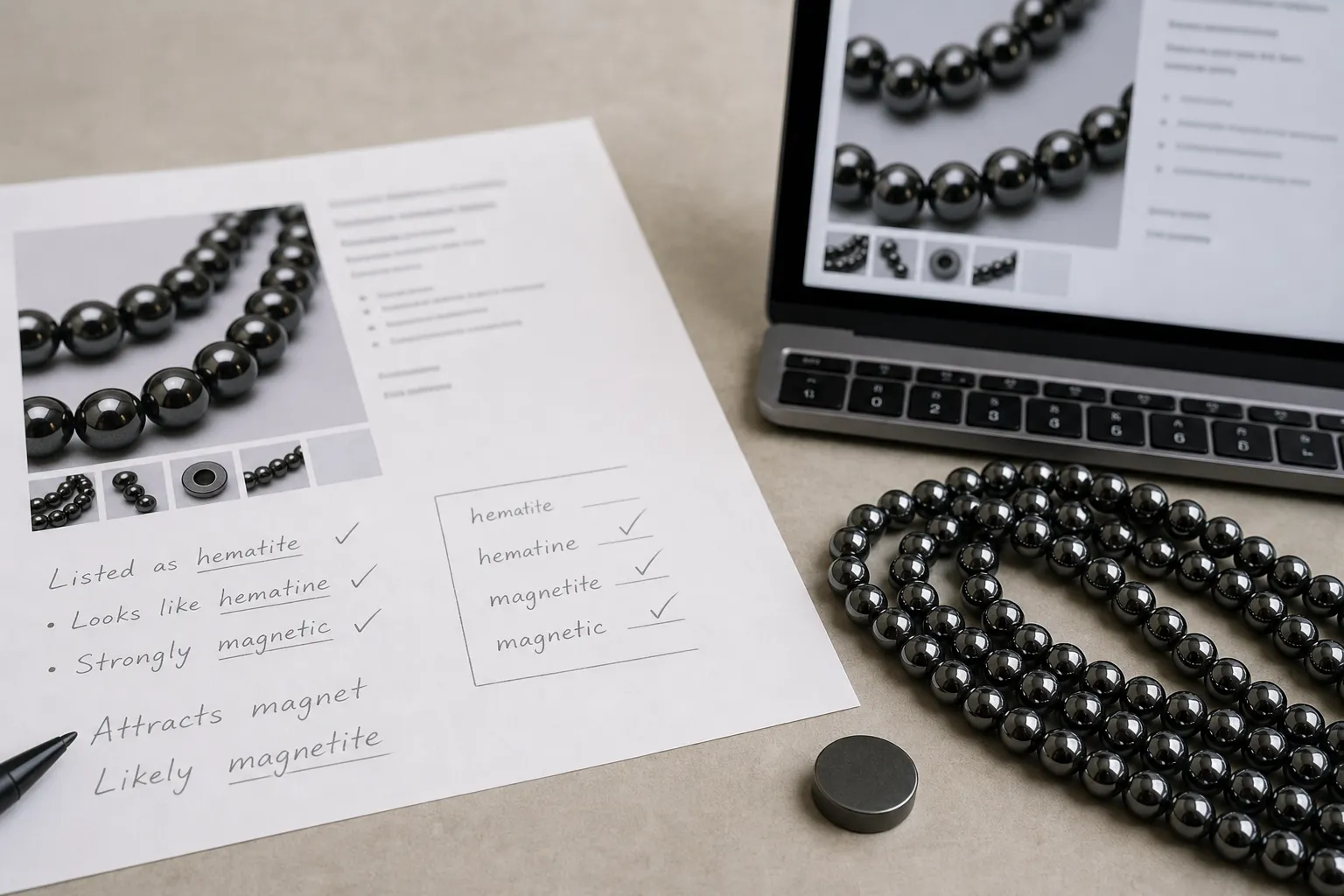
A magnet test is the easiest check, but it is also the easiest to overread.
- Strong attraction: a useful warning sign; ask about synthetic hematine, magnetite, mixed iron oxides, or manufactured magnetic bead material.
- Weak or no obvious attraction: more consistent with ordinary hematite; still not proof.
- Mixed response within one strand: possible mixed materials, uneven manufacturing, or inconsistent labeling.
The Chemical Education Xchange bead activity is a helpful reminder of this limit. In that educational comparison, beads purchased under hematite-related names showed density results close to hematite within experimental error, while their magnetic behavior differed. That does not settle the bead market, but it shows why simple checks can point in different directions: density may look plausible while magnet response raises another question.
Density testing is not very practical for most jewelry buyers. Polished beads have holes, coatings, and strand components that can complicate measurements.
A streak test is also mentioned in hematite versus magnetite discussions. Hematite is commonly associated with a red-brown streak, while magnetite is commonly associated with a black streak. But a streak test can scratch or damage polished beads. If you want to keep a bracelet or necklace intact, do not make a hematite bead streak test your first move.
For certainty, specialized testing may be needed. A buyer’s magnet, eye, and seller label can narrow the possibilities; they cannot fully identify composition, origin, or treatment.
A short handling note for strongly magnetic beads
If your strand contains small, strongly magnetic beads, treat them as small magnets as well as jewelry components.
Keep loose magnetic beads away from young children and pets, especially if they are small enough to swallow. More than one swallowed magnet can create a serious ingestion hazard.
People with pacemakers or other implanted medical devices should follow their device and professional guidance about strong magnets. This page cannot evaluate an individual device situation; it can only flag that strong magnetic jewelry deserves more caution than ordinary non-magnetic bead strands.
For storage, keep strongly magnetic beads in a small container rather than loose in a mixed jewelry tray. They can cling to metal tools, pull against clasps, or scratch softer items.
The practical answer
Hematite beads are sold as magnetic or non-magnetic because sellers mix mineral names, manufactured bead terms, and magnet-response descriptions.
Strong magnetism in hematite beads often suggests synthetic hematine, magnetite-rich material, mixed iron oxides, or loose labeling. Non magnetic hematite beads are more consistent with ordinary hematite, but they still do not prove that a strand is natural or untreated.
Use magnet response alongside seller wording, finish, uniformity, and any available material description. If the difference matters to you, ask whether the beads are natural hematite, synthetic hematine, magnetite, or another iron oxide product.
If the answer stays vague, the most accurate conclusion is not simply “real” or “fake.” It is: the strand has not been identified with enough precision to say more.
Sources
Sources and further reading
Reference links are limited to sources considered suitable for public citation in this page.