ProtectCrystal handling note
Seller wording guide
Raw vs Polished Obsidian, Cinnabar, and Hematite: What Seller Listings Mean
When a seller calls obsidian, cinnabar, or hematite “raw,” “rough,” “polished,” “tumbled,” “cabochon,” or “on matrix,” read that word as a finish and form cue first. It usually tells you how the piece looks or was prepared, not whether the mineral identity, origin, handling suitability, value, or crystal-use meaning has been proven.
In raw vs polished crystals, “raw” usually points to an unshaped or minimally cleaned specimen. “Polished” usually means the surface has been smoothed, tumbled, carved, cut, or finished for display or wear.
That difference can help you predict texture, edges, shine, and likely use. It cannot confirm that a red piece is cinnabar rather than red hematite, that a locality label is documented, or that a polished cinnabar item is appropriate for jewelry or frequent handling.
upward
Read the full overview first
Use the broader guide first if you need the full scope before this page.
Read the listing word as a finish cue first
Seller wording is useful when you keep it in the right lane. Ask whether the phrase is describing the surface, the shape, the host rock, the color, or something that would need stronger support.
Raw / rough
May reasonably suggest: unpolished surface, natural fracture, matrix, coating, granular area, or rough specimen.
Does not prove: mineral identity, untouched origin, or stronger crystal meaning.
Polished
May reasonably suggest: smoothed surface, tumbled stone, cabochon, bead, carving, slab, or finished display piece.
Does not prove: purity, handling suitability, authenticity, or higher value.
Tumbled
A rounded small stone processed to a smooth finish. It does not prove natural shape, original surface, or certainty of material.
Cabochon
A shaped stone with a smooth domed or flat polished face. It does not prove that the whole piece is one pure mineral.
On matrix
Mineral attached to host rock. It does not prove the exact composition of every visible area.
In quartz
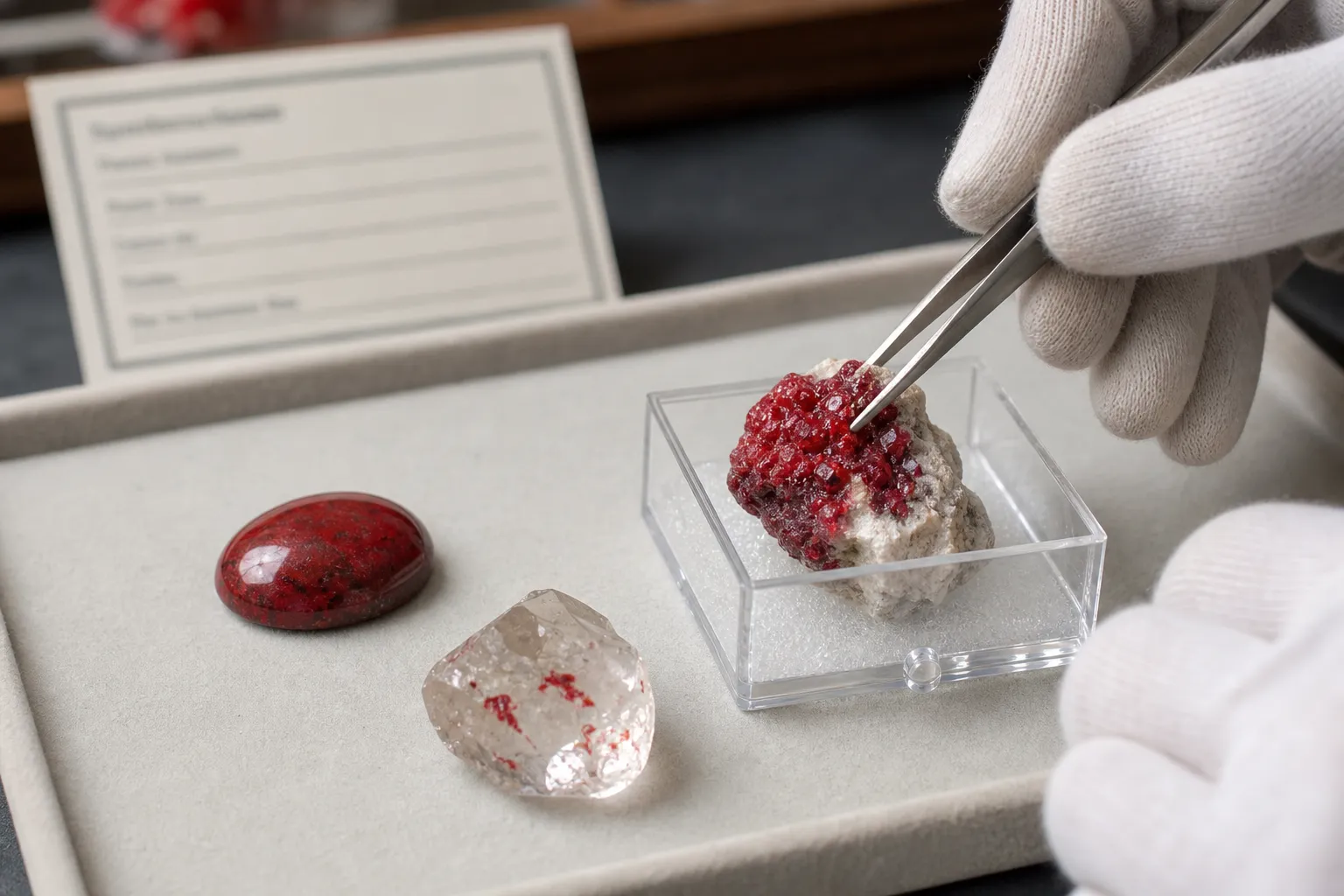
Inclusions or patches within quartz or quartz-rich material. It does not prove that every red area is cinnabar.
Bright red / dark red / metallic / glassy / heavy
These are appearance or feel cues. They do not provide a final identification without documentation or testing.
Obsidian
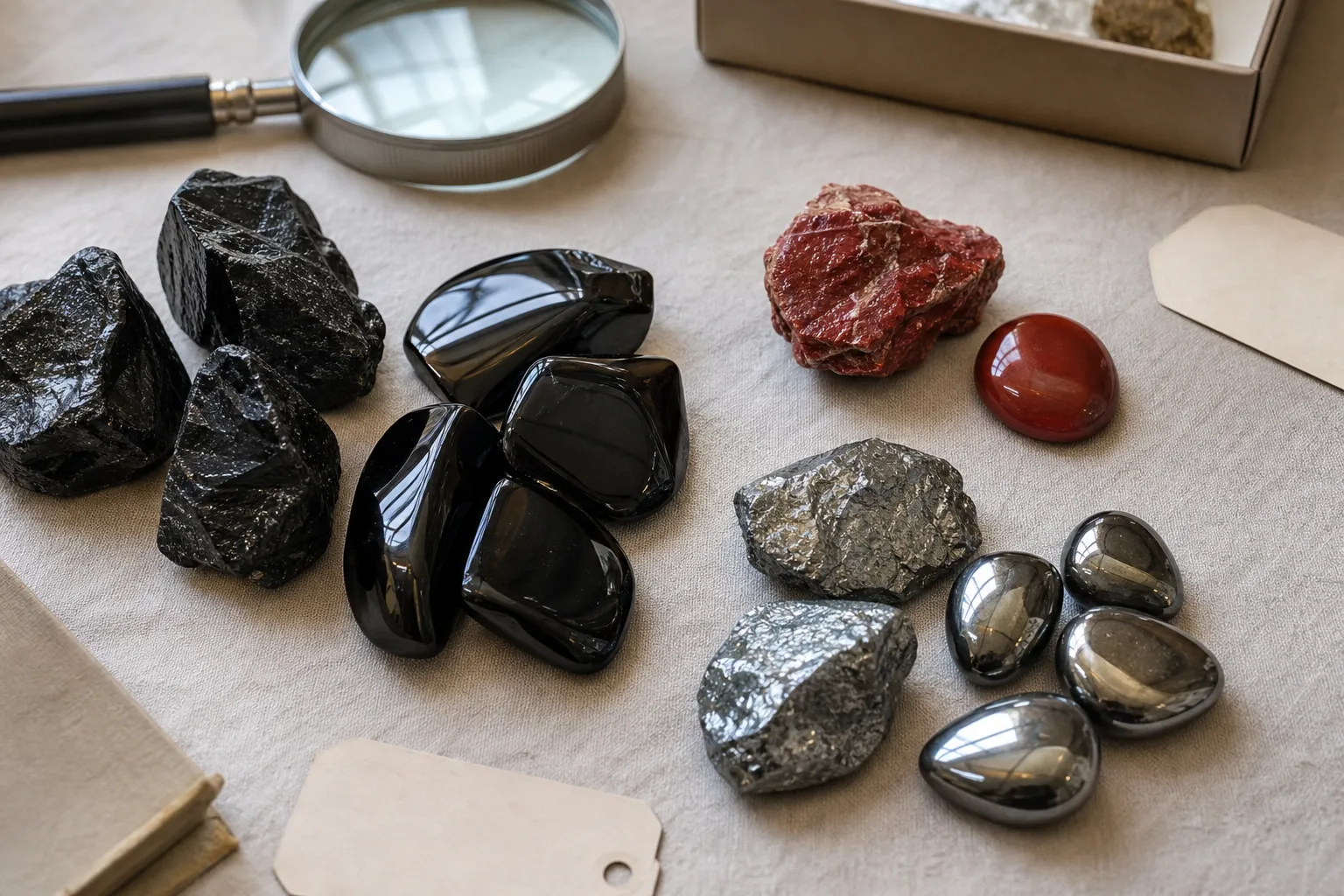
For obsidian, the raw-versus-polished distinction is mostly about texture and presentation. Raw or rough obsidian may show broken, glassy fracture surfaces and sharper-looking edges. Polished obsidian may appear as a glossy palm stone, bead, carving, slab, or cabochon. The finish tells you how it was prepared, not whether it has a particular source or personal effect.
Cinnabar
For cinnabar, finish language deserves more caution. Cinnabar is commonly described as mercury sulfide, HgS, and mineral references often describe it as scarlet, bright red, brick-red, brownish red, or darker depending on the material. It may appear as crystals, coatings, encrustations, granular material, massive material, or material attached to matrix. A polished cinnabar listing may also mean cinnabar-bearing quartz or polished matrix material, not a solid piece of pure cinnabar.
Hematite
For hematite, seller wording can be easy to overread. Hematite may be listed as metallic, heavy, red, dark, polished, tumbled, or bead-like. Red color and weight can be clues, but they are not a reliable home identification method, especially in small beads, mixed stones, or polished pieces.
How the same words change by stone
A polished obsidian palm stone and a polished cinnabar cabochon are both “polished stones,” but the buying question is not the same.
Obsidian: raw or polished mostly changes feel and display use
“Raw obsidian” or “rough obsidian” usually means the piece has not been shaped into a smooth decorative object. You may see irregular edges, natural-looking breaks, or a less uniform surface.
“Polished obsidian” usually means the piece has been cut, tumbled, carved, or smoothed to bring out shine and make it easier to hold, display, or wear. A polished surface may make the stone look more uniform and reflective, but it should not be treated as proof of origin, treatment history, or crystal-use result.
If the listing leans on protective crystal language, read that as personal, cultural, or marketplace meaning. It may explain why the seller uses words like grounding, shielding, or protection, but it does not verify an outcome.
Cinnabar: polish describes form, not reduced concern
Cinnabar is the material in this comparison where “polished” can be most misleading. A buyer might assume that a polished cinnabar cabochon, bead, or carving is more settled than a raw specimen. The safer reading is simpler: polish only tells you the surface was finished.
Raw cinnabar specimens may be described as:
- cinnabar crystal on matrix;
- cinnabar in quartz;
- bright red, scarlet, brick-red, or brownish red cinnabar;
- granular cinnabar;
- massive cinnabar;
- encrusting or coating cinnabar;
- dark or hepatic cinnabar.
Polished cinnabar listings may describe cabochons, slabs, beads, carvings, or cinnabar-bearing quartz. A polished cabochon may be mixed material: red areas, quartz, host rock, backing, and surface finish can all affect what you are actually looking at.
Handling point
For handling, keep the point practical: do not heat, drill, grind, sand, crush, tumble, or create dust from cinnabar material. Keep it away from mouth contact, food-preparation surfaces, children, pets, and situations where abrasion is likely. If a seller presents polish as if it settles every handling question, slow down and look for better details.
Hematite: color and weight can confuse red listings
Hematite listings often emphasize metallic shine, dark color, red tones, or a heavy feel. In a cinnabar comparison, one useful caution is that massive red hematite can resemble massive cinnabar. Mineral-property references list cinnabar as very dense, but a buyer should not turn “feels heavy” into a final test.
Small stones, mounted cabochons, matrix pieces, mixed aggregates, and unknown composites can all distort what you think you are feeling. A red patch in a specimen is not automatically cinnabar or hematite.
For a red hematite vs cinnabar listing, look for the seller’s actual documentation, not just color adjectives. If the listing uses “red hematite,” “cinnabar,” “cinnabar in quartz,” and “heavy” loosely or interchangeably, treat that as uncertainty.
Listing phrases that often cause overconfidence
Some phrases sound more conclusive than they are. They may be useful clues, but they should not carry more weight than the seller can support.
“Vermilion” or “Chinese Red”
These words often point to cinnabar’s long association with red pigment and decorative traditions. They can explain why cinnabar listings sound different from ordinary crystal listings. They do not prove that the object in the photo is mineral cinnabar, has a specific composition, or should be handled like a simple polished stone.
Locality names
Listings may mention places such as Almadén, Idrija, Tongren, Guizhou, Hunan, New Almaden, New Idria, Terlingua, or Huancavelica. These names can be part of legitimate specimen description, but a locality label is only as useful as the documentation behind it. On its own, it should not be read as proof of origin, value, or identity.
“Cinnabar cabochon”
A cabochon is a cut and polished form. It does not tell you whether the material is pure cinnabar, cinnabar in quartz, cinnabar-colored material, or a composite. If the cabochon is meant for jewelry, also consider whether the setting could create abrasion, skin contact, or wear over time.
“Heavy”
A heavy feel may fit some dense minerals, and cinnabar is commonly listed with a high density. But “heavy” in a seller description is still a rough sensory cue. It is not a substitute for careful mineral identification, especially in small polished stones or matrix pieces.
“Raw is more powerful” or “polished has stronger energy”
This is crystal-use language, not material evidence. Some buyers prefer raw or rough crystal specimens because they like natural texture and matrix. Others prefer polished stones because they are easier to hold, carry, or display. Those preferences can be meaningful personally, but they do not establish mineral identity, handling suitability, or a measurable effect.
A practical way to compare a listing before buying
Use the listing photos and wording to separate what you can observe from what you are being asked to assume.
-
1. Identify the form.
Is it rough, tumbled, cabochon-cut, carved, beaded, slabbed, or on matrix? This tells you about presentation before it tells you anything else.
-
2. Name the visible surface.
For obsidian, is it glassy, glossy, broken-looking, or uniformly polished? For cinnabar, are the red areas crystals, coatings, patches, or inclusions in quartz? For hematite, is the look metallic, earthy red, massive, or bead-like?
-
3. Treat color as a clue, not a conclusion.
Bright red can fit cinnabar language, but darker red, brownish red, and red hematite can complicate the picture. A photo alone may not be enough.
-
4. Check whether the seller separates material from meaning.
A stronger listing usually distinguishes mineral description, finish, size, matrix, locality, and handling notes. A weaker one may blend “raw,” “rare,” “protective,” “vermilion,” “Chinese Red,” and locality names into one persuasive paragraph without documentation.
-
5. Ask for the missing information.
For cinnabar especially, ask whether the item is cinnabar in quartz, on matrix, stabilized, backed, drilled, intended for display, or intended for wear. If the seller cannot clarify, decide whether that uncertainty fits your intended use.
-
6. Match the form to the handling plan.
A display specimen in a closed case, a pocket stone, a drilled bead, and a pendant are not the same use case. For cinnabar, avoid formats where friction, dust, heat, or mouth contact could be part of normal use.
What a raw or polished label cannot settle
A raw or polished label cannot confirm authenticity. It cannot verify a locality name. It cannot tell you whether red material is cinnabar, hematite, pigment residue, coating, altered material, or a mixed aggregate. It also cannot show whether a cinnabar item contains impurities, native mercury, stabilizers, or other materials that matter for handling.
For certainty, specialized testing may be needed. Research on cinnabar identification commonly uses methods such as XRD, Raman spectroscopy, XRF-XRD, or related analytical tools to distinguish materials and support composition claims. That does not mean every buyer needs lab work for every decorative stone. It does mean that a photo, color adjective, polish, and confident seller wording are not the same as verification.
A useful buying posture is to sort the listing into three columns:
Visible
Finish, shape, color, luster, matrix, size, obvious inclusions.
Plausible but not proven
Mineral identity, locality, whether red areas are cinnabar or hematite, whether the piece is mixed material.
Not established by the listing
Guaranteed effect, confirmed purity, verified origin, or handling suitability in every setting.
If the listing is for obsidian, polish mainly affects look and touch. If it is for hematite, be careful with red-color comparisons and weight-based assumptions. If it is for cinnabar, read “polished” as a finish word only, then make your decision around documentation and conservative handling.
Sources
Sources and further reading
Reference links are limited to sources considered suitable for public citation in this page.