ProtectCrystal handling note
Buyer comparison
How Obsidian, Cinnabar, and Hematite Are Commonly Sold
A shopper looking up how obsidian cinnabar and hematite are sold is usually trying to make sense of listings that blur several things at once: the claimed material, the shape, the finish, the price unit, and sometimes symbolic crystal language. A title may say “obsidian bracelet,” “hematite beads,” or “cinnabar specimen,” but the real buying question is more specific: what is the seller offering, what form is it in, and what can reasonably be checked before purchase?
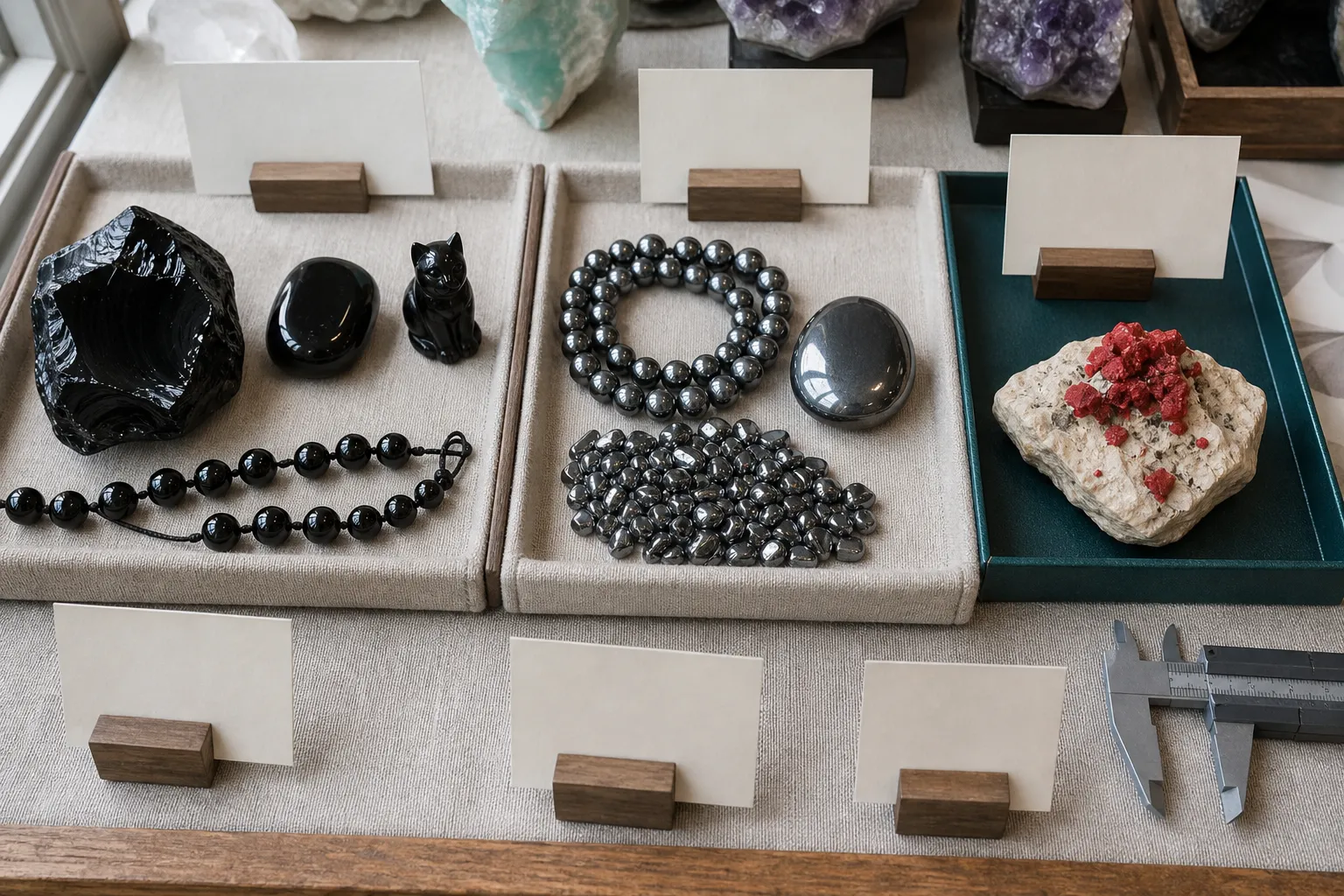
Obsidian and hematite often appear in polished crystal-shop formats such as tumbles, palm stones, beads, carvings, and small chips. Cinnabar may appear in jewelry-style wording too, but it is also commonly encountered in collector-specimen language, where matrix, associated minerals, locality, and seller-stated documentation matter more. Because cinnabar is mercury sulfide, listings that mention native mercury, powdery surfaces, or fragile matrix should be read with extra care.
upward
Read the full overview first
Use the broader guide first if you need the full scope before this page.
The Sales Forms Buyers Usually Need to Compare
Start by separating the material name from the sales form. “Obsidian,” “cinnabar,” and “hematite” are material claims. “Raw,” “tumbled,” “bead,” “cabochon,” “carving,” or “on matrix” describes how the item is being sold.
Raw or rough pieces
Usually unpolished chunks, fragments, or natural-looking pieces. Texture, broken edges, or matrix may be visible, but appearance alone does not confirm identity.
Tumbled stones
Small polished pieces sold individually, in sets, or by weight. Common for pocket stones, bowls, grids, and mixed crystal sets; check size and treatment wording.
Palm stones and worry stones
Larger polished pieces shaped for holding. Finish, size, and comfort often affect price.
Cabochons
Polished, shaped pieces for jewelry or display. Usually sold by piece, size, or weight; material disclosure still matters.
Beads and strands
Drilled pieces for bracelets, necklaces, or craft use. Read bead size, strand length, finish, hole size, coating, dye, and magnetic wording carefully.
Carvings and figurines
Decorative shapes cut from claimed material. The shape can distract from the material claim; ask whether the whole object is the named material.
Collector specimens
Mineral pieces described with matrix, locality, crystal habit, and associated minerals. Especially relevant for cinnabar; documentation language may be useful but should be checked.
Chips and gravel
Small fragments sold for bowls, jars, crafts, or display. Small size makes visual checking harder, especially in mixed lots.
The form changes the question. With polished vs raw crystals, rough pieces may show more surface context, while polishing can make an item easier to handle or display but may hide some clues. With beads, strand details and treatment language matter. With collector specimens, the listing should ideally say more about matrix, locality, associated minerals, and any seller-stated analysis.
Raw vs Polished Obsidian, Cinnabar, and Hematite
“Raw” and “polished” are presentation terms, not automatic quality grades.
A raw or rough listing usually suggests the piece has not been shaped into a smooth retail form. Photos may show broken edges, natural-looking surfaces, pockets, host rock, or irregular shapes. That can help a buyer understand the piece, but poor photos or missing measurements still leave uncertainty.
A polished listing usually means the material has been tumbled, cut, shaped, buffed, or finished for display, handling, or jewelry use. Tumbled obsidian and hematite may be sold as pocket stones, bowl stones, set fillers, or small gift items. Palm stones, worry stones, and cabochons are polished forms where the value often includes finish and usability as much as the material claim.
Obsidian appearance names
For obsidian, names such as black, snowflake, mahogany, or rainbow usually signal appearance categories in the listing. Black obsidian points to a dark glassy look. Snowflake obsidian points to pale patterning against a dark base. Mahogany obsidian points to reddish-brown and black patterning. Rainbow obsidian points to sheen or color effects that may depend on lighting. These names help explain the seller’s visual label, but they do not prove that every bead, lot, or photo is accurately represented.
Hematite wording
For hematite, polished listings often emphasize a dark metallic-looking shine, a heavier feel than many common tumbled stones, beads, or small carved shapes. The available source set for this page is not strong enough to make broad claims about how often hematite appears in each retail form, so the better buyer habit is to check wording: natural hematite, magnetic hematite, coated beads, composite material, or hematite-colored product can mean different things.
Cinnabar handling boundary
For cinnabar, raw versus polished is not just an appearance choice. Cinnabar is more often seen in careful mineral-specimen contexts than as a casual handling stone. If a cinnabar listing mentions native mercury, visible droplets, powdery material, loose matrix, or uncertain treatment, treat it as a display-specimen purchase rather than a pocket stone, water-use item, or skin-contact jewelry choice.
Tumbled Stones, Chips, Beads, and Small Lots
Small-format listings create many misunderstandings because the listing photo may show a pile, while the price may apply to one piece, one strand, one bag, or a weight-based lot.
Tumbled obsidian and hematite
Tumbled obsidian and hematite are commonly sold to crystal buyers as small polished stones. Listings may say “one intuitively selected,” “one piece,” “100g,” “mixed sizes,” or “set of five.” Those words matter. A photo of many stones does not always mean the buyer receives everything shown.
Before comparing tumbled listings, check:
- whether the price is for one stone, a set, or a weight-based lot;
- whether the photo shows the exact item or a representative batch;
- whether size ranges are listed;
- whether dye, coating, composite, or other treatment wording appears;
- whether the seller separates obsidian types or sells them as a mixed group.
Visible cues such as color, shine, patterning, and surface finish can suggest why a seller used a name. They should not be treated as certainty by themselves.
Crystal chips and gravel
Crystal chips and gravel are often sold for bowls, crafts, jars, display, or decorative fills. The main issue is not only “Is this obsidian or hematite?” but also “How much can I actually check when the pieces are tiny?”
Small chips are difficult to evaluate from photos. A seller may show mixed fragments under bright lighting and apply one material name to the whole bag. If the lot is mixed, ask whether each material is identified or whether the label is decorative shorthand.
Cinnabar chips deserve a stricter buying boundary. Do not treat cinnabar fragments as casual handling material, water-use material, or bottle-filler material based only on a decorative listing. If the seller cannot explain the form, surface condition, and documentation clearly, it is better approached as a specimen question, not a craft-supply question.
Obsidian and hematite beads
Obsidian and hematite beads appear often in bracelet, necklace, and craft listings. The key terms are bead diameter, strand length, hole size, finish, and treatment wording.
Hematite beads listings may use “magnetic” or “non-magnetic.” Read that as a seller-stated category that needs clarification, not as a complete identification standard. Ask whether the seller means natural hematite, magnetized hematite, synthetic or composite material, coated beads, or another iron-rich bead product.
Obsidian bead listings may use black, snowflake, mahogany, or rainbow appearance names. Because cutting and polishing can make beads look more uniform than rough pieces, check whether the photos show the exact strand, a representative strand, or a mixed batch.
What “Cinnabar” Can Mean in Jewelry and Specimen Listings
Cinnabar is the term that needs the closest reading. In casual jewelry listings, “cinnabar” may not always mean a natural cinnabar mineral specimen. It may refer to a red carved look, a lacquer-style object, a bead described through color tradition, or a claimed mineral material. The word should not be treated as self-verifying.
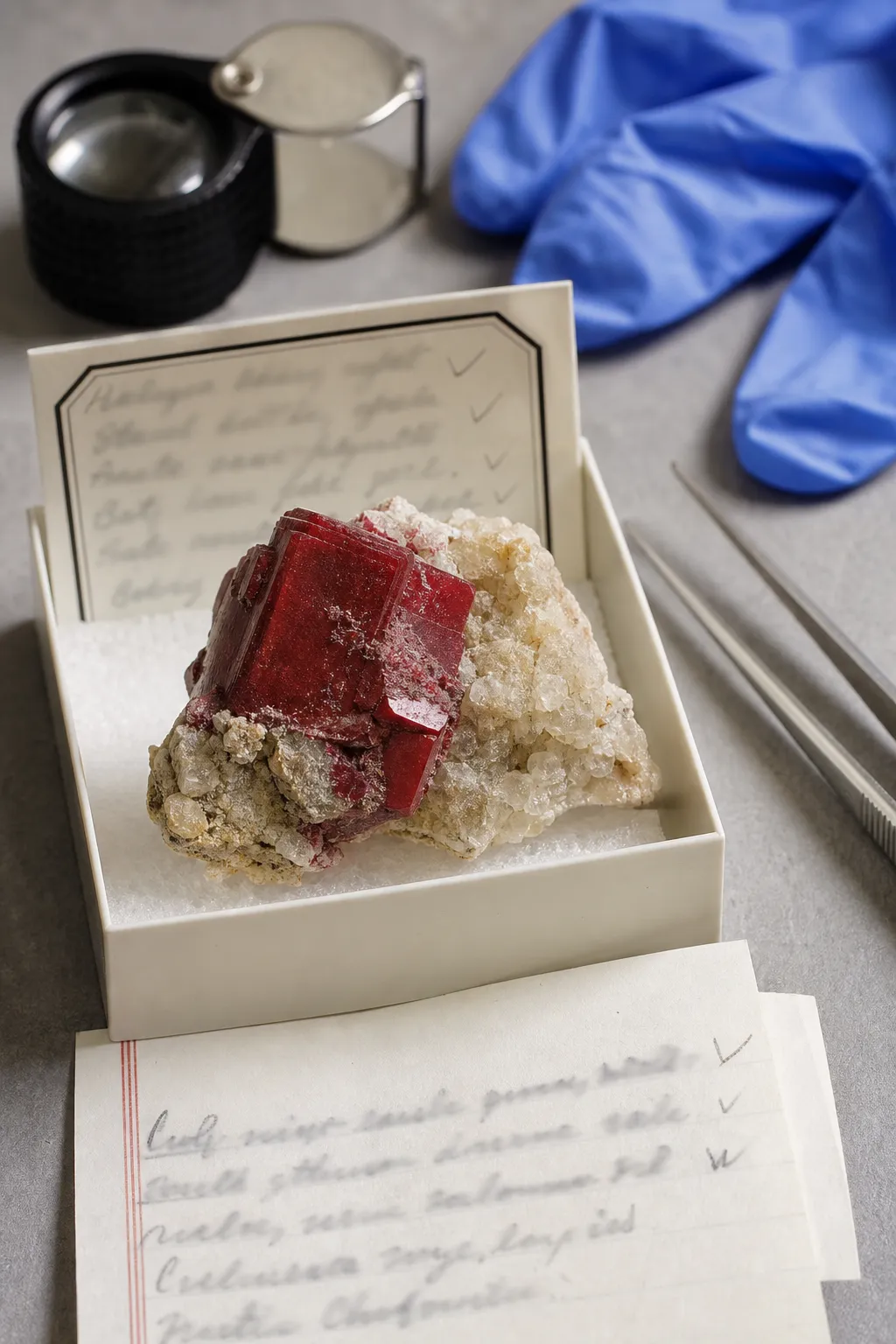
In specialist mineral listings, cinnabar is often presented differently. Collector-style titles may include phrases such as cinnabar with quartz, cinnabar with calcite, cinnabar with gypsum, cinnabar with dolomite, or cinnabar with mercury. Listings may mention:
- cinnabar on matrix;
- specimen size and main crystal size;
- mine, district, municipality, country, or broader locality;
- associated minerals such as quartz, calcite, gypsum, dolomite, baryte, pyrite, or native mercury;
- visible descriptors such as rhombohedral crystals, twinning, translucency, luster, defined faces, red color, or striations;
- former collection labels, handwritten labels, catalog numbers, or approximate collection dates;
- seller-stated analysis or paperwork.
Those details can make a listing more useful, especially for collector specimens. They still do not mean a buyer can identify cinnabar from red color or shine alone. References on cinnabar and mercury-based materials show that instrumental methods such as spectroscopy or elemental analysis may be used when identification, classification, or provenance questions matter. If a listing says “analyzed” or “documented,” ask what is included, who performed the analysis, and whether it applies to the exact specimen being sold.
The phrase cinnabar with mercury is not decorative filler. If native mercury, visible droplets, powdery surfaces, loose matrix, or uncertain treatment are mentioned, avoid grinding, soaking, ingestion-related uses, water-bottle use, and casual skin-contact wear. Stronger handling instructions should come from qualified mineral-safety or occupational-safety guidance, not from a decorative crystal listing.
Listing Words That Change the Purchase Meaning
Many crystal listings mix descriptive words with promotional words. A useful buyer habit is to sort them into three groups.
Form and finish words
These describe what you are receiving:
- raw, rough, natural-looking;
- tumbled, polished, palm stone, worry stone;
- cabochon, bead, strand, drilled;
- carving, figurine, tower, sphere;
- chips, gravel, mixed lot;
- on matrix, with quartz, with calcite;
- per piece, per gram, per strand.
Treatment or composition words
These need closer attention:
- natural;
- dyed;
- coated;
- reconstituted;
- composite;
- glass;
- lacquered;
- magnetic;
- non-magnetic;
- stabilized;
- heat-treated.
Promotional words
“Excellent,” “rare,” “classic,” “extra bright,” “very vivid,” or “few available” may explain a seller’s tone or pricing, but they are not the same as measurements, disclosure, analysis, or item-specific documentation.
The sources available for this page do not support confident claims about how common every treatment is across obsidian and hematite listings. So the practical move is simple: if a treatment word appears, ask what it means for that exact item. If no treatment word appears and the distinction matters to you, ask before buying.
Pricing Formats: Per Piece, Per Gram, Per Strand, or Per Lot
A fair crystal buying comparison starts with the sales unit. Similar-looking listings may be selling completely different quantities.
Per piece
Per piece pricing is common for palm stones, worry stones, carvings, cabochons, single tumbles, and collector specimens. In this format, check size, finish, visible features, and whether the photo shows the exact item.
Per gram or per ounce
Per gram or per ounce pricing is common for chips, gravel, rough lots, and tumbled mixes. Check total weight, size range, and whether the lot is sorted or mixed.
Per strand
Per strand pricing is common for beads. Check bead diameter, strand length, number of beads if given, finish, drilling, and whether the strand shown is exact or representative.
Per lot
Per lot pricing is common for mixed crystal sets. These can be convenient, but mixed obsidian and hematite sets may include different shapes, sizes, and material claims under one theme. If cinnabar appears in a mixed lot, pause and ask what form it is in, why it is included, and what documentation or handling information the seller provides.
For collector cinnabar specimens, pricing may also reflect color, crystal form, associated minerals, locality, display appeal, and seller positioning. Research on collector mineral markets notes that collector value can be less transparent than commodity pricing because subjective qualities matter. A higher price is not proof of better identity or lower handling concern; it may reflect aesthetics, locality, specimen presentation, or market demand.
A Practical Reading Framework Before You Buy
Read the listing in layers.
- Identify the claimed material. Is it obsidian, cinnabar, hematite, or a mixed group? If the material name sounds decorative or vague, ask for clarification.
- Identify the form. Raw piece, tumbled stone, bead strand, cabochon, carving, chips, jewelry, or collector specimen each requires a different check.
- Separate visible cues from proof. Color, luster, pattern, weight impression, polish, and crystal shape may support a seller’s category, but they do not confirm identity on their own.
- Read treatment words slowly. Natural, dyed, coated, reconstituted, magnetic, lacquered, or composite can change what is being sold.
- Treat cinnabar as a special case. Matrix, quartz, calcite, locality, analysis, or native mercury language often points toward a collector-specimen listing. Powdery, loose, mercury-associated, or poorly explained pieces are not good candidates for everyday touch, water use, or jewelry wear.
- Ask documentation questions without overvaluing paperwork. Useful questions include: Is the photo of the exact item? What is included with the specimen? Does the document identify this exact piece? Who performed the analysis? Are treatments disclosed? What is the return policy if the item does not match the description?
Short Notes on Common Listing Phrases
“Obsidian sold as black, snowflake, mahogany, or rainbow”
Usually points to the appearance category used by the seller. It helps explain the visual label, but it does not replace material verification.
“Cinnabar on matrix”
Usually means cinnabar is presented attached to host rock or associated mineral material. Matrix can be important in collector specimens, but loose or powdery surfaces should be approached cautiously.
“Cinnabar with quartz” or “cinnabar with calcite”
Often names an associated mineral in the specimen. This is collector-style wording, not a guarantee that everything can be verified by eye.
“Cinnabar with mercury”
A handling-sensitive phrase. Treat it as a display-specimen cue and ask for qualified guidance before any handling-intensive use.
“Hematite beads, magnetic or non-magnetic”
Read this as a seller-stated category that needs clarification. Ask what material, treatment, or manufacturing description the seller is using.
“Natural, dyed, coated, or reconstituted”
These words can change the purchase meaning. If the seller does not define them, ask before comparing price.
“Per piece, per gram, or per strand”
This tells you what you are actually buying. Match the pricing unit before deciding one listing is cheaper than another.
The strongest buying habit is to read crystal listings as a combination of material claim, form, finish, treatment, documentation, and intended use. Obsidian, cinnabar, and hematite may all appear in personal or cultural crystal language, but the purchase decision should rest on observable details, careful seller wording, and clear limits on what appearance alone can show.
Sources
Sources and further reading
Reference links are limited to sources considered suitable for public citation in this page.