ProtectCrystal handling note
Magnet check
Is Cinnabar Magnetic Like Hematite
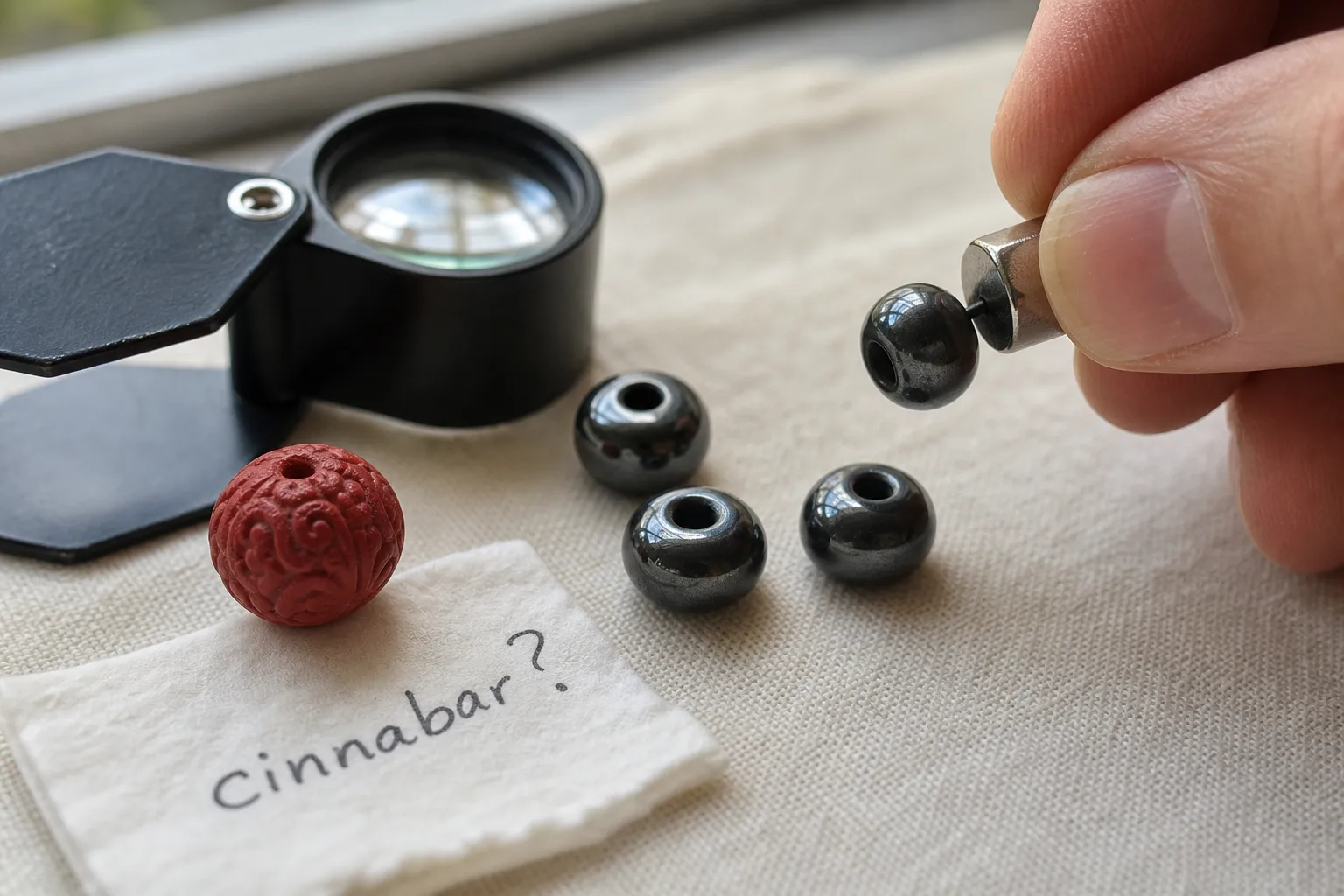
Cinnabar is generally not magnetic like products sold as “magnetic hematite.” If a red bead, carving, or specimen labeled as cinnabar strongly snaps to a magnet, take that as a warning clue: the item may contain another magnetic material, have a metal core, be manufactured, or be mislabeled.
The opposite is also true. If a red item does not attract a magnet, that does not prove it is cinnabar. Resin, dyed stone, glass, pigment-based objects, and many other red materials can also be non-magnetic.
So the practical answer to is cinnabar magnetic like hematite is: no, not in the way buyers usually mean when they compare it with magnetic hematite beads. A magnet can raise questions, but it cannot confirm what the object is.
upward
Read the full overview first
Use the broader guide first if you need the full scope before this page.
Quick comparison: cinnabar, hematite, and “magnetic hematite” labels
Natural cinnabar
What it usually means: Mercury sulfide mineral, commonly written as HgS.
Expected magnet response: Usually weak to absent.
What the result can tell you: Strong attraction is a reason to question the label.
Natural hematite
What it usually means: Iron oxide mineral.
Expected magnet response: More nuanced than many listings suggest.
What the result can tell you: A simple magnet test may not settle the identity.
“Magnetic hematite” beads or bracelets
What it usually means: Marketplace term often used for magnetic bead products.
Expected magnet response: Often noticeably attracted to magnets.
What the result can tell you: May suggest a manufactured, magnetized, composite, or metal-bearing product.
Red “cinnabar” beads or carvings
What it usually means: Could mean mineral cinnabar, cinnabar pigment, resin cinnabar, lacquer-style carving, or cinnabar-colored material.
Expected magnet response: Depends on the actual material.
What the result can tell you: Seller wording needs context; appearance alone is not enough.
Cinnabar’s mineral identity is tied to mercury sulfide, not iron. Hematite is an iron oxide mineral, which is why the two get compared in buyer conversations. But even with hematite, “magnetic” can mean different things depending on whether someone is talking about a natural mineral specimen or a bead product sold under a commercial label.
Why “magnetic hematite” causes confusion
Many buyers first meet hematite through polished beads, bracelets, and magnetic jewelry. In that market, “magnetic hematite” often becomes shorthand for a shiny dark gray bead that reacts to a magnet.
That does not mean every item sold that way behaves like a natural hematite specimen.
For a buyer, the useful distinction is:
- A strong magnet response in a bead sold as hematite may point toward a magnetized, synthetic, composite, metal-bearing, or otherwise manufactured product.
- A weak or absent response does not automatically identify the bead as natural hematite.
- A red item sold as cinnabar should not be expected to behave like magnetic hematite products.
If your “cinnabar” bead reacts like a magnetic hematite bead, the magnet is telling you to slow down. It is not giving you a final mineral report.
What a magnet test can and cannot show
A magnet test is useful because it is quick and can be done without damaging the piece. Hold a small magnet near the item and watch for movement. Do not scrape, drag, chip, crush, or grind the material while testing.
That matters with suspected cinnabar because cinnabar contains mercury and can be relatively soft.
A magnet response can suggest a few different situations:
- Strong attraction: If a red mineral, bead, or carving jumps toward the magnet, that is not typical for natural cinnabar. It may contain another magnetic material, a hidden metal part, a manufactured magnetic core, or a different mineral.
- Weak or uncertain attraction: A tiny pull can be hard to read. A clasp, wire, spacer bead, setting, nearby tool, or embedded metal may be reacting instead of the red material itself.
- No attraction: This is consistent with non-magnetic cinnabar, but it is also consistent with many other red materials. “Non-magnetic” is not the same as “confirmed cinnabar.”
The main mistake is treating the magnet as an authenticity test. It works better as a sorting clue: useful, but limited.
Cinnabar identification clues that do not damage the piece
Home identification has limits, but a few visible and handling clues can help you decide whether to ask more questions before buying, wearing, or storing the item.
Natural cinnabar is often described as:
- bright red to brownish red;
- mercury sulfide, or HgS;
- relatively soft, around Mohs 2–2.5;
- heavy for its size because of high density;
- bright to dull in luster, depending on the surface;
- sometimes associated with minerals such as quartz, calcite, barite, or other sulfides.
Some mineral references mention a scarlet streak. For a suspected cinnabar object, treat that as a known property, not a recommended home test. A streak test damages the material and can create powder.
Avoid scratch tests, drilling, sanding, grinding, tumbling, heating, and acid tests on suspected cinnabar. Those are poor casual checks for a mercury-bearing specimen.
Seller wording can also blur several different materials or traditions, including:
- natural cinnabar mineral;
- cinnabar pigment;
- vermilion-related pigment language;
- resin cinnabar material;
- lacquer-style carved beads;
- red molded or dyed decorative pieces;
- “cinnabar-style” jewelry.
That does not make every decorative cinnabar listing wrong. It means the word “cinnabar” may be used in more than one way. If a red item attracts a magnet, the label alone should not carry much weight.
Handling suspected cinnabar while checking it
Because cinnabar contains mercury, handle suspected cinnabar more carefully than ordinary decorative stone. An intact specimen is different from loose powder or a damaged object, but the basic rule is simple: avoid dust, heat, and unnecessary direct contact.
Do not:
- heat, burn, or place cinnabar near high heat;
- crush, sand, drill, grind, or tumble it;
- inhale dust from damaged material;
- ingest it or use it in powders;
- make crystal water, elixirs, or mouth-contact preparations with it;
- use powdery or damaged cinnabar in incense, ritual burning, food-contact objects, or skin-contact mixtures.
If a piece is crumbling, dusty, damaged, inherited, or uncertain, stop handling it casually. Place it in a sealed bag or separate container, wash your hands after contact, and ask someone qualified for the situation, such as a mineral specialist, conservation professional, hazardous-materials professional, health professional, poison control service, or relevant local authority.
For this question, the concern is not crystal meaning or seller language. It is the mercury-bearing material itself.
If a red “cinnabar” item attracts a magnet
Do not try to solve the mystery with destructive tests. Use the magnet result as a reason to ask better questions.
Ask the seller, if possible:
- Is this natural cinnabar mineral, cinnabar pigment, resin cinnabar, or cinnabar-style carving?
- Is it dyed, molded, lacquered, composite, or metal-cored?
- Is “magnetic” part of the product description?
- Is there documentation from a reputable mineral or gem identification source?
- Is the piece meant as a decorative object rather than a natural mineral specimen?
If the item is valuable, old, powdery, or important to identify with confidence, specialized testing may be needed. Non-destructive methods such as X-ray fluorescence, X-ray diffraction, and Raman spectroscopy are used in mineral and cultural-material identification contexts. A regular buyer does not need that equipment for every bead, but it shows why color, weight, seller wording, and a magnet response should be treated as clues rather than proof.
Bottom line
Cinnabar is not expected to be magnetic like magnetic hematite products. A strong pull in a red item labeled cinnabar is a reason to question the material or construction.
But the magnet test has two limits: attraction does not identify the item, and no attraction does not confirm cinnabar. Keep the check gentle, avoid destructive tests, and treat damaged or powdery suspected cinnabar with extra care.
Sources
Sources and further reading
Reference links are limited to sources considered suitable for public citation in this page.