ProtectCrystal handling note
Practical magnet check
Is Hematite Magnetic but Obsidian Is Not
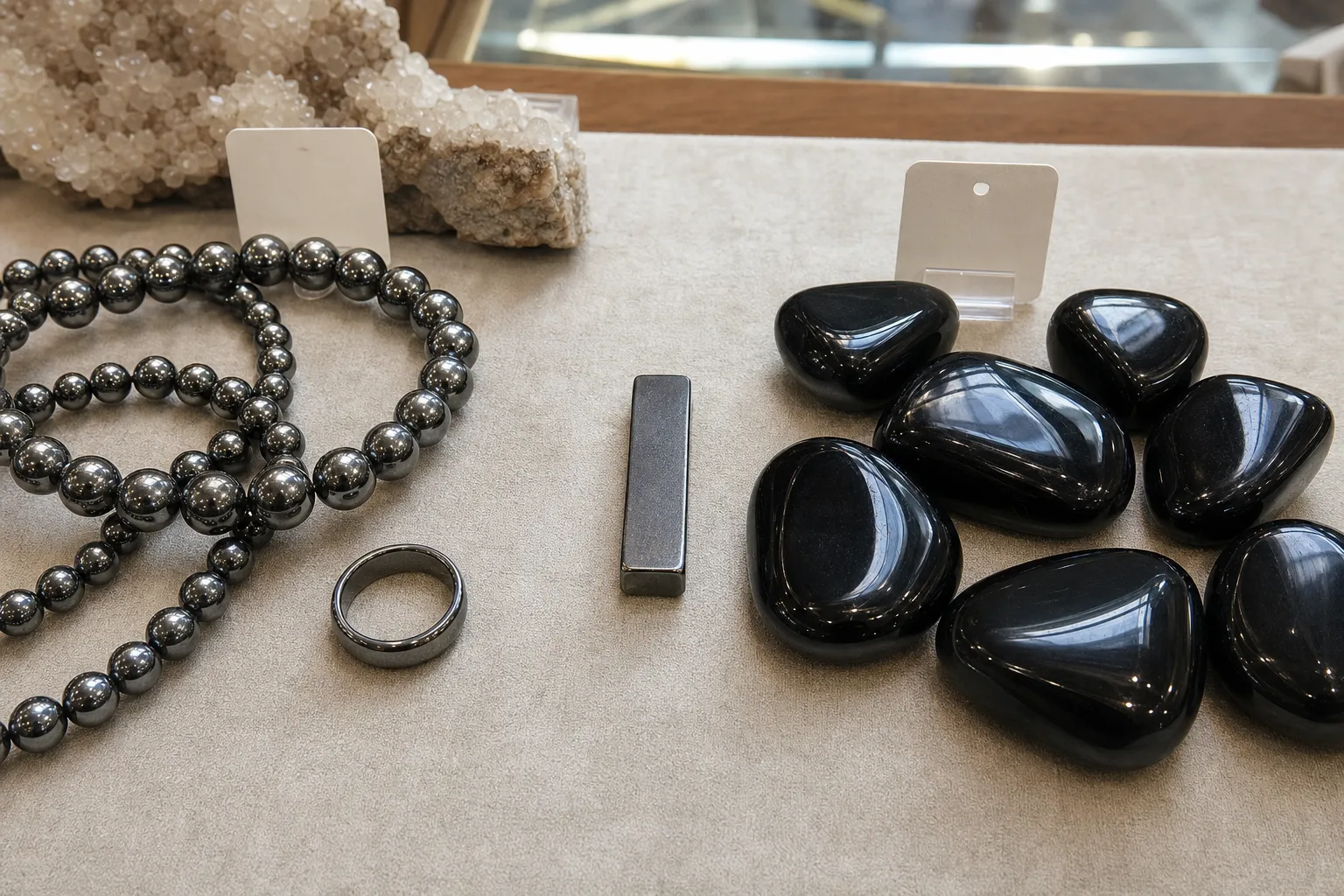
If you are holding a dark bead, bracelet, ring, or tumbled stone, here is the practical answer: hematite can be weakly magnetic, but ordinary natural hematite should not behave like a strong refrigerator magnet. Obsidian is different. It is volcanic glass, not hematite-like iron oxide, so an obsidian magnetic test usually should not show the same kind of response.
So, is hematite magnetic? Sometimes, weakly. A strong snap-to-magnet reaction in jewelry sold as “magnetic hematite” is a caution sign, not proof that the piece is natural hematite. It may point to hematine beads, Hemalyke-style material, magnetite-rich material, another iron-oxide mixture, or a manufactured magnetic jewelry material.
upward
Read the full overview first
Use the broader guide first if you need the full scope before this page.
Hematite, magnetic hematite, and obsidian at a glance
The confusion often starts because all three can be dark, polished, and sold as beads or bracelets. Color is not the main difference. Material is.
| Object or listing term | What it usually means for a buyer | Magnet response to expect | What it does not prove |
|---|---|---|---|
| Natural hematite | An iron oxide mineral, commonly written as Fe₂O₃. It may look metallic gray, black, silver-gray, or reddish-brown. | May show weak attraction, or little obvious response in a simple home check. | Weak response does not certify that it is natural hematite. |
| Magnetic hematite jewelry | A retail phrase often used for strongly magnetic hematite-like beads, bracelets, or rings. | Often much stronger than ordinary natural hematite; beads may pull toward a magnet or each other. | Strong magnetism does not prove natural hematite. |
| Hematine beads / Hemalyke-style beads | Marketplace terms often used for man-made or hematite-like jewelry material. Exact composition can vary. | Commonly sold because the material is magnetic or hematite-like. | The label alone does not confirm the exact mineral composition. |
| Obsidian | Volcanic glass, often black and glossy when polished. | Not expected to react like hematite in a simple magnet comparison. | Lack of magnetism alone does not prove it is obsidian. |
The key point: hematite vs obsidian is not just a black-stone comparison. Hematite is an iron oxide mineral. Obsidian is volcanic glass. They can look similar in polished jewelry, but they should not be judged by the same clues.
Why natural hematite can be weakly magnetic
Hematite is not “just iron” in the way a steel magnet or magnetite-rich object might behave. Physics explanations describe hematite at room temperature as having weak magnetic behavior rather than acting like a strong permanent magnet.
In buyer language, that means two things can both be true:
- Natural hematite magnetism exists, but it is usually weak.
- Strong magnetic hematite jewelry may not be ordinary natural hematite.
Specific pieces can vary. Grain size, impurities, mixed iron oxides, and magnetite inclusions may affect how a specimen responds. A raw mineral sample with mixed iron minerals can behave differently from a polished bead strand, and a processed jewelry item may behave differently again.
That is why the simple internet rules do not work well. “Real hematite is never magnetic” is too absolute. “If it is magnetic, it must be real hematite” is also too absolute. A better version is: weak attraction can fit natural hematite, but strong magnetism deserves a closer look.
Why strong magnetism in hematite jewelry can mislead you
A bracelet or ring that jumps strongly to a magnet can feel convincing. Many shoppers assume that because hematite contains iron, stronger magnetism must mean a more “real” piece. That is not a reliable conclusion.
In listings, “magnetic hematite” often works as a product phrase rather than a precise mineral label. It may describe a magnetic bracelet style, a hematite-colored bead, or a hematite-like material. Terms such as hematine beads and Hemalyke are also used in bead and jewelry contexts, but the exact manufacturing details behind every seller’s wording are not always clear. Treat those names as marketplace language unless the seller gives better material information.
Strong magnetism can suggest:
- a manufactured magnetic hematite-like material;
- hematine or Hemalyke-style beads;
- magnetite-rich material;
- another iron-oxide mixture;
- a piece made or magnetized for magnetic jewelry use.
It does not let you name the exact composition at home.
A useful buyer rule: a hematite magnet test can raise questions, but it cannot finish the identification. If the piece is inexpensive, perfectly uniform, mirror-smooth, and described only as “magnetic hematite stone,” the listing may be using a familiar crystal name more loosely than a mineral reference would.
Why obsidian should not react like hematite
Obsidian is commonly described in geology references as volcanic glass formed from rapidly cooled lava. It is not the same kind of material as hematite iron oxide. A polished black obsidian bead can look glossy and dark, but that surface similarity does not make it a hematite-like magnetic material.
For a buyer, this means:
- An obsidian magnetic test is not a hematite test.
- Obsidian should not be expected to show hematite’s red to reddish-brown streak.
- Obsidian usually gives a different weight impression from dense hematite.
- A black glossy surface alone is not enough to separate obsidian from hematite, glass, or other dark materials.
Some natural materials contain tiny inclusions, so real-world pieces are not always perfectly simple. Still, for a normal crystal-counter comparison, obsidian is not the material you expect to snap to a magnet like magnetic hematite jewelry.
If a seller describes one bead as both “obsidian” and “magnetic hematite,” read carefully. Those terms point to different material stories. It may be a mixed bracelet, a decorative name, or a search-friendly listing rather than a precise identification.
What you can check without over-reading the result
Home observations can help you decide whether to ask better seller questions or seek specialized testing. They should not be treated as a pass/fail authenticity certificate.
1. Magnet response
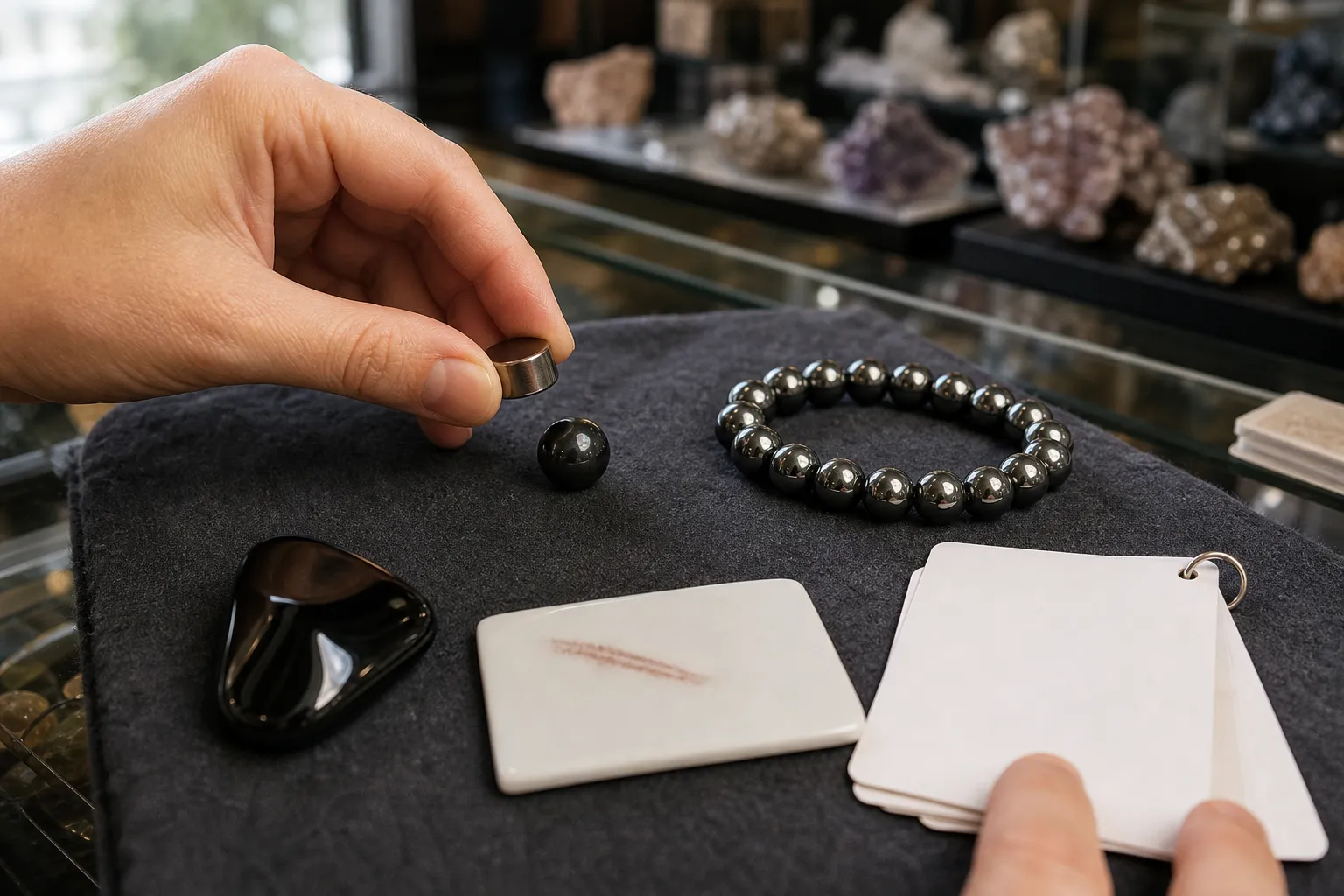
Hold a small magnet near the item and observe gently. Do not let a strong magnet slam into a polished stone, bead, or jewelry setting.
A weak pull can be compatible with hematite. A strong pull, bead-to-bead attraction, or bracelet behavior typical of magnetic jewelry can suggest that the item is not ordinary natural hematite. The test still cannot tell you whether it is hematine, magnetite-rich material, ferrite-like material, or another mixture.
2. Streak color
A classic hematite clue is a red to reddish-brown streak. Mineral references commonly use this because hematite’s powder color can be reddish even when the surface looks metallic gray or black.
For jewelry, this clue has a major limitation: streak testing can scratch or mark polished beads, rings, and collector pieces. If it is used at all, it belongs on raw material, an inconspicuous area, or in a professional setting. Do not damage a finished bracelet for a clue that still would not prove everything by itself.
Obsidian is not expected to give hematite’s red streak because it is volcanic glass, not hematite iron oxide.
3. Weight impression
Hematite often feels heavy for its size. A strand of hematite beads may feel denser than a similar-looking strand of glossy black glass or obsidian. Obsidian can be dark and polished, but it usually does not give the same dense, metallic weight impression.
This is only a rough cue. Bead size, drill holes, coatings, settings, and mixed materials can all change how a piece feels in the hand.
4. Surface, shape, and seller wording
Very uniform beads or rings are not automatically a problem, but they deserve careful reading when combined with strong magnetism. Natural hematite can be cut and polished, of course. A bead strand that is perfectly identical and strongly magnetic may be using “hematite” in a broader retail sense.
Look for wording such as:
- “magnetic hematite”;
- “hematine”;
- “Hemalyke”;
- “hematite-like”;
- “man-made hematite”;
- “magnetic bracelet”;
- “natural hematite.”
Those terms are not interchangeable. If the listing is unclear, ask whether the seller means natural mineral hematite or a hematite-like jewelry material, and whether any material disclosure is available.
Is magnetic hematite fake or real?
The better question is: what does the seller mean by “magnetic hematite”?
If the listing means natural hematite that shows weak attraction, that can fit hematite’s known weak magnetic behavior. If it means a strongly magnetic bracelet made for magnetic jewelry use, it may be a hematite-like manufactured material or a mixed iron-oxide material. In that case, calling it simply “real hematite” may be too vague.
Strong magnetism is not a clean fake-or-real switch. It is a clue that the product may not be ordinary natural hematite as a mineral collector would use the term.
The reverse is also true. A piece that does not react strongly to a magnet is not automatically proven natural. Some natural hematite may show only weak response, and some imitations or other dark materials may also show little response.
A note on magnetic jewelry claims
Some magnetic hematite jewelry is sold with wellness or personal-use language. That language is separate from mineral identification. A magnet response does not demonstrate a body effect, and it should not be used as evidence that a stone is natural hematite, better quality, or more valuable.
If you buy hematite or obsidian for symbolic, grounding, or protective-crystal reasons, that is a personal or cultural context. It should not replace material checks when the question is what the bead, ring, or tumbled stone is physically made from.
Bottom line for a buyer
If your dark polished piece is labeled hematite, a weak magnetic response can be consistent with natural hematite. If it is strongly magnetic, especially in bead or bracelet form, treat that as a reason to question the listing language rather than as proof of authenticity. It may be magnetic hematite jewelry, hematine beads, Hemalyke-style material, magnetite-rich material, or another iron-oxide mixture.
If the piece is obsidian, understand it separately: obsidian is volcanic glass, not hematite iron oxide, and it should not be expected to match hematite’s magnet response, red streak, or dense metallic feel.
For certainty, appearance, magnetism, streak, and weight are only clues. Specialized mineral or gemological testing may be needed when the exact material matters.
Sources
Sources and further reading
Reference links are limited to sources considered suitable for public citation in this page.