
ProtectCrystal handling note
Cleaning comparison
Cinnabar vs Hematite Cleaning: What Changes Because of Handling Risk
The practical difference is this: cinnabar vs hematite cleaning is not just a choice between two stone-care routines. Hematite usually calls for finish protection; cinnabar calls for lower-contact handling.
upward
Read the full overview first
Use the broader guide first if you need the full scope before this page.
For hematite
A soft dry cloth, very slight moisture when needed, and quick drying are usually enough. The main concern is dulling a polish, damaging a coating, loosening bead stringing, or stressing metal parts.
For cinnabar
Especially a cinnabar-labeled piece or an uncertain red specimen, avoid anything that removes material or creates particles: no scraping, sanding, drilling, tumbling, abrasive brushing, polishing compounds, heat, steam, or ultrasonic cleaning. If you are not sure whether a red object is hematite, cinnabar, dyed material, or something else, handle it more like cinnabar until the identity is clearer.
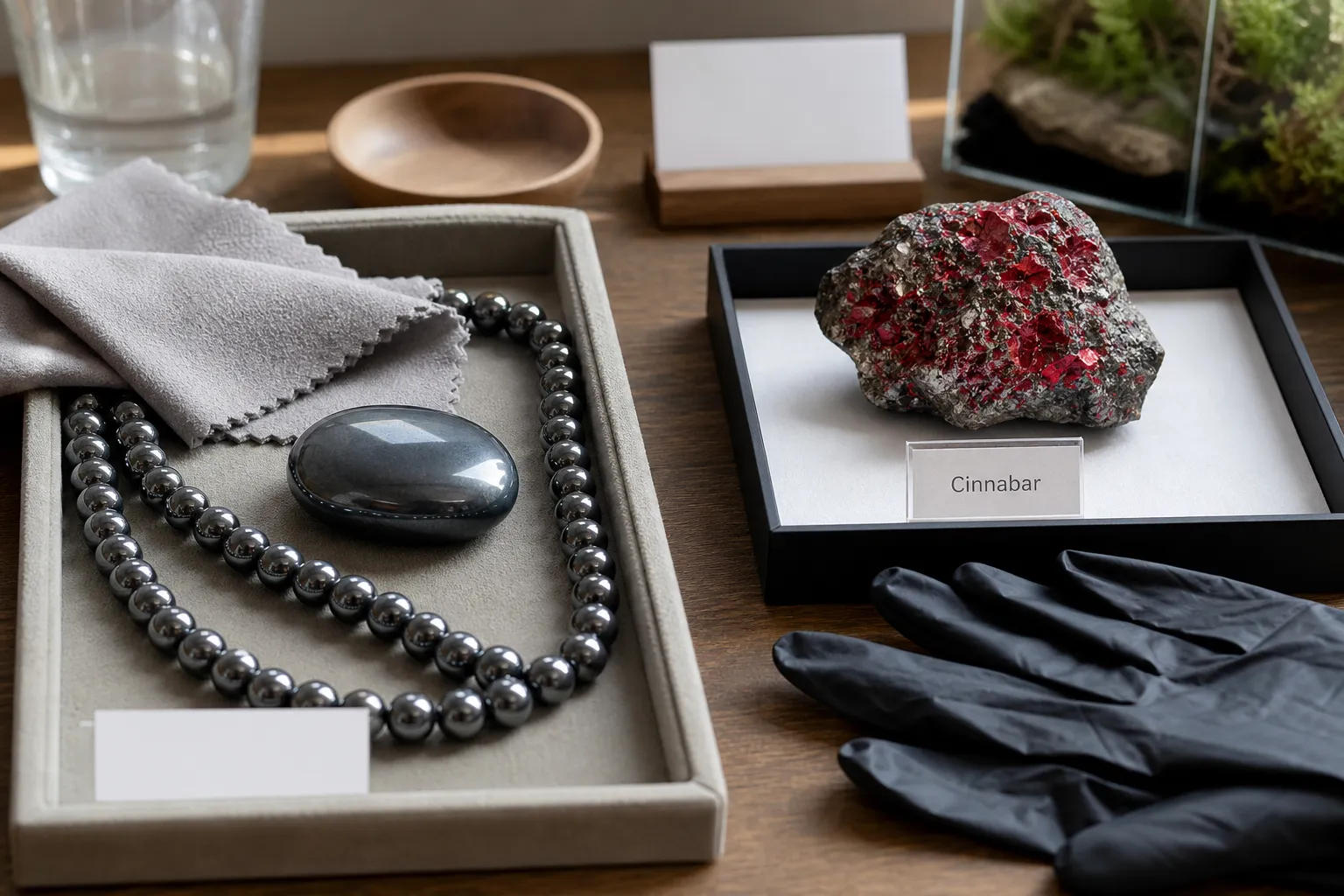
What changes at the cleaning table
The cleaning logic changes because cinnabar and hematite are different materials. Cinnabar is commonly described as mercury sulfide, HgS. Hematite is an iron oxide mineral. That distinction does not make every red object easy to judge by sight, but it does change the safest first move.
For a hematite bead, palm stone, carving, or jewelry-like piece, ask:
- Will moisture affect the finish, coating, stringing, glue, or metal parts?
- Is the piece plated, magnetic, reconstructed, or surface-treated?
- Will rubbing or polishing dull the shine?
For cinnabar, ask a stricter set of questions:
- Will this action create dust or loose particles?
- Will it scrape, grind, or remove surface material?
- Is the red identity actually confirmed?
- Could this piece be handled less instead of cleaned more?
A toothbrush, polishing cloth with compound, rotary tool, tumbler, or ultrasonic cleaner may sound normal in casual stone-care talk. For cinnabar or an unknown red mineral, those methods push in the wrong direction: more friction, more surface disturbance, and more chance of residue coming off.
This does not mean every hematite item can be immersed, or that every cinnabar specimen has the same condition. It means the cleaning decision starts from different priorities.
Cleaning hematite stone is mostly about protecting the finish
For most buyer-facing hematite care, keep the routine modest. Remove loose dust with a soft dry cloth. If grime remains, use a barely damp cloth, then dry the piece promptly. This is especially sensible for hematite jewelry, bead strands, magnetic pieces, glossy tumbled stones, and items sold with vague treatment descriptions.
Hematite is often valued for its dark metallic-looking luster or smooth polish. Rough cleaning can change that visible surface. Abrasive powders, stiff brushes, repeated hard rubbing, or polishing compounds may leave fine marks or reduce gloss.
The bigger mistake is assuming “hematite” always means one simple untreated mineral object. In the crystal market, hematite may appear as natural-looking stones, beads, magnetic items, coated pieces, or lookalike products. Shine alone cannot confirm all of that. If the surface looks unusually mirror-like, coated, painted, iridescent, strongly magnetic, or vaguely described by the seller, clean it as a finished object.
For hematite jewelry, avoid soaking, ultrasonic cleaning, harsh detergents, and vigorous scrubbing around drilled holes or settings. A soft cloth does less, but that is the point: hematite cleaning precautions are usually about preventing dulling, loosening, or finish damage.
Some readers search for “cleansing hematite crystals” when they mean a personal or symbolic practice. This page is about physical cleaning only. If the object is dusty or oily, treat it as a surface-care problem: low moisture, low abrasion, and no assumption that water exposure is harmless for the whole piece.
Cleaning cinnabar means doing less, not going deeper
For cinnabar, the better question is often not “How do I deep clean it?” but “Can I avoid disturbing the surface?”
Cinnabar is commonly identified in mineral references as mercury sulfide. Safety data-style documents for mercury sulfide materials are not household crystal-care manuals, but they do support a cautious handling boundary: avoid creating airborne particles, loose residue, or unnecessary contact with damaged material.
For a cinnabar-labeled specimen, avoid:
- sanding, filing, scraping, or grinding;
- drilling, carving, reshaping, or tumbling;
- abrasive polishing cloths or polishing compounds;
- stiff brushing, especially on rough, porous, powdery, or flaking areas;
- ultrasonic cleaning;
- heat, steam, or hot-water experiments;
- long soaking or chemical cleaning meant to brighten the red.
A very light dusting around a stable display piece may be as far as a non-specialist should go. If dust is loose, do not blow it into the air. If the piece has powdery residue, shedding grains, damaged edges, or an unknown coating, do not try to restore the surface at home. Keep it away from casual handling, children, pets, food preparation areas, and objects that invite frequent touching.
The point is not to name one household method that makes cinnabar suitable for every use. The available sources do not give that kind of consumer cleaning protocol. The practical goal is narrower: do less, create no dust, remove no material, and avoid methods that make the surface more disturbed than it was before.
If a cinnabar-like piece is jewelry, the caution does not disappear. Cleaning around drilled holes, bead edges, worn areas, or skin-contact surfaces can increase abrasion. A smooth red bead or carving does not prove composition, coating, stability, or suitability for repeated wear. Appearance can suggest a category, but it cannot settle the handling question.
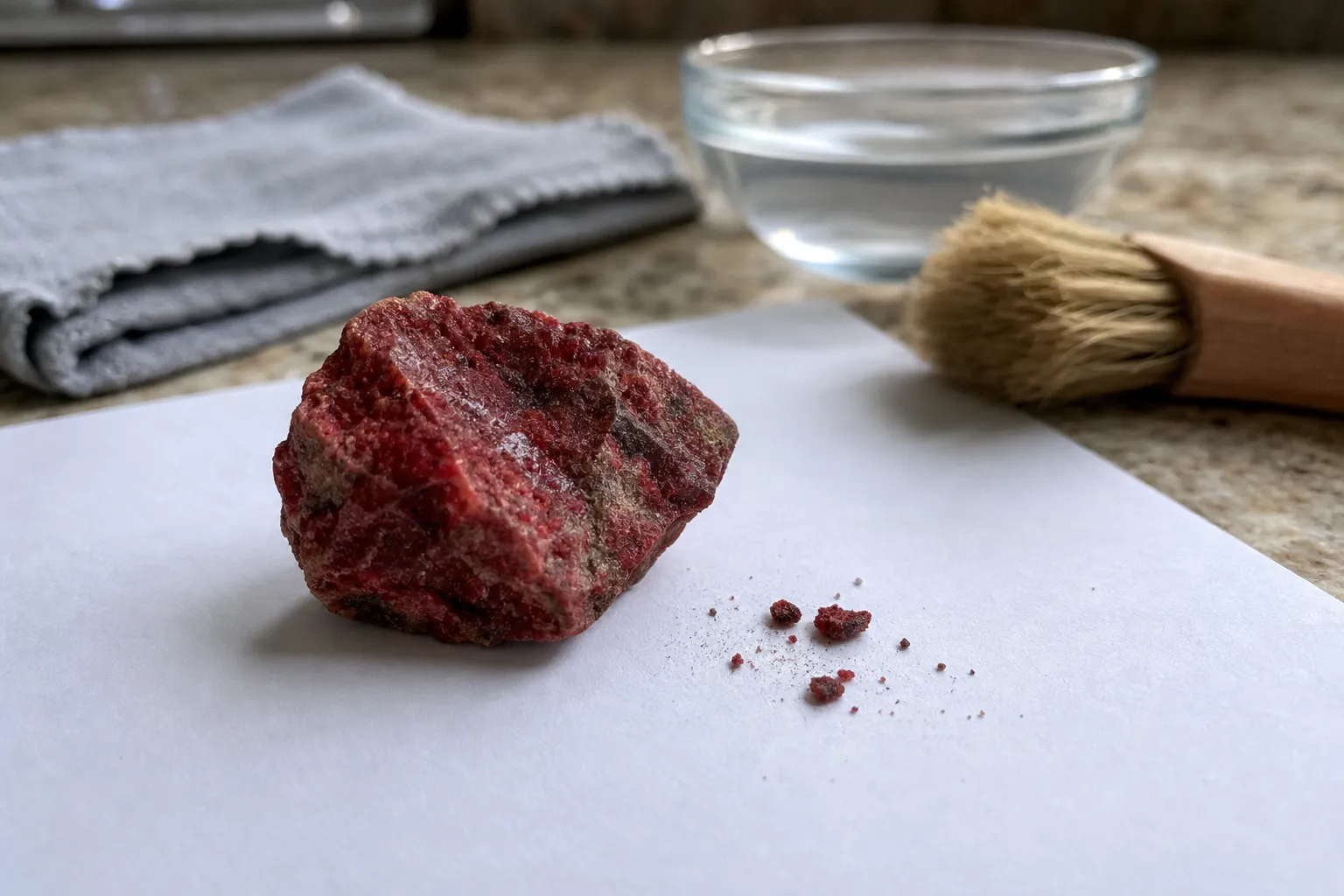
When the red mineral identity is uncertain
The hardest cases are not clearly labeled hematite or clearly labeled cinnabar. They are red stones with old labels, pigment-like residue, lacquered surfaces, mixed seller terms, or uncertain marketplace names. Red appearance alone is not enough.
Museum and analytical identification work may use methods such as XRF, XRD, Raman spectroscopy, SEM–EDX, FTIR, or related tools to distinguish red mineral materials. That level of testing is not part of normal household cleaning, but it gives buyers a useful limit: color, shine, and seller wording can suggest identity; they do not prove it.
Use the higher-caution route if:
- the label mentions cinnabar, vermilion, mercury sulfide, or an old red mineral name;
- the piece leaves red residue on tissue, fingers, packaging, or display fabric;
- the surface is crumbly, powdery, porous, or flaking;
- the seller description mixes decorative, symbolic, pigment, and mineral language without clear material detail;
- the item came from an old collection and the label cannot be checked;
- you were about to polish, soak, or brush it because it “looks like a normal stone,” but you cannot identify it confidently.
Do not try to clean your way into certainty. Avoid soaking, ultrasonic cleaning, abrasive polishing, and hard brushing. Separate the piece from lower-caution stones, limit handling, and seek professional identification if the result affects how you will store, display, sell, or wear it.
Specialized testing is not always necessary for casual display decisions, but it may be the only way to move beyond guesswork. A magnet, loupe, scratch test, or color comparison can be misleading in this situation. Scratch testing is especially poorly suited because it deliberately removes material.
Common cleaning misunderstandings
“Natural mineral” does not mean ordinary stone cleaning
Cinnabar shows why that shortcut fails. A mineral can be natural and still call for lower-contact handling. The cleaning question is whether your action creates dust, removes surface material, or increases contact with loose residue.
Hematite is not always water-friendly as a whole object
Many tumbled stones are sold as durable pocket stones, but for hematite the issue is often coating, polish, drilled holes, stringing, adhesive, spacers, or metal findings. That is why soaking hematite stone or hematite jewelry is usually unnecessary when a cloth will do.
Symbolic marketplace language does not decide cleaning care
Cinnabar and hematite may both appear in crystal-use discussions, and hematite is often described in grounding language. Those meanings may matter to personal practice, but they do not determine physical cleaning care. Symbolic wording does not confirm mineral identity, surface stability, or handling conditions.
A smooth red surface does not settle the material question
Polished cinnabar-like material is sometimes treated as settled because it looks sealed or smooth. A polished surface may have less loose texture than a crumbly specimen, but it does not confirm what the material is, what coating is present, or how it will respond to friction, heat, liquid, or repeated wear. For certainty, specialized testing may be needed.
A simple rule before you clean
Use this rule when choosing between hematite-style cleaning and cinnabar-style caution:
- If it is clearly hematite and the issue is light dust or fingerprints, use a soft dry or barely damp cloth, then dry it.
- If it is hematite jewelry, magnetic hematite, coated hematite, or beadwork, clean only the surface and avoid immersion unless you have material-specific care information.
- If it is labeled cinnabar, vermilion, mercury sulfide, or has loose red residue, do not scrub, polish, sand, soak, heat, or use an ultrasonic cleaner.
- If the red mineral identity is uncertain, treat the object as if cinnabar handling differences matter until you know more.
- If cleaning would require force, stop. Force is exactly what turns a small surface-care task into abrasion, dust, or finish loss.
That is the core answer: hematite cleaning usually protects the look and construction of the piece; cinnabar cleaning is mainly about minimizing contact and avoiding surface disturbance.
Sources
Sources and further reading
Reference links are limited to sources considered suitable for public citation in this page.