ProtectCrystal handling note
Cinnabar Powdery Surface vs Hematite Red Dust: What It May Suggest
If you are comparing a cinnabar powdery surface vs hematite red dust, start with where the powder appears.
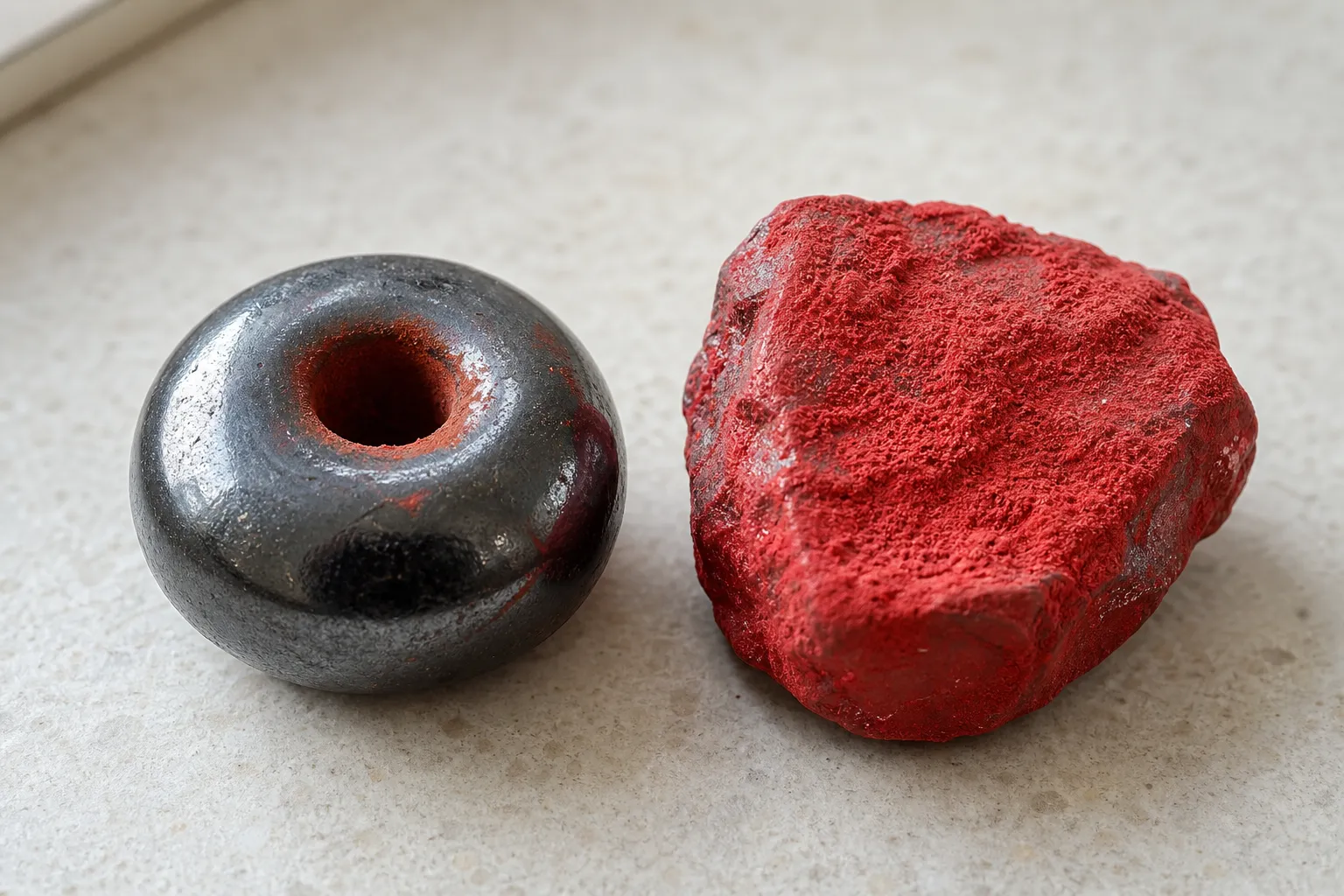
Red or reddish-brown dust around drilled holes, rubbed edges, chips, or cord wear can fit hematite-like abrasion, because hematite is known for a red to reddish-brown streak when powdered. A loose powdery red surface on something sold as cinnabar should be read more cautiously. It may involve cinnabar-related material, but it may also be pigment, coating, carving residue, iron-rich dust, dyed material, or contamination.
The practical next step is not aggressive home testing. If an item is sold as cinnabar, or you suspect it may be cinnabar, and it is shedding powder, avoid creating more dust. Contain it, wash your hands after handling, and do not sand, grind, polish, scratch-test, or rub it hard.
upward
Read the full overview first
Use the broader guide first if you need the full scope before this page.
The quick read: the location of the red powder matters
A red mark alone does not identify a mineral. The better clue is how the powder behaves and where it is showing up.
Red or reddish-brown dust at a bead hole
Abrasion from drilling, stringing, or cord movement; this can fit hematite-like streak behavior
It does not prove that the bead is definitely hematite.
Red dust on a chipped edge or rubbed high point
Surface wear, streak, coating loss, or iron-rich residue
It does not prove that the material is fully identified.
A whole surface that looks chalky or powdery red
Loose pigment, coating, carving residue, degraded finish, mineral powder, or contamination
It does not prove that it is natural cinnabar.
A seller uses words like “cinnabar,” “vermilion,” or “red hematite”
Marketplace wording worth checking
It does not prove mineral identity.
A polished piece leaves no dust right now
A stable surface finish under current handling
It does not prove that abrasion could never change the surface.
Hematite is an iron oxide mineral, and mineral references commonly note its red to reddish-brown streak. That is why hematite red dust or a hematite red streak can make sense when a hematite-like object is abraded. A streak is the color of the mineral’s powder, not necessarily the color of the polished surface.
Cinnabar is different. It is a specific mercury sulfide mineral, not just a name for anything bright red. A powdery red cinnabar surface on a bead, pendant, carving, or specimen should be treated first as a handling issue, then as an identification clue.
When red dust fits hematite-like abrasion
Hematite is commonly seen in beads, cabochons, tumbled pieces, small carvings, and jewelry-like items. A polished hematite piece may look dark gray, metallic, silvery, blackish, or mirror-like, while its powdered streak can be red or reddish brown. That contrast surprises many buyers: a dark metallic bead can still leave reddish residue if it is worn down.
Red dust on hematite is more plausible when it appears in friction points:
- inside or around drilled bead holes;
- along chipped edges;
- where beads rub against one another;
- where cord, wire, or a clasp has worn the surface;
- on a rough underside that was not polished as fully as the visible face.
In those situations, hematite abrasion red dust can be consistent with known streak behavior. It still does not confirm the material by itself. Coated beads, iron-rich stones, dyed materials, and composite products can also leave reddish residue.
The amount matters too. A faint reddish-brown smear at a rubbed edge is different from loose powder across the whole object. Local residue near a drill hole may simply reflect wear. A chalky layer that wipes off over the entire surface may point toward a coating, pigment, old carving residue, or another surface material.
One common misunderstanding is that red dust automatically means cinnabar. It does not. Many iron-rich materials can produce red or brownish powder. Hematite’s red streak is a normal mineral-observation clue; cinnabar identification from loose red powder is much less secure without more reliable testing.
Why a powdery cinnabar-like surface deserves caution
Cinnabar is associated with mercury sulfide. That is why a powdery item sold as cinnabar should be handled conservatively. A visual check cannot tell you how much cinnabar, if any, is present. The practical point is simple: do not create or breathe loose dust from suspected cinnabar.
If you have a cinnabar powdery surface or loose cinnabar surface dust, use low-disturbance handling:
- place the item on a disposable paper towel or clean tray before inspecting it;
- avoid blowing on it or brushing it dry;
- do not sand, grind, drill, polish, scratch, or streak-test it at home;
- wash your hands after handling;
- keep it away from children, pets, food surfaces, cups, water bottles, mouths, cosmetics, and skin products;
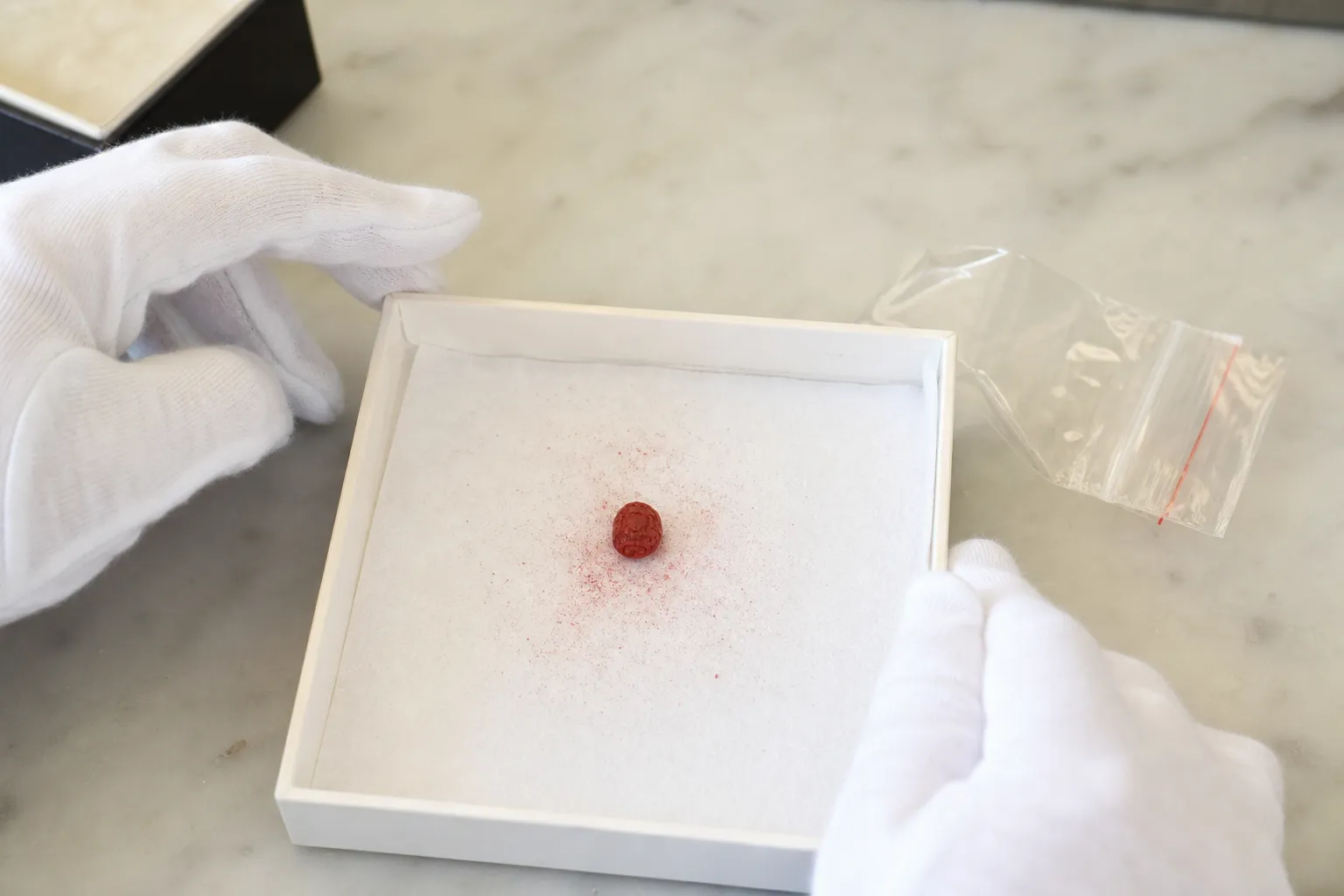
- store a shedding piece in a sealed small bag or rigid display box so dust does not spread onto other items.
This is especially relevant for carved beads and pendants. In listings, “cinnabar bead” may mean natural mineral cinnabar, cinnabar-colored lacquer, resin, red pigment, a coated carving, dyed material, or an antique-style decorative object. Sometimes cinnabar is used as a color or style term rather than a mineral identification.
That does not mean every red carved bead has the same concern, or that every seller is using the word carelessly. It means seller wording is not proof. If the piece is powdery and the label says cinnabar, treat it as a suspected cinnabar handling caution until you have better information.
Cinnabar, vermilion, red pigment, and “red stone” are easy to mix up
The word “cinnabar” carries several overlapping meanings. In mineral references, cinnabar means a specific mercury sulfide mineral. In historical and art contexts, it is closely connected with vermilion, a red mercury sulfide pigment term. In crystal and bead listings, it may be used more loosely for red carved-looking pieces, lacquer-style beads, or decorative products.
That overlap is why red powder mineral identification can get messy. A red powdery surface may be:
- mineral powder from a cinnabar-bearing specimen;
- vermilion-like pigment or red coating;
- iron oxide residue from hematite or another iron-rich material;
- clay, ochre-like earth, or polishing compound trapped in recesses;
- residue from drilling or carving;
- degraded finish on a bead or pendant;
- transferred dust from storage with another object.
Color can look convincing and still be a weak clue. Both cinnabar-related material and iron oxide material can appear red. Coatings can imitate mineral color. Old residue can collect in carved grooves and around bead holes. A polished surface may hide what the interior or coating is.
This is also where simple home tests can cause more confusion. A streak test is a real mineral-observation method, but intentionally rubbing an unknown red specimen to make powder is the wrong move for suspected cinnabar. For hematite-like items, existing abrasion marks may be useful. For suspected cinnabar, avoid making more dust.
What you can check without making the dust worse
A careful visual check can narrow the possibilities, as long as it stays non-destructive.
First, look at the dust location. If reddish dust is concentrated at holes, string channels, or rubbed edges, abrasion is a strong possibility. If the whole surface sheds evenly, think about coating, pigment, residue, or unstable surface material.
Next, look at the finish. Hematite jewelry pieces are often highly polished and metallic-looking, though not every product sold as hematite is the same. Cinnabar-labeled decorative pieces may look bright red, orange-red, brownish red, carved, lacquer-like, matte, or granular depending on what they actually are and how they were made or finished.
Check whether the red powder appears only after friction. If a bead leaves residue after rubbing against a cord, that points toward mechanical wear. If powder is already loose in the bag, box, or listing photo, treat it as a shedding surface rather than a fresh streak clue.
Read the seller wording closely. Phrases such as “natural cinnabar,” “cinnabar color,” “vermilion,” “red hematite,” “magnetic hematite,” “lacquer,” “resin,” “antique style,” and “dyed” do not all mean the same thing. Some are mineral claims. Some are color or style descriptions. If the listing avoids clear material details, keep that uncertainty in your decision.
If the object is valuable, old, unusually powdery, or intended for wearing, ask for better documentation or consult a qualified mineral or gem professional. Technical methods such as X-ray fluorescence, X-ray diffraction, and Raman spectroscopy are used in specialized settings to distinguish visually similar red materials. You do not need lab equipment to make a buying decision; the point is that appearance alone has limits.
A practical decision path
Use the red dust as a cue, not a verdict.
If the object is hematite-like and the dust is only at worn points, it is reasonable to read it as possible abrasion or streak behavior. Inspect the holes, stringing, and edges. If it keeps shedding heavily during ordinary handling, you may not want it as wearable jewelry because the residue can transfer onto skin, clothing, or storage surfaces.
If the object is sold as cinnabar and has loose powder, switch to caution mode. Do not perform scratch or streak tests. Do not try to “clean it up” by sanding or polishing. Contain it, minimize handling, and decide whether you want to keep a powdery item at all. If you keep it, treat it more like a contained display piece than a high-contact object.
If the item is a carved red bead or pendant with unclear seller wording, assume the label may be style language until shown otherwise. A careful reading is: this may be cinnabar, cinnabar-colored material, pigment, coating, or another red decorative product. That is less satisfying than a firm answer, but more accurate than treating a photo or dust smear as proof.
For online buying, ask direct material questions before purchase:
- Is this natural mineral cinnabar, cinnabar-colored lacquer or resin, dyed stone, or another material?
- Is the red color throughout the piece or mainly on the surface?
- Does the item shed powder or leave residue?
- Is it intended for wearing, display, or craft use?
- Can the seller provide non-marketing material information?
The answer may still be incomplete, but vague replies are useful in their own way. They tell you not to treat the listing as confirmed mineral identification.
Bottom line
Red dust on hematite often points toward abrasion or streak behavior, especially around drilled holes and rubbed edges. A powdery red cinnabar surface is different: it may be mineral powder, pigment, coating, residue, or contamination, and because cinnabar is mercury sulfide, the sensible response is cautious handling rather than more abrasion-based testing.
For a practical buyer, the best conclusion is: hematite-like red dust can be a normal clue under wear; cinnabar-like surface powder is a reason to slow down, contain the item, and avoid making dust. Visual signs may suggest a direction, but they cannot identify the material with certainty or settle how the item should be used in every setting.
Sources
Sources and further reading
Reference links are limited to sources considered suitable for public citation in this page.