
ProtectCrystal handling note
Specimen handling comparison
Raw Cinnabar vs Raw Hematite: Handling Differences for Specimens
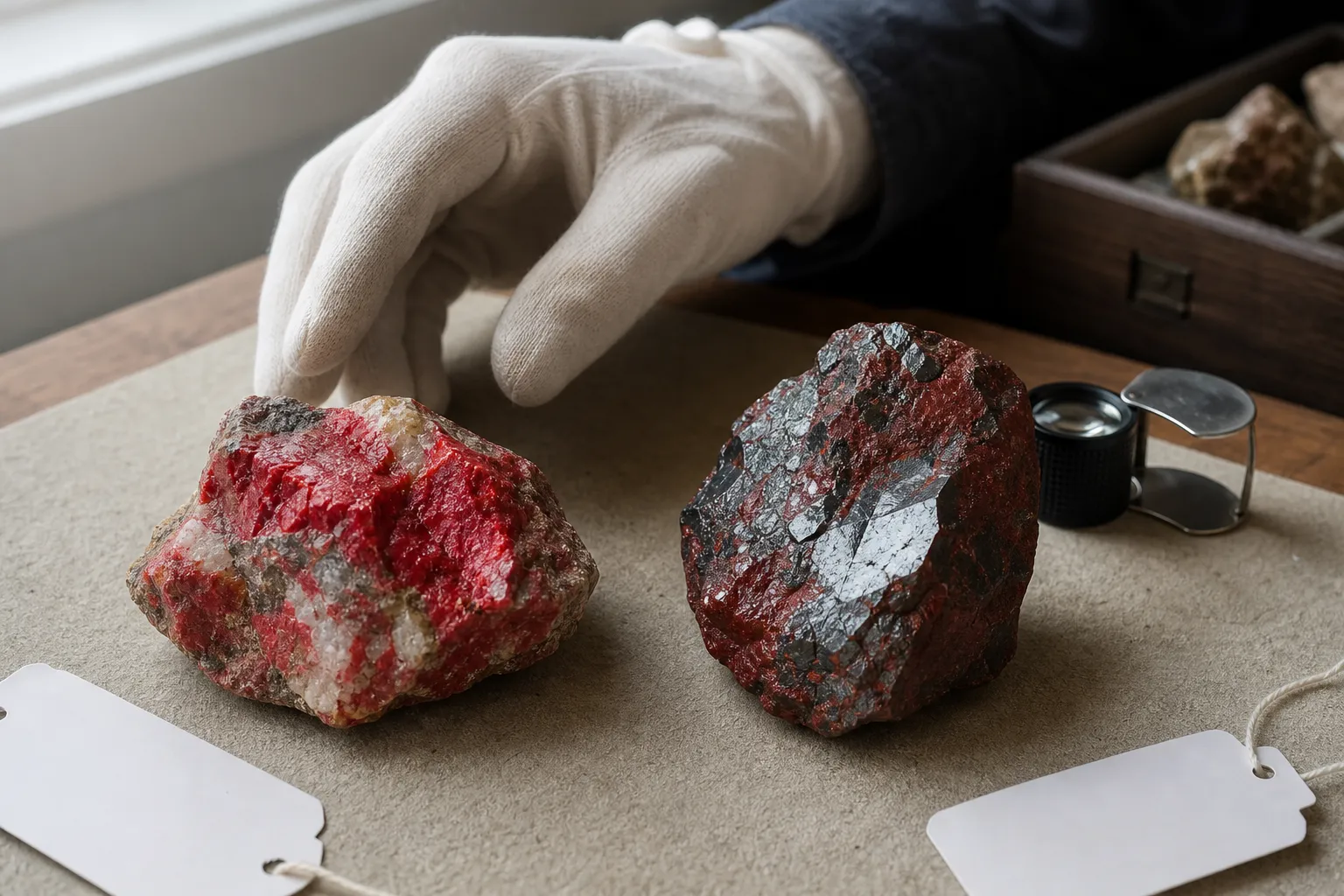
If you are comparing raw cinnabar vs raw hematite and the red specimen is not clearly identified, handle it as suspected cinnabar first. That does not mean every red stone is alarming. It means you should avoid the actions that make a possible cinnabar specimen harder to manage: heat, abrasion, powder, loose fragments, and casual pocket or shelf handling.
Raw cinnabar is mercury sulfide, often described as bright red to brownish red, and rough pieces may be soft, dusty, mixed with quartz, or sold under unclear “red ore” wording. Do not heat, grind, drill, polish, tumble, scratch-test, streak-test, or break suspected cinnabar. Store it separately in a labeled closed container or display box, and wash hands after handling.
A raw hematite specimen is usually handled differently. Hematite is iron oxide, and common concerns are red-brown residue, staining, friable surfaces, soaking, and rough cleaning. The problem is overlap: red color, heavy feel, and seller wording can make cinnabar and massive red hematite hard to separate by appearance alone.
upward
Start with the broader guide
Use the broader guide first if you need the full scope before this page.
The practical handling difference
If the specimen may be raw cinnabar
This includes “cinnabar in quartz,” “mercury ore,” “vermilion,” or an unclear red ore. Use minimal handling, no heat, no dust-making, separate labeled storage, and handwashing afterward.
If the specimen is raw hematite
Use ordinary mineral care: control red-brown residue, keep dry if crumbly, avoid harsh cleaning, and protect surfaces from staining.
If the specimen is unclear
A red, heavy, soft, crumbly, or seller-ambiguous stone should be treated as suspected cinnabar until a better identification step is available.
Cinnabar is commonly listed as HgS. Hematite is commonly listed as Fe2O3. Both can be dense-looking red mineral specimens, especially when the surface is massive rather than crystalline. Because a visual mix-up changes how you should handle the piece, this comparison starts with care habits before identification confidence.
Clues that help, but do not prove identity
Visible clues can help you decide how cautious to be, but they should not be turned into destructive home tests.
Color
Cinnabar is often associated with vivid red, scarlet, or brownish red color. Hematite can also appear red, red-brown, or earthy, especially in massive pieces. A hematite-like red stone is not automatically hematite, and a duller red specimen is not automatically cinnabar.
Color becomes more useful when paired with wording and texture. A bright red area in pale quartz described as “cinnabar in quartz” should be handled as suspected cinnabar. A red-brown iron-looking piece labeled hematite may be ordinary hematite, but wording such as “mercury ore,” “vermilion,” or “cinnabar-like” should slow the decision down.
Weight
Cinnabar is very dense, with mineral references often listing density around 8. Hematite is also heavy for a common collector mineral, with specific gravity commonly given around 5.26. So both can feel weighty in the hand, and cinnabar may feel unusually heavy for its size.
Still, “feels heavy” cannot identify a specimen. Matrix, shape, size, metal-bearing inclusions, and expectation all affect hand feel. Treat weight as a reason to be more careful, not as a verdict.
Softness, crumbling, and residue
Cinnabar is relatively soft, often listed around Mohs 2.0–2.5. A rough cinnabar specimen may scratch, shed, or fragment more easily than harder collector stones. That matters because powder and broken edges are exactly what you want to avoid with suspected cinnabar.
Hematite can also leave red-brown residue, and some rough pieces can shed dust. The difference is the reason for caution: hematite residue is usually a staining and dust-control issue, while suspected cinnabar dust calls for more conservative containment.
Do not use a streak plate, scratch test, grinding test, hot needle, flame, or acid check on a suspected cinnabar specimen. Streak testing may sound like a classic mineral clue, but in this comparison it creates powder, so it is the wrong move for an ordinary buyer.
Matrix and mixed pieces
Cinnabar may occur with quartz and other minerals. Seller descriptions such as “cinnabar in quartz,” “red ore,” or “mercury ore” are meaningful caution signals. Mixed pieces are also harder to interpret visually. A red area on a pale or gray matrix may be cinnabar, hematite staining, another red mineral, or a mixture.
If the red area is soft, powdery, unusually dense, quartz-hosted, or sold with cinnabar-related terms, isolate and label the specimen instead of trying to prove the identity by damaging it.
What not to do with suspected raw cinnabar
If a specimen is labeled cinnabar, sold as mercury ore, described as vermilion, or uncertain enough to concern you, avoid:
- heating, baking, steaming, boiling, burning, flame testing, or hot-water cleaning
- hot ultrasonic cleaning or any cleaning method that adds heat and vibration
- drilling, carving, sanding, polishing, tumbling, or bead-making
- crushing, breaking, scratch testing, or streak testing
- carrying loose raw pieces in pockets or bags where they can rub and shed fragments
- placing dusty pieces near food areas, bedding, children’s items, or pet-accessible shelves
- touching your face, mouth, or eyes while handling the specimen
The no-heat rule is the clearest one. Cinnabar is a mercury sulfide mineral, and heating mercury-bearing material is not the same situation as passive display. Research discussions distinguish HgS from elemental mercury and other mercury forms, but that distinction should not be used as permission for home alteration. Collector pieces may be weathered, dusty, damaged, or mixed with other minerals.
If a suspected cinnabar piece has already been drilled, sanded, heated, broken, or made dusty, stop casual handling. Keep the specimen and any fragments contained. If there is concern about heating, grinding, or visible mercury-like material, do not try to judge the situation from appearance alone; seek appropriate hazardous-materials, poison-control, or medical guidance for the circumstances.
Storage and inspection
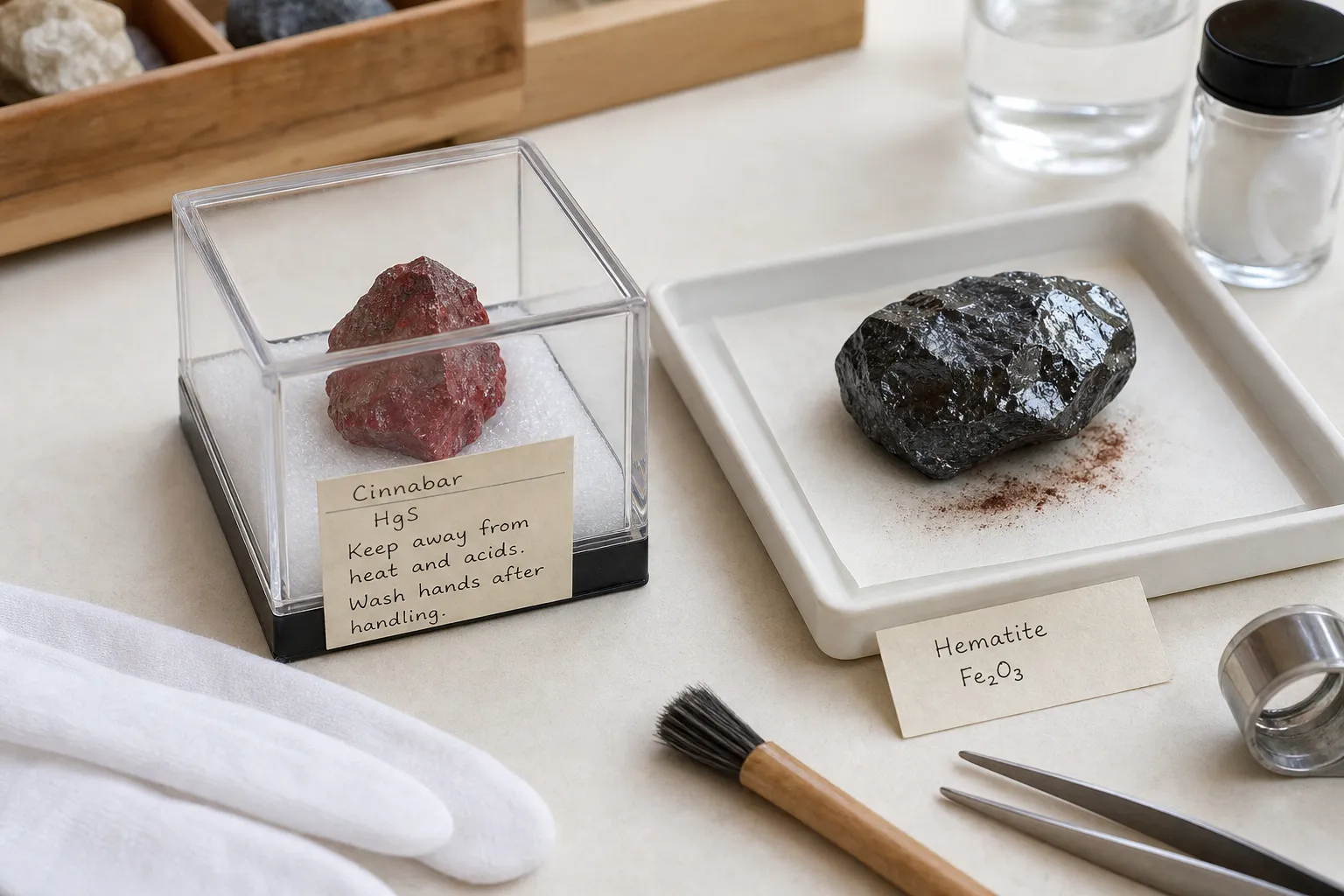
For suspected cinnabar storage
Aim for containment and clear labeling:
- Place the specimen in a small closed display box, sealed bag, or separate lidded container.
- Add a plain label such as “suspected cinnabar / do not heat or abrade.”
- Keep it away from children, pets, food preparation areas, and high-heat locations.
- Avoid frequent handling; inspect through the container when possible.
- If you handle it, use clean hands, avoid face contact, and wash hands afterward.
- If chips or dust are present, keep them inside the container rather than brushing them onto a desk, cloth, or shelf.
For a raw hematite specimen
The routine is usually less restrictive:
- keep it dry if the surface is rough, porous, or crumbly
- place it where red-brown residue will not stain fabric, paper labels, or pale shelves
- avoid soaking if the piece is friable or appears surface-treated
- use gentle dry inspection before cleaning
- do not assume a shiny, magnetic, or finished market item behaves like a raw piece
Raw hematite red residue can be messy, but it is not the same handling category as suspected cinnabar dust.
Seller wording that should slow you down
Marketplace wording can be useful, but it is not proof. Read these terms as clues:
“Cinnabar” — handle conservatively, even if the piece is small or decorative.
“Cinnabar in quartz” — treat the red areas as suspected cinnabar unless identified otherwise.
“Mercury ore” — use cinnabar-style containment and avoid heat or abrasion.
“Vermilion” or “Chinese Red” — may be pigment, decorative, or historical wording; do not treat it as a handling clearance.
“Massive red hematite” — plausible for hematite, but massive red hematite can visually overlap with cinnabar.
“Red ore specimen” — too broad to identify; ask for more information or handle cautiously.
“Hematite-like” or “cinnabar-like” — a sign that the description may be based on appearance rather than certainty.
A polished cinnabar cabochon, bead, or jewelry listing also does not prove that raw cinnabar is appropriate for drilling, polishing, daily skin contact, or home lapidary work. Market availability is not the same as material certainty.
Crystal-use language may appear in listings for both minerals, especially around personal protection traditions or grounding symbolism. That language may matter to display preference, but it should not replace mineral handling decisions.
When identification matters
For casual display, conservative handling may be enough: if it might be cinnabar, contain it and avoid heat or dust. But if you need to know the identity before selling, altering, giving away, wearing, or placing the piece in a shared collection, visual checks have limits.
Specialized identification may involve methods such as X-ray fluorescence, X-ray diffraction, or Raman spectroscopy. Analytical studies use these methods because visually similar red materials and mixed aggregates can be difficult to separate by appearance alone. A buyer does not need to own these instruments; the practical point is that certainty may require help from a qualified mineral dealer, lab, museum contact, university department, or analytical service.
When asking for help, keep the question narrow: “Is this red area cinnabar, hematite, or another mineral, and should it be handled as mercury-bearing?” Include clear photos, seller wording, size, weight, matrix, and known locality if available. Do not damage the specimen to create a sample unless an appropriate professional process calls for it.
Bottom line
For raw cinnabar vs raw hematite, the main difference is what happens if you guess wrong. Mistaking hematite for cinnabar may make you more cautious than necessary. Mistaking cinnabar for ordinary hematite may lead to heating, drilling, sanding, scratching, or loose storage that should have been avoided.
Use the conservative rule: if a red, heavy, soft, crumbly, quartz-hosted, or seller-ambiguous specimen could be cinnabar, handle and store it as suspected cinnabar until better identified. If it is a raw hematite specimen with ordinary red-brown residue, manage staining, dust, dryness, and surface fragility without importing cinnabar’s mercury-specific precautions.
Sources
Sources and further reading
Reference links are limited to sources considered suitable for public citation in this page.