ProtectCrystal handling note
Gift decision guide
How to Choose Between Obsidian, Hematite, and Cinnabar as a Gift
If you need to choose obsidian, hematite, or cinnabar as a gift, use this rule: choose obsidian for a familiar dark protective-crystal style, hematite for a practical jewelry-leaning gift, and cinnabar only for an informed adult collector or careful display recipient.
Cinnabar can be beautiful and culturally interesting, but it is mercury sulfide and is softer than many common jewelry stones. That makes it the narrowest choice here—not a casual pick for children, pets, daily skin-contact wear, pocket stones, or rough handling.
The simplest way to decide is to let the symbolism guide the mood of the gift, but let the recipient’s real use decide the material.
upward
Read the full overview first
Use the broader guide first if you need the full scope before this page.
The quick gift match
Classic protective crystal gift
Better choice: Obsidian
Dark, glossy, familiar, and easy to explain in crystal-shop language.
Bracelets, beads, or simple jewelry
Better choice: Hematite or obsidian
Usually more practical than cinnabar for regular wear.
Unusual mineral specimens
Better choice: Cinnabar, with caution
Vivid red color and mineral-history appeal, but best treated as a display piece.
Child, pet household, or casual recipient
Better choice: Obsidian or hematite
Avoid cinnabar where scratching, mouthing, breakage, or careless handling is possible.
Recipient drawn to red carved objects
Better choice: Cinnabar-style item, only if clearly described
“Cinnabar” can mean different things in listings.
Low-maintenance daily piece
Better choice: Hematite or obsidian
Cinnabar is the least suitable of the three for daily jewelry use.
This is not a ranking of spiritual strength. Obsidian, hematite, and cinnabar are all often described in protective-crystal language, but that belongs in the area of personal meaning, tradition, or gifting symbolism—not promised results.
Choose by how the gift will be used
A good crystal gift is one the recipient can actually live with.
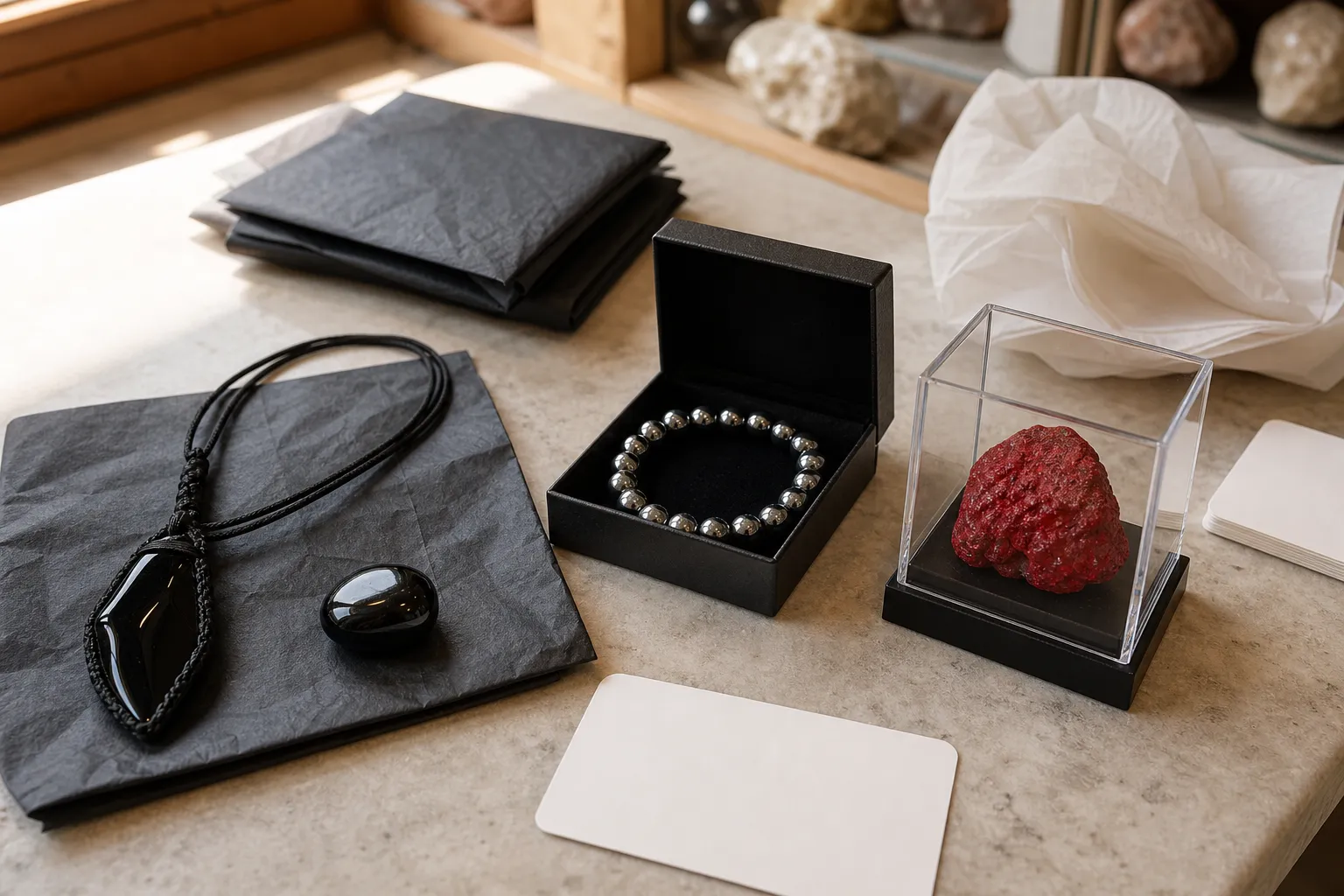
For daily jewelry, stay with obsidian or hematite unless the seller makes it very clear that the item is not natural cinnabar. Bracelets, pendants, rings, and pocket stones are touched, rubbed, dropped, cleaned, and sometimes worn against skin for long periods. That kind of use is not a good match for cinnabar, especially if the piece may chip, abrade, or shed material.
For a desk, shelf, altar, or collector’s cabinet, cinnabar becomes more reasonable, but only for an adult who understands it as a careful-display material. Natural cinnabar is often described as scarlet to brick-red and is historically connected with vermilion pigment and decorative use. That can make it memorable, but not low-maintenance.
For a first crystal gift, obsidian is usually the easiest to explain. It has a strong visual identity: dark, glassy, and dramatic. Names such as black obsidian, snowflake obsidian, mahogany obsidian, or sheen obsidian are common in crystal shops. Those names may describe appearance, but photos and seller labels alone cannot prove origin, quality, or variety.
For a minimalist or jewelry-focused recipient, hematite may be the most practical direction. It is often sold in simple beads, rings, and pendants, and its metallic-looking finish suits people who prefer neutral accessories. Be careful, though, with strong seller claims about coatings, magnetism, unusual colors, or special finishes unless the listing explains the material clearly.
What each stone says as a gift
Obsidian reads as direct, dark, and protective in common crystal-gift language. It suits someone who likes black jewelry, polished stones, volcanic-glass aesthetics, or a simple object with a steady visual presence. If you are comparing obsidian and hematite, choose obsidian when the recipient prefers glossy black, dramatic contrast, or a stone that feels more visibly connected to volcanic glass.
Hematite reads as practical, polished, and understated. It works well when the recipient already wears neutral jewelry or likes compact bead bracelets. If you are unsure whether they want a strongly symbolic gift or simply an attractive object, hematite can feel less intense than a bright red cinnabar piece or a large glossy obsidian carving.
Cinnabar sends a different message: vivid red color, old decorative associations, and a more collector-like feel. Cinnabar gemstone meaning is often discussed in commercial crystal language around red energy, power, transformation, or prosperity, but those are cultural and marketplace meanings rather than verifiable outcomes. The material identity matters more for gift choice: cinnabar is mercury(II) sulfide, HgS, and that is why it deserves extra caution.
A good cinnabar gift is not “a red crystal for anyone.” It is a carefully chosen object for someone who appreciates mineral specimens, historical materials, or display pieces—and who will not treat it like a daily fidget stone.
Why cinnabar changes the answer
Cinnabar is the exception in this comparison because it is not just another red crystal-shop item.
Mineral references commonly describe cinnabar as mercury sulfide, often scarlet to brick-red, with a Mohs hardness around 2.0–2.5. That low hardness matters for gifts because softer material can scratch or abrade more easily. Cinnabar is also part of mercury-bearing mineral safety discussions. The available toxicology literature distinguishes cinnabar from some other mercury forms, but that does not make cinnabar jewelry automatically suitable for casual use.
For gift buying, keep the rule conservative:
- Do not choose cinnabar for children.
- Do not choose it for homes where pets may access or mouth objects.
- Do not choose it for someone likely to scratch, chip, sand, wet-grind, or repeatedly rub the piece.
- Do not choose it for daily skin-contact jewelry.
- Do not choose it when the seller description is vague and the recipient expects an easy-care gift.
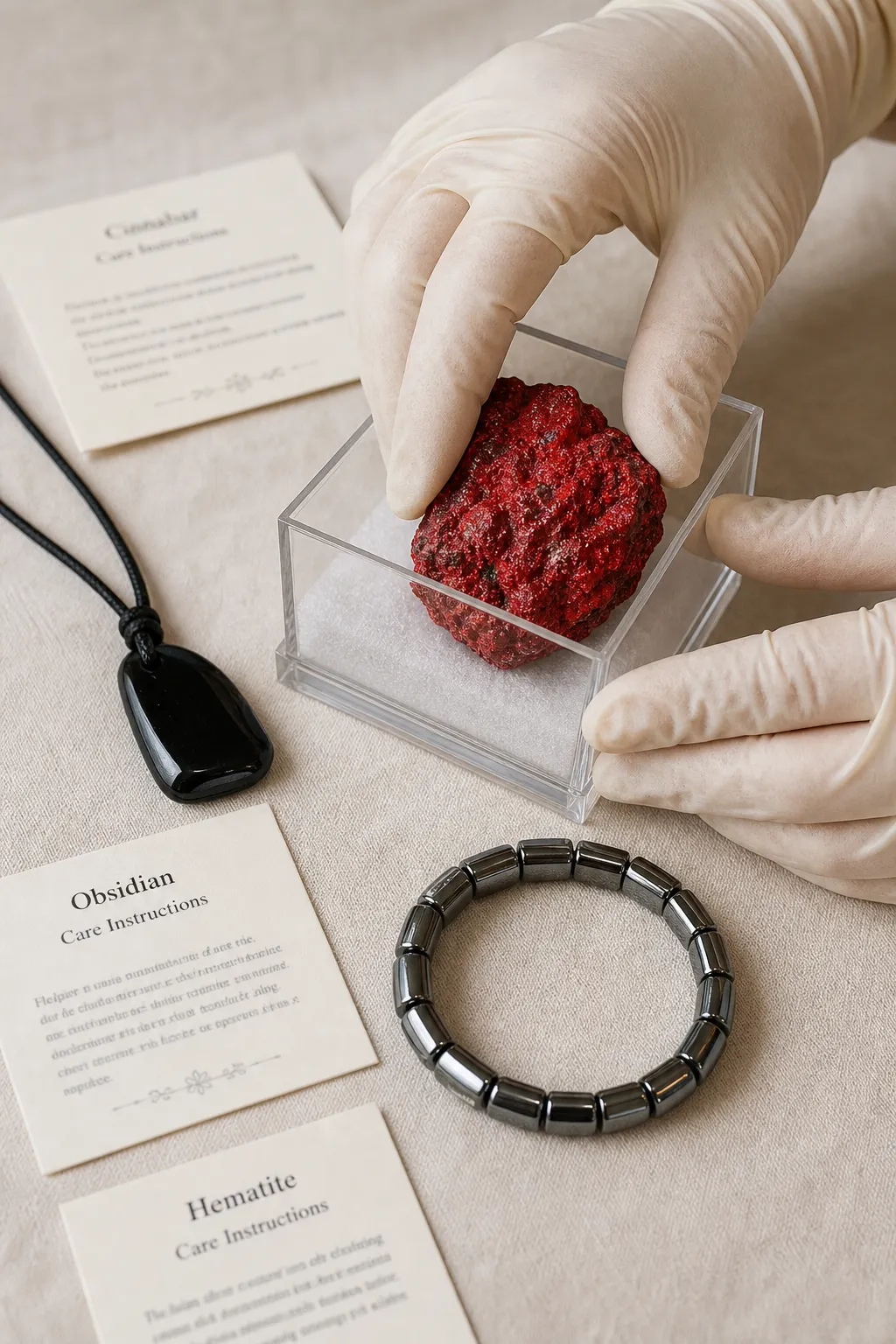
Cinnabar may still fit as a collector’s display specimen. In that case, look for a stable-looking piece, keep it contained or placed where it will not be handled often, and avoid damaged, powdery, flaking, or dusty material.
Read seller wording carefully
Most gift buyers do not have lab tools, and they do not need to become mineral testers. The goal is simply to avoid making a high-confidence purchase from low-confidence clues.
For obsidian, seller photos may show glossy black, brown-black, gray, snowflake-like, or sheen-like appearances. These visible signs may suggest an obsidian-style item, but they cannot prove the material, locality, or variety name. If a listing leans heavily on dramatic variety claims, ask for plain material details.
For hematite, be cautious with claims around finish, magnetism, coatings, and unusual colors. Hematite jewelry is common, but a listing should still explain what is being sold. If the gift depends on a specific look or feature, ask whether any coating, treatment, or composite material is involved.
For cinnabar, read every word. Terms such as “cinnabar gemstone,” “carved cinnabar,” “vermilion,” “red lacquer,” “natural cinnabar specimen,” and “resin-based cinnabar look” may not describe the same thing. A natural cinnabar specimen, a lacquer-style object, and a red resin piece have different handling implications. A red carved item is not automatically natural cinnabar.
Visible cues for cinnabar may include scarlet to brick-red color, a red streak, a heavy feel for size, and luster that ranges from bright to dull. These can suggest cinnabar, but they do not prove it. For certainty, expert identification or specialized testing may be needed; technical studies use tools such as XRF, XRD, or Raman spectroscopy, while a product photo cannot do that work.
A practical decision path
Choose obsidian
Choose obsidian if the recipient likes black stones, glossy pieces, volcanic-glass style, or familiar protective-crystal symbolism. It is a strong default when you want the gift to feel meaningful without introducing cinnabar’s handling concerns.
Choose hematite
Choose hematite if the recipient prefers wearable, neutral, metallic-looking jewelry and you want something practical rather than dramatic. It is a good direction when the gift should blend into everyday accessories.
Choose cinnabar only in a narrow case
Choose cinnabar only if the recipient is an adult collector or careful display owner, understands that cinnabar contains mercury as mercury sulfide, and will not wear, abrade, mouth, break, or heavily handle it.
Skip cinnabar if you are buying for a child, a pet-accessible home, a daily bracelet wearer, a person who likes pocket stones, or someone who may not read handling notes. In those cases, obsidian or hematite is the better result for a protective crystal gift comparison.
Common misunderstanding: “cinnabar” is not always one thing
The word “cinnabar” creates more confusion than obsidian or hematite because it appears in several overlapping contexts.
It can refer to the natural mineral cinnabar, which is mercury sulfide. It can also appear in the history of vermilion pigment, red carved lacquer traditions, and modern marketplace descriptions for red carved or lacquer-like jewelry that may not be natural cinnabar mineral.
That matters because the right gift choice depends on the actual object, not the color name. A red lacquer-style bangle, a resin-based cinnabar-look bead, and a natural cinnabar specimen should not be evaluated as if they are identical.
Useful seller questions include:
- Is this natural cinnabar mineral, lacquer-style material, resin, or another red material?
- Is it intended for display or daily wear?
- Does the item shed dust, flake, or have damaged surfaces?
- Are there any handling or storage instructions?
- Can the seller explain the material without relying only on symbolic claims?
If the answers stay vague, choose obsidian or hematite instead.
Final recommendation
For most gift buyers, choose obsidian for symbolic impact or hematite for wearable practicality. Both are easier gift directions than cinnabar when the recipient expects jewelry, pocket stones, or low-maintenance use.
Choose cinnabar only for an informed adult collector when the piece will be displayed, stored carefully, and handled minimally. Its red color and historical associations can make it special, but those qualities do not remove the handling caution that comes with a mercury-sulfide mineral.
In short: obsidian for a classic protective crystal gift, hematite for everyday jewelry style, and cinnabar for careful adult display—not casual daily wear.
Sources
Sources and further reading
Reference links are limited to sources considered suitable for public citation in this page.