ProtectCrystal handling note
Can Hematite Be Bright Red Like Cinnabar
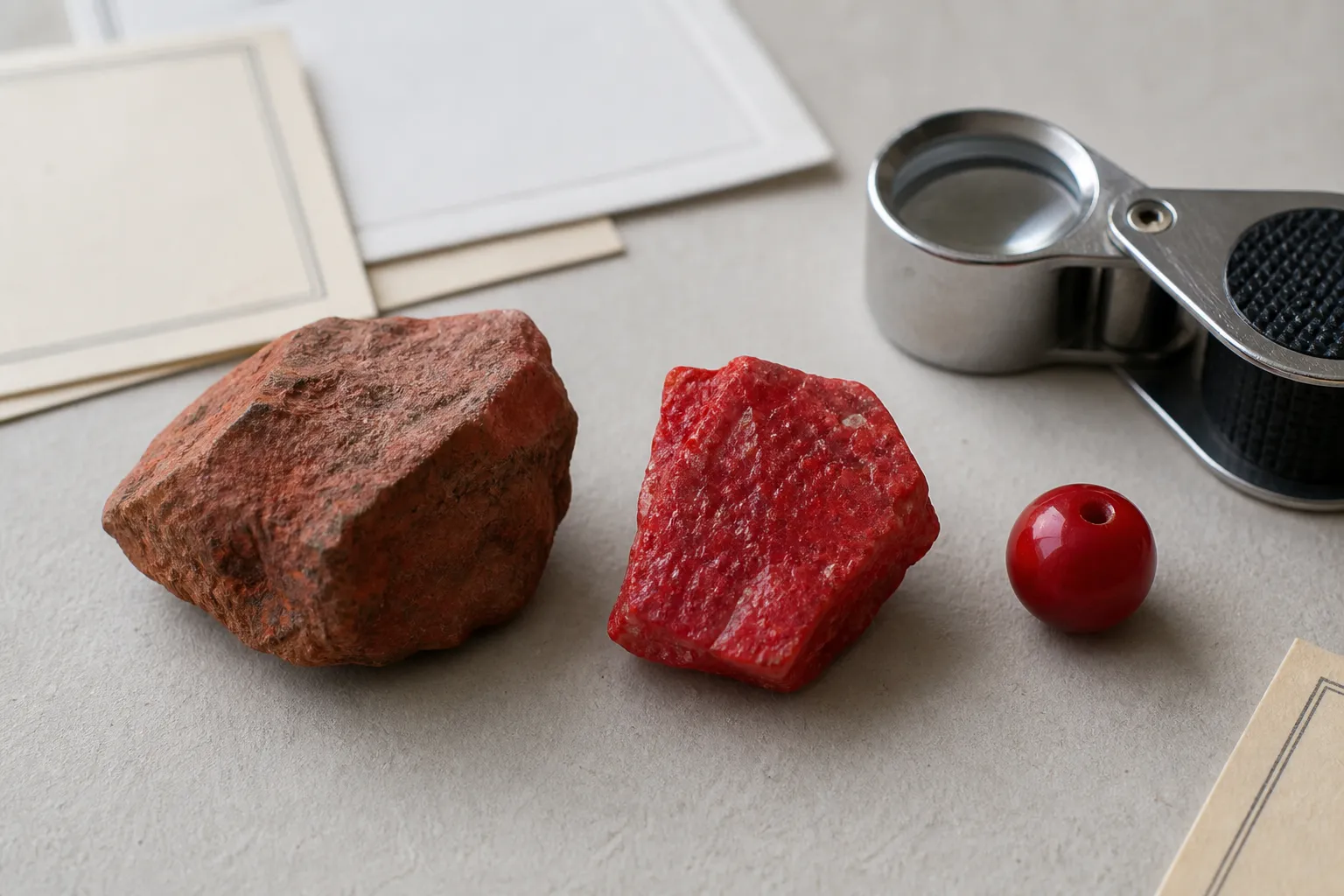
Yes, hematite can be red, and some massive red hematite can resemble cinnabar at first glance. But if you are asking, can hematite be bright red like cinnabar, the practical answer is narrower: a bright cinnabar-red surface is not enough to identify a piece as hematite, cinnabar, or natural material.
Hematite is an iron oxide mineral often associated with steel-gray metallic pieces, earthy red forms, reddish-brown tones, and a red streak. Cinnabar is a mercury sulfide mineral strongly associated with vivid red, scarlet, and vermilion colors. The confusing part for buyers is that a red look can come from the mineral itself, a coating, dye, resin, mixed material, pigment-style wording, or a seller’s color description.
upward
Read the full overview first
Use the broader guide first if you need the full scope before this page.
The short buyer answer
If a bead, palm stone, carving, or rough specimen is sold as “bright red hematite,” treat the label as a clue, not an identification.
Natural hematite may show red-related color in several ways:
- earthy red or reddish-brown surfaces;
- dull or powdery red areas;
- a red to reddish-brown streak;
- massive red hematite that may resemble massive cinnabar;
- mixed or polished material where only part of the object looks hematite-like.
What deserves a closer look is a smooth, highly uniform, intensely bright red surface that looks like lacquer, resin, paint, or a saturated “cinnabar red color” finish. That appearance does not rule hematite out, but it raises questions. It may be a red mineral surface, a manufactured finish, dyed material, a coating over another base, or simply a product color name.
For a crystal buyer, the useful answer is: hematite can be red, but a cinnabar-like red appearance does not prove hematite.
Hematite vs cinnabar appearance: clues that help, but do not settle it
Hematite and cinnabar can overlap visually, especially when both are in massive form. In mineral descriptions, “massive” means a compact mineral mass rather than obvious individual crystals. It does not mean the piece is physically large.
That overlap is why a bright red mineral can be difficult to judge from a shop tray or online photo.
Main color impression
Hematite may show: steel-gray, blackish, reddish-brown, earthy red, or massive red.
Cinnabar may show: bright red, scarlet, brick red, or brownish red.
Buyer meaning: red alone cannot separate them.
Streak
Hematite may show: a red to reddish-brown streak.
Cinnabar may show: red to reddish-brown or scarlet-toned streaks.
Buyer meaning: streak may help, but it can damage the piece and create dust.
Luster
Hematite may show: metallic, submetallic, dull, or earthy luster depending on form.
Cinnabar may show: adamantine to dull or earthy luster depending on form.
Buyer meaning: luster can suggest a direction, not prove identity.
Weight impression
Hematite may show: a weighty feel for its size.
Cinnabar may show: a typically very dense feel.
Buyer meaning: “very heavy” may raise a question, but hand feel is unreliable.
Surface finish
Hematite may show: metallic or earthy surfaces, polished gray-black pieces, and red massive forms.
Cinnabar may show: vivid red mineral surfaces, sometimes dull or earthy.
Buyer meaning: a glossy uniform red surface may also be coating, resin, or lacquer.
Seller wording
Hematite wording may include: “hematite,” “red hematite,” “magnetic hematite,” or “hematite bead.”
Cinnabar wording may include: “cinnabar,” “vermilion,” “Chinese red,” or “cinnabar red.”
Buyer meaning: seller language is not mineral identification.
The strongest clue is the whole pattern: color, streak, luster, broken edges, density, surface texture, and seller description. Even then, visible signs may suggest an answer rather than prove one. For certainty, specialized mineral testing may be needed.
Why “cinnabar red” can mislead shoppers
“Cinnabar red” is often used as a color phrase, not a mineral diagnosis. The same is true for terms such as “vermilion,” “Chinese red,” and sometimes “cinnabar-style.” These words may point to a strong red color tradition, a decorative finish, a pigment association, or a market category.
That matters because a listing may say:
- “cinnabar red hematite”;
- “vermilion red mineral”;
- “Chinese red stone”;
- “bright red hematite beads”;
- “cinnabar color carved bead”;
- “red hematite protective crystal.”
Those phrases do not all mean the same thing. Some describe color. Some describe style. Some may be mineral claims. Some are simply sales language. A seller may use “cinnabar red” to mean “bright red like cinnabar” without saying the object is actual cinnabar. Another seller may use “hematite” loosely for a heavy-looking bead or metallic-looking material.
A useful rule: if the word is being used like a paint color, treat it as a color term until the seller gives mineral-specific details.
Helpful details may include the mineral name, locality, natural-versus-treated disclosure, whether it is coated or dyed, and whether any testing has been performed. A short listing title should not be treated as proof.
When bright red hematite should raise extra questions
A bright red object labeled as hematite is not automatically wrong. These situations simply call for more careful reading.
The red looks like a surface layer
If the red is perfectly even, glossy, plastic-like, or sitting over a different-looking base, it may be a coating, resin, lacquer, paint, or dye. Check drill holes, chipped edges, scratches, bead seams, and worn spots. If the inside color differs strongly from the outside, the visible red may not be the body color of the material.
That still does not tell you what the base material is. It only tells you the red appearance may be a surface effect.
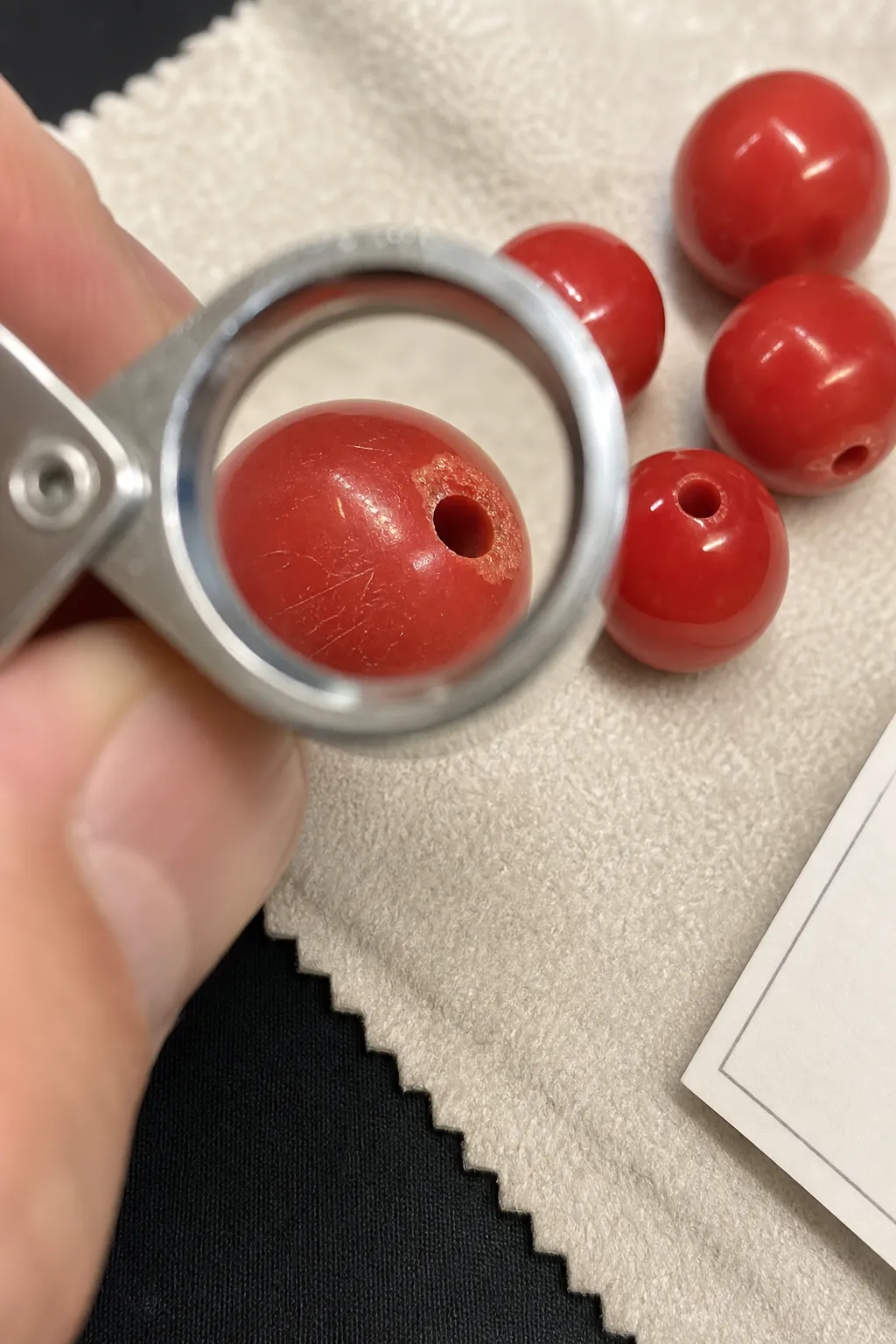
The piece is a bead or carving, not a raw specimen
Beads and decorative objects have more manufacturing variables than many rough mineral specimens. They may be dyed, stabilized, coated, molded, carved from composite material, or sold under a color name.
A “bright red hematite” bead could be hematite-related, but it could also be another material using hematite or cinnabar language for appearance. Ask whether the piece is natural hematite, treated hematite, coated stone, resin, synthetic material, or a cinnabar-style decorative object.
The piece is unusually heavy and vividly red
Cinnabar is generally denser than hematite, so a compact vivid red specimen that feels surprisingly heavy for its size can raise a cinnabar question. But hand feel is a weak tool. Shape, size, matrix minerals, hidden cavities, and expectation can all distort weight impressions.
Density or specific gravity can be useful in mineral identification, but “it feels heavy” should not be treated as a final answer.
The seller uses several identity words at once
A listing that combines “hematite,” “cinnabar,” “vermilion,” “Chinese red,” “benefits,” and “protective” language may be mixing mineral identity, color description, and crystal-use language.
For this question, keep the meanings separate:
- Hematite is a mineral identity.
- Cinnabar is a mineral identity and mercury sulfide.
- Cinnabar red may be only a color phrase.
- Protective crystal language is a personal or cultural use context, not a material test.
- Bright red is an appearance, not an authentication result.
Be careful with streak tests on unknown bright red minerals
A streak test can help in mineral identification because it shows the color of a mineral’s powder on an unglazed porcelain plate. Hematite is well known for its red streak, and cinnabar can also produce red-related streak colors. That overlap is one reason streak alone does not settle every hematite-versus-cinnabar question.
There is also a practical caution: streak testing scratches the specimen and creates powder. If an unknown bright red mineral might be cinnabar, scraping, grinding, sanding, drilling, cutting, or heating it is not a good casual test. Cinnabar is mercury sulfide, so a suspected cinnabar piece should be handled more conservatively than an ordinary decorative stone.
If you are unsure whether a vivid red specimen could be cinnabar:
- do not grind, cut, drill, heat, or polish it at home;
- do not scrape powder from it just to check color;
- keep it away from food, mouths, and children’s handling;
- wash your hands after handling;
- store it separately from jewelry or stones that get frequent skin contact;
- ask for proper identification before altering or wearing it.
This does not mean every red mineral is cinnabar. It is a practical boundary for an unknown bright red mineral where cinnabar is one reasonable possibility.
What a buyer can reasonably check before buying
You cannot prove hematite, cinnabar, coating, or dye from a product photo alone. You can, however, reduce confusion by asking better questions.
Use these checks when a piece is described as bright red hematite or cinnabar-like hematite:
- Ask what the seller means by “red.”
Is it naturally red hematite, a red coating, dyed material, or a color name? - Ask whether the piece is treated.
“Natural,” “stabilized,” “coated,” “dyed,” “resin,” and “composite” are different material claims. - Look for broken or worn areas.
A different interior color may suggest that the red surface is not the whole material. - Compare surface character.
Earthy red, metallic gray, and dense mineral texture look different from a glossy decorative coating. - Be cautious with very vivid red rough material.
Massive red hematite may resemble massive cinnabar, and associated minerals can complicate identification. - Do not let spiritual or decorative wording replace material details.
Crystal-use language may explain why people buy the piece, but it does not identify the mineral. - Use testing only when appropriate.
If the item is valuable, fragile, powdery, or possibly cinnabar, avoid destructive home checks and seek proper mineral identification.
The goal is not to become a lab at the checkout counter. It is to avoid turning a color impression into certainty.
Bottom line
Hematite can be red, and massive red hematite can sometimes look close enough to cinnabar to confuse buyers. But a bright cinnabar-red surface is not enough to identify the piece as hematite, cinnabar, or natural material.
If you see “bright red hematite,” “cinnabar red hematite,” “vermilion red mineral,” or “Chinese red mineral” in a listing, read those words carefully. They may describe color, style, treatment, or marketing language rather than mineral identity.
For a rough practical answer: red or reddish-brown hematite is plausible; cinnabar-like brightness deserves caution; coatings and dyes are possible; and an unknown bright red mineral should not be scraped, heated, drilled, or handled casually if cinnabar is a reasonable possibility. For certainty, visual checks are not enough, and specialized testing may be needed.
Sources
Sources and further reading
Reference links are limited to sources considered suitable for public citation in this page.