
ProtectCrystal handling note
Material comparison
Can Hematite Look Like Black Obsidian
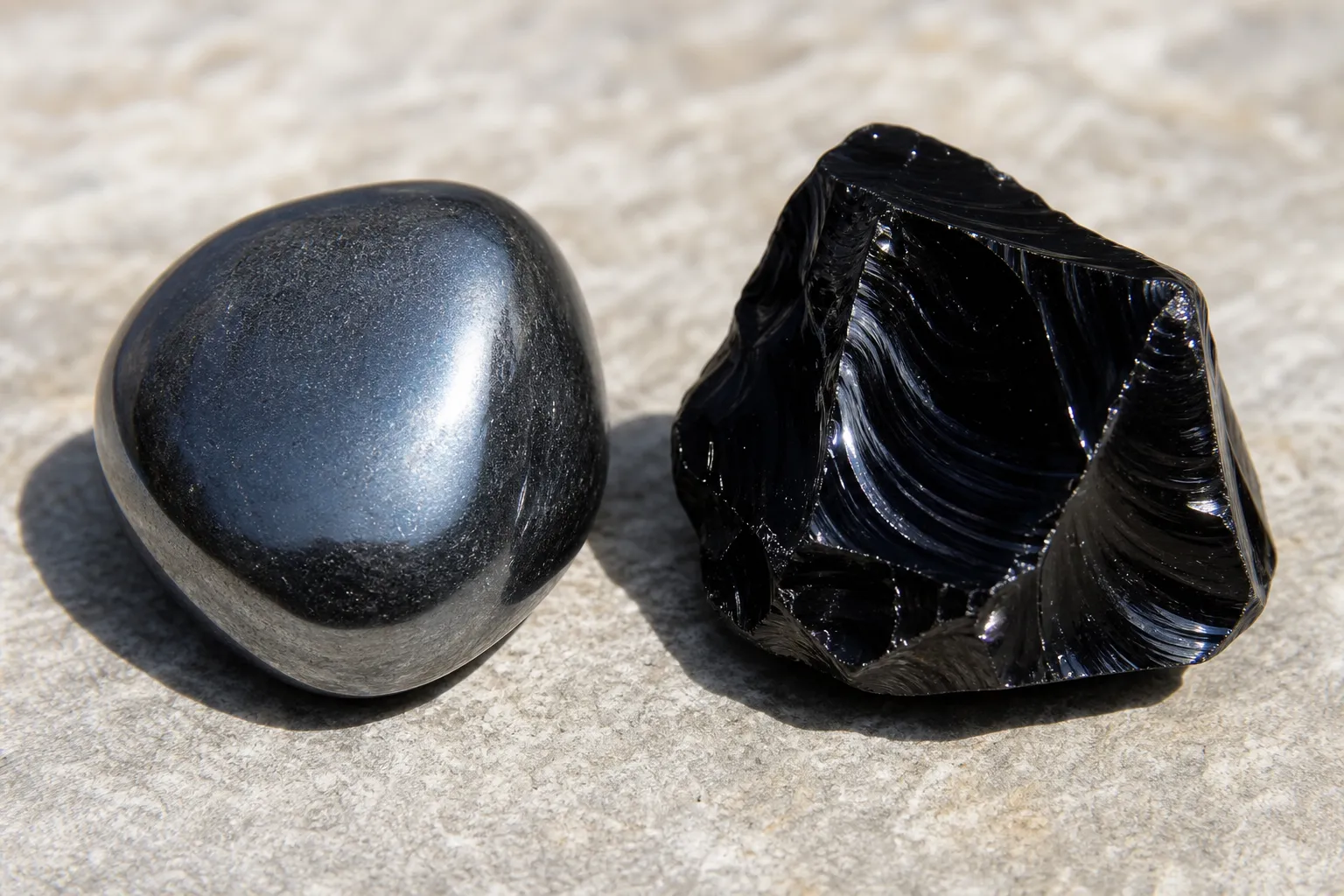
Yes. Hematite can look like black obsidian at a glance, especially when it is polished, tumbled, cut into beads, photographed in low light, or placed beside other shiny black stones in a crystal set.
The catch is that resemblance is not identification. Hematite and black obsidian can both present as smooth, dark, reflective stones, but they are different materials. Hematite is an iron-oxide mineral often associated with metallic or submetallic luster. Obsidian is volcanic glass and is commonly recognized by a glassy look. Color alone is a weak clue, so the useful question is: what else do you see or feel?
upward
Read the full overview first
Use the broader guide first if you need the full scope before this page.
Why polished hematite gets mistaken for obsidian
The confusion usually starts with the finish. Rough material may show more texture, but polishing removes many of the easy visual cues. A polished hematite bead and a polished black obsidian bead can both look sleek, dark, and reflective in a small product photo.
Hematite is not always the obvious red-brown material people expect from its streak or pigment associations. In jewelry and tumbled stones, it often reads as dark silvery gray, gunmetal, metallic charcoal, or blackish gray. Under dim light, that gray can look almost black. In a small bead, there is even less surface area for the eye to catch the undertone.
Black obsidian is usually perceived as deep black glass. A highly polished piece may show a sharp reflection, while matte black obsidian can look softer, quieter, or less glass-like than expected. That means the overlap is not only “shiny black versus shiny black.” A very polished hematite bead and a glossy obsidian bead can both look dark and mirror-like, while matte obsidian may look more charcoal than glass.
This is why a buyer may open a bracelet pack or tumbled set and feel that hematite and obsidian look nearly the same. In better light, one may show a metallic gray flash and the other a deeper glassy black. In flat lighting or over-contrasted seller images, that difference can disappear.
Quick cues to compare hematite versus black obsidian
Use more than one clue. No single visual detail is enough for certainty, especially on finished jewelry.
| Cue | Hematite may show | Black obsidian may show | What it tells you |
|---|---|---|---|
| Color | Dark gray, gunmetal, blackish, silvery black | Deep black, sometimes brownish or slightly translucent at thin edges | Helpful, but not enough by itself |
| Luster | Metallic or submetallic sheen | Glassy luster | A strong clue, not proof |
| Weight impression | Often noticeably heavy for its size | Usually less heavy than similarly sized hematite | Useful when comparing similar shapes and sizes |
| Streak | Red-brown streak is a classic hematite clue | Does not give hematite’s red-brown streak | More diagnostic, but may damage a finished piece |
| Finish | Can look mirror-dark when polished | Can look glossy and glass-like when polished | Finish can blur the difference |
| Existing chip or edge | May look more mineral-like, depending on the piece | May show glass-like fracture | Observe only if already present; do not break the stone |
The most practical non-destructive clue is often weight. Hematite has a high density compared with many common stones, so a bead or tumble may feel surprisingly heavy for its size. If two similarly sized pieces are in your hand and one feels much denser, hematite becomes more plausible. That still does not prove identity, because size, drilling, shape, mounting, and unknown manufactured materials can affect the feel.
Luster is the next useful clue. Hematite often flashes metallic gray or steel-like when you rotate it near a light. Obsidian more often looks like dark glass: smooth, glossy, and reflective without the same metal-like undertone. But lighting and cameras can fool you. A phone photo can turn metallic gray into flat black, and highly polished obsidian can reflect a room so strongly that it almost looks metallic.
The classic hematite clue is a red-brown streak. Hematite’s surface color can vary, but its streak is widely used in mineral identification. However, a streak test is not a casual bracelet check. It involves rubbing the material on a streak plate or unglazed porcelain, and it can mark, scratch, or dull a polished stone. For beads, pendants, palm stones, or pieces you want to keep pristine, use streak testing only when damage is acceptable or the sample is rough.
When the resemblance is strongest
Hematite is most likely to pass as a black obsidian lookalike in these situations:
Online listings
Small photos, strong contrast, and edited shine can hide the difference between metallic gray and glassy black. A listing that only says “black crystal” or leans on symbolic wording may not give enough material information.
Bracelets and bead strands
Small polished spheres hide texture, fracture, and undertone. In this format, the weight of the strand and the seller’s material description may matter more than the look of one bead.
Tumbled crystal sets
Tumbled hematite and black obsidian can look similar when mixed with other dark stones. A darker hematite piece or a softer matte obsidian piece may reduce the expected contrast.
Dim indoor light
Hematite’s metallic flash is easier to see when the stone is turned near a light source. Without that angle change, it may simply read as black.
Loose marketplace wording
Phrases like “deep black luster,” “metallic accent,” “matte obsidian,” “magnetic hematite,” or “black stone” can describe style as much as material. They may be clues to how the item is being sold, not confirmation of what it is.
If the wording is vague and the material matters to you, ask the seller for a clearer material label and whether the item is natural, manufactured, treated, or simply sold under a jewelry-trade name.
What usually separates them
Hematite often looks more metallic and feels heavier; black obsidian often looks more glassy and deep black.
That rule is useful, but it should not be stretched into certainty.
A polished hematite piece may show a steel-like surface, a silvery undertone, or fine metallic sparkle. It can look black from straight on, then flash gray when tilted. In bead form, it may feel dense compared with other stones of similar size.
Black obsidian usually carries a glassy identity because it is volcanic glass. A polished piece may look like a dark mirror. If an edge is already chipped or exposed, glass-like fracture can be a clue. Do not break, chip, or flake a stone to check this; obsidian can form sharp glass-like edges, and damaging a finished piece is unnecessary for normal buyer decisions.
Matte black obsidian is one common exception. Because it is less glossy, it may not show the “deep black glass” look people expect. A matte finish can make obsidian appear softer or more charcoal-like, while polished hematite may look more reflective. Surface finish can reverse a beginner’s expectations.
Size also matters. On a large palm stone, undertone, reflection, and weight are easier to judge. On a 6 mm bead, everything is compressed: color looks darker, reflections are tiny, and weight differences are harder to isolate unless you compare a full strand.
What not to rely on
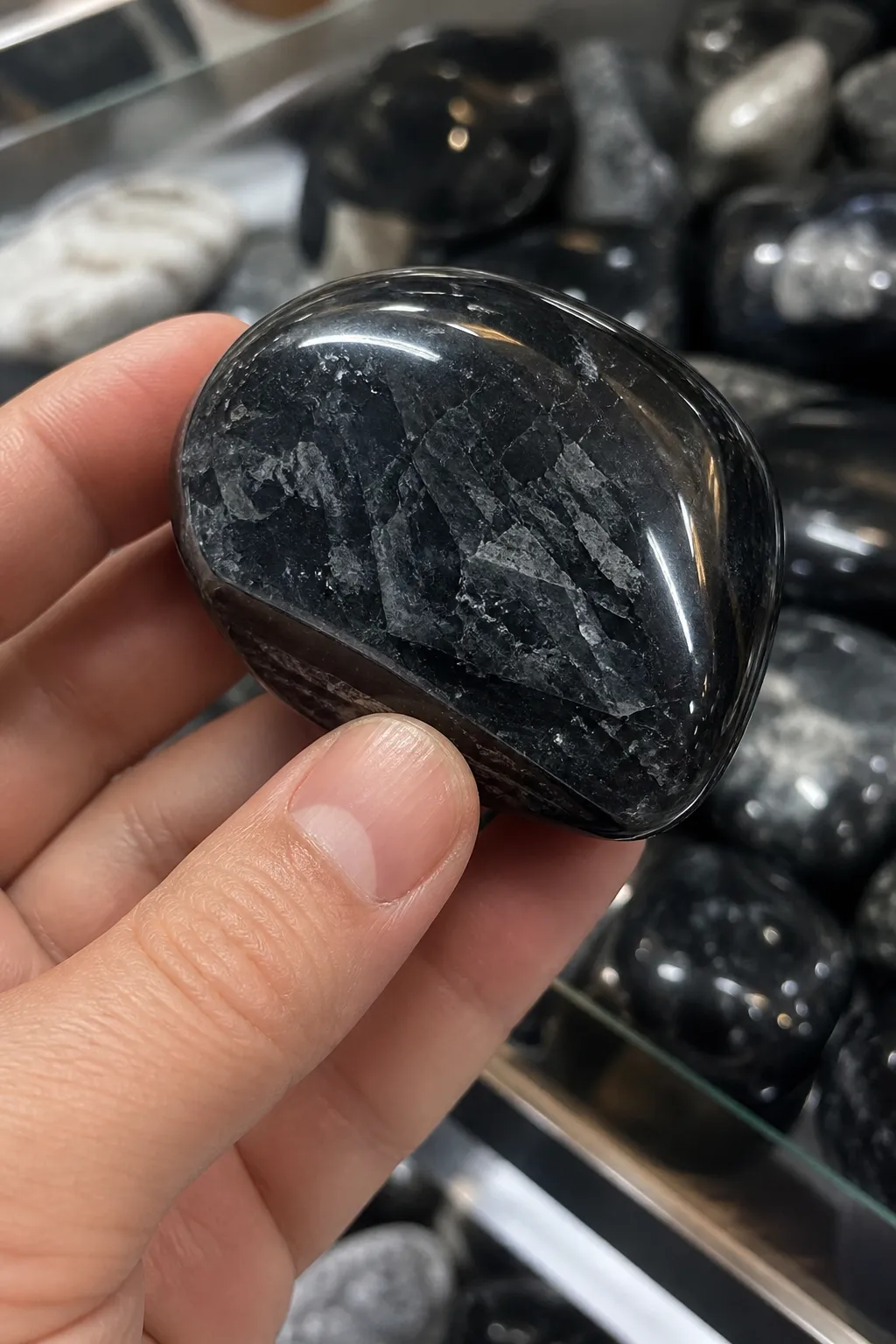
Do not rely on black color alone. Many dark materials can look similar in photos, including other minerals, treated stones, glass, and mixed jewelry materials. “Shiny black” is a visual description, not a material name.
Do not rely only on a crystal-set card. Cards may organize stones by name, theme, or personal-use meaning, but they are not a mineral test.
Do not use protective or metaphysical descriptions as identification evidence. Hematite and obsidian are both discussed in cultural and personal crystal-use contexts, but those descriptions do not verify material identity.
Do not assume a seller label is enough when accuracy matters. For a casual tumble, careful observation may be enough for your own sorting. For resale, collecting, higher-value purchases, or material certainty, ask for clearer documentation or seek qualified mineral or gemological testing.
A practical check before you ask for testing
If you are holding the stone now, start with a non-destructive check:
- 1. Look under bright, neutral light. Rotate the stone slowly. Does it flash metallic gray, or does it look more like dark glass?
- 2. Compare weight with a similar-sized piece. If it feels unusually heavy for its size, hematite becomes more likely.
- 3. Check the undertone. Hematite often leans dark silvery gray or gunmetal. Black obsidian often reads deeper black and glassier.
- 4. Inspect only existing edges or chips. A glass-like chipped edge may suggest obsidian, but do not create a new break.
- 5. Read the seller wording carefully. “Black crystal” is weaker than a clear material label with supporting details.
- 6. Avoid streak testing on finished jewelry unless marking it is acceptable. A red-brown streak can point toward hematite, but the test can affect the finish.
If the clues point in different directions, that is normal. Polished stones are made to look attractive, not to display every identification feature. The honest answer may be: it resembles one, but appearance alone cannot confirm it.
So, is it hematite or black obsidian?
A dark, shiny stone may be hematite mistaken for obsidian if it has a metallic silvery-gray sheen, feels heavy for its size, and would give a red-brown streak in an appropriate mineral test. It may be black obsidian if it reads as deep black volcanic glass, has a glassy surface, and shows glass-like fracture only where an edge is already exposed.
The final boundary is simple: visible signs can suggest, not prove. For an inexpensive tumbled stone, careful observation may be enough for personal sorting. For a purchase where identity matters, use clearer seller information or qualified testing rather than relying on a photo, a label, or black color alone.
Sources
Sources and further reading
Reference links are limited to sources considered suitable for public citation in this page.