
ProtectCrystal handling note
Hematite wear check
Are Chipped Hematite Beads Still Safe to Wear
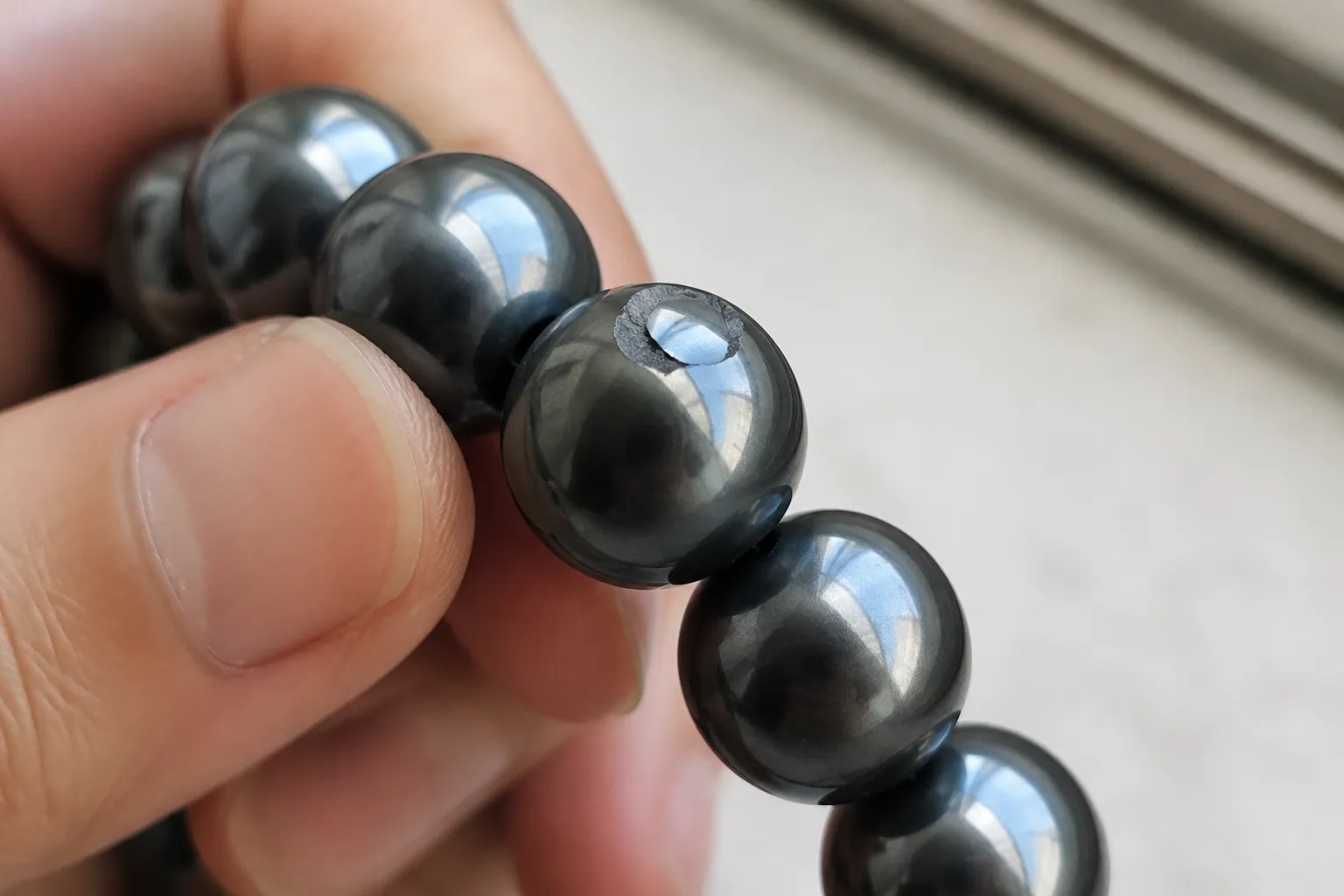
A chipped hematite bead may still be wearable when the damage is small, smooth, stable, and not affecting the stringing. For chipped hematite beads safety, the practical answer is conditional: a shallow nick is different from a sharp break, a spreading crack, a flaking finish, or damage around the drill hole.
If the bead catches on skin or fabric, sheds tiny fragments, exposes a rough coating edge, or changes how the bracelet sits, stop wearing it until the bead is replaced or the bracelet is repaired.
One wording point helps avoid confusion. A “hematite chip bracelet” can be an intentional style made from irregular nugget-like beads. This page is about accidental damage: a new chip, crack, lifted surface, broken edge, or damaged bead hole on hematite jewelry.
upward
Read the full overview first
Use the broader guide first if you need the full scope before this page.
The quick wear-or-stop check
Use your eyes first, then a careful fingertip check. Do not press a sharp edge into your skin. If you are unsure, remove the bracelet from daily wear and inspect it in better light.
Hematite is often recognized by its metallic gray to black look, though it can also appear in earthy forms. The University of Minnesota’s Common Minerals resource describes hematite as commonly having a hardness around 5–6, with softer earthy varieties and a reddish-brown streak. That gives a useful boundary: a hard-feeling mineral can still chip, crack, or lose a surface finish when it is knocked, drilled, strung tightly, or worn under repeated stress.
Hardness is not the same as impact resistance. For a bead, the question is simpler: is this damaged bead still smooth, stable, and secure on the bracelet?
When the chip is probably only cosmetic
A chipped hematite bead is more likely to be a cosmetic issue when all of these are true:
- The chipped spot feels smooth.
- No crack runs out from the chip.
- The bead is not shedding dust, flakes, or small fragments.
- The damage does not reach the drilled hole.
- The bracelet tension feels normal.
- The bead does not scrape neighboring beads, fabric, or skin.
- The finish is not peeling or lifting around the damaged area.
This kind of mark can look obvious on a polished metallic bead, but it does not automatically mean the whole bracelet needs to be discarded. If the nick is shallow and stable, you may choose to keep wearing the bracelet occasionally while watching the area.
Check it again after a day or two of wear. If the nick grows, turns rough, or develops a line toward the hole, treat it as a repair point rather than normal wear.
Location matters too. A chipped bead near a clasp, knot, charm, or tight curve may rub more than one sitting loosely in the middle of the bracelet. On stretch bracelets, repeated pulling can make drill-hole damage more important than the visible chip.
For hematite, the best home decision comes from reading the surface, crack pattern, and stringing together.
When to stop wearing damaged hematite jewelry
Stop wearing the bracelet if the damage is sharp, unstable, or connected to the structure of the piece. A bead does not have to split in half to become a poor choice for regular wear.
The clearest stop-wear signs are:
- A sharp edge. If the bead can scratch skin, snag a sleeve, or catch hair, it should not stay in active wear.
- A crack running from the chip. A cracked hematite bead can look mostly intact from one side and still be weakened.
- Damage at the drill hole. The cord, elastic, or wire pulls through this point, so chips here matter more.
- Flaking or dust. A bead that leaves loose fragments during handling should be removed.
- A lifted or peeling finish. Some hematite-style beads are sold as colored, plated, dyed, or coated. A chip showing a different-looking layer does not prove composition, but it does show the finish is no longer intact.
- Changed bracelet tension. If one bead shifts, the elastic looks stretched, or the bracelet no longer sits evenly, the issue may be stringing damage as much as bead damage.
If the chip happened after a drop or hard knock, inspect nearby beads as well. Faceted beads, cornered shapes, and tight stringing can hide small impact points. One visible hematite bracelet chip may be the easiest sign to spot, not the only stressed area.
For children, pets, or anyone likely to put jewelry in the mouth, be more cautious with broken beads and loose parts. That is a small-parts concern, not a hematite-specific claim.
If wearing the bracelet causes a cut, irritation, or discomfort, remove it and seek appropriate professional advice. Do not try to identify the cause from appearance alone.
Check the bead hole, cord, and clasp before blaming only the chip
Many damaged bracelet problems are not only about the bead surface. The stringing can fail even when the hematite still looks mostly polished.
Check the bracelet in good light:
- Separate the chipped bead from its neighbors. Gently roll it so you can see both sides of the hole.
- Look around the drill hole. A chip that reaches the hole, widens it, or creates a crescent-shaped break is more serious than a surface nick.
- Inspect the stringing material. Elastic may look whitened, stretched, or frayed. Thread may fuzz. Wire may kink. Knots may loosen.
- Check the clasp and jump rings. A bracelet can feel unreliable because a connector is bent or a clasp is opening, not because the bead itself is failing.
- Feel for bead-on-bead scraping. A rough edge can grind against neighboring beads and make the damage worse.
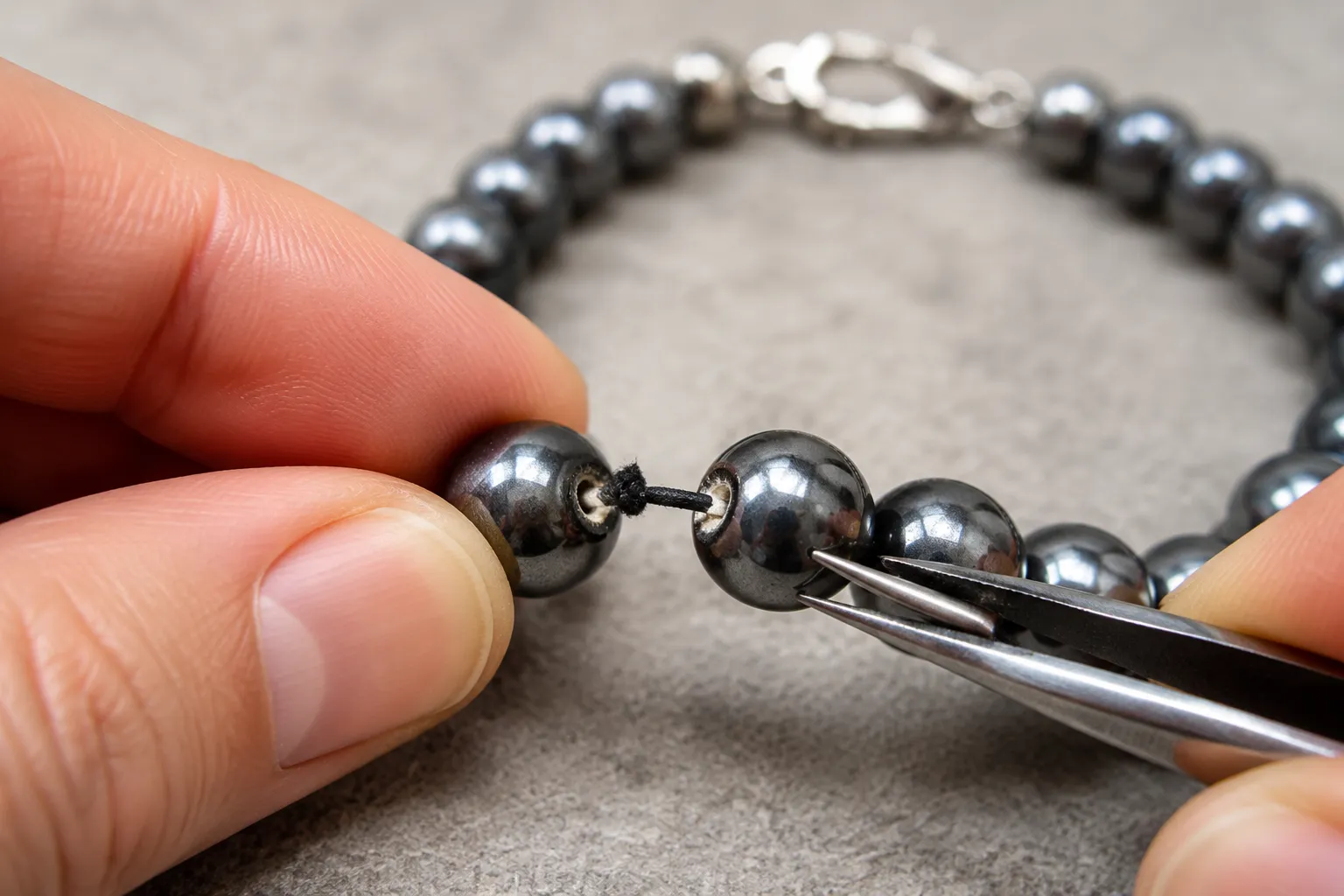
If the bracelet matters to you, replacing one bead is usually better than continuing to wear a weak point. Restringing may also be sensible when the cord is old, several beads feel tight, or the damaged bead sits near a knot.
Do not soak or aggressively scrub the damaged area to “test” it. A soft cloth is enough for a first look. Rough cleaning around chips, lifted finish, or cracks can turn a small problem into a larger one.
The bead is only one part of the wear decision. The stringing carries the bracelet.
Hematite chip bracelet vs chipped bead
Search results and product listings can make this confusing. “Hematite chip bracelet,” “nugget chips,” or “chip beads” may describe a deliberate irregular style. Those pieces are uneven by design. A rough outline is not automatically damage.
An accidental chipped bead is different. It usually has a newer-looking break, a sharp corner, a missing patch from a polished surface, a crack from impact, or a damaged hole. On coated or colored beads, the damaged area may show a different tone underneath or a lifted edge around the finish.
The distinction is practical:
Intentional hematite chip bracelet
Should have many irregular pieces with a consistent style and no fresh sharp breaks.
Chipped hematite bead
One bead, or a few beads, has new damage that changes the surface, edge, finish, or structure.
Cracked hematite bead
May need replacement even if it still looks wearable from one angle.
If you bought the bracelet secondhand or online, you may not know whether the irregularity is design or damage. In that case, judge the bead by touch, stability, hole condition, and whether any fragments are loose. Seller wording cannot settle the physical wear question for the bead in your hand.
A style term is not the same as a safety check.
Coating damage and finish changes
Not all hematite-style beads have the same surface. Marketplace wording commonly includes metallic, plated, dyed, coated, faceted, multicolor, smooth, and drilled beads. Those descriptions do not verify composition, but they explain why a chip may look as if a different layer has appeared.
If a hematite bead coating is damaged, focus on what you can observe:
- Is the edge rough?
- Is the finish lifting like a thin skin?
- Does color rub off on a cloth?
- Are flakes coming loose?
- Does the damaged spot sit against skin?
If the answer is yes, stop wearing that bead against skin and replace it if you want to keep the bracelet in use. The available public material for this page does not support broad claims about coating chemistry, skin contact, or authenticity from appearance alone. A visual check can show that a surface is damaged; it cannot prove what the coating is.
This is also why a shiny metallic finish should not be treated as proof that a bead is untreated, impact-proof, or suitable for every wearing condition. Shine is an appearance cue, not a full material test.
With hematite beads, finish damage is a reason to be conservative.
Cleaning chipped hematite jewelry
Cleaning chipped hematite jewelry should be gentle and brief. The goal is to remove surface dirt without pushing water, grit, or pressure into a damaged area.
Use a soft dry cloth first. If needed, use a barely damp cloth, then dry the bracelet carefully. Do not scrub inside a crack, pick at a lifted coating edge, or use stiff brushes around a chip. Avoid twisting, impact, and hard pulls while cleaning.
Do not use cleaning as a strength test. If a bead sheds fragments, flakes, or dust during gentle wiping, that is already a stop-wear sign. Replace the bead or retire the bracelet from wear.
Store the bracelet where it will not be crushed against harder objects. A small pouch or separate compartment is enough for ordinary storage. The point is to reduce knocks and friction, not to create a complicated care routine.
A chipped bead needs less handling, not more.
What a home inspection cannot tell you
A home check can help you decide whether a chipped hematite bead is smooth, stable, and wearable for ordinary jewelry use. It cannot verify everything.
From appearance alone, you cannot reliably confirm:
- Exact mineral identity.
- Whether a bead is natural, treated, coated, plated, or imitation.
- Coating composition.
- Complete skin-contact suitability.
- Future breakage behavior.
- Any spiritual or personal outcome from wearing it.
Some crystal communities read broken hematite as meaningful. That may be part of a personal or cultural practice, but it should not replace the physical inspection. A broken or sharp bead is still a damaged object. Check the edge, crack, finish, hole, and stringing before deciding whether to keep wearing, repair, replace, or retire the piece.
The public evidence available for chipped hematite bead safety is limited. The strongest independent source used here supports general hematite properties, not a jewelry-specific rule for every damaged bead. So the answer stays practical and conditional: keep wearing only if the chip is smooth, stable, not shedding, away from the drill hole, and not stressing the bracelet. Otherwise, repair it, restring it, replace the bead, or stop wearing that piece.
Sources
Sources and further reading
Reference links are limited to sources considered suitable for public citation in this page.