
ProtectCrystal handling note
Bedtime jewelry check
Is It Safe to Sleep Wearing Hematite Jewelry
Polished hematite has a cool metallic surface, so a bracelet or pendant can feel easy to leave on after a long day. For bedtime, the practical answer is more cautious: sleeping with hematite jewelry is usually a comfort and jewelry-construction decision, not a crystal-effects decision.
It is usually better to remove hematite jewelry before sleep if the piece is tight, sharp-edged, fragile, magnetic, irritating your skin, or worn around the neck. A smooth, loose bracelet may feel fine for a short nap, but a full night adds pressure, twisting, bedding friction, and clasp movement. If you would notice it, adjust it, or worry about it while turning over, take it off.
upward
Read the full overview first
Use the broader guide first if you need the full scope before this page.
The Bedtime Answer Depends More on the Jewelry Than the Stone
The main question is not whether hematite has a protective meaning. Many crystal buyers associate hematite with grounding or protection, but that belongs in personal or cultural context. It does not show that a piece improves sleep, prevents harm, or changes physical safety while you are asleep.
The better question is simpler: can this object stay on your body for several hours while you are not paying attention to it? A bracelet, necklace, anklet, or ring can press into skin, catch on fabric, bend at a weak point, or break as you move. Jewelry that feels acceptable at 9 p.m. can feel different after hours under blankets or in one position.
A hematite bracelet is usually the most reasonable bedtime candidate because it sits away from the throat and face. Even then, check the fit. If the beads leave deep marks, pinch when your wrist bends, or make you aware of swelling or pressure, remove it. A bracelet should slide off without effort.
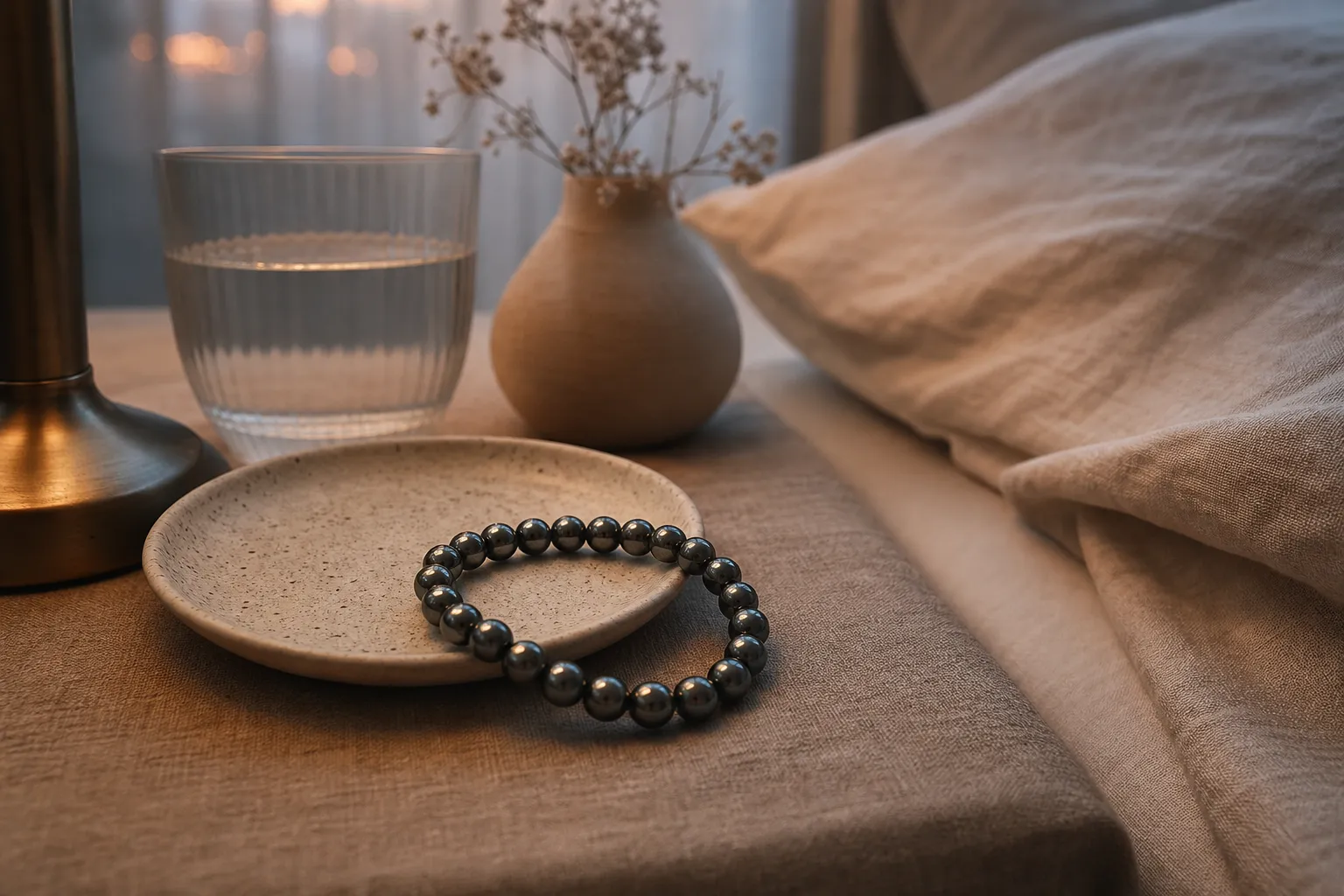
A hematite necklace at night deserves more caution. Any chain, cord, choker, or pendant can twist, pull, snag, or press while you sleep. If you want the stone nearby for a personal routine, placing it on a bedside dish is usually cleaner than wearing hardware around your neck.
For bedtime, hematite is jewelry first.
The practical decision
- Remove pieces that are tight, sharp, fragile, irritating, magnetic with health-specific concerns, or worn around the neck.
- Treat a smooth, loose bracelet as lower concern than a necklace, choker, heavy pendant, or damaged strand.
- Use a bedside dish if the personal routine matters but the hardware is not a good sleep companion.
- If the piece distracts you, changes your sleep position, or makes you check it repeatedly, take it off.
Quick Checks Before Sleeping With a Hematite Bracelet
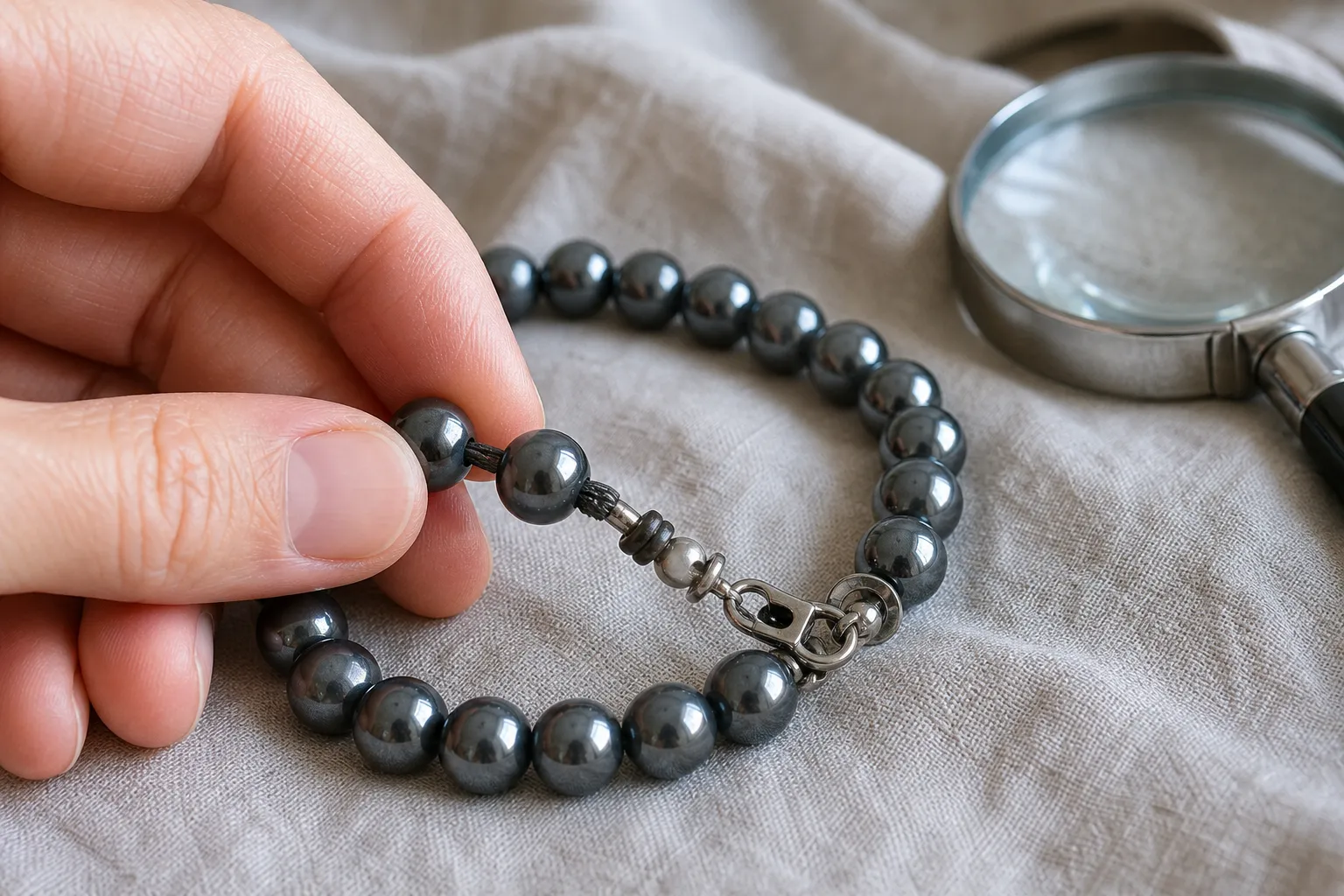
Before you sleep with a hematite bracelet, inspect it under normal room light. This does not prove material identity or overall safety. It only helps you spot obvious problems that matter in bed.
Stringing and loose beads
Stretch bracelets weaken over time, and bead strands can loosen. Loose hematite beads are a bedtime concern because a strand that breaks in bed may scatter small parts into sheets, pillows, or the floor. If children or pets may access the area, remove the bracelet and store it out of reach.
Clasp condition
If the bracelet is not elastic, check the clasp. A bent, sticky, or half-closing clasp is not a good sleep candidate. Bedding creates extra movement, and you may not notice a failure until morning.
Edges and findings
Run a fingertip around the beads, spacers, and metal findings. Sharp edges may come from chipped beads, rough separators, cracked coatings, or damaged metal parts. Do not keep wearing a piece that scratches fabric or skin.
Finish wear
Some pieces sold as hematite or hematite-like jewelry may include coatings, plating, polish, or dyed components. Rubbing, flaking, dull patches, or residue on skin can suggest wear, but it does not prove what the material is. For certainty about composition or coating, specialized testing may be needed. For bedtime, visible wear is enough reason to pause use.
If the bracelet fails any of these checks, remove it before sleep.
When Removing Hematite Jewelry Is the Better Choice
Remove hematite jewelry before bed if it causes skin discomfort, catches on bedding, feels heavy, or makes you change your sleeping position. Sleep is a poor time to monitor a piece of jewelry. A small irritation while awake can become a longer contact point overnight.
Skin discomfort
Skin discomfort is a stop signal, not something to push through. Redness, itching, pressure marks, tenderness, or rash-like irritation can come from friction, trapped moisture, metal findings, coatings, soaps, or personal sensitivity. This page cannot identify the cause. The practical step is to remove the jewelry, clean and dry the skin, and avoid wearing the same piece to bed again if discomfort returns. If irritation is persistent or concerning, ask a qualified professional.
Snagging and breakage
Snagging is another clear reason to avoid overnight wear. Clasps, chain links, bead holes, elastic knots, spacer charms, and wire loops can catch on bedding. If the piece pulls on a sweater, towel, or blanket during the day, it is not a good sleep piece.
Breakage matters even if the beads look solid. A snapped cord, stretched elastic, open jump ring, cracked bead, or loose pendant setting is inconvenient during the day; in bed, it can leave beads under your body or near the edge of the mattress.
Magnetic hematite jewelry
Magnetic hematite jewelry needs a tighter boundary. “Magnetic hematite” is often sold as a distinct style in crystal and wellness spaces, but this page does not have enough source support to make technical claims about magnet strength, devices, or sleep effects. If you use an implanted medical device, have been told to avoid magnets, are pregnant and unsure, or have a health-specific concern, do not sleep in magnetic jewelry unless a qualified professional has said it is appropriate for your situation.
When the concern is physical, remove the jewelry first.
Why Crystal Meaning Does Not Settle the Safety Question
Hematite is often discussed in protective crystal language, and some buyers keep it close because it feels grounding, steady, or symbolically protective to them. That meaning can be part of a personal routine. It should not be used as evidence that sleeping with hematite jewelry is physically safer or suitable for every body and every design.
Seller wording can blur this line. A listing may describe a bracelet as calming, grounding, protective, magnetic, natural, coated, polished, or suitable for daily wear. Those words do not answer whether the elastic is worn, the clasp is reliable, the bead edges are smooth, or the fit is right for your wrist at night.
The same caution applies to authenticity language. A hematite-looking bead may appear metallic gray, shiny, matte, polished, dark, or heavy-looking, but visual cues alone cannot confirm identity, coating, or treatment. Appearance can suggest what to ask next; it cannot settle every material question. If the exact material matters to you, ask the seller for clearer information or consider specialized testing through an appropriate service.
For sleep, do not ask the jewelry to prove a belief. Ask whether it behaves well as jewelry.
A Practical Bedside Routine
If you like wearing hematite during the day but are unsure about bedtime, choose a routine that keeps the personal meaning without adding avoidable discomfort.
- Remove necklaces, chokers, cords, and heavy pendants before lying down. Place them on a small dish, tray, or soft cloth near the bed if you want the piece nearby. This keeps the ritual close without keeping hardware around your neck during sleep.
- For bracelets, decide by feel and condition. A smooth bracelet that fits loosely, has no sharp edges, shows no loose beads, and does not catch on fabric is lower concern than a tight, damaged, or complicated piece.
- If you toss and turn, sleep with your hands under your body, share a bed with a child or pet, or wake easily from pressure, removal is the more practical choice.
- Do not sleep with broken or questionable jewelry “just one more night.” If elastic is stretched, a clasp feels weak, a bead is cracked, or the finish is rubbing off, set it aside. Repair, restring, or retire the piece before using it again.
- Use clean storage as part of care. A bedside tray helps prevent pieces from being stepped on, tangled in blankets, or lost under the bed. For hematite, the most useful overnight habit may be storing it well rather than wearing it all night.
A careful routine beats a symbolic shortcut.
Evidence Limits for This Page
The available research material for this article did not include public, verifiable reference links, firsthand testing, jewelry-safety sources, dermatology guidance, mineralogical references, or magnet-safety sources. That limits the strength of any claim this page should make.
For that reason, this article keeps the answer narrow. It does not claim that hematite improves sleep, protects the wearer, verifies wellness effects, proves authenticity by appearance, or establishes technical safety for magnetic jewelry. It also does not claim that every hematite bracelet, necklace, coating, clasp, or bead strand behaves the same way.
The practical guidance here rests on observable bedtime concerns: pressure, tightness, snagging, breakage, loose beads, sharp edges, finish wear, and skin discomfort. Those are buyer checks you can make without pretending to run a lab test or professional review.
If your concern involves a medical device, pregnancy, repeated skin reaction, a child’s access to small beads, or uncertainty about magnetic hematite jewelry, treat that as outside a crystal article’s limits. Remove the jewelry and ask an appropriate qualified professional when the concern is personal health or device-related.
Bottom Line
It is usually more sensible to remove hematite jewelry before sleeping, especially necklaces, tight bracelets, damaged strands, magnetic pieces with health-specific concerns, or anything that irritates your skin. If you choose to sleep with a hematite bracelet, keep it smooth, loose, intact, non-snagging, and easy to remove.
Hematite can still have personal meaning without being worn through the night. The better bedtime check is physical: comfort, fit, construction, finish, and what remains uncertain.