
ProtectCrystal handling note
Buyer comparison
Tumbled Obsidian vs Tumbled Hematite: Key Buying Clues
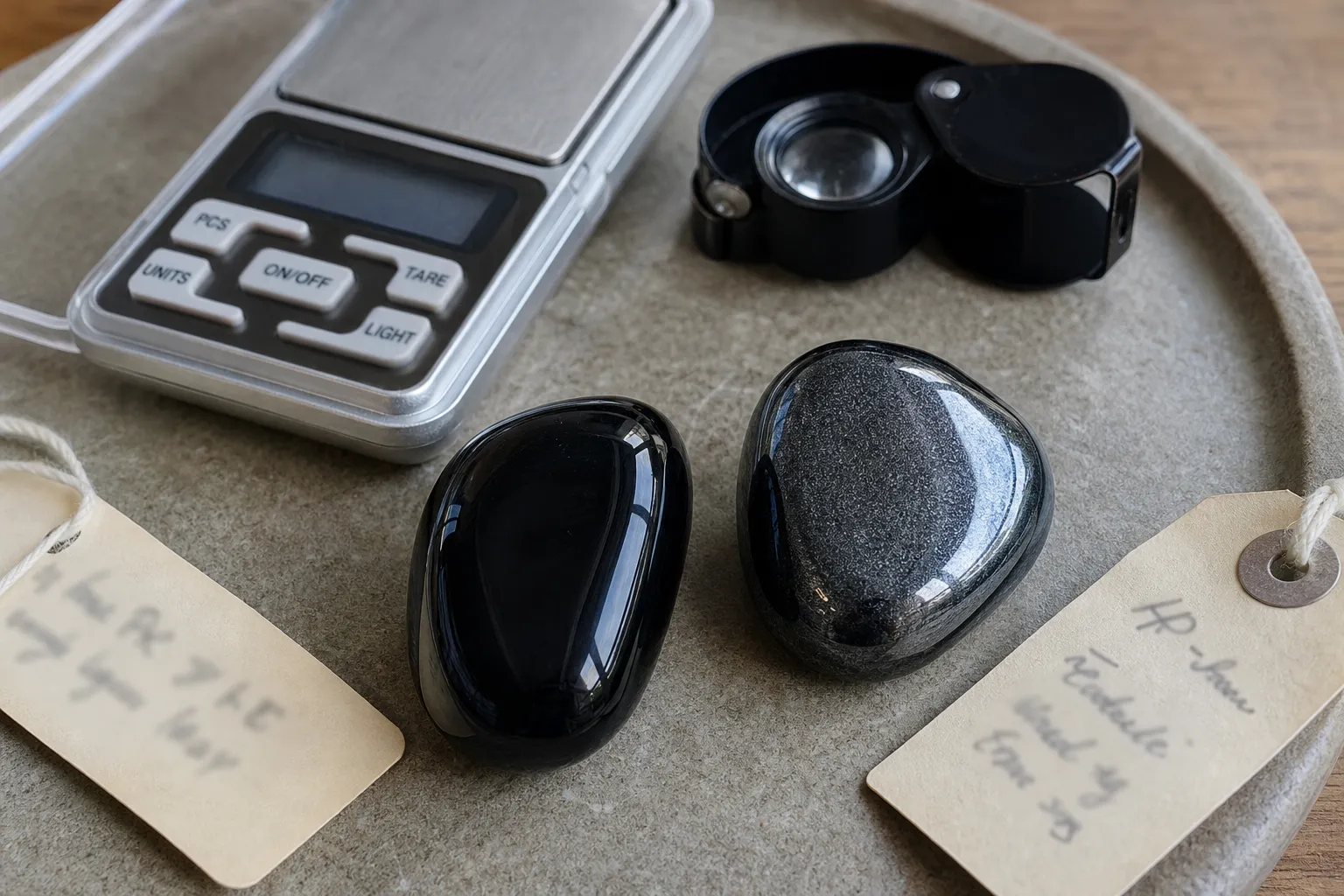
When comparing tumbled obsidian vs hematite, start with what you can actually check: weight, surface shine, color impression, chips, streak-related wording, and the seller’s label. A similar-size piece of tumbled hematite often feels heavier and may look metallic gray-black, steel gray, or slightly sparkling. Tumbled black obsidian is volcanic glass, so it more often looks glossy, glassy, and pitch black; damaged spots may show sharp glass-like edges.
Those clues can make one answer more likely. They do not prove a specific polished stone’s identity from appearance alone.
upward
Read the full overview first
Use the broader guide first if you need the full scope before this page.
Quick side-by-side buying clues
Use this as a first pass when two dark polished stones look alike in a listing photo, shop tray, or mixed crystal set.
The strongest practical approach is to combine clues: similar-size weight, pitch black vs dark gray appearance, glassy vs metallic shine, chip behavior, any reddish-brown streak note, and the exact seller wording.
Weight is often the best simple clue
For many buyers, the most useful first check is the hematite weight comparison. Hematite is an iron oxide mineral and is much denser than volcanic glass, so a piece of tumbled hematite commonly feels compact and heavy for its size.
This works best when the pieces are close in size, shape, and thickness. A large obsidian tumble can weigh more than a small hematite piece simply because it has more material. A flat hematite bead and a chunky obsidian pebble are not a fair comparison.
If you are buying online, weight can still help when the listing gives both dimensions and weight. A seller who only says “black crystal” or “protection stone” without size, material, or weight is giving you less to judge. That does not make the listing wrong, but it does lower confidence.
A practical check
- Compare pieces of similar size, not just similar color.
- Notice whether one feels unusually dense for its size.
- Treat “heavy” as consistent with hematite, not as proof.
- Be cautious when dramatic seller language replaces basic material details.
Color and luster: pitch black glass vs metallic gray-black
Color is the clue people notice first, but it is easy to overread. In polished stones, both materials can look dark, glossy, and nearly black under shop lighting or in product photos.
Tumbled black obsidian is commonly associated with a glassy black look because obsidian is volcanic glass. A polished piece may appear pitch black, mirror-like, or deep glossy black. For this comparison, the useful clue is the glass-like surface impression, not blackness alone.
Tumbled hematite often reads differently: dark gray, steel gray, metallic gray-black, or black with a metallic cast. Some pieces may show a subtle sparkle or silvery flash where the polish catches the light. If one stone looks “pitch black” and another looks “dark gray with sparkling,” that difference is worth noting.
Still, color alone cannot settle the question. Photos can make hematite look blacker than it appears in hand, and a glossy finish can make different dark materials look closer than they are. If the listing has only one front-facing image, ask for natural-light photos, side views, and basic size or weight details.
Pitch black with glassy shine
This can fit tumbled black obsidian.
Metallic gray-black hematite
It may look almost black in low light but often has a steel-like cast.
Dark gray with subtle sparkle
This can point toward hematite-like material, though it does not prove natural hematite.
Uniform glossy black surface
It could be natural material, glass, coating, or another dark stone.
Chips and edges: why obsidian damage matters
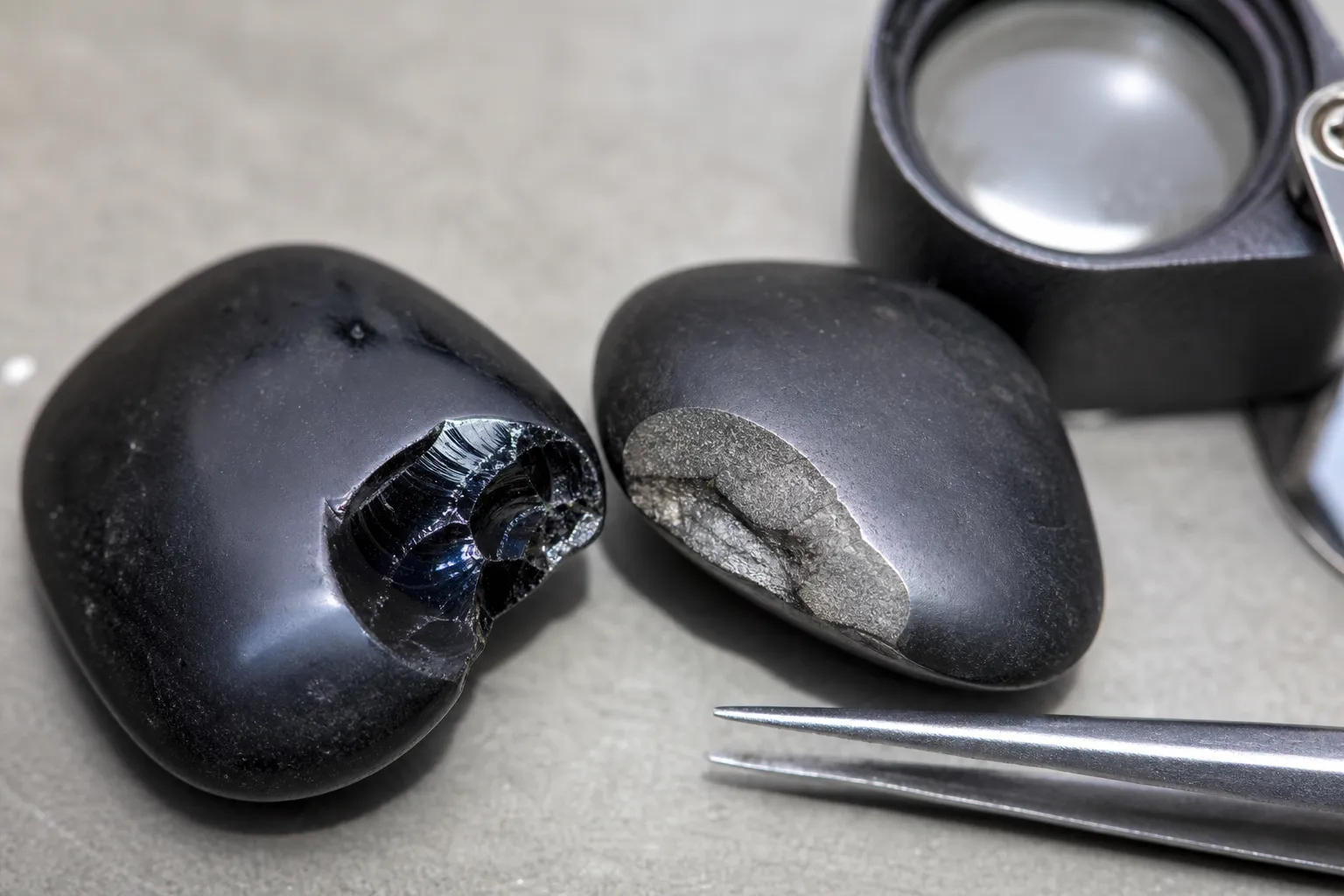
Obsidian’s glassy nature matters most when a piece is chipped. A smooth tumble may be comfortable to hold, but a broken corner, crack, or fresh chip can have a sharp glass-like edge.
If a black tumble has a small damaged area that looks curved, glassy, or sharp, that is consistent with obsidian. It is not a complete identification by itself, because other glassy materials can chip too, but it matches the behavior expected from volcanic glass.
For handling
- Do not rub a chipped obsidian edge with your thumb.
- Keep fragments away from children and pets.
- Store a damaged piece separately so it does not scratch other stones or fabric.
- Do not assume a polished stone is smooth at every edge.
Hematite can also chip or break, but its stronger buying clues are usually density and metallic gray-black appearance. If a seller photo shows damage, zoom in: glassy chips point one way; dull gray or metallic-looking worn spots may point another. Either way, visible damage matters if you plan to carry the stone, wear it, or include it in a handled crystal set.
The hematite red streak clue is useful, but not always worth testing
The hematite red streak clue comes from a classic mineral observation: hematite is associated with a red to reddish-brown streak or powder, even when the stone itself looks gray, black, or metallic. That is why buyer discussions sometimes mention a reddish brown streak test.
For a polished tumble, the caution is simple: streak testing is not a harmless check. It usually means scraping the stone on unglazed ceramic. That can mark the ceramic and may scratch, dull, or damage the stone’s finish. If the piece is a bead, a sentimental stone, or something you may return, think carefully before doing it.
A better use of this clue is to read the listing. If a seller describes hematite and mentions a reddish-brown streak as a mineral clue, that wording is at least aligned with known hematite behavior. If the listing says “hematite” but focuses only on magnetism, perfect black gloss, or brand-like terms without material detail, slow down and compare the other clues.
A visible red mark can support a hematite identification, but coatings, mixed materials, contamination, and testing technique can complicate casual checks. For certainty, specialized testing may be needed.
Seller wording: hematite, hematine, Hemalyke, and magnetic labels
The words in the listing can matter as much as the photo. With obsidian, seller wording is usually straightforward: “black obsidian,” “tumbled black obsidian,” or “obsidian volcanic glass.” The label does not verify the exact stone, but it should at least point to the expected material category.
Hematite listings can be more confusing. You may see:
- hematite
- magnetic hematite
- hematine
- Hemalyke
- “real hematite”
- “hematite-like”
- “magnetic beads”
These labels should not be treated as interchangeable. The point is not to reject every unfamiliar term, but to read carefully—especially for beads, rings, and very uniform shiny pieces.
Do not use magnetism as the single deciding rule. Commercial listings and videos often make magnetism sound simple, but buyer-level checks are not reliable enough to make “magnetic” or “not magnetic” a final answer for every polished item. Avoid heating stones or using phone-screen tricks as identification methods; they can damage the item or give misleading results.
A better seller-wording check
- Does the listing clearly name the material?
- Does it separate natural hematite from hematine, Hemalyke, or magnetic hematite-style products?
- Are dimensions and weight provided?
- Are the photos clear enough to judge luster, color, and chips?
- Is the item described with material details rather than only crystal-use language?
A crystal card can tell you how a stone is commonly presented in personal or cultural crystal practices. It does not authenticate the mineral.
When the clues do not line up
Sometimes the signs conflict. A stone may look very dark but feel heavy. A photo may look pitch black while the seller calls it hematite. A listing may use vague “black protection stone” wording with no weight, no clear chip view, and no material detail.
Use a confidence scale instead of forcing a yes-or-no answer.
More consistent with tumbled black obsidian
A stone is more consistent with tumbled black obsidian when it is glossy black, glass-like in appearance, relatively lighter than a similar-size hematite piece, and any chips look sharp or glassy.
More consistent with tumbled hematite
A stone is more consistent with tumbled hematite when it feels notably heavy for its size, reads as metallic gray-black rather than pure glassy black, and the seller’s description fits hematite as an iron oxide mineral or mentions a reddish-brown streak clue carefully.
Uncertain
A stone is uncertain when the only clue is “black and shiny,” the photo is heavily edited, the listing mixes terms, or the item is described mainly through crystal-effect language instead of material details.
That uncertainty is normal. Polishing removes many natural surface clues, and product photography can flatten differences. These checks are useful for sorting and buying decisions, not for guaranteeing identity from a photo or one home observation.
Compact buying checklist
Before buying or sorting a dark polished tumble, ask:
- Is it similar in size to the stone I am comparing it with?
- Does one piece feel much heavier for its size?
- Is the surface glassy black or metallic gray-black?
- Do chips look like sharp glass-like edges?
- Is there any seller mention of a red or reddish-brown streak?
- Would a streak test damage a polished piece I care about?
- Does the listing clearly separate hematite, hematine, Hemalyke, and magnetic hematite-style products?
- Am I relying on a crystal card, label, or marketing phrase instead of observable material clues?
For everyday buying, these questions are usually enough to avoid the most common mix-ups between tumbled black obsidian and tumbled hematite. For an expensive, sentimental, or strongly claimed item, ask for better documentation or use qualified testing. The practical goal is a better buying decision—not pretending that one visual clue can prove everything.
Sources
Sources and further reading
Reference links are limited to sources considered suitable for public citation in this page.