ProtectCrystal handling note
Hematite finish comparison
Raw Hematite Meaning vs Polished Hematite Meaning
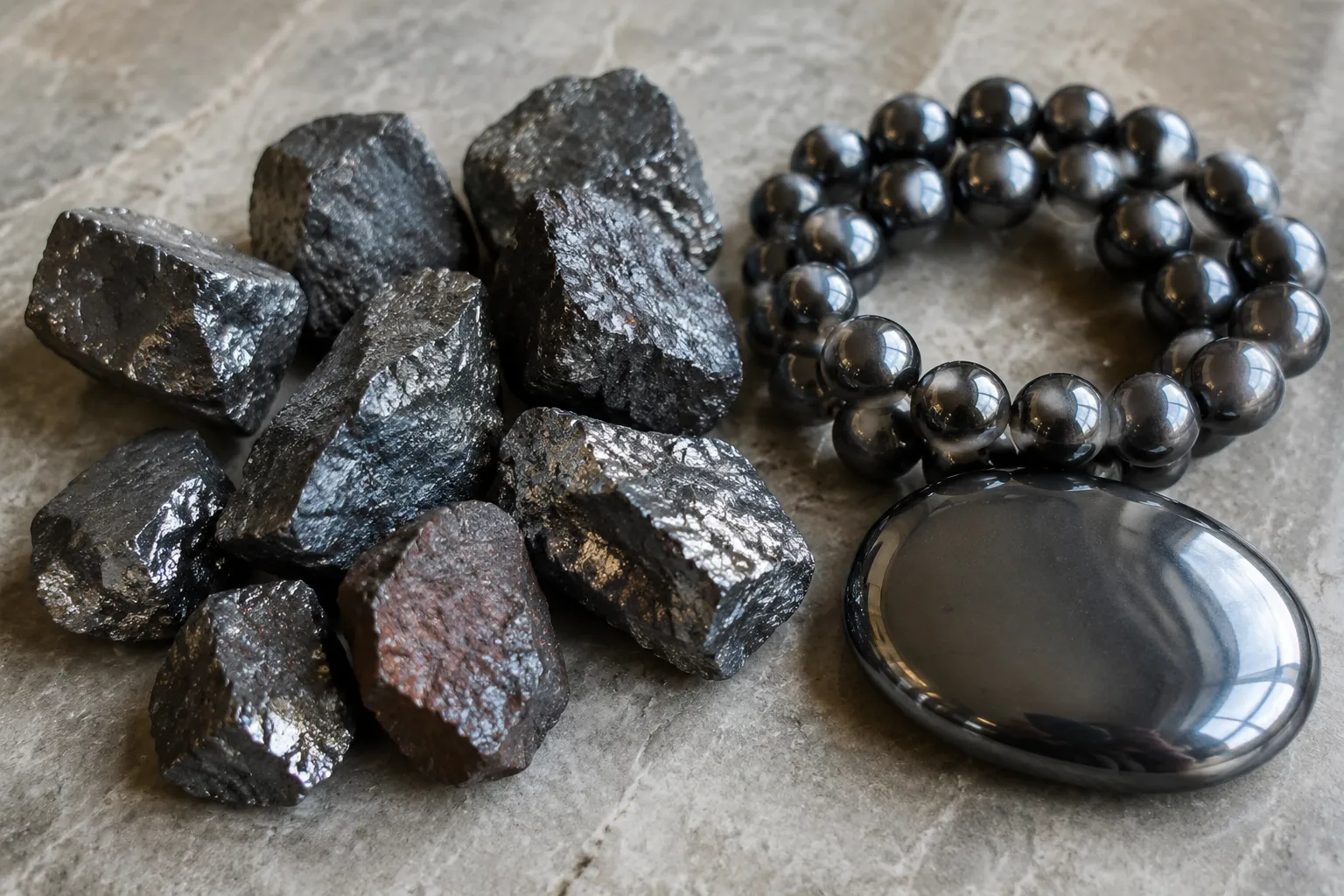
Raw hematite meaning is usually tied to a rougher, earthier, more specimen-like piece. Polished hematite meaning is usually tied to a smoother, more wearable form of the same mineral. If the material is correctly identified as hematite, the raw piece and the polished bead are not different minerals. The finish mainly changes what a buyer can see and feel: texture, edge shape, shine, portability, and how naturally the piece fits jewelry, pocket carry, or display.
That makes the meaning difference mostly cultural and marketplace language, not a proven change in effect. Raw hematite is often described as more direct, natural, or earthy. Polished hematite is often described as more refined, practical, and easy to keep close. The surface can support those interpretations, but it cannot prove stronger grounding, stronger protection, or authenticity by itself.
upward
Start with the broader guide
Use the broader guide first if you need the full scope before this page.
The Short Comparison: Raw vs Polished Hematite
| Buyer question | Raw hematite | Polished hematite |
|---|---|---|
| What changes visually? | Often irregular, rough, earthy, glittering, reddish-brown in spots, or attached to matrix | Often smooth, shaped, opaque, dark gray to silver-gray, metallic, or mirror-like |
| What changes in handling? | May have uneven edges, fragile-looking surfaces, or a specimen feel | Usually easier to hold, wear, carry, or set into beads, cabochons, carvings, and palm stones |
| What does it commonly mean in crystal-use language? | Often linked with earthiness, directness, and raw hematite grounding beliefs | Often linked with daily use, routine carrying, jewelry, and a more controlled presentation |
| What does the finish prove? | It may show a rough surface or natural-looking presentation | It may show lapidary work or surface treatment |
| What does it not prove? | It does not prove a stronger effect, better protection, or natural origin on its own | It does not prove weaker meaning, shine-based protection, or authenticity on its own |
Hematite is an iron oxide mineral, and mineral references describe it across a wide appearance range: metallic, submetallic, earthy, gray, black, brown, reddish, silver-gray, and sometimes highly reflective. That matters because raw hematite appearance does not have to be dull, and polished hematite appearance is not the only shiny version. Specular hematite, for example, can look naturally glittering or reflective before it is turned into a bead or cabochon.
The practical answer is simple: choose raw hematite if rough texture, mineral character, or earthy symbolism is the point. Choose polished hematite if smooth handling, jewelry use, pocket carry, or a cleaner metallic luster matters more. The meaning follows the use context more than the finish proves anything.
What Raw Hematite Meaning Usually Implies
Raw hematite meaning usually starts with the visible condition of the piece. A rough specimen may show broken surfaces, uneven texture, earthy coatings, reddish-brown areas, sparkling faces, or gray-black metallic sections. Some pieces are sold as rough chunks. Others may be attached to host rock or matrix. Those features make the stone feel closer to a mineral specimen than a finished jewelry component.
In crystal-practice language, that roughness is often turned into words such as natural, direct, earthy, grounding, protective, and strong. Those are common cultural and seller terms, not material test results. A raw surface can make the symbolism feel more immediate because the piece looks less worked. That is a reasonable personal interpretation, but it should not be treated as evidence that raw hematite has a verified effect that polished hematite lacks.
Raw pieces also leave more room for uncertainty. A rough surface may show more color variation and texture, but it can also hide coatings, mixed material, or confusing mineral associations. A reddish-brown area may fit hematite's known streak and iron oxide character, yet color alone is not enough to confirm identity. Weight impression, opacity, luster, and streak can be useful clues, but they remain clues.
Do not turn rawness into a shortcut for authenticity. "Rough," "natural," and "unpolished" usually describe presentation or surface condition. They do not automatically prove that the piece is untreated, correctly labeled, or more meaningful.
What Polished Hematite Meaning Usually Implies
Polished hematite meaning usually comes from contact and use. Polishing can make hematite smoother, darker-looking, more reflective, and easier to shape into beads, cabochons, palm stones, carvings, rings, and pendants. In a shop listing, polished hematite often reads as the practical option: something to wear, carry, hold, or keep on a desk without sharp or crumbly edges.
That usability shapes the symbolism. Polished hematite is commonly associated with everyday grounding, steady presence, and personal protection language because it fits bracelets, rings, pocket stones, and repeat handling. A polished bead can be kept close more easily than a jagged specimen. A palm stone can feel more comfortable than a rough chunk. Those are real handling differences, even when the meaning remains personal or cultural.
The polished surface can also affect expectation. Many buyers picture hematite as dark, metallic, heavy-feeling, and mirror-like because polished jewelry forms are so familiar. But polish does not create hematite's mineral identity. It changes the surface presentation of a material that may already have metallic or submetallic luster.
A shiny piece is not automatically "better." A mirror-like surface does not prove a stronger hematite protection meaning, and it does not prove the item is genuine hematite. Polished products may involve coatings, shaped components, or trade labels that need careful reading. The cleaner the finish, the less natural surface detail a buyer may be able to inspect.
Finish Changes Handling, Not the Core Mineral
The most useful way to compare raw vs polished hematite is to separate three layers: mineral identity, surface finish, and personal meaning.
Mineral identity
Hematite is hematite when the material is correctly identified as that iron oxide mineral. A raw chunk and a polished bead can share the same mineral identity, just as a rough stone and a cabochon can be different presentations of the same material. For certainty, specialized testing may be needed, especially with confusing labels, coated products, or unusually magnetic items.
Surface finish
Raw hematite texture may feel uneven, granular, sharp-edged, or specimen-like. Polished hematite luster may appear smoother, darker, brighter, or more reflective. The finish can change how the stone feels in the hand, whether it catches on fabric, whether it suits jewelry, and whether it is comfortable for routine carry.
Personal meaning
Many crystal buyers use hematite grounding meaning and hematite protection meaning as shorthand for why they choose the stone. Those meanings may matter in a personal practice, but the available material does not show that a rough surface creates one result and a polished surface creates another. The finish may support a preferred ritual style or daily habit. It should not be treated as a measured effect.
This is where some listings become slippery. A seller may imply that raw hematite is more powerful because it is untouched, or that polished hematite reflects unwanted energy because it is shiny. Those phrases explain market language. They do not establish a fact about the stone.
Buyer Clues That Help Without Over-Promising
Finish words
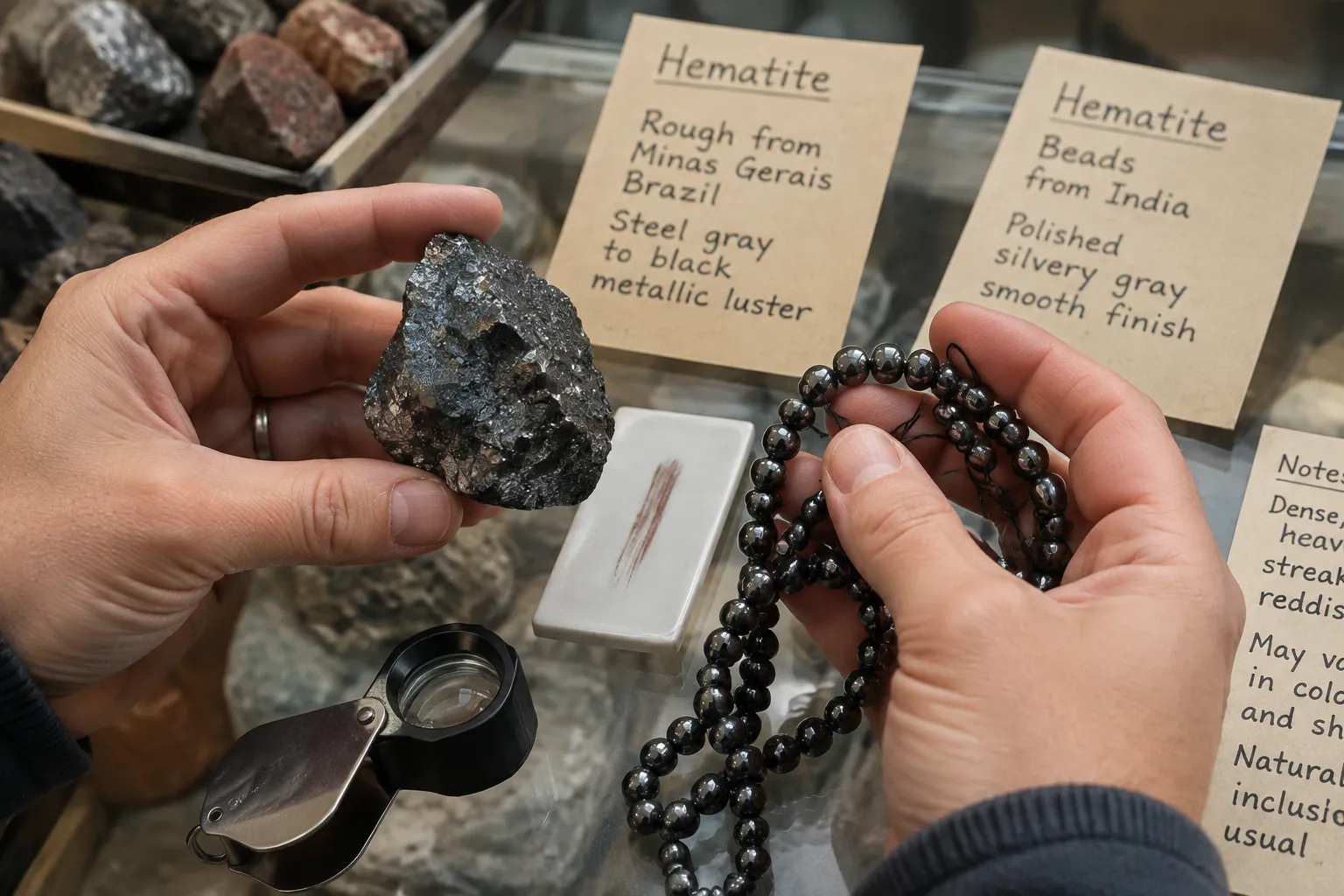
Start with the finish words. "Raw," "rough," and "unpolished" usually point to surface condition. "Polished," "tumbled," "cabochon," "bead," and "carving" usually point to a worked product form. These words help set expectations for handling and appearance, but they do not settle authenticity.
Luster and color range
Look at the luster and color range. Hematite may appear metallic, submetallic, earthy, gray, black, brown, reddish, or silver-gray. A polished piece may look mirror-like. A raw piece may look dull in one area and glittering in another. Variation is not automatically suspicious.
Reddish-brown streak
Understand the reddish-brown streak carefully. Mineral references commonly treat hematite's reddish-brown streak as an important clue, and it explains why a dark metallic stone can still be tied to red-brown powder or marks. But streak testing can damage finished jewelry, valued specimens, and surfaces. Do not grind hematite or create dust for a casual check. If a test would damage the piece, skip it or ask for proper evaluation.
Magnetism claims
Be cautious with strong magnetism claims. Products sold with "magnetic hematite" language are a known buyer-confusion area, but the available material is not strong enough to give a simple rule for every item sold that way. Strong magnetism should not be treated as proof that a piece is natural hematite. It is a reason to read the seller's description more carefully.
For raw hematite authenticity clues, think in groups rather than single signs: opacity, weight impression, metallic or earthy luster, possible reddish-brown streak, surface texture, and seller wording. Together, these may suggest hematite. They do not prove it from appearance alone.
Common Confusion Around Meaning Claims
Raw does not automatically mean spiritually stronger
The biggest confusion is the idea that raw hematite must be spiritually stronger because it looks less processed. That is a common raw hematite market claim, but the stronger-meaning part belongs to belief and marketing language. What a buyer can actually observe is narrower: raw pieces can look and feel rougher, earthier, more irregular, or more specimen-like.
Polished does not mean less serious
The second confusion is the idea that polished hematite is less natural or less serious because it has been worked. Polishing changes the surface. It does not automatically erase personal meaning, and it does not turn hematite into a different mineral when the material is genuinely hematite. For many buyers, polished hematite is the form that actually gets used because it is comfortable to wear or carry.
Reflectivity is visual, not a result claim
The third confusion is the mirror-like surface. A polished hematite surface can reflect light; that is an observable visual quality. Turning that reflectivity into a promise about protection is a separate interpretation.
Surface color and streak color are different
The fourth confusion is color. A buyer may see black, silver-gray, or dark metallic hematite and wonder how that fits a reddish-brown streak. It can fit. Surface color and streak color are not the same thing. Still, a single color clue is never enough to settle identity.
Which One Should You Choose?
Choose raw hematite when texture is part of the appeal
Choose raw hematite when you want a specimen-like piece where texture is part of the appeal. It suits buyers who prefer irregular surfaces, visible mineral character, earthy color variation, or a less finished display object. It may be less comfortable for jewelry or pocket carry, depending on edges and stability.
Choose polished hematite when touch matters
Choose polished hematite when touch matters. A polished bead, cabochon, palm stone, or carving is usually better for repeated handling, wearing, or keeping in a bag or pocket. It may show less rough surface detail, but it gives a cleaner, smoother format for everyday use.
If your question is about meaning, neither finish has to win. Raw hematite meaning often leans toward earthiness and directness because of how the piece looks. Polished hematite meaning often leans toward practical use and steady carry because of how the piece functions. The better choice is the one whose surface, shape, and use match your intention without asking the finish to prove an outcome.
If your question is about identity, slow down. Visual checks can suggest hematite, and mineral clues can help you avoid obvious mismatches, but limits of visual identification remain. When a listing makes strong claims about natural origin, unusual magnetism, special coatings, or finish-based power, treat the wording as something to verify, not something to accept from shine or roughness alone.
Bottom Line
Raw hematite and polished hematite can carry different meanings in crystal-use language, but the difference comes mainly from presentation and handling. Raw hematite is commonly read as rough, earthy, direct, and specimen-like. Polished hematite is commonly read as smooth, wearable, reflective, and practical for everyday use.
The finish can change texture, luster, shape, edges, and portability. It cannot, by itself, prove stronger grounding, stronger protection, or certain authenticity. For a buyer, the strongest check is still practical: look at the surface, read the seller language carefully, avoid damaging tests, and leave room for uncertainty when appearance alone is doing too much work.
Sources
Sources and further reading
Reference links are limited to sources considered suitable for public citation in this page.