ProtectCrystal handling note
Meaning comparison
Hematite Protection Meaning vs Grounding Meaning
Hematite protection meaning usually points to symbolic boundary language: staying firm, not taking on every mood around you, and using the stone as a reminder of personal limits. Hematite grounding meaning usually points inward: feeling present, practical, and connected to the body, routine, or the task in front of you.
The two meanings overlap because both suggest steadiness. They are not the same. Protection is outward-facing: what someone wants to keep at a distance. Grounding is inward-facing: how someone wants to feel less scattered.
Neither meaning should be treated as a promised result, a verified safety effect, or proof of what hematite can do. The safest reading is that these are common crystal-use interpretations used by sellers, collectors, and crystal enthusiasts as symbolic or personal-use language.
upward
Read the full overview first
Use the broader guide first if you need the full scope before this page.
The Short Difference
When someone calls hematite a protection stone, they are usually using “protection” as a metaphor. The idea is less about physical safety and more about personal limits: not absorbing every tense mood in a room, pausing before reacting, or carrying an object that represents firmness.
When someone calls hematite a grounding stone, the focus shifts to steadiness. Some people use a hematite bead, palm stone, or pendant as a tactile reminder to slow down, notice where they are, and return attention to what is directly in front of them.
That is why hematite protection vs grounding language often appears together. A person who feels more grounded may also feel better able to hold a boundary. The difference is emphasis, not a strict rule.
What “Protection” Means in Hematite Descriptions
In hematite crystal use language, protection is commonly framed through images of a shield, wall, armor, or firm personal edge. These are metaphors. They describe how people talk about the stone, not a verified effect from the stone itself.
A seller description might call hematite a stone for boundaries. A crystal user might treat it as a reminder not to take in every stressful mood nearby. Someone else might describe it as a confidence object because its dark, metallic-looking surface feels solid or serious to them.
That is where the hematite boundary stone meaning comes from. The “boundary” is not a literal barrier. It usually means: “I want to be clearer about what I accept, what I respond to, and what I leave alone.”
Protection language should avoid overstatement
- It should not present hematite as creating spiritual certainty.
- It should not turn a symbolic object into a replacement for practical choices.
- It should not treat seller wording as evidence that the stone produces a specific outcome.
The practical value, if someone chooses to use hematite this way, is in the reminder. A bracelet can prompt a pause before a difficult conversation. A small stone on a desk can mark the start of focused work. A pocket stone can become part of a personal routine. Those uses are about attention and meaning, not proof.
What “Grounding” Means in Hematite Language
Hematite grounding meaning usually has a quieter tone than protection language. Instead of “keep this away from me,” grounding says, “bring me back to what is steady and real.” It is often described through words like presence, weight, stillness, routine, and body awareness.
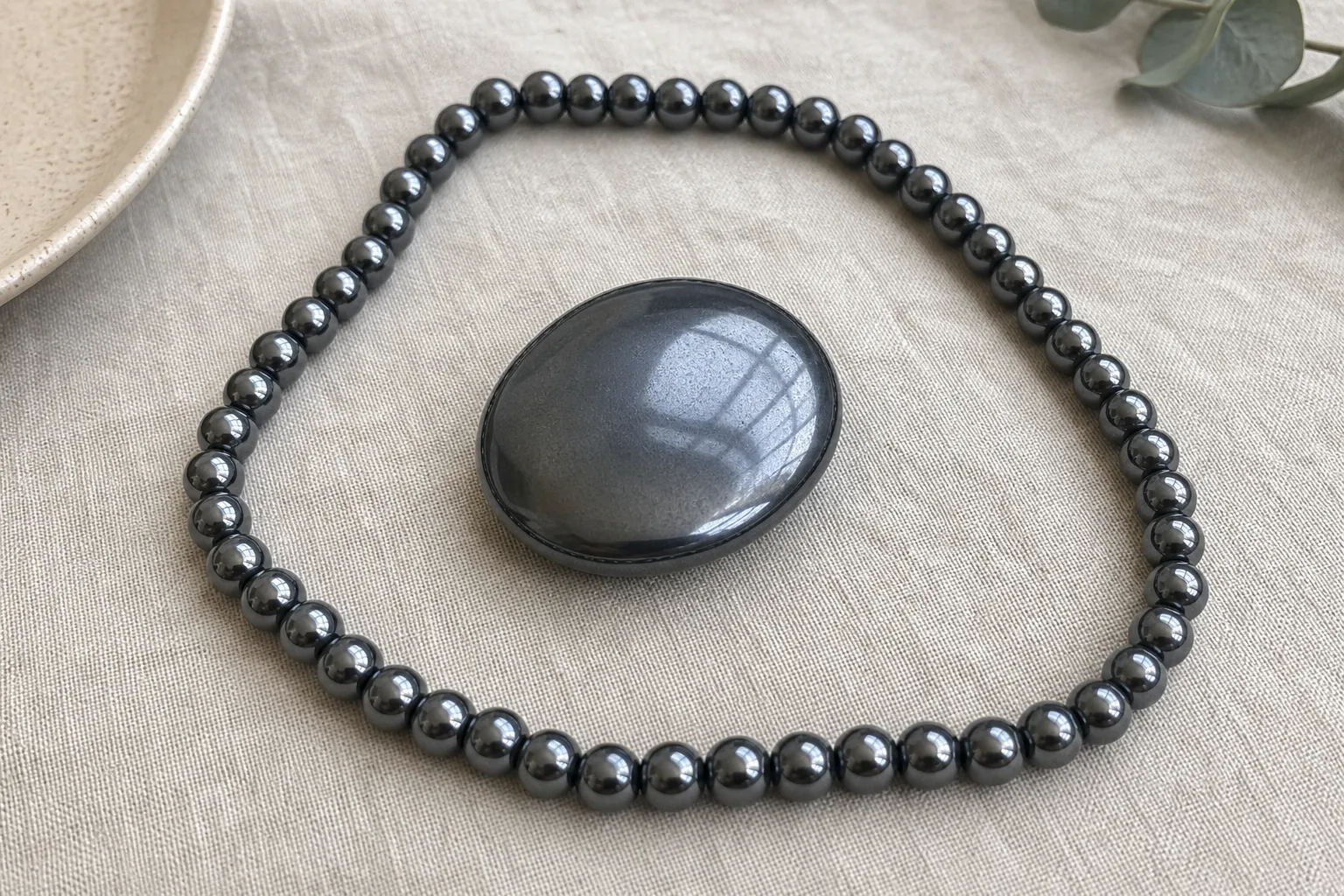
This may be one reason hematite is often paired with grounding language. Polished hematite is commonly seen as dark gray to silvery beads, tumbled stones, or smooth pieces with a metallic appearance. Some pieces may feel comparatively weighty in the hand, depending on size and material. Those visible and handling cues can explain why people associate the stone with a solid, grounded mood, but they cannot prove identity or effects on their own.
In everyday use, grounding language is usually personal and practical. A person may hold a stone during a quiet pause, keep it near a notebook, place it by a work area, or choose it because it looks simple and steady compared with brighter crystals. These choices can make sense as personal symbolism without turning into a factual claim about results.
Grounding vs protection crystals can become confusing because both categories are often used during stressful or overstimulating moments. Protection language imagines a boundary between the person and what feels intrusive. Grounding language imagines the person settling back into their own body, task, or surroundings.
Why the Two Meanings Get Blended
The blend happens because protection and grounding answer similar reader needs in different language. Someone searching for hematite protection meaning may be decoding a product description, choosing between stones, or wondering why hematite is grouped with protective crystals. Someone searching for hematite grounding meaning may be trying to understand why the same stone is also described as centering or steadying.
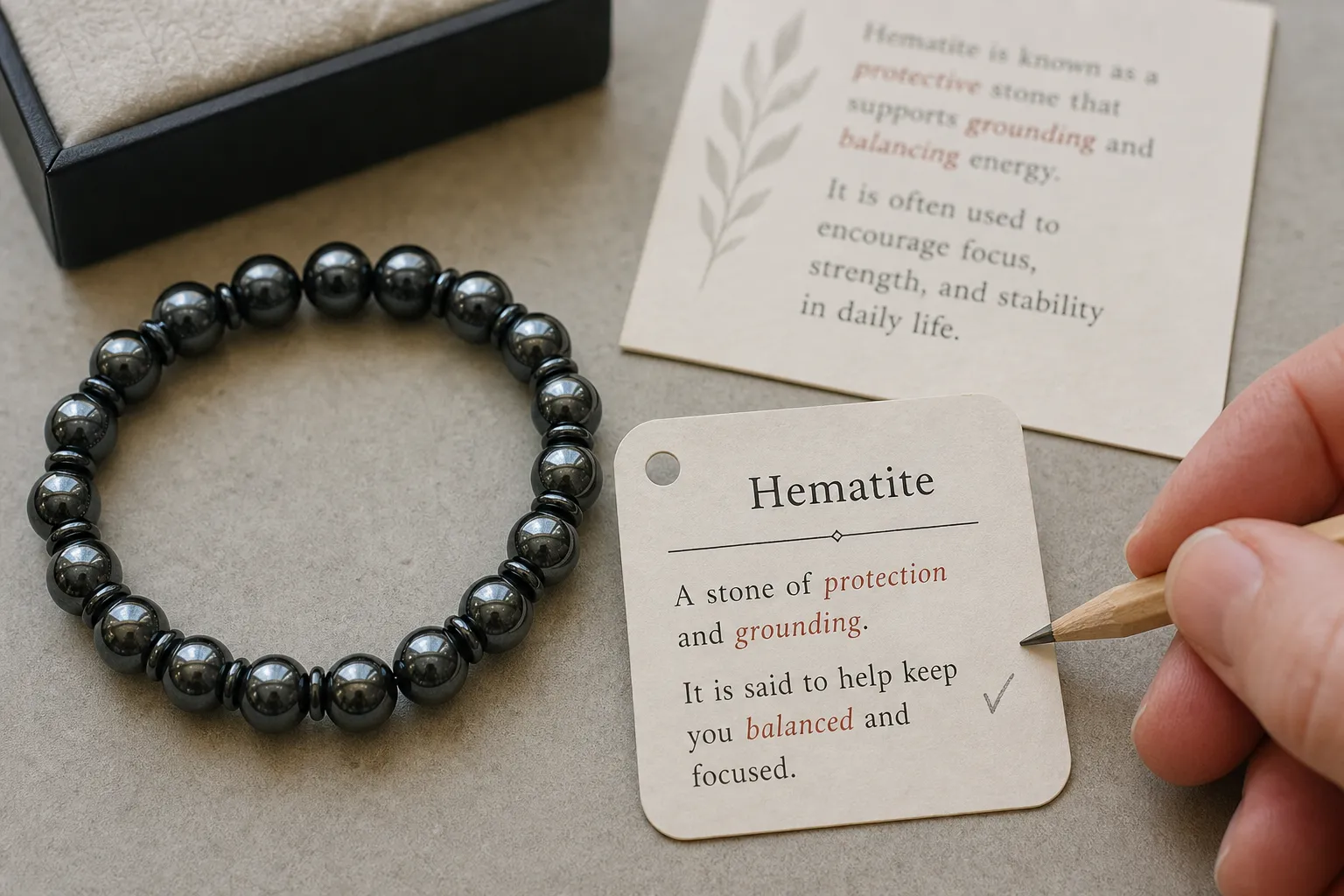
Crystal listings also compress many interpretations into short labels. A bead strand may be called “protective,” “grounding,” “balancing,” and “confidence-supporting” without explaining the difference. On a product page, those words often work more like mood tags than careful definitions.
The same sentence can feel harmless or overstated depending on how it is written. “Hematite is often described as a boundary stone” is a cautious meaning statement. “Hematite will protect you from negative surroundings” turns the symbol into a promised outcome. This page can explain the first kind of language; it should not endorse the second.
The same applies to grounding. “Some people use hematite as a reminder to feel more present” is a limited personal-use statement. “Hematite makes you emotionally stable” goes beyond what a meaning card or seller phrase can support.
How to Read a Hematite Listing Without Over-Interpreting It
If you are comparing a hematite listing, bracelet description, or crystal meaning card, read the protection and grounding words as clues to intended use, not as proof.
- If the description emphasizes “shield,” “negative energy,” or “protection,” it is using outward-facing boundary language.
- If it emphasizes “centered,” “steady,” “present,” or “rooted,” it is using inward-facing grounding language.
- If it uses both, it is likely combining common hematite interpretations rather than making a precise distinction.
- If it promises specific life, safety, spiritual, or emotional outcomes, treat that as marketing language rather than confirmed fact.
- If it claims the item’s identity is certain from appearance alone, remember that visible cues can suggest but not prove what the material is.
This keeps the answer useful without turning it into an authenticity guide. Hematite pieces are commonly sold as polished beads, tumbled stones, and jewelry-style items, and seller descriptions may lean heavily on meaning language. Those details help you understand the marketplace context. They do not establish mineral identity, quality, or results by themselves.
For a buyer or casual crystal user, the better question is not “Which meaning is objectively true?” It is “Which meaning is this description using, and is it making a claim I should treat cautiously?”
When Protection Meaning Fits Better
Hematite protection meaning fits better when the focus is on limits, separation, or confidence around outside pressure.
Examples of protection-style wording include:
- wanting a symbolic reminder to hold personal boundaries;
- using hematite as a confidence object before a difficult conversation;
- placing it near a work area as a visual cue to stay firm and focused;
- choosing it because the dark, metallic look feels strong or shield-like.
These are meaning-based examples, not verified effects. Hematite as symbolic shield language belongs in this category because it turns the stone into a reminder of firmness, not a promise that anything outside the person will change.
Protection language can also be the more useful label when comparing hematite with other crystals described as protective. For example, obsidian is often discussed in sharper, barrier-like terms in crystal culture, while hematite is often described with steadiness and firmness. Without stronger sources, that comparison should stay a language comparison, not a claim about measurable performance.
When Grounding Meaning Fits Better
Hematite grounding meaning fits better when the focus is on steadiness, routine, or returning attention to the present moment.
Examples of grounding-style wording include:
- keeping a stone near a planner or notebook as a cue to focus on the next task;
- holding a smooth piece during a quiet pause;
- choosing hematite jewelry because its simple appearance feels steady rather than decorative;
- using the stone as part of a personal habit that marks the start or end of the day.
Here, the useful part is the symbolic cue. Some people find repeated objects and actions helpful for organizing attention. That does not mean hematite itself has been shown here to create a specific result. It means the object can be chosen as part of a personal practice.
Grounding language is the better label when the emphasis is not on blocking anything, but on coming back to basics: body, breath, schedule, ordinary tasks, and direct surroundings. If protection is about the edge, grounding is about the center.
The Main Limitation
This page has no high-quality public reference links to support stronger claims about hematite meanings, mineral traits, safety outcomes, authenticity, or spiritual effects. That does not make every crystal-use phrase useless. It means the wording should stay modest.
A careful page can say that hematite is often described in protection and grounding language. It can explain what those words usually point to in common crystal conversations. It can help a reader decode a seller card or choose the interpretation that matches their own intention.
A careful page should not say that hematite confirms emotional results, creates spiritual certainty, or can be identified with certainty from a polished look. Those would require a different level of support. For mineral identity, specialized testing may be needed. For personal effects, a meaning card or seller phrase is not enough evidence.
So the compact answer is this: hematite protection meaning is about symbolic boundaries and shield-like imagery; hematite grounding meaning is about steadiness, presence, and returning to practical reality. They often appear together because both suggest firmness, but they answer different needs. Read them as common hematite interpretations, not as promised outcomes.