ProtectCrystal handling note
Hematite meaning comparison
Hematite Grounding Meaning Compared With Protection Meaning
People usually search for hematite grounding meaning because two ideas keep getting blended together: is hematite mainly a grounding stone, a protection stone, or both?
In crystal-use language, grounding usually points inward: steadiness, weight, presence, body awareness, and a connection-to-earth feeling. Protection points more toward boundaries, shielding imagery, and feeling guarded. The two meanings can sit together, but they are not the same claim.
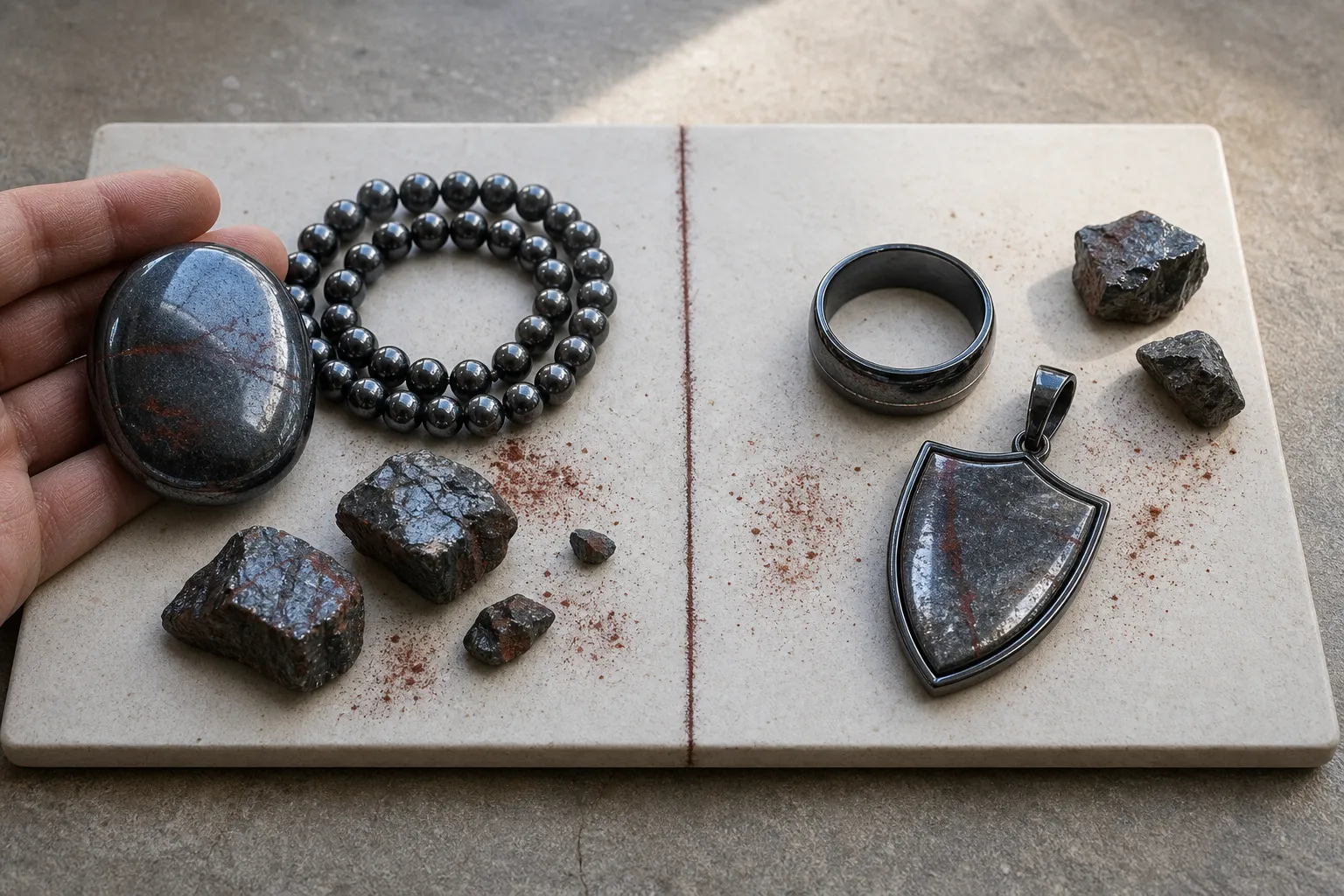
Hematite also has real mineral traits that make the symbolism easy to understand: a dark metallic or earthy look, a red to reddish-brown streak, an iron-rich identity, and a dense, polished feel in many jewelry pieces. Those facts can explain why people associate hematite with weight and structure. They do not show that the stone creates a specific grounding or protective result.
upward
Start with the broader guide
Use the broader guide first if you need the full scope before this page.
Hematite Grounding vs Protection: The Practical Difference
The easiest way to compare hematite grounding vs protection is to ask what the word is trying to do.
Grounding language is inward-facing. It is often used when someone wants a stone to symbolize steadiness, contact with the present moment, physical weight, balance, or a less scattered feeling. In this use, hematite as a grounding stone is not about blocking something outside the person. It works more like a reminder of weight, structure, and presence.
Protection language is boundary-facing. Hematite protection meaning is commonly associated with shielding, guarding one’s space, or not taking on what feels intrusive. In seller descriptions, that may show up as “protective,” “shielding,” or “for negative energy.” That wording belongs to crystal-use and marketplace language, not to a verified material effect.
Grounding Meaning
- Focuses on steadiness and presence.
- Directs attention toward the body, weight, and the present.
- Frames hematite as a stone for balance, focus, and earth connection.
- Connects to dense feel, metallic shine, dark color, and polished or earthy surface.
- Should not be assumed to create measurable emotional or physical results.
Protection Meaning
- Focuses on boundaries and shielding symbolism.
- Directs attention toward outside pressure or unwanted influence.
- Frames hematite as a stone for guardedness, strength, or a shield idea.
- Uses the same physical traits; the meaning changes by interpretation.
- Should not be assumed to prevent harm or block negative energy.
The overlap is understandable. A person who feels grounded may also feel more ready to hold boundaries. A dark, heavy, metallic-looking stone can also make protection imagery feel natural. Still, grounding describes a stabilizing association. Protection describes a guarding association.
Why Hematite Is Often Called a Grounding Stone
Hematite’s grounding reputation makes more sense when its physical traits and symbolic meanings are kept in separate lanes.
Mineral references describe hematite as an iron oxide with metallic to earthy luster. It may appear dark gray, black, brownish, reddish, or earthy depending on form, and it is known for a red to reddish-brown streak. Polished hematite can look dark silver and mirror-like. Earthy hematite can look duller, redder, or more powdery.
Those visible traits give crystal buyers something concrete to notice before moving into meaning. A cool, weighty, dark, metallic-looking stone can easily become associated with downward attention, steadiness, structure, and contact with the body. That is why the grounding crystal meaning attached to hematite often feels intuitive.
The useful boundary is simple: the mineral facts support the description of the stone, not the promised outcome. Hematite’s iron content, shine, streak, and weight impression can explain why grounding language feels fitting to many people. They do not make grounding a measurable or universal effect.
Physical qualities that may match the symbolism
- A polished bead or palm stone may feel smooth, compact, and intentional.
- A raw or earthy piece may feel more direct, mineral-like, and less decorative.
- A dark metallic surface may suit someone drawn to structure and focus.
- A red streak, when tested appropriately on unglazed porcelain, can suggest hematite, but it does not confirm every seller claim by itself.
Grounding is the meaning layer. Luster, streak, finish, and weight impression are the observable layer.
Hematite Protection Meaning Without Overstating It
Hematite protection meaning is usually built around the idea of a shield. In crystal listings, jewelry descriptions, and personal-use language, hematite may be described as a stone for boundaries, guardedness, or staying less affected by unwanted energy. A “hematite shield meaning” in a listing usually belongs to that symbolic vocabulary.
A careful reading keeps the meaning personal rather than literal. Some people use hematite as a reminder to hold boundaries, pause before reacting, or carry a symbol of steadiness through the day. That can be meaningful without turning the stone into a protective device.
How form changes symbolic use
Bracelet
Commonly used as a daily grounding and boundary reminder. Check fit, finish, coating wear, and whether beads are magnetic.
Ring
Often read as focus, restraint, or personal boundary symbolism. Watch comfort, sizing, and surface wear.
Palm stone
Used as a grounding object for quiet moments. Smooth polish may hide natural texture.
Raw piece
Carries earthier mineral symbolism. Avoid rubbing dusty or friable surfaces on skin or fabric.
Shield pendant
Uses boundary symbolism in visual form. Treat the design as symbolic, not functional protection.
Protection language becomes misleading when it is written as certainty. A seller can call hematite protective because that is a common crystal association. A reader should still understand that “protective” is doing symbolic work, not scientific work.
Raw, Polished, and Magnetic Hematite Meaning
Raw hematite meaning and polished hematite meaning often differ because the object gives a different visual impression. The underlying crystal vocabulary may be similar, but the surface changes how people read the stone.
Raw or earthy hematite can look more mineral, matte, reddish, brownish, or granular. It tends to emphasize the earthier side of hematite’s identity. For someone interested in hematite grounding meaning, this can feel closer to stone, weight, natural texture, and earth connection. It may also make the red streak association easier to understand, although streak testing is not appropriate for every finished item.
Polished hematite usually looks smoother, darker, shinier, and more reflective. In beads, rings, and tumbled stones, that finish often supports meanings around focus, composure, and sleek boundary symbolism. A polished surface can make hematite look almost like metal, which is one reason protection language appears so often in jewelry descriptions.
Magnetic hematite needs more careful wording. Many items sold as magnetic hematite are consumer accessories, and not all hematite specimens behave the same way magnetically. Magnetism should not be treated as proof that the grounding meaning is stronger. It is also not a simple authenticity test.
If a hematite bracelet, bead strand, or accessory is described as magnetic, the symbolic meaning does not automatically change. It may still be sold with grounding, protection, balance, or focus language, but the magnetism is a material or product feature, not evidence that the meaning works more strongly.
Magnetic accessory caution
Magnetic jewelry or accessories may be a concern for people with pacemakers or other implanted medical devices. General magnet-safety guidance for implanted devices is not hematite-specific, but readers in that situation should follow device guidance or ask a qualified clinician before wearing magnetic accessories close to the body.
That caution should stay close to the purchase decision. It matters when “magnetic hematite meaning” is mixed with jewelry, but it should not take over the whole topic.
How Seller Descriptions Blend Grounding, Protection, and Focus
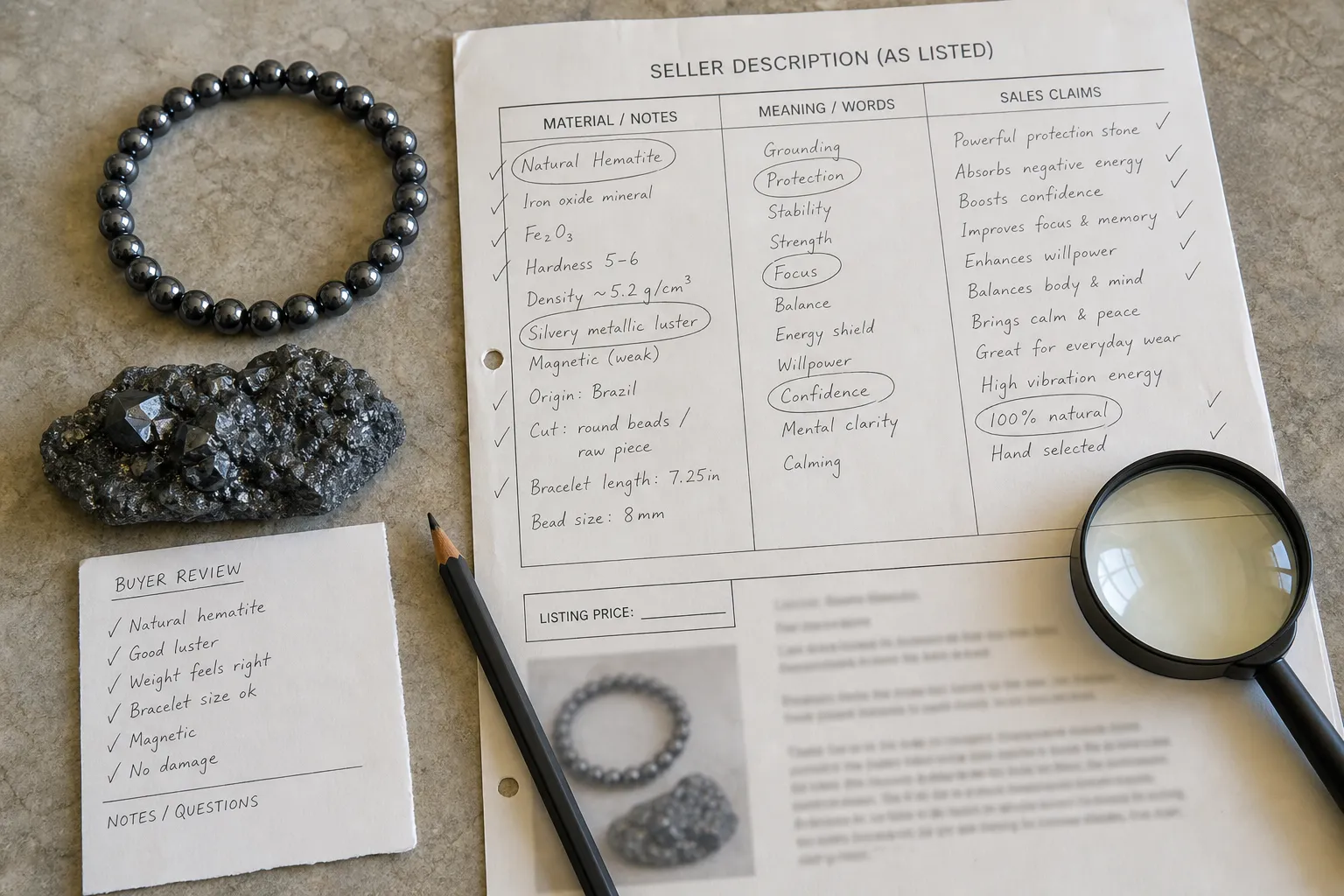
Hematite seller descriptions often compress several ideas into one line: grounding, protection, balance, strength, focus, and negative-energy wording. That does not always mean the seller has separated the claims carefully. Often, it is a cluster of common crystal keywords.
A better way to read a listing is to sort the wording into three layers.
Mineral Layer
Visible and testable traits: metallic or earthy luster, dark gray to black or reddish appearance, red streak, polished or raw finish, and weight impression. These are the most concrete parts of the description, although visual cues still have limits.
Symbolic Layer
Grounding, shielding, balance, focus, and boundary language are common crystal-use meanings. They may help a buyer choose a piece that feels personally fitting, but they should not be read as promised results.
Sales Layer
Dramatic wording or phrases can make the stone sound like it can reliably change outcomes. Stronger wording does not make the piece more authentic, more suitable, or more meaningful.
Questions to ask while reading a hematite listing
- Does the seller describe the object clearly: bead, ring, raw specimen, polished stone, pendant, or magnetic accessory?
- Do the photos show surface, luster, color, finish, and wear points?
- Is “grounding” used as symbolic meaning, or written like a result the buyer should expect?
- Is “protection” framed as boundary symbolism, or as a promise?
- Does the listing rely mostly on spiritual wording while giving little material detail?
- If magnetism is mentioned, is it explained as a product feature rather than proof of meaning?
This keeps the useful parts of hematite crystal use meaning without asking the stone, or the seller’s wording, to carry more than it can.
What Hematite Grounding Meaning Cannot Promise
Hematite grounding limitations are not a weakness of the stone. They are a clarity issue.
The available mineral sources can support facts about hematite as a material. They can explain why hematite is visually and symbolically suited to words like weight, earth, iron, darkness, shine, and structure. They do not document the origin of every modern crystal meaning, and they do not verify grounding or protection as outcomes from the mineral itself.
A careful version of the meaning is this: hematite grounding meaning is a common crystal-use association with steadiness, presence, weight, balance, and connection-to-earth language. Hematite protection meaning is a common association with shielding, boundaries, and feeling guarded. Both can be used as personal or cultural symbolism. Neither should be treated as a confirmed result from the stone.
This matters when people ask, “Does hematite protect from negative energy?” A cautious answer is that hematite is often described that way in crystal-use language, but the phrase is best understood as symbolic or personal-use wording. If someone wants a reminder to hold boundaries, hematite jewelry or a pocket stone may fit that intention. If someone needs practical protection in an ordinary-life situation, the answer should not be delegated to a crystal.
The same applies to hematite meaning for balance. Balance is a common bridge word between grounding and protection. It can mean steadier attention, a more centered personal symbol, or a design choice that feels composed. It should not be stretched into a promised change in physical, emotional, financial, or safety outcomes.
Let hematite’s material traits make the meaning understandable, but do not let the meaning rewrite the material facts.
A Reader’s Framework for Choosing the Right Meaning
If you are choosing hematite for yourself or comparing pieces before buying, start with the role you want the object to play.
Choose Grounding
Choose the grounding frame if your main attraction is the stone’s weight, dark color, iron-mineral identity, smooth feel, or earth-connected symbolism. Raw hematite, palm stones, tumbled pieces, and simple bracelets can all fit this frame depending on how you prefer to hold or wear the stone.
Choose Protection
Choose the protection frame if you are drawn to boundary language, shield designs, dark reflective surfaces, or jewelry that feels like a personal marker. In this frame, a hematite ring, pendant, or bracelet may be less about display and more about a visible reminder.
Choose Both
Choose a combined frame if the listing or your own use naturally blends both ideas. Many people do not experience grounding and protection as separate categories. The caution is not that the meanings cannot overlap; it is that they should not become claims the mineral evidence cannot support.
Before buying, check the material description as well as the meaning description. A listing that says only “grounding and protection hematite” but gives no clear photos, no finish details, no note on whether it is magnetic, and no basic material information leaves too much for the buyer to infer. A better listing does not need to sound technical, but it should help you understand the physical object you are considering.
For visual checks, keep the limits in view. Metallic luster, a dark polished surface, and a reddish streak can suggest hematite-related identity, but appearance alone is not final proof. Coatings, lookalike materials, composite products, and seller wording can complicate the picture. For certainty, specialized testing may be needed.
FAQ
Is hematite grounding meaning the same as hematite protection meaning?
No. They often overlap in crystal-use language, but grounding points more toward steadiness, presence, and earth connection. Protection points more toward boundaries and shielding symbolism. A single hematite piece may be described with both meanings.
Does a hematite bracelet have a different meaning than a ring?
The core meanings are similar, but the form changes how the symbol is used. A hematite bracelet is often read as a daily grounding and boundary reminder because it is visible and wearable. A hematite ring may feel more like a focused personal symbol tied to the hand.
Does magnetic hematite make the grounding meaning stronger?
The available material evidence does not support that jump. Magnetism is a product or material feature, not proof of stronger grounding or protection meaning. Magnetic accessories also deserve extra caution for readers with implanted medical devices.
Can hematite’s appearance prove it is real?
Visible signs can help, but they cannot prove identity by themselves. Hematite may show metallic or earthy luster, dark coloring, and a red streak, but finished jewelry and marketplace products can be more complicated. For certainty, specialized testing may be needed.
Sources
Sources and further reading
Reference links are limited to sources considered suitable for public citation in this page.