
ProtectCrystal handling note
Streak test caution
Cinnabar vs Hematite Streak: Why Color Tests Need Caution
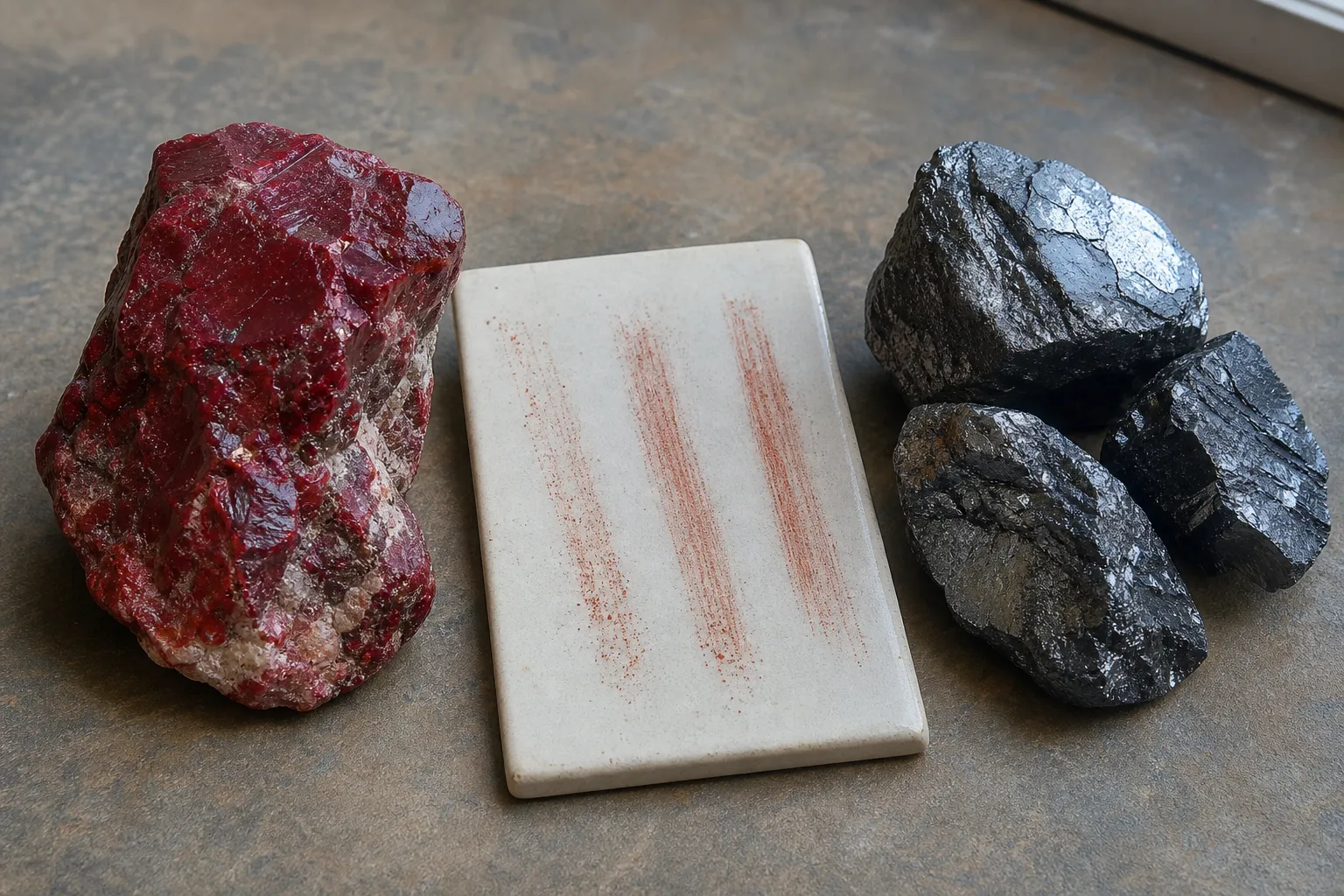
A cinnabar vs hematite streak check is only a clue, not a clean separator. Cinnabar is commonly listed with a red streak. Hematite is commonly taught as leaving a red to reddish-brown streak, sometimes described as rust-red or blood-red. That overlap means a red mark on an unglazed porcelain streak plate can narrow the possibilities, but it cannot prove which mineral you have.
For a bead, polished stone, small specimen, or seller-described item, treat streak color as one part of the picture. If cinnabar is possible, do not make extra dust just to test it. A streak test creates mineral powder, and cinnabar is a mercury sulfide mineral, not just a red decorative material.
upward
Start with the broader guide
Use the broader guide first if you need the full scope before this page.
What the streak test is actually showing
A mineral streak is the color of the mineral in powdered form. The common method is to rub the specimen across an unglazed porcelain streak plate and look at the powder mark left behind. That is different from judging the outside color of the piece.
This matters because surface color and powder color can disagree. Hematite is the classic example: a piece may look dark metallic gray, black, brownish, red, or silvery, yet still leave a reddish streak when it powders properly.
Cinnabar adds the caution. Its streak is also described in the red range, so the cinnabar streak color and hematite streak color can overlap enough to mislead a buyer.
How to read common streak results
Bright red powder
Could fit cinnabar; may overlap with other red-streak materials. It cannot prove that the specimen is cinnabar, genuine, or appropriate for casual handling.
Rust-red or blood-red powder
Often associated with hematite. It cannot prove that the piece is definitely hematite.
Reddish-brown powder
Can fit hematite descriptions and other iron-rich material. It cannot prove that cinnabar is impossible.
Weak, gritty, or broken-looking mark
May be a poor test result rather than a true powder color. It cannot provide a reliable mineral identity.
The important word is “powder.” A true streak is not loose dirt, surface dye, iron staining, broken grains, polish residue, or a smear from a coating.
Why both minerals can sit in the red family
Hematite is iron oxide. It can look dark, metallic, silvery, or black in hand, especially in polished beads and specular-looking pieces, but its streak is widely described as red to reddish-brown. That is why a dark gray “hematite” bead may still make a reddish mark.
Cinnabar is mercury sulfide and is strongly associated with red color. Mineral references commonly list its streak as red. In crystal-market language, this can tempt quick shortcuts: “red streak means cinnabar” or “blood-red streak means hematite.” Neither shortcut is dependable.
A red-family streak is better treated as a sorting clue. It may show that surface color alone was misleading. It may also point toward a smaller group of possibilities. It does not give the kind of confirmation that specialized testing or an experienced in-person assessment may provide.
Seller wording deserves the same caution. Terms such as “cinnabar-like,” “hematite-like,” “blood red,” “metallic,” “natural,” “authentic,” or “protective” describe how the item is being presented. They are not mineral identification.
When a streak test can mislead you
Even a familiar streak test can produce a distorted result.
Surface coatings and polish can change the first mark
A bead, cabochon, carved object, or decorative stone may have wax, resin, lacquer, dye, oil, or polishing residue on the surface. The first scrape may test that outer layer more than the mineral underneath.
Weathering and staining can affect the powder
A stored or natural specimen may have an altered outer surface. Powder from a weathered skin, stained crack, or dirty edge may not represent the fresh mineral.
Contamination can create a false color
Red dust from another specimen, iron staining, or residue on the streak plate can make a mark look more diagnostic than it is.
Streak plate hardness has limits
Streak plates are commonly around Mohs 6.5 to 7. If the mineral is harder than the plate, it may scratch the porcelain instead of leaving its own powder. Mixed material, inclusions, and surface finish can also complicate the result.
Crumbly material can look like streak
If the mark is chunky, gritty, sparkly, or full of loose fragments, you may be looking at broken debris rather than a clean mineral powder color.
Finished pieces are poor test subjects
A streak test is destructive at the contact point. On a bead, pendant, inlay, antique object, lacquered item, or seller-owned piece, even a small scratch may be too much damage for too little certainty.
A good stopping rule is simple: if the test would damage the item, create questionable dust, or still leave you unsure, do not treat streak as the deciding factor.
Why suspected cinnabar needs a different approach
Hematite and cinnabar may overlap in streak color, but they should not be handled with the same assumptions. Cinnabar is a mercury-bearing mineral. For this page’s narrow question, the practical caution is enough: do not casually scratch, grind, file, sand, drill, or powder a piece that may be cinnabar.
That does not turn this into a detailed toxicology or disposal guide. The point is smaller and more useful for a buyer: a streak test deliberately makes powder, and powder is exactly what you should avoid creating when cinnabar is a possibility.
For a cautious check
- Do not streak-test a piece if the seller already describes it as cinnabar or cinnabar-bearing.
- Do not scrape a red mineral repeatedly to “get a clearer color.”
- Do not use a red streak as permission to wear, store, or handle the item in any particular way.
- Keep questionable mineral powder away from your face, hands, children, and pets.
- If identification affects handling decisions, ask a qualified mineral professional or lab instead of relying on a home color test.
The streak test can be useful for many minerals. Suspected cinnabar is one case where making the clue may not be worth it.
Better clues to check before scratching anything
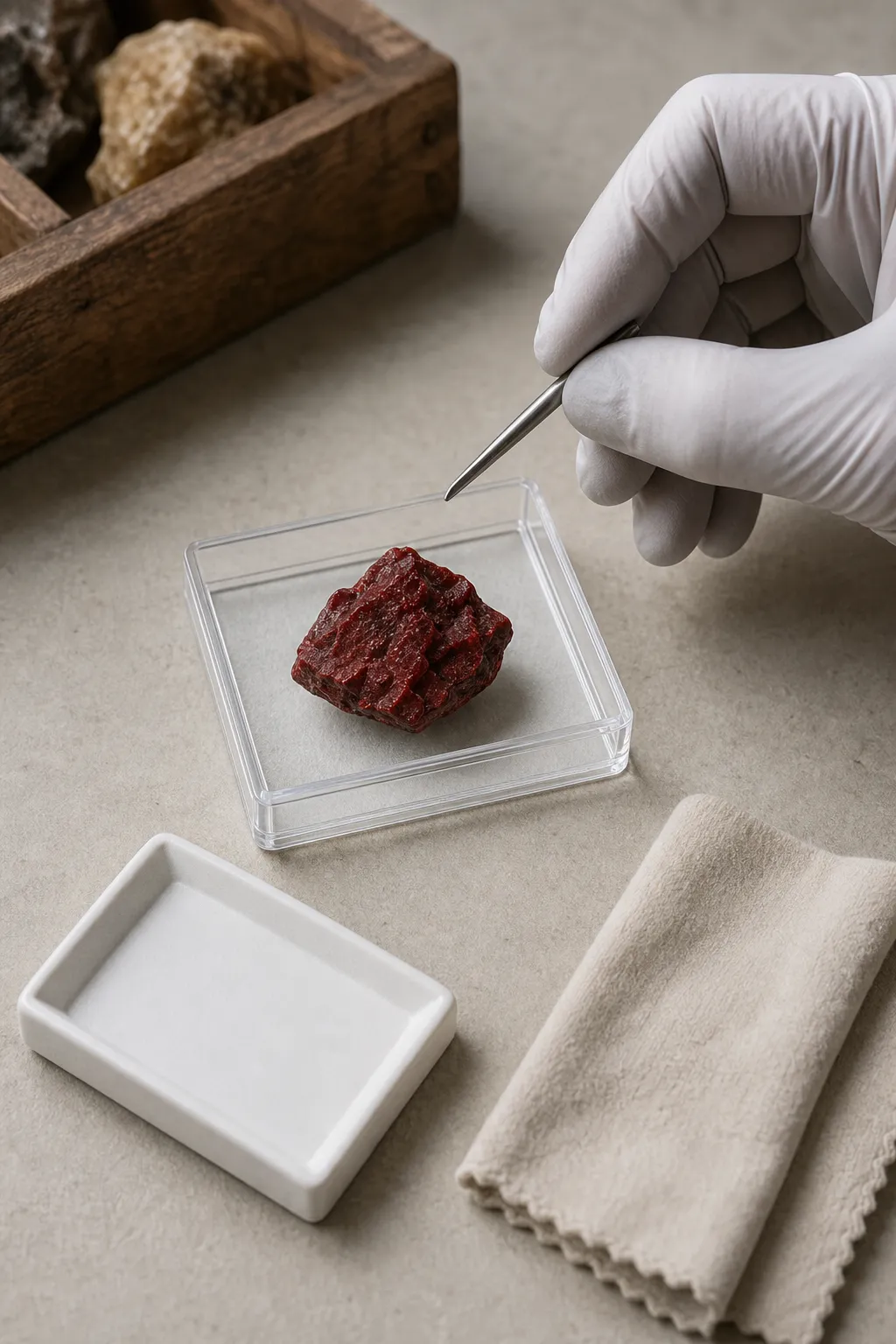
If you are holding a small crystal-market item, start with non-destructive observations. None of these proves identity alone, but they can keep you from overreading one red mark.
Look at surface appearance.
Hematite is often sold as dark metallic gray, silvery, black, or reddish-brown material, especially in beads and tumbled pieces. Cinnabar is more strongly associated with red material, though cinnabar-bearing specimens and decorative objects can vary.
Notice luster and finish.
A mirrorlike metallic surface points the conversation differently from a dull earthy red surface or a resin-coated carved item. Still, finish can be manufactured, coated, or enhanced.
Consider weight impression.
Hematite often feels notably heavy for its size compared with many common polished stones. Cinnabar can also be dense, so weight is not a clean separator. A surprisingly light “hematite” bead may instead raise questions about coating, imitation, or another material.
Use magnet response cautiously.
Some hematite-market beads are strongly magnetic because they are not simply natural hematite as described in mineral references. Magnetism can be a marketplace clue, but it is not a clean answer to the cinnabar vs hematite streak question.
Read seller language as positioning, not proof.
“Natural cinnabar,” “hematite-like,” “red protection stone,” or “authentic blood red mineral” may tell you how the item is being sold. It does not replace identification.
Ask whether the object is coated, carved, lacquered, dyed, or composite.
Many decorative red objects are not simple raw mineral specimens. A streak test on a coated item may only test the coating.
If these clues conflict, that is normal. Mineral identification usually depends on several properties, not one color mark. For certainty, specialized testing or an experienced in-person assessment may be needed.
The practical answer for buyers
The best answer to “What does the streak mean?” is not a clean yes or no. It means you have one clue, and in this case the clue overlaps.
A red streak can fit cinnabar. A red, rust-red, blood-red, or reddish-brown streak can fit hematite. A dark metallic surface does not rule out hematite. A red surface does not prove cinnabar. A confident listing does not turn a streak mark into authentication.
For ordinary crystal buying
- If an inexpensive polished item is sold as hematite, a reddish streak may be consistent with hematite, but it is not formal proof.
- If the item is described as cinnabar or looks like it may contain cinnabar, do not create dust just to compare streak color.
- If the item is valuable, old, carved, coated, or sentimental, avoid destructive testing.
- If handling confidence matters, use non-destructive observation first and seek a more qualified identification route when needed.
The cautious conclusion is not that streak tests are useless. It is that the cinnabar vs hematite streak question sits exactly where streak testing is easy to overinterpret. Red-family powder can guide your next question, but it should not be used as the final answer.
Sources
Sources and further reading
Reference links are limited to sources considered suitable for public citation in this page.