ProtectCrystal handling note
Buyer comparison
Cinnabar Beads vs Hematite Beads: Color, Coating, and Weight Clues
If you are comparing cinnabar beads vs hematite beads, begin with what you can actually observe: color, surface finish, weight, bead-hole wear, and seller wording.
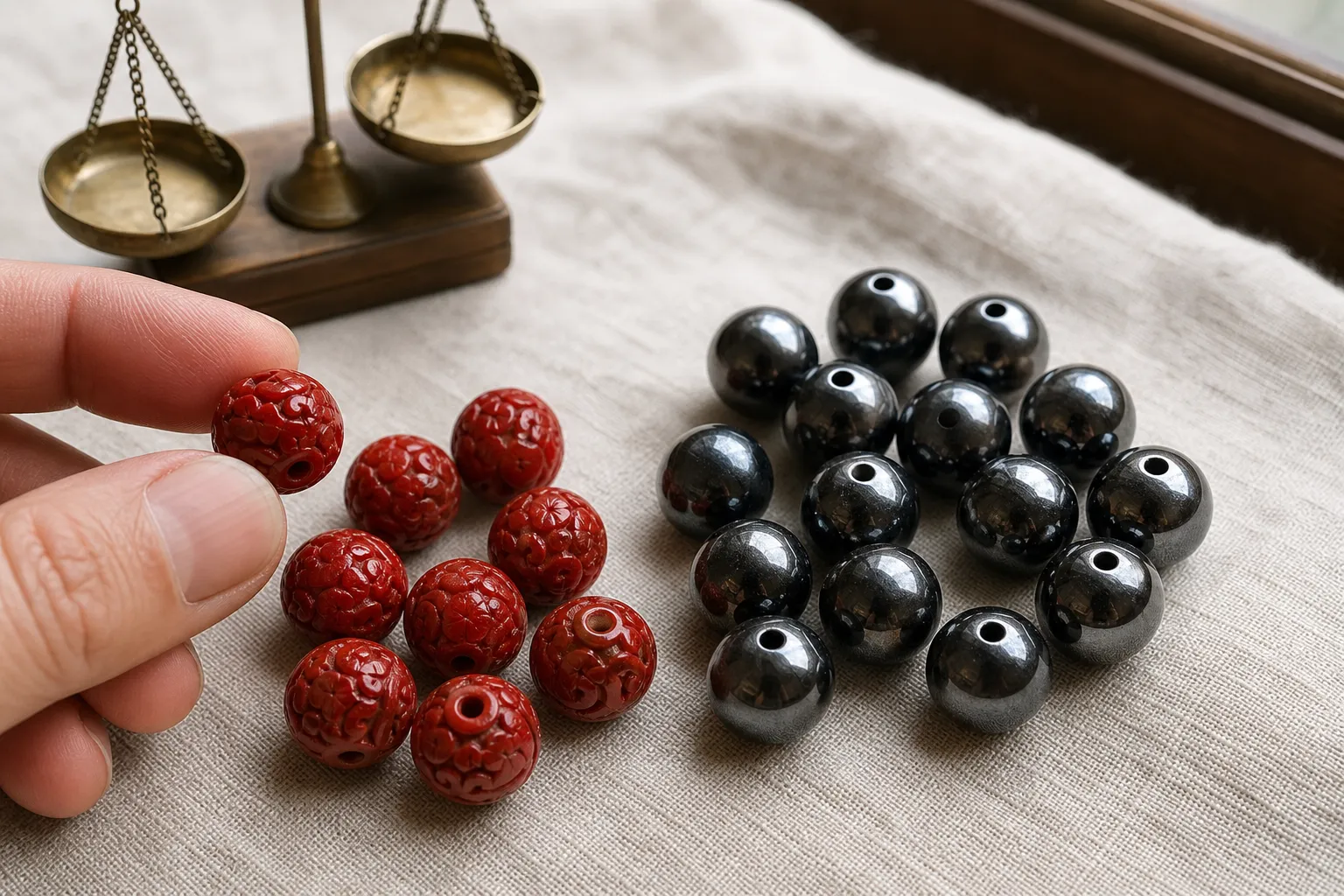
Hematite beads are commonly sold as metallic gray, black, steel-gray, or gunmetal-looking beads, and they often feel heavy for their size. Cinnabar-style beads are usually associated with red color, carved patterns, or a glossy lacquer-like surface. But a red bead is not automatically real cinnabar, and a heavy dark bead is not automatically natural hematite.
Home checks can sort possibilities. They cannot prove identity, safety, age, value, or authenticity. If a red bead may be cinnabar, avoid dusty or damaging tests and treat it cautiously unless proper material testing has been done.
upward
Read the full overview first
Use the broader guide first if you need the full scope before this page.
Quick clue table: what to check first
Main color
More typical of hematite beads: Metallic gray, black, steel-gray, gunmetal.
More typical of cinnabar-style beads: Red, orange-red, deep red, carved or lacquer-like.
What it cannot prove: Color alone cannot identify the material.
Weight
More typical of hematite beads: Often noticeably heavy for bead size.
More typical of cinnabar-style beads: Variable, depending on the real base material.
What it cannot prove: Heavy does not always mean hematite.
Surface finish
More typical of hematite beads: Polished metallic shine; plated or coated finishes are common.
More typical of cinnabar-style beads: Glossy red, carved, painted, lacquer-like, resin-like, or mineral-like.
What it cannot prove: A coating can hide the core.
Magnetism claims
More typical of hematite beads: “Magnetic hematite” appears often in listings.
More typical of cinnabar-style beads: Not a normal cinnabar clue.
What it cannot prove: Magnetism is not a reliable shortcut.
Bead-hole edges
More typical of hematite beads: May show polish, chips, coating wear, or uniform drilled holes.
More typical of cinnabar-style beads: May show red layers, chips, resin/lacquer-like edges, or a different core.
What it cannot prove: Hole wear suggests possibilities, not proof.
Seller wording
More typical of hematite beads: Hematite, hematine, Hemalyke, plated hematite, titanium-coated hematite, “hematite color.”
More typical of cinnabar-style beads: Red cinnabar beads, carved cinnabar, cinnabar jewelry, real cinnabar.
What it cannot prove: Listing language is not verification.
Use the table as a sorting tool, not a final answer. A bead can be heavy and coated. A bead can be red because of resin, lacquer, dye, pigment, or another stone. A bead can be listed as hematite while actually being a hematite-like manufactured product.
Color clues: red is not enough
The easiest visible difference is usually color. Hematite beads are often recognized by a dark metallic look: gunmetal, dark silver, mirror-like black, or steel gray. That appearance fits many polished hematite bead strands.
The confusing part is that hematite is also linked with red in mineral contexts. Hematite is an iron oxide, and powdered or fine-grained hematite can appear red to reddish-brown. That is why red-brown streak descriptions appear in mineral references. For bead buyers, the useful point is simple: a reddish mark or red-brown mineral association should not be used as a shortcut to cinnabar.
Cinnabar is strongly associated with red because it is mercury sulfide and has long been known as a red mineral pigment. In bead listings, though, “red cinnabar beads” may refer to carved-looking red beads, red lacquer-style beads, resin beads, dyed material, or objects sold with cinnabar-inspired wording. Unless the object has been properly identified, “cinnabar-style” is often the more careful description.
A practical reading looks like this
- Metallic gray or black bead: may suggest hematite or a hematite-like bead, especially if it feels heavy.
- Bright red carved bead: may suggest cinnabar-style jewelry, lacquer, resin, dyed material, pigment, or another red substance.
- Red-brown mark or powder association: can relate to hematite in some mineral contexts and should not be treated as a cinnabar clue by itself.
- Mixed red and dark areas: may reflect coating wear, dirt, pigment, matrix, age, or alteration.
Photos make this harder. Bright lighting can make black hematite look silver, make coatings look natural, or make resin look like carved mineral. If you are reading a listing, ask for close photos of bead holes, worn edges, side views, and any chipped areas—not only the most polished front view.
Coating and finish clues: look past the name
Coatings are one of the main reasons bead identification gets messy. The visible surface may not match the body of the bead.
Hematite listings often use terms such as plated hematite, rainbow hematite, iridescent hematite, titanium-coated hematite, blue hematite, gold hematite, or gunmetal finish. Sometimes “hematite color” is only a color description. These phrases should make you look more closely, because they may describe a surface treatment, a manufactured hematite-like material, or a bead that resembles hematite without being natural hematite.
Possible coating clues include
- very bright rainbow, blue, gold, or oil-slick color;
- color that seems to sit mainly on the outer surface;
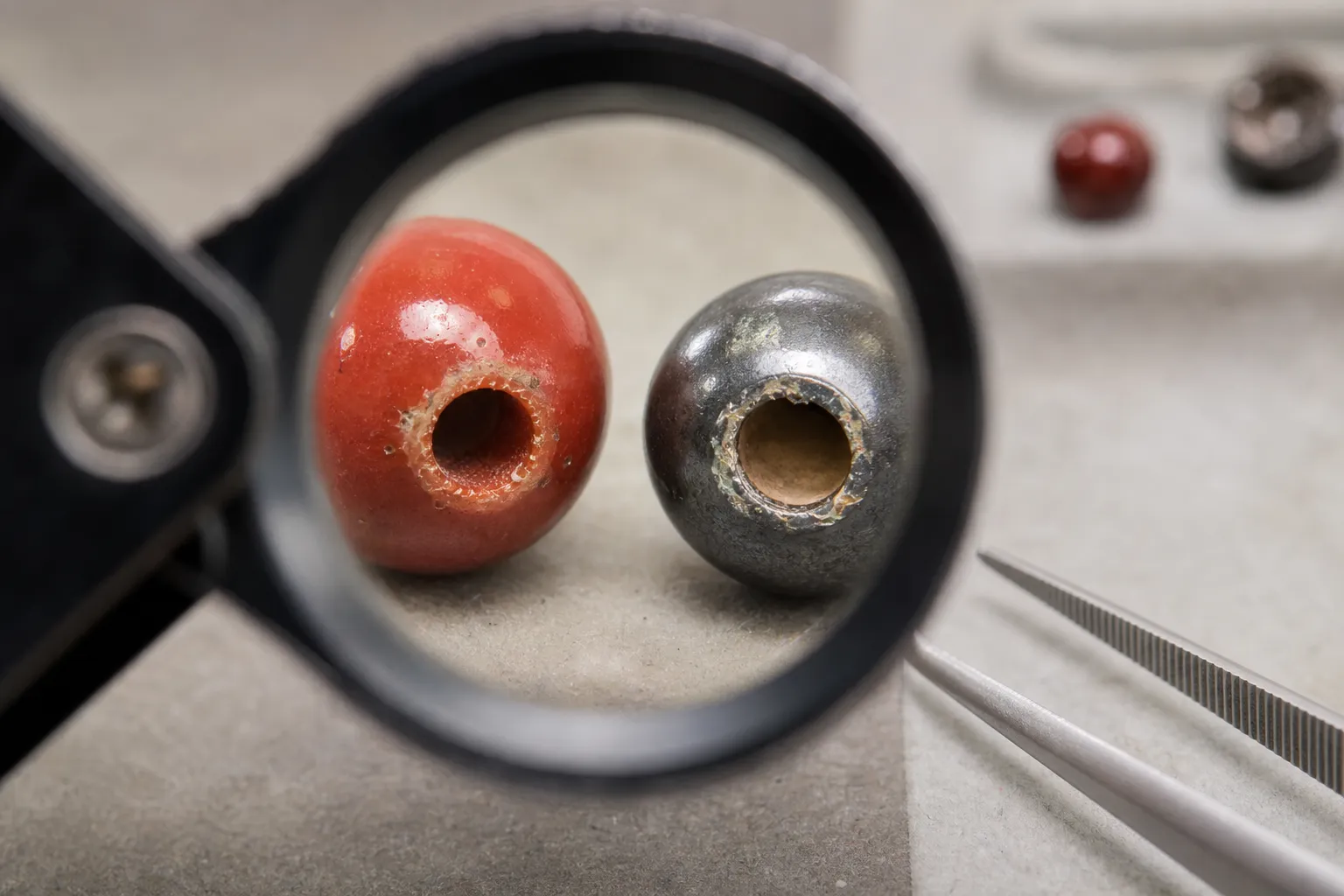
- tiny chips near bead holes showing a different color underneath;
- extremely uniform metallic shine across every bead;
- seller wording that emphasizes finish more than material.
For red cinnabar-style beads, finish clues matter even more. A red carved bead could be natural mineral, lacquer, resin, dyed material, painted material, or another red substance. A glossy red surface, repeated molded-looking pattern, or clean red layer at a chip can suggest a manufactured or coated object, but it still does not tell you exactly what the bead is made of.
Bead-hole edges are useful because wear often shows there first. Look for a different interior color, flaking, a red outer layer over a paler core, or an unusually smooth molded opening. Natural stone beads may show small chips, pits, or inclusions, but manufactured beads can also look irregular, and natural beads can be highly polished. Treat the hole as one clue among several.
Do not sand, drill, heat, burn, file, or grind unknown red beads to “check” them. Those actions can damage the bead and may create dust or chips. With possible cinnabar or unknown red material, that is a poor tradeoff for a home guess.
Weight clues: hematite often feels heavy, but weight is not proof
Weight is one of the better everyday clues for hematite beads. Hematite has relatively high density for a common bead material, so polished hematite or hematite-like beads often feel noticeably heavy compared with wood, resin, many glasses, or lighter stones of the same size. If a small strand feels surprisingly weighty and the beads are metallic gray or black, hematite or a hematite-like material becomes more plausible.
That clue still has limits. Educational bead investigations have shown that density can be useful, while magnetic behavior and product type can vary among beads sold as hematite-related materials. For a shopper, the lesson is not “weight proves hematite.” It is that weight can support the possibility when it matches color, finish, and clearer seller wording.
Several things can imitate a heavy feel
- dense glass;
- metal cores;
- manufactured hematine, Hemalyke, or Hemalike-type beads;
- coated beads over a dense base;
- beads that are larger than they appear in photos.
Weight is also hard to judge online. A bracelet photo does not tell you density. Even in person, “heavy” is a comparison, not a measurement. A large resin bead may feel substantial simply because it is large; a small hematite bead may not feel dramatic by itself.
For cinnabar-style red beads, weight varies too much to rely on. A bead sold as cinnabar could be lacquered, resin-based, dyed, carved from another material, coated, or made with an unknown base. Some may feel light, some moderate, and some dense. Weight alone cannot answer what cinnabar beads are made of in a specific listing.
A useful rule: heavy metallic gray beads may point toward hematite or hematite-like material; red beads need more caution and cannot be identified by weight alone.
Seller phrases that deserve a second look
Seller wording can help you know what to ask next, but it should not be treated as proof.
“Magnetic hematite”
“Magnetic hematite” is common in bead listings. Natural hematite is not something a buyer should identify by a simple fridge-magnet expectation. Beads sold with magnetic wording may be manufactured, altered, or hematite-like products. Magnetic behavior can vary, so it is not a single reliable test.
“Hematine,” “Hemalyke,” and “Hemalike”
“Hematine,” “Hemalyke,” and “Hemalike” are marketplace words often used for manufactured hematite-like beads. They may be perfectly usable in jewelry, but the wording matters if you are trying to distinguish natural hematite from lookalikes.
“Plated hematite” or “titanium-coated hematite”
“Plated hematite” or “titanium-coated hematite” points to the surface. The finish may change the visible color, shine, and wear pattern. If you care about natural mineral appearance, coating language matters.
“Real cinnabar” or “natural cinnabar”
“Real cinnabar” or “natural cinnabar” should be read carefully. Cinnabar is a mercury-containing mineral, and reliable identification in objects may require analytical methods such as XRF, XRD, Raman spectroscopy, or related instruments. A seller’s phrase does not replace that. The same caution applies to carved red beads described as cinnabar jewelry when the listing gives no material details beyond color and style.
“Cinnabar beads meaning” belongs in a different category. Cinnabar and hematite are often discussed in crystal and symbolic-use contexts, including personal protection themes. Those meanings may matter to a buyer culturally or personally, but they do not identify the bead material or establish a physical effect.
What not to do with unknown red or metallic beads
The useful home checks are visual, gentle, and non-destructive: compare color, note weight, inspect coating, read seller language, and look closely at bead-hole edges.
Avoid tests that create dust, heat, chips, or damaged surfaces, especially with possible cinnabar-style red beads. Do not lick, sand, drill, file, burn, heat, aggressively soak, or grind a bead to see what happens. These methods can ruin finishes and may expose unknown material.
A gentle wipe with a dry or slightly damp soft cloth may help separate surface dirt from finish, but do not treat cleaning as identification. If red color transfers, that may suggest dye, pigment, residue, or surface instability, but it still does not reveal the full composition.
If you are buying, ask practical questions instead
- Is the bead described as natural mineral, coated, plated, resin, lacquer, dyed, or unknown?
- Does the seller distinguish hematite from hematine or Hemalyke-type material?
- Are the red beads solid material, carved lacquer, coated, or simply described by style?
- Are there close photos of chips, holes, backs, and worn edges?
- Is there any testing information beyond appearance and marketing terms?
If the answer is vague, treat the bead as visually interesting but unverified.
When home clues are enough
Home clues are usually enough for low-stakes sorting: deciding whether a bead looks more like metallic hematite jewelry, a hematite-like coated bead, or a red cinnabar-style bead that deserves caution.
They are not enough when the question is identity, safety, age, value, or authenticity.
For hematite beads, a metallic gray-black look plus a heavy feel can be a useful sign, especially when seller wording is clear and coating terms are disclosed. Still, plated hematite, magnetic hematite, and hematine-like products can complicate the picture.
For red cinnabar beads, stay more conservative. Red color and carved style can suggest the marketplace category, but they cannot prove the bead is cinnabar. Because true cinnabar is mercury sulfide and modern red bead materials vary, visual checks should stay modest. If you need confidence, seek specialized material analysis or buy only from sources that give transparent material information and testing details.
The simplest comparison holds up well: hematite beads are often heavy metallic gray or black; cinnabar-style beads are usually red and may have lacquer-like or carved surfaces. Coatings, lookalikes, and seller wording can blur both categories, so treat every clue as suggestive rather than final.
Sources
Sources and further reading
Reference links are limited to sources considered suitable for public citation in this page.