ProtectCrystal handling note
Obsidian handling guide
Obsidian Sharp Edges and Safe Handling
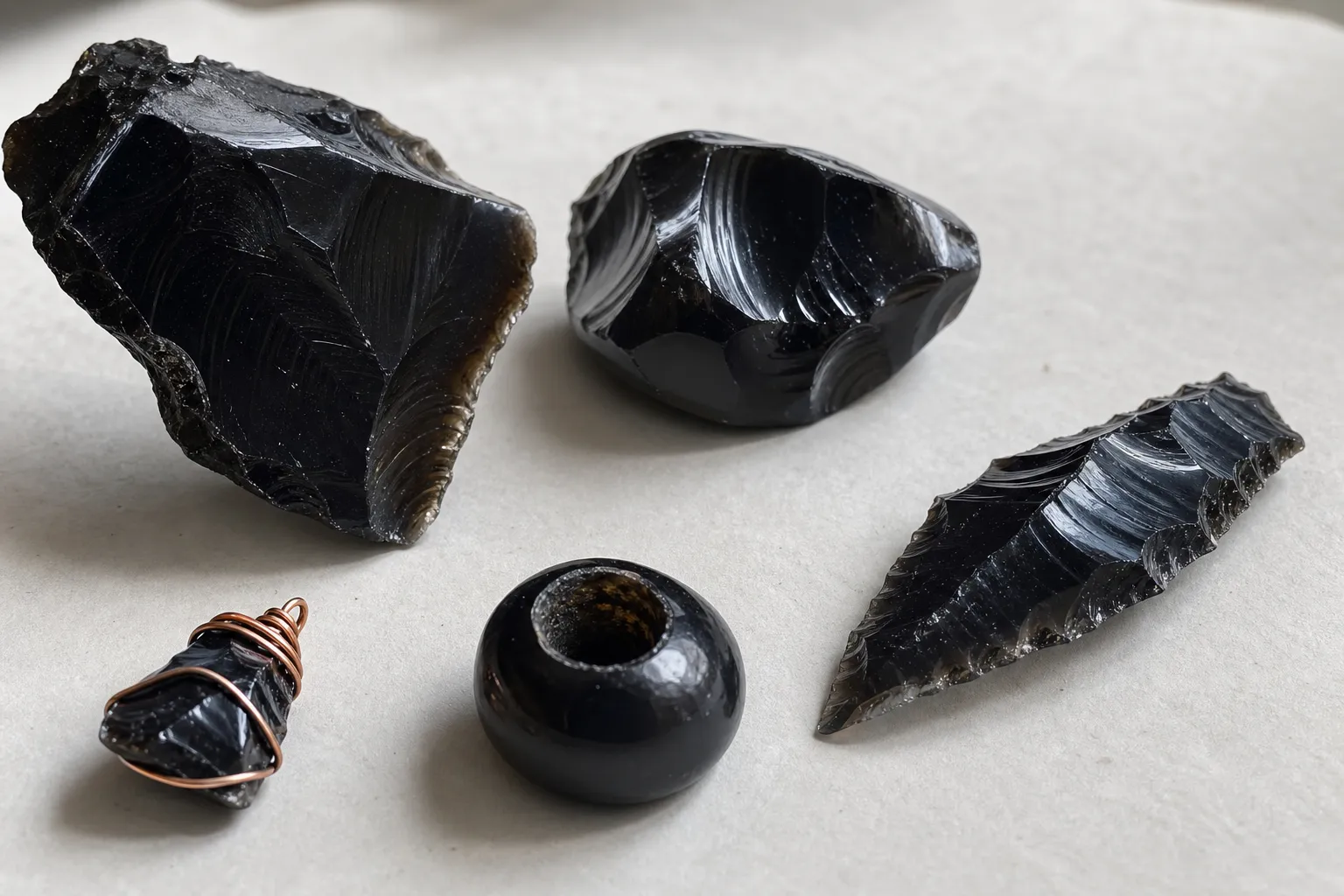
Obsidian is often sold as polished palm stones, raw display pieces, pendants, points, beads, and small chips for bowls or crystal grids. The handling question changes as soon as the surface is no longer smooth. Obsidian sharp edges can show up on raw pieces, fresh chips, snapped points, drilled beads, wire-wrapped fragments, or tumbled stones with one missed corner.
Use a simple rule first: do not test an edge with your fingertip, do not carry loose broken pieces in a pocket, and treat chipped obsidian more like a sharp decorative fragment than like an ordinary rounded stone.
This page has no approved public reference links attached to it, so the guidance stays narrow. It focuses on visible condition, practical handling, and cautious storage rather than making firm claims about origin, fracture behavior, authenticity, or crystal effects.
upward
Start with the broader guide
Use the broader guide first if you need the full scope before this page.
What Changes When Obsidian Has a Sharp Edge
A smooth, rounded obsidian stone is a different handling situation from a raw, chipped, or broken one. The useful question is not whether the piece looks dramatic, expensive, meaningful, or “real.” It is whether an exposed edge can press into skin, snag fabric, scratch nearby stones, or break further when moved.
Fresh-looking chip or snapped point
The exposed area may be sharper than the older surface.
Thin flake, sliver, or shard
It can be hard to see and easy to press by accident.
Polished stone with one rough corner
The piece may feel smooth overall while still having one problem spot.
Damage near a drilled hole
Cord movement or wearing pressure may expose the chip.
Loose chips in a bowl or pouch
Fingers may reach in without seeing every edge.
Wire wrapping around an irregular piece
Metal may hide part of the damage while leaving another edge exposed.
This does not make every raw obsidian piece unsuitable to own. It means the right use depends on the edge, the setting, and who may touch it.
A stable display specimen has a different profile from a pocket stone, bracelet charm, child’s curiosity object, or bowl of loose chips. The same piece can move from “fine for a shelf” to “poor choice for a pocket” after one corner breaks.
Can Obsidian Cut Skin When You Handle It?
Sharp or broken obsidian edges may cut skin. When you do not know how sharp a chip is, assume pressure on that edge is a bad idea. The point is not to prove sharpness by touching it; the point is to avoid that pressure in the first place.
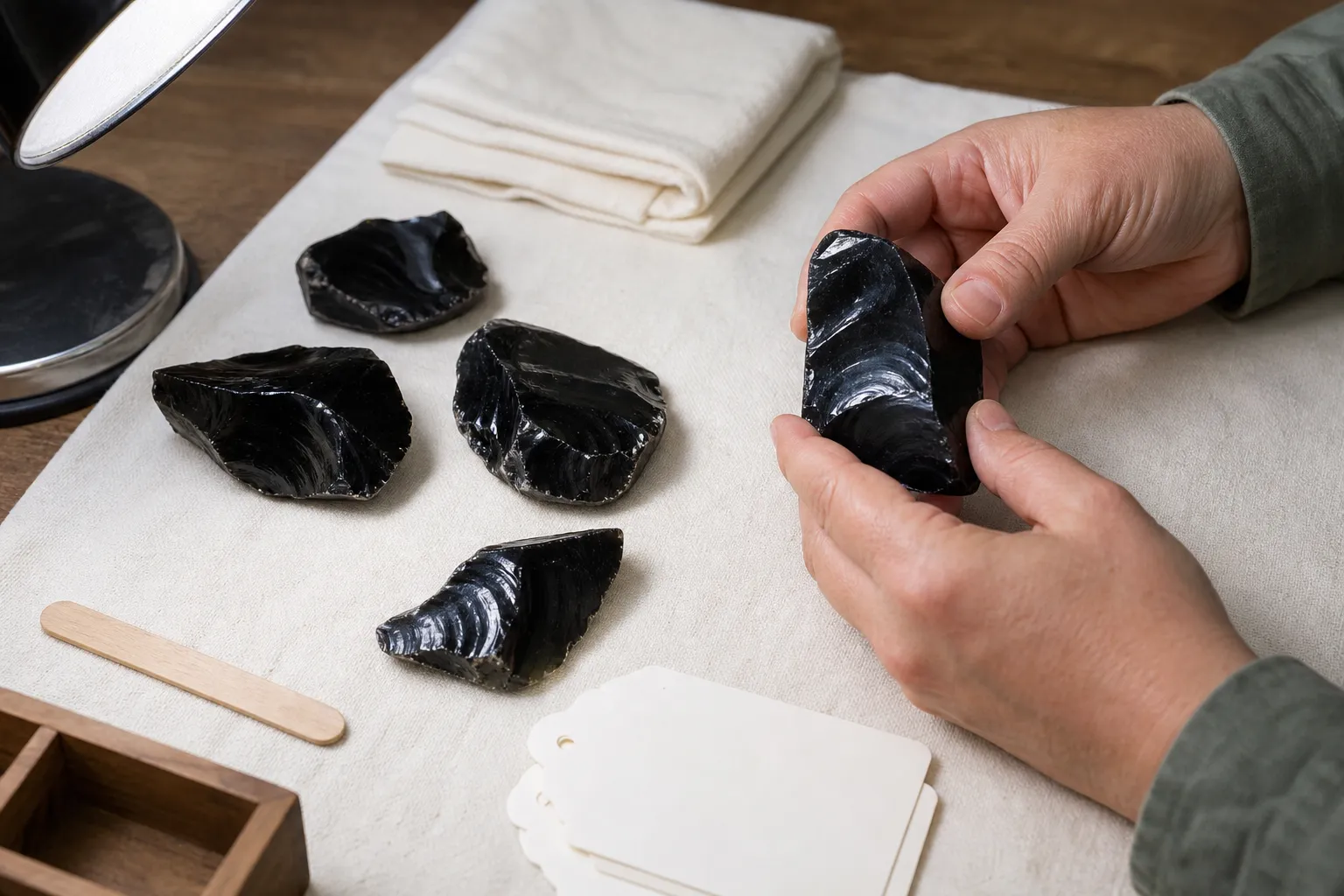
If you need to pick up sharp obsidian, hold the larger, thicker, duller-looking part of the stone. If the piece is small, fractured, or awkward to grip, use a folded cloth, paper towel, or suitable gloves instead of pinching near the edge. Set it down on a stable surface before inspecting it.
Helpful habits
- Look before touching, especially after a stone falls or arrives damaged.
- Turn the piece by broad faces, not points or flaked rims.
- Do not sweep tiny broken pieces into your hand.
- Do not run a finger along an edge to check sharpness.
- Keep the work area clear so loose chips are easier to see.
- Put broken pieces in a rigid container rather than a soft pouch.
A glossy black surface can look smooth in one area and still have a cutting edge at a chip, corner, or thin flake. A matte or rough-looking area is not automatically the sharper part. Judge the actual exposed edge and the intended use.
How to Check Obsidian Edges Without Using Your Finger
The most useful inspection is visual and indirect. You are not trying to identify the stone from appearance alone or prove where it came from. You are checking whether the object needs different storage, wearing, or cleaning habits.
Try this sequence:
- Place the piece on a flat, well-lit surface.
- Look for chips, thin flakes, snapped tips, and needle-like points.
- Rotate the stone by touching only broad, stable areas.
- Use a light-colored cloth or paper underneath so small dark fragments stand out.
- If you need to check snagging, use the edge of a disposable cloth very lightly.
- Stop handling if the piece sheds fragments or feels unstable.
This check can flag a handling concern, but it cannot prove the stone is properly finished, structurally sound, or authentic. For certainty about material identity, specialized testing may be needed. For everyday ownership, you usually do not need that level of certainty to decide that a chipped edge should not be pressed into skin, dropped into a pocket, or handed to a child.
A magnifying glass can help with small chips, but good light, a steady surface, and slow rotation matter more than poking at the edge.
Raw, Polished, Tumbled, and Broken Pieces Need Different Treatment
People often ask about obsidian handling safety as if every form should be judged the same way. Form matters.
Raw obsidian
Raw obsidian can have irregular points, thin edges, and uneven surfaces. It may work well as a display piece, but it deserves slower handling. Pick it up from the thickest area and avoid sliding it against other stones.
Polished obsidian
Polished obsidian is commonly sold as palm stones, spheres, towers, worry stones, pendants, and beads. Polishing can reduce exposed edges, but it does not make every piece suited to every use. A polished point can still have a sharp tip. A pendant can chip near a drilled hole. A smooth surface can still break if dropped.
Tumbled obsidian
Tumbled obsidian is often easier to handle because the edges are rounded, but tumbled obsidian sharp spots can still occur. Check the stone before giving it to someone who may handle it absentmindedly. One missed corner can matter more than the general finish.
Broken obsidian
Broken obsidian pieces call for the most conservative handling. If a stone snaps, chips, or sheds fragments, assume the new edges may be sharper than the older surface. Wrap the piece, box it, or set it aside until you decide whether to keep, repair, repurpose, or discard it.
Jewelry has a higher threshold. A display edge that never touches skin may be acceptable to some owners, but jewelry moves, rubs, catches on clothing, and presses against the body. If an obsidian piece is too sharp for jewelry, a new cord or wrap may not fix the real problem: the exposed stone edge.
What to Do If an Obsidian Stone Chips or Breaks
When an obsidian stone chips or breaks, deal with the fragments before deciding whether the piece is still attractive, valuable, or meaningful.
A practical response
- Pause and keep children and pets away from the area.
- Pick up larger pieces by broad faces or with a cloth.
- Use a rigid container for pieces with exposed edges.
- Avoid soft fabric pouches for loose shards or needle-like chips.
- Check the floor, table, or display shelf for tiny dark fragments.
- Label the container if someone else may handle it later.
If the original stone was used as a pocket stone, worry stone, bowl piece, or jewelry component, reconsider that use. A chipped obsidian stone may still be kept as a display piece, but it may no longer be a good choice for casual carrying or wearing.
Do not try to smooth a sharp edge with improvised tools unless you already have the right lapidary knowledge and equipment. This page cannot verify when a damaged piece can be refinished, and a quick home fix should not be treated as enough for skin contact. If the piece matters to you, ask a lapidary or experienced stone worker whether refinishing is realistic.
If you decide not to keep the fragments, wrap them before placing them in a disposal container so no one reaches into loose sharp pieces later.
Carrying, Wearing, and Storing Sharp Obsidian
Loose pocket carry is usually a poor match for obsidian with exposed chips, points, or broken edges. A pocket adds pressure, movement, keys, coins, fabric, and the chance that your hand reaches in without looking. If you want to keep the piece with you, a rigid box or wrapped storage method is more sensible.
For bags, use the same logic. Do not drop raw shards or chipped stones into a soft pouch with other objects. Choose a small hard case, a wrapped bundle inside a box, or a divided container where the edge cannot press through fabric or scrape neighboring stones.
For display, focus on stability and access. Sharp obsidian should not be balanced on a narrow point, placed at the edge of a shelf, or mixed loosely with rounded stones that invite rummaging. If it is part of a crystal bowl or grid, place it where it can be seen and lifted deliberately.
Obsidian chips in bowls need extra caution. Small chips can look decorative, but they are easy to stir, spill, or grab without noticing individual edges. If the bowl is purely decorative and out of casual reach, the concern is lower. If visitors, children, or pets can access it, loose chips are a weak choice.
Before wearing sharp obsidian jewelry, inspect the areas that touch skin, clothing, cord, chain, or wire. Watch for exposed chips near drilled holes, prongs, wraps, and pendant tips. If the edge catches fabric, scratches a surface during indirect checking, or feels unstable when moved with a cloth, do not wear it until it is evaluated or changed.
Wire wrapping can make an irregular piece look wearable without removing the sharpness. The wrap may secure the stone, but it can also hide damage or point an edge outward. A beautiful wrap is not the same thing as a comfortable finish.
Children, Pets, and Casual Handling
Obsidian is not automatically a good hands-on object for children just because it is sold as a crystal. The issue is the shape, finish, size, and chance of breakage. Smooth, intact, larger pieces may be easier to supervise than small chips, thin flakes, or raw fragments, but age-appropriate judgment still matters.
For children, avoid:
- Loose broken obsidian pieces.
- Small shards or chips in bowls.
- Points that can be pressed into skin.
- Jewelry with exposed broken edges.
- Any piece that may be put in the mouth.
- Display stones placed where they can fall or be thrown.
Pets add another unpredictable layer. A shiny stone on a low shelf can be knocked down. A bowl of chips can spill. A pouch can be chewed. If the piece has sharp or broken edges, store it where pets cannot reach it.
The same thinking applies to guests. If a stone looks like an ordinary polished palm stone, people may pick it up without asking. If it has a sharp edge, do not rely on everyone noticing. Use a display stand, box, or location that discourages casual handling.
Where People Mix Up Safety, Authenticity, and Crystal Meaning
Obsidian is often discussed in symbolic or protective crystal language. That context explains why buyers may want to carry it, wear it, place it near a doorway, or keep it in a bowl. Those are personal and cultural use patterns, not proof that a sharp piece is appropriate for skin contact or everyday carry.
Three mix-ups lead to poor decisions.
Polished is not the same as no sharp spots
A polished stone can still have chips, broken tips, or damage near drilled areas.
Authentic-looking is not the same as comfortable to handle
Appearance-based cues may help with shopping questions, but they cannot prove an edge will not cut, snag, or scratch. Material identity and handling condition are separate questions.
Personal meaning does not override physical form
A stone can matter to someone and still need a box. A piece can be part of a crystal routine and still be a poor choice for a pocket, bracelet, or loose bowl.
The better approach is to match the piece to the use. Rounded palm stone: easier for repeated handling. Raw shard: better for controlled display. Chipped pendant: pause before wearing. Loose chips: keep out of casual reach. Broken pieces: wrap, contain, and decide later.
A Simple Decision Frame for Obsidian Sharp Edges
Use this frame when deciding what to do with sharp, chipped, or broken obsidian.
If the piece touches skin
Hold it to a higher edge standard. Pendants, bracelets, rings, pocket stones, and worry stones should not have exposed points or chips where pressure is likely.
If the piece is only displayed
Focus on stability and access. A sharp specimen can be displayed more responsibly when it is stable, visible, and not handled casually.
If the piece is broken
Contain it before evaluating it. Do not sort fragments bare-handed, place loose shards in a soft pouch, or assume the largest piece is the only concern.
If children, pets, or visitors can reach it
Choose the more conservative storage method. A box, case, or higher shelf is simpler than relying on warnings.
If you cannot inspect it clearly
Slow down. Poor lighting, tiny fragments, black surfaces on dark tables, and decorative bowls all make edges easier to miss.
If the intended use involves movement or repeated touch
Choose a smoother piece. Obsidian used for jewelry, carrying, or frequent handling should be judged by the most exposed edge, not by the most attractive face.
Bottom Line
Obsidian sharp edges deserve practical respect, especially after a chip, break, or rough purchase. Do not test sharpness with skin. Pick up raw or damaged pieces from broad surfaces, use a cloth or gloves when needed, store fragments in a rigid container, and keep loose shards away from children, pets, pockets, jewelry pouches, and casual bowls.
The modest claim is enough: broken or sharp edges may cut, scratch, or snag, so handle them as exposed edges rather than ordinary smooth stones. Crystal meaning can remain part of why someone chooses obsidian, but it should not replace basic handling judgment.