
ProtectCrystal handling note
Cinnabar handling guide
Is Cinnabar Safe to Handle
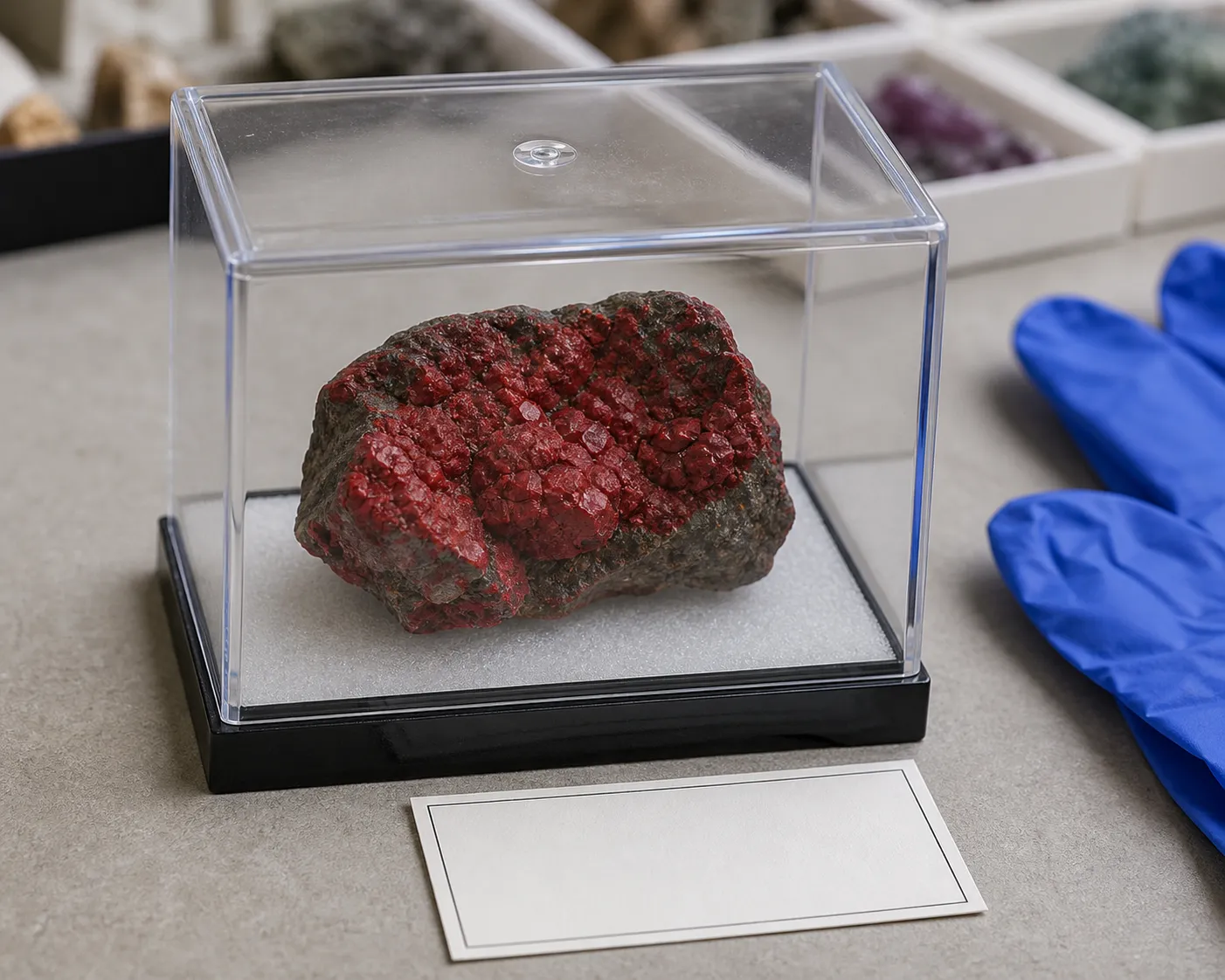
A red cinnabar specimen can look like an ordinary collector stone until the label mentions mercury. That is why many buyers ask is cinnabar safe to handle after finding a bead, carving, rough piece, or display mineral. The practical answer is conditional: brief contact with an intact, stable specimen is not the same as breathing dust, licking it, ingesting it, heating it, sanding it, polishing it, or wearing an unknown material against skin every day.
Cinnabar deserves more caution than obsidian or hematite because it is a mercury sulfide mineral, commonly represented as HgS. Treat it as a display mineral first, not as a casual pocket stone.
upward
Read the full overview first
Use the broader guide first if you need the full scope before this page.
The Handling Answer Depends on the Piece
Mineral and chemistry references identify cinnabar as mercury sulfide. That fact explains the caution, but it does not make every handling situation identical.
For a buyer, the better question is not only “can you touch cinnabar?” It is “what kind of cinnabar, in what condition, and what are you doing with it?”
A stable display specimen in a box or case is different from a powdery, crumbly, scratched, drilled, or broken piece. A smooth bead sold as “cinnabar” may be natural cinnabar, imitation material, lacquered work, dyed composite, or something else. Visual appearance can suggest possibilities, but it cannot prove the material or its handling profile.
First decision frame
Intact display specimen
Handle briefly, avoid rubbing, wash hands after.
Powdery or shedding piece
Avoid bare handling where possible; contain it and do not disturb residue.
Cutting or abrasion
Avoid as a home activity because it can create dust.
Heat or harsh treatment
Avoid; this is no longer normal collector handling.
Unknown jewelry or beads
Treat seller claims as incomplete until the material and finish are clearer.
Homes with children or pets
Store contained, labeled, and out of reach.
The safer habit is simple: limit contact, prevent dust, keep cinnabar away from mouths and food surfaces, and store it deliberately.
Why Cinnabar Contains Mercury but Is Not Liquid Mercury
One common mix-up is treating cinnabar as if it were the same thing as a spill of liquid elemental mercury. Another goes the opposite way: assuming that because cinnabar is mercury sulfide rather than liquid mercury, it needs no caution. Both shortcuts miss the handling question.
Cinnabar mercury sulfide is not liquid elemental mercury rolling across a surface. Public environmental-health materials often separate mercury forms, including elemental mercury, organic mercury compounds, and inorganic mercury compounds. The form matters.
But “not liquid mercury” does not mean “ordinary red stone with no concern.” Cinnabar contains mercury in a mineral compound, and mercury-containing dust or residue should not be treated casually. Occupational safety resources on mercury compounds are not household collector instructions, but they support a broad boundary: dust, inhalation, ingestion, and uncontrolled exposure routes deserve caution.
For crystal buyers, the takeaway is practical. Do not panic because you briefly touched an intact piece once. Do not treat cinnabar like hematite beads either. Cinnabar belongs in a more cautious category: display, contain, label, handle briefly, and avoid anything that creates dust or brings the material near the mouth.
The form matters, and so does the way you handle it.
Cinnabar Dust and Surface Contact
Cinnabar’s low hardness, often listed around Mohs 2 to 2.5 in mineral references, helps explain why abrasion matters. A softer mineral can be more vulnerable to scratching, rubbing, and powdery surface loss than harder display stones. That does not prove a specific specimen is shedding harmful dust, but it gives buyers a reason to avoid unnecessary friction.
Surface contact and dust are different scenarios. Touching an intact surface briefly is one thing. Rubbing a soft red area, scraping a coating, sanding a carving, or polishing a dull bead is another. Dust changes the handling question because material can move from the specimen into air, onto fingers, onto tables, or toward the mouth.
Buyer-visible cues to check
- Loose red powder in the box, pouch, or wrapping.
- Crumbly edges, fresh chips, or soft-looking granular areas.
- Red residue on fingers after light contact.
- Drilled bead holes with powdery material around the opening.
- A coating that appears cracked, peeling, sticky, or worn.
- Seller wording that says “natural cinnabar” without explaining whether it is solid mineral, lacquered, imitation, or composite.
These signs may suggest a need for more caution. They do not prove composition or exposure level. For certainty, specialized testing may be needed, and most crystal buyers will not have that available from a counter display or marketplace photo.
If the piece leaves residue, stop handling it casually. Put it in a small container or sealed display box, keep dust from spreading, and wash your hands.
When Gloves Make Sense
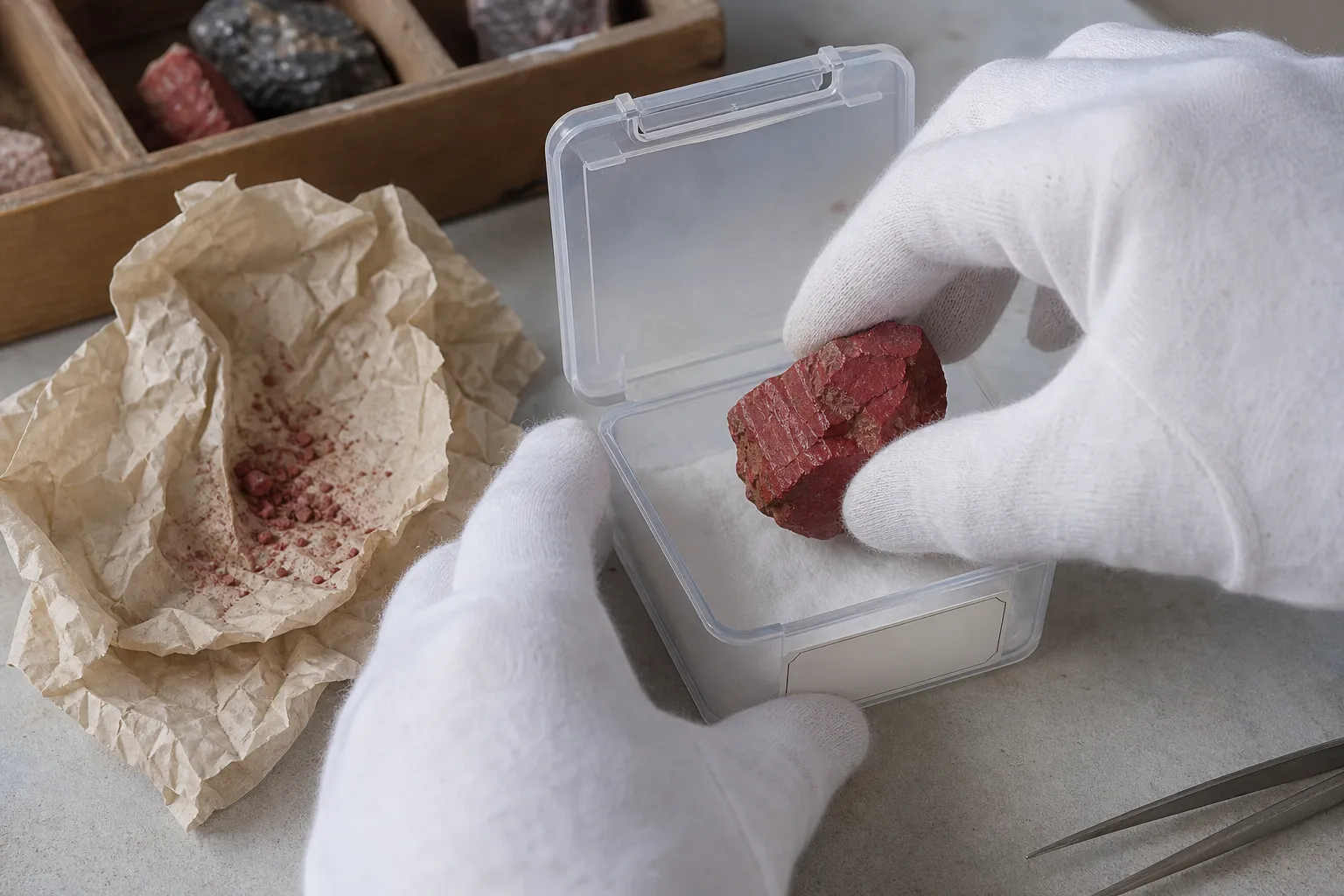
Gloves are useful when the condition of the piece is uncertain, the surface is dusty, or you need to move a broken or powdery specimen. Wearing gloves with cinnabar is not about turning every brief look into a lab procedure. It is about adding a barrier when residue, damage, or uncertainty changes the situation.
Consider gloves when
- The piece is newly received and packed with loose red dust.
- The label is unclear and the seller cannot explain the material.
- The specimen is broken, chipped, or friable.
- You are reorganizing several cinnabar pieces.
- You have cuts or irritated skin on your hands.
- You need to move it before placing it into contained storage.
For an intact display specimen, some collectors may handle it briefly with bare hands and then wash up. Collector guidance is useful here because it separates ordinary viewing-stone handling from cutting, polishing, heating, acid cleaning, and ingestion. That context is not a government safety standard, but it matches the practical distinction buyers need.
After handling cinnabar, wash hands with ordinary soap and water. Keep the piece away from snacks, cups, kitchen counters, lips, and face touching. Handwashing is a cleanup step after limited contact, not permission for frequent rubbing.
Short contact is one category. Repeated handling is another.
Broken or Chipped Cinnabar Needs More Restraint
Broken or chipped cinnabar deserves a more cautious response because damage can expose fresh surfaces and loose particles. The concern is not that every chip automatically creates a major household event. The concern is that broken, powdery, or shedding material is harder to control than an intact display piece.
If a cinnabar specimen arrives damaged, do not blow on it, brush it aggressively, vacuum it with a household vacuum, or wipe it across a food surface. Those actions can spread fine particles. Keep the movement small and controlled.
A practical response
- Put on disposable gloves if loose residue is visible.
- Place the piece and fragments in a small bag, lidded box, or display container.
- Keep packing material separate if it has red dust or crumbs.
- Wipe the non-food work surface gently with a damp disposable towel.
- Wash hands after the piece is contained.
- Label the container so it is not mistaken for a casual tumbled stone.
Do not sand the chipped edge smooth. Do not polish it at home. Do not try to “refresh” the surface with oil, heat, acid, or abrasive cleaning. Those fixes move the problem from simple storage into material disturbance.
If you bought the piece as jewelry or a handled object, a broken surface is also a reason to stop wearing it and reassess. A seller’s reassurance does not tell you whether the item is natural cinnabar, coated material, imitation, lacquer, or a mixed product.
Can You Clean Cinnabar With Water or Soap?
Cleaning cinnabar should be minimal. The better buyer habit is dry, gentle, non-abrasive care unless a qualified source has identified the material and recommended otherwise. Avoid soaking, ultrasonic cleaners, steam cleaning, acids, heat, sanding, polishing compounds, and stiff brushes.
A quick exterior dusting of a contained display case is different from washing the mineral itself. If the surface has loose dust, the goal is to avoid spreading it, not to scrub the specimen into a cleaner-looking state. A slightly damp disposable cloth may be used on the surrounding non-food surface after the specimen is moved, but the cinnabar itself should not be treated like quartz, obsidian, or glass.
Soap and water sound mild, but they can still create problems if the piece is porous, powdery, coated, glued, or part of jewelry with unknown construction. Water can move residue into cracks, bead holes, stringing material, or packaging. For many buyers, the better question is not “how do I clean it?” but “should I leave it contained and avoid disturbing the surface?”
If a cinnabar piece looks dirty, powdery, or altered, store it rather than trying to improve it. Display minerals do not need to be polished to be respected.
Cinnabar Jewelry and Seller Reassurance
Cinnabar jewelry creates more uncertainty than a boxed specimen because jewelry is designed for repeated contact, movement, sweat, rubbing, and sometimes contact with clothing or skin oils. The marketplace also uses “cinnabar” in several ways. A red carved bead may be sold as natural cinnabar, imitation cinnabar, lacquered cinnabar, sealed cinnabar, or simply “cinnabar style.”
That language matters, but it is not proof. A seller statement does not verify the material, coating integrity, imitation status, or exposure profile. A coating may reduce direct contact when intact, but buyers usually cannot confirm how it was made, how durable it is, or whether it has worn around bead holes and edges.
Be especially cautious with
- Bracelets or necklaces that rub against skin for long periods.
- Beads with worn holes, red powder, or flaking finish.
- Pendants worn against warm skin or under clothing.
- Vintage pieces with unknown coatings or repairs.
- Items marketed through symbolic language while giving little material detail.
Cinnabar is sometimes discussed in crystal circles as a protection symbol, prosperity symbol, or transformation stone. That belongs in personal or cultural context. It should not override material caution. Protective crystal meaning is not evidence that a piece is suitable for repeated wear.
If you want the look without the same uncertainty, consider red glass, ceramic, resin, or another clearly described material from a seller who states what the item is. If you want true cinnabar, a contained display specimen is easier to manage than daily jewelry.
Cinnabar in Family Homes
In a home collection, cinnabar is best treated as a labeled display mineral rather than a loose object on a shared shelf. That is especially true around children, pets, visitors, or anyone who may pick up stones without knowing the difference between obsidian, hematite, and cinnabar.
Storing cinnabar safely can be simple
- Keep it in a lidded display box, specimen case, or sealed bag inside a labeled container.
- Store it away from food-prep areas, bedside bowls, pockets, and children’s crystal trays.
- Keep it from rubbing against harder stones that may scratch it.
- Do not place loose cinnabar where pets can lick, chew, paw, or knock it down.
- Keep broken or dusty pieces separate from clean display stones.
Cinnabar around children needs a stricter threshold because children may touch, mouth, drop, scrape, or trade stones without understanding the label. Cinnabar around pets also needs caution because chewing, licking, and floor-level access create different routes from adult display viewing.
This does not mean a collector must discard every cinnabar specimen. It means the storage method should match the material. Obsidian may chip sharply, hematite may raise different imitation or coating questions, and cinnabar has its own mercury-containing mineral boundary.
Label it before someone else handles it.
When You Are Not Sure What the Red Piece Is
Many buyer problems start with uncertainty: a red bead was inherited, a carving came from an online listing, or a seller used the word “cinnabar” without details. Do not try to solve the question by scratching, burning, sanding, soaking, or scraping the piece. Those tests can damage the object and may increase contact with residue if it is real cinnabar or a coated composite.
Use non-destructive checks first
- Read the listing for words such as natural, imitation, lacquered, composite, sealed, or carved.
- Look for powder, chips, worn edges, or residue around holes.
- Keep the item contained while you compare seller information.
- Ask the seller what the material is, not just what style it represents.
- Avoid wearing it until the material and condition are clearer.
- If the answer matters for value or safety, consider specialist identification rather than home testing.
Visible signs may include red, scarlet, brick-red, earthy, granular, massive, crystalline, or coating-like surfaces. Those features can support a cautious guess, but they do not confirm identity. Metacinnabar, a related black mercury sulfide form, can appear in mineral discussions, but it should not distract from the buyer task: unknown material should be handled conservatively until clarified.
A red object sold as cinnabar is a claim, not a conclusion.
The Cinnabar Handling Precautions That Matter Most
The most useful cinnabar handling precautions reduce unnecessary contact and prevent dust or mouth exposure. You do not need to turn a crystal shelf into a technical workspace. You do need to treat cinnabar differently from routine tumbled stones.
Prioritize these habits
- Handle intact pieces briefly and wash hands afterward.
- Avoid licking, ingesting, rubbing on lips, or placing near food.
- Avoid sanding, drilling, polishing, tumbling, heating, or acid cleaning.
- Contain broken, dusty, or powdery material instead of brushing it around.
- Store pieces labeled and away from children, pets, and food surfaces.
- Be skeptical of jewelry claims that do not explain material, coating, and wear condition.
- Treat protective or symbolic meanings as personal context, not physical safety evidence.
The evidence base is strong enough to identify cinnabar as mercury sulfide and to support broad caution around mercury-containing dust, ingestion, inhalation, heat, and harsh treatment. It is thinner for precise household claims about every intact consumer specimen. That is why the best answer stays scenario-based.
Cinnabar can be part of a mineral collection, but it asks for more restraint than many red decorative stones. Check the condition, limit handling, avoid dust, and store it where curiosity cannot turn into unnecessary contact.
Sources
Sources and further reading
Reference links are limited to sources considered suitable for public citation in this page.